Basilica of Xirokrini: An Early Christian Church in Thessaloniki
Site at a Glance
- Popularity
- Low
- Country
- Greece
- Primary era
- Medieval
- Eras represented
- Classical, Medieval
- Civilizations
- Byzantine
- Site type
- Religious
- Remains
- Basilica
On this page5 sections
History
The Basilica of Xirokrini is a church of the early Christian period, the first centuries of Christianity, in Thessaloniki’s Xirokrini district, Greece. It is dated to the fifth or early sixth century. Classified as an Orthodox church, it is affiliated with the Ecumenical Patriarchate, the senior see of the Eastern Orthodox Church, based in Constantinople, now Istanbul. The church is no longer in use.
Christian tradition places Saint Nestor’s martyrdom in Roman times in the area above present-day Democracy Square, where the Golden Gate then stood. Nestor was a disciple of Saint Demetrius and a martyr, someone honored for dying for the Christian faith. Churches of the early Christian and Byzantine periods, the latter part of the Eastern Roman Empire’s history, found in the district, including this basilica, are associated either with Nestor’s martyrdom and memory or with the deaths of the sisters Agape, Irene, and Chionia, who were also honored as martyrs. The association is not assigned to this basilica alone.
The basilica was discovered during construction of a building at 20 Margaropoulou Street, behind the New Railway Station. Two other early Christian churches have been found in the district. One, at the junction of Lagkada and Agiou Dimitriou streets, dates to the first half of the fifth century. The other was uncovered during metro construction at Democracy Square, above a late-antique warehouse complex that points to the area’s commercial character. These three churches are among five early Christian churches found outside Thessaloniki’s walls.
Remains
Surviving church fabric
Aisles and later extension
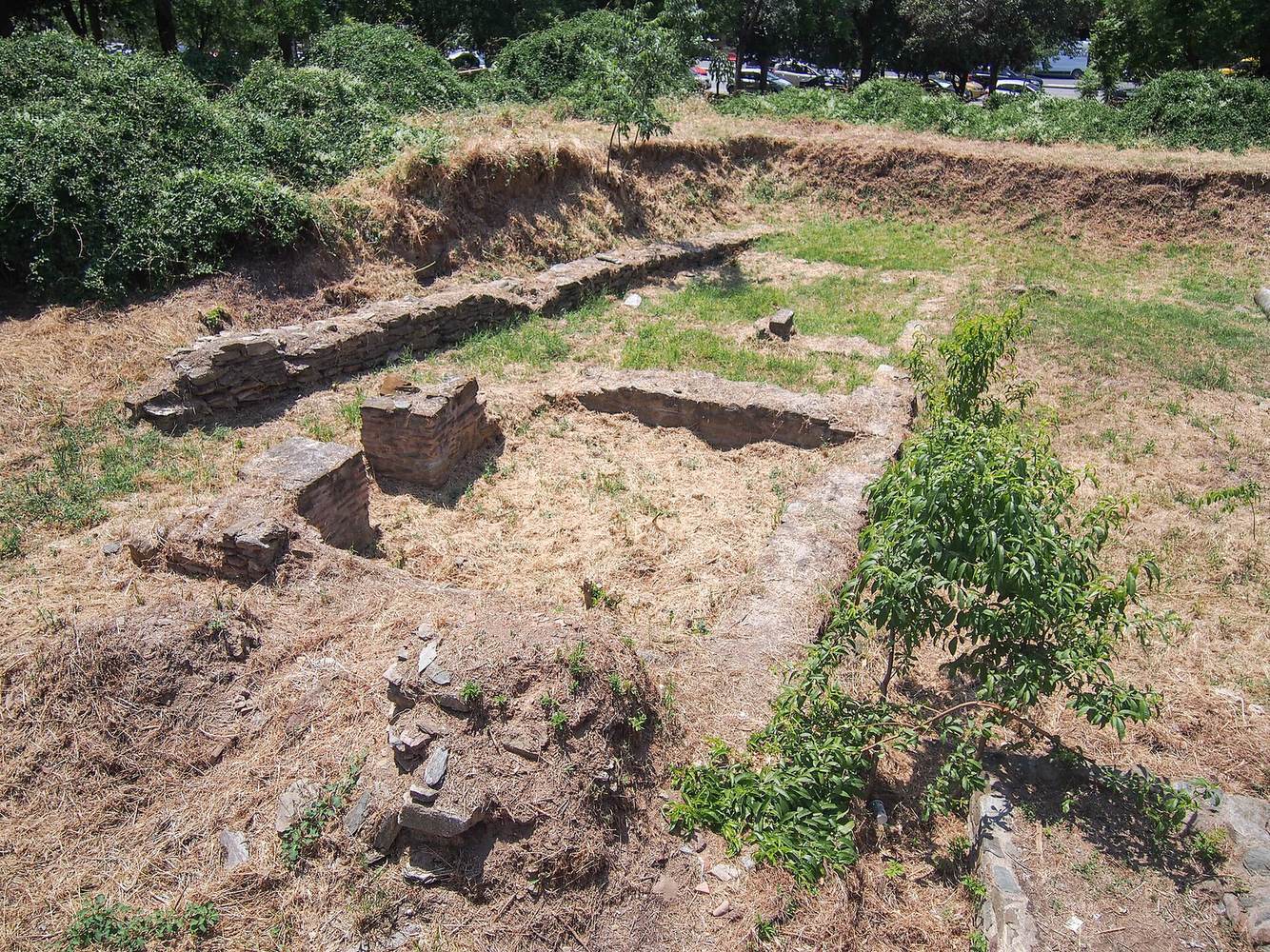
The ruined basilica has a three-aisled plan and is described as having a Roman architectural style. Its north aisle was extended in a second building phase. Parts of the remains are visible in a park on Regkoukou Street, and the sanctuary faces the winter sunrise.
Apse and underground passage
The apse contained a semicircular synthronon, a semicircular seating arrangement for clergy, installed when the church was built. Beneath it was a circular crypt, an underground passage.