Basilica of the Holy Face: A Pilgrimage Sanctuary in Manoppello, Italy
Site at a Glance
- Rating
- 4.7
- Popularity
- Medium
- Country
- Italy
- Primary era
- Modern
- External website
- Open
- Eras represented
- Early Modern, Modern
- Civilizations
- Italian, Kingdom of Naples, Kingdom of the Two Sicilies, Spanish
- Site type
- Religious
- Remains
- Basilica
On this page13 sections
History
The Basilica of the Holy Face is a Catholic church in Manoppello, Italy, developed within a sixteenth-century Capuchin friary dedicated to Saint Michael the Archangel. It belongs to the Archdiocese of Chieti-Vasto and is dedicated to the Holy Face of Jesus. The church and friary became a major pilgrimage destination in Abruzzo after an image believed by tradition to show Christ’s face was brought there.
Origins of the Holy Face devotion
The friary is documented from the sixteenth century. According to its foundation tradition, a mysterious pilgrim brought the image to Manoppello in 1506 and gave it to Giacomo Antonio Leonelli before disappearing. The Leonelli family kept it until Marzia Leonelli sold it, in poor condition, to Donato Antonio de Fabritiis, a notary.
De Fabritiis entrusted the image to the Capuchin priest Clement of Castelvecchio and arranged for it to be brought to the friary around 1620. The image was given to the Capuchins in 1638. The friars administered the friary, which was also associated with the Holy Name of God, while devotion to the image gradually made the church increasingly known as the Sanctuary of the Holy Face.
The image was traditionally identified either with the Veil of Veronica or with the sacred Mandylion, a Christian image traditionally associated with a miraculous representation of Christ’s face. These identifications belong to devotional tradition rather than establishing that the two relics were historically identical. The history of the image is recounted in the Historical Relation of Donato of Bomba and in the 1638 notarial deed of donation.
Capuchin administration and later development
The Capuchin friars were expelled in 1811 during the Napoleonic suppression of religious institutions. The friary was then given to the Poor Clares, a female Franciscan order. After the Bourbon restoration, the Poor Clares returned the complex to the Capuchins in 1816.
The church underwent further work in 1848, and the friary was enlarged in 1858 to accommodate a novitiate school. After a brief closure under the Piedmontese religious laws of 1866, the friary reopened. In 1876, its vegetable garden was confiscated for use as a civil cemetery, a function it still retains.
The feast of the Holy Face has been celebrated on the Feast of the Transfiguration of Jesus since 1703. That feast commemorates the Christian account of Jesus appearing in radiant form before selected disciples. A periodical devoted to the relic began publication in 1906, and in 1926 the friary became the site of the Saint Michael Seraphic Seminary, a seminary associated with the Franciscan tradition.
Twentieth-century changes and recognition
The church and friary were enlarged during the 1960s to accommodate increasing numbers of pilgrims. The work destroyed much of the characteristic Abruzzese Capuchin complex, including its earlier simple facade, arcaded porch, and original single-nave arrangement. The facade was demolished and rebuilt in 1965 with a deliberately historicizing design influenced by Santa Maria di Collemaggio in L’Aquila.
Pope Benedict XVI, head of the Roman Catholic Church from 2005 to 2013, visited the church in September 2006 and raised it to the rank of minor basilica. This is a papal title granted to a church of particular religious or historical importance and does not refer to its physical size. The church is also recognized as a sanctuary.
Several historical figures are associated with the presentation and preservation of the Holy Face. Leonelli initially examined the image with skepticism before accepting its authenticity. De Fabritiis acquired it and promoted its installation at the Capuchin church, while Clement of Castelvecchio arranged for its care. The Capuchin friar Remigius of Rapino later restored and reframed it.
Remains
Site layout and exterior
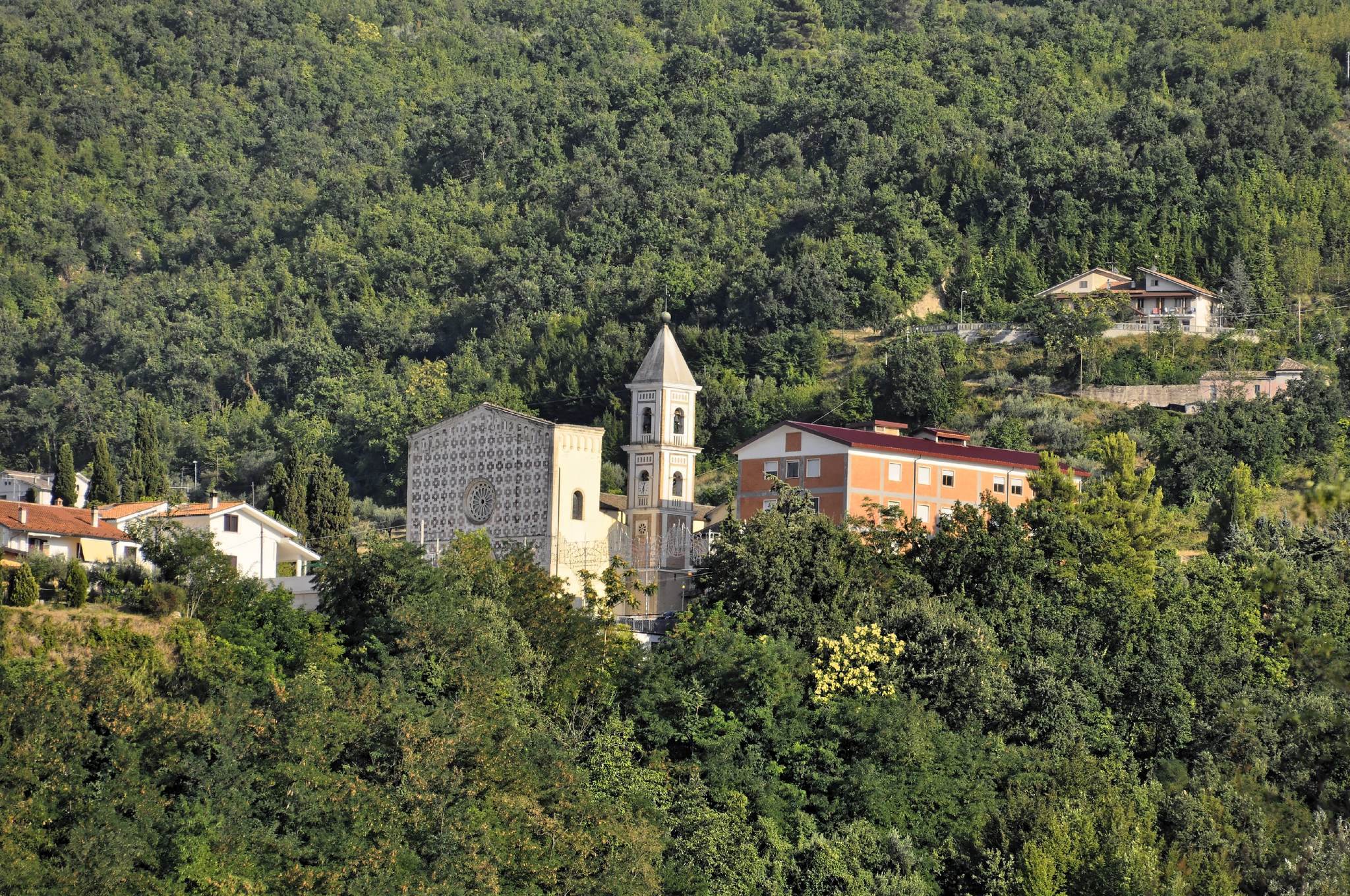
The complex stands on a hill outside Manoppello and consists of the basilica and a Capuchin friary. The friary lies behind the church and has a quadrangular plan organized around a central arcaded cloister. Later accommodation buildings were added for pilgrims, while the former vegetable garden became a civil cemetery in 1876.
Facade
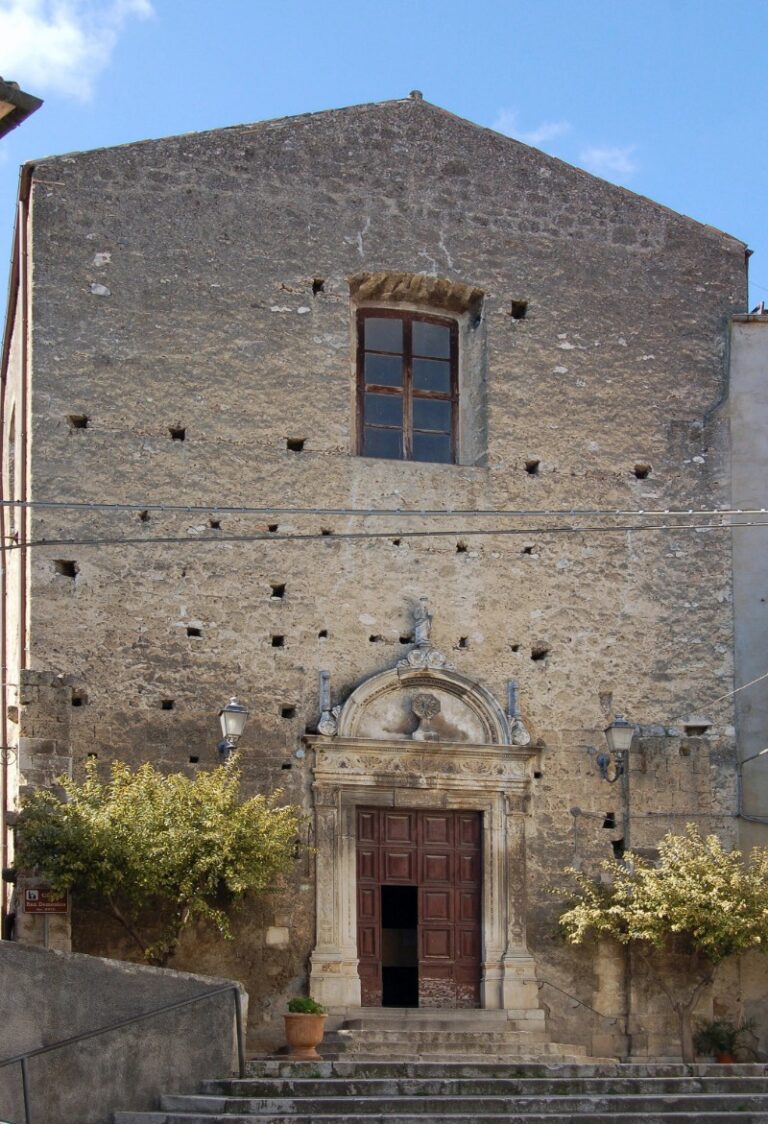
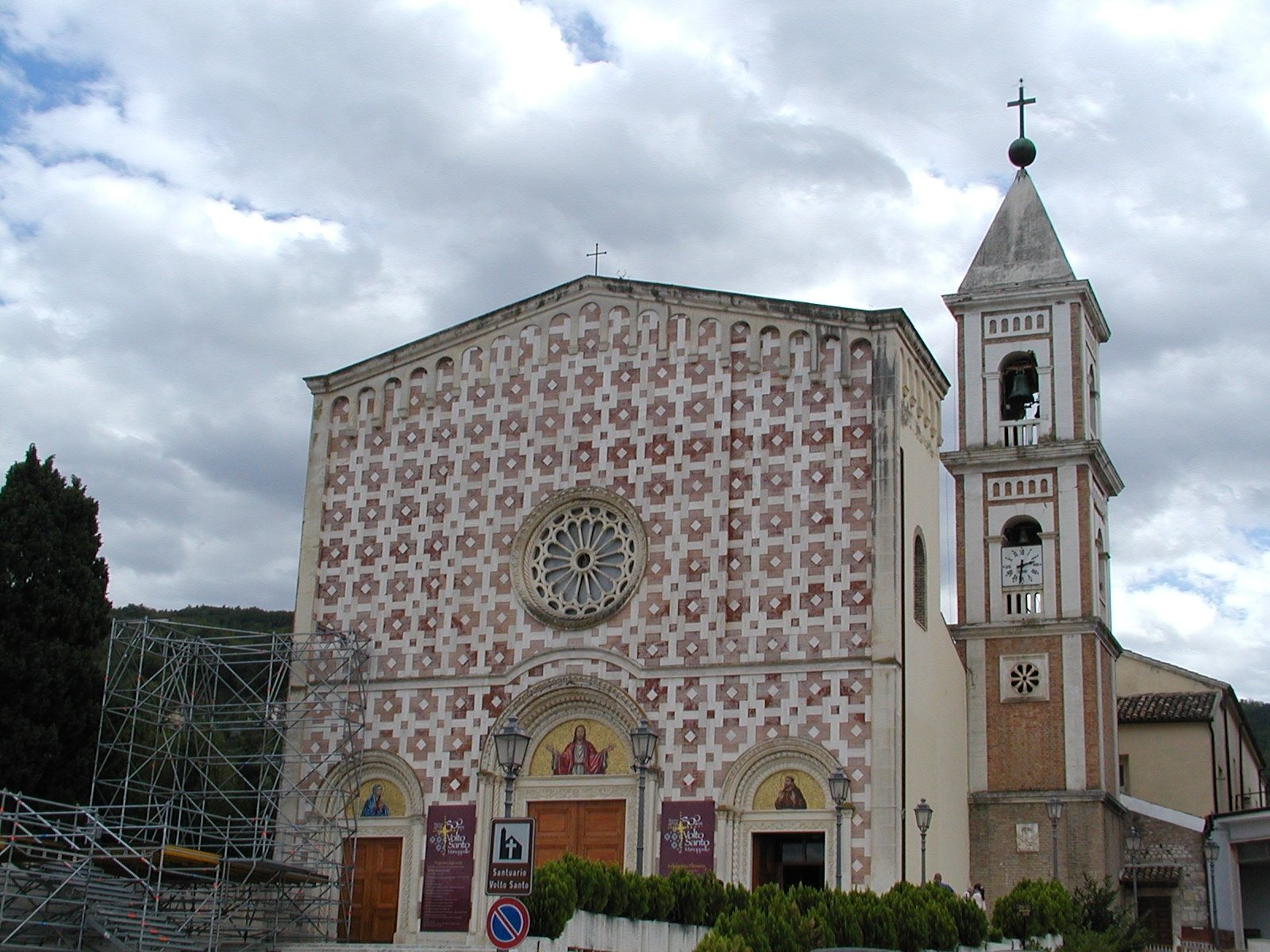
The present facade is a gabled structure built from rough red and white stone blocks arranged in a geometric pattern of small crosses. Three round-arched portals open into the church, with the central entrance larger than the two outer ones. Above it is a central rose window, a large circular window with radiating tracery, modeled on the rose of Santa Maria di Collemaggio in L’Aquila.
The central portal follows the Romanesque Abruzzese type and has twisted shafts within its moulding. Its lunette, the semicircular area above the doorway, contains a mosaic of the Holy Face, also described as a mosaic of the Merciful Christ.
Bell tower
A detached bell tower stands on the left side of the basilica. Dating from the 1960s, it is built of red brick with white-stone decoration and is divided into three sections by white-stone cornices. The lower section contains rose motifs, while the two upper sections have arched openings for the bells and end in a pyramidal spire.
Interior and chapels
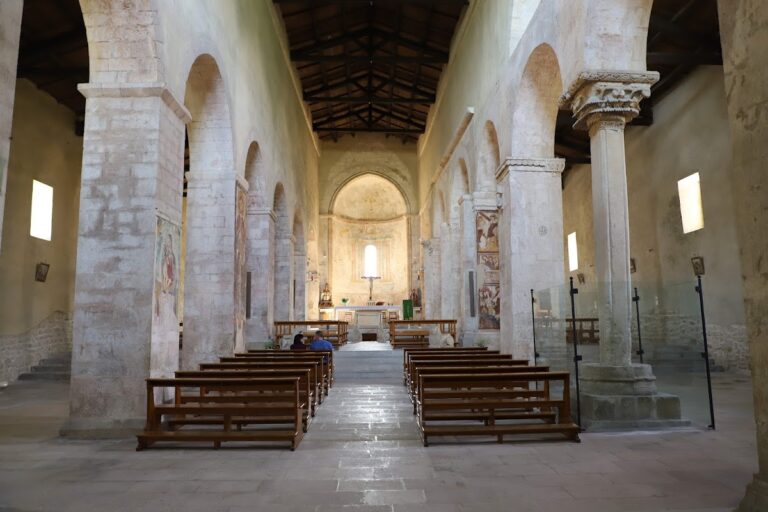
The church originally had a single barrel-vaulted nave. The 1960s alterations widened the interior and introduced column divisions, polychrome stained-glass windows, and historiated glazing, meaning stained glass containing figurative or narrative scenes. The present interior combines Neoclassical and late Art Nouveau elements. A rectangular entablature, the horizontal architectural assembly above supports, runs around the perimeter, while round-arched side chapels are separated by pillars connected to it.
The 1960s works added a wooden coffered ceiling modeled on Renaissance examples, including the ceiling of Pescara Cathedral. The church also contains a wooden choir with eighteenth-century paintings of Capuchin saints, including Saint Fidelis and Saint Joseph of Leonessa. The stained-glass windows were made by the D’Aurelio firm of Atri in 1948.
Chapel of Our Lady of Pompeii
The privileged chapel dedicated to Our Lady of Pompeii has late-Baroque decoration. Its stucco tabernacle contains a sculptural group of the Madonna and Child between Saint Dominic and Saint Rose of Lima, supported by angels. A false stucco dome contains the Dove of the Holy Spirit and cherubs playing instruments, while the side bas-reliefs show Marian miracles.
The altar table is decorated with vegetal motifs and vine tendrils surrounding the Mystic Lamb. The chapel also contains a Neoclassical tabernacle with relics of Saint Stephen of the Wolf, who came from Carovilli, died at Manoppello, and founded the monastery of Saint Peter in Valle Bona. Silvino Donatelli of Lettomanoppello made the tabernacle and signed it in 1914. Michele Patrignani created the chapel’s stucco decoration in 1925. An iron grille made by Antonio and Felice Ranieri of Guardiagrele was later stolen.
Other artworks and furnishings
A canvas of the Immaculate Madonna with angels, known as the “Madonna Without Sin,” is located in a chapel on the left. On the right side of the nave is a nineteenth-century painting by Francesco M. De Benedictis of Guardiagrele showing the Immaculate Madonna between Saint Francis and Saint Anthony.
The church also contains contemporary sculptures of Saint Michael fighting the Demon and Saint Francis with the Cross. Bruno Forte, Archbishop of Chieti-Vasto, commissioned the baptismal font. Alberto Cicerone made the new ambo, seat, and Paschal candle holder near the main altar in 2017.
Holy Face reliquary
The Holy Face was formerly kept in the privileged chapel and was later moved to the main altar. It is now displayed behind the altar in a raised tabernacle, a receptacle used here for the displayed relic, and enclosed within a glass case reached by a double flight of stairs. The arrangement has been compared with the protected relic at the Church of Saint Francis in Lanciano.
The tabernacle is a nineteenth-century Neoclassical tempietto, or small temple-like structure, supported by putti and decorated with Ionic volutes. The main altar is described as having a monumental tabernacle and also as a marble altar erected in 1914.
The image was originally surrounded by additional fabric, reportedly in proportions resembling a tablecloth. Remigius of Rapino cut away this surrounding material, placed the image in a walnut frame, and protected it with two sheets of glass. The Holy Face is now preserved in the basilica’s glass-covered reliquary, a container made to protect and display a relic.
Friary museum
The friary museum contains ex votos, devotional objects offered in fulfillment of a vow or in gratitude for a perceived divine favor, together with material associated with devotion to the Holy Face. Its holdings include objects donated by pilgrims, Immaculate Hearts, objects formerly belonging to Capuchin friars, and older paintings of Saint Francis, Saint Rita, and the Lamentation over the Dead Christ.
The collection of Father Domenico of Cese of Avezzano is among the museum’s holdings. Numerous examples of popular craftsmanship are preserved in the ex voto collection, and some have been examined by ethnographers. The museum therefore brings together the material expressions of pilgrimage with objects connected to the history of the Capuchin community.