Basilica of St. Bernardine of Siena: A Renaissance Franciscan Church in Italy


Site at a Glance
- Rating
- 4.9
- Popularity
- Very Low
- Country
- Italy
- Primary era
- Medieval
- External website
- Open
- Eras represented
- Medieval, Early Modern
- Civilizations
- Grand Duchy of Tuscany, Republic of Siena
- Site type
- Religious
- Remains
- Basilica
On this page15 sections
History
The Basilica of St. Bernardine of Siena is a Roman Catholic church in Italy, built and developed as a Franciscan religious complex on the Colle della Capriola outside Siena’s city walls. The present church belongs chiefly to the Renaissance period and is generally dated from 1476. Administered by the Friars Minor, the Franciscan order, it is regarded as the most important church outside Siena’s walls and is dedicated to St. Bernardine of Siena, the fifteenth-century Franciscan preacher closely associated with the site.
Hermitage and Franciscan foundation
A hermitage existed on the site by 1192. An earlier chapel was associated with St. Bernardine, who lived on the Colle della Capriola. The convent was founded in 1403 by Blessed Giovanni da Stroncone, during the period when the Osservanza, or Observance, a Franciscan reform movement advocating stricter monastic discipline, shaped the religious identity of the community.
Bernardine’s connection with the complex continued after its foundation. In 1444 he lived there as a hermit in a cell now recalled by a reconstruction in the convent’s Oratorio di San Bernardino. He later left for L’Aquila, where he died. The site therefore combined an older tradition of solitary religious life with the organized Franciscan convent established in the fifteenth century.
Creation of the Renaissance church
A Franciscan chapter held at San Lucchese in Poggibonsi in 1474 considered how the pre-existing church might be enlarged. The project was evaluated in 1476, the year generally connected with the beginning of the present basilica. Construction continued through the 1490s. The design is probably attributable to Francesco di Giorgio Martini, a Sienese Renaissance architect, engineer, painter, and sculptor, with probable collaboration by Giacomo Cozzarelli, a Sienese artist and architect.
Pandolfo Petrucci, the leading ruler of Renaissance Siena, commissioned major additions in 1495 and 1496. These included the crypt, new convent facilities, and a burial place for the Petrucci family. Further expansion followed in later phases, including work after 1505 by Fra Timoteo de’ Medici. The complex consequently developed beyond the church itself, incorporating spaces for burial, communal religious life, and the administration of the convent.
War, rebuilding, and modern reconstruction
The Renaissance complex was heavily damaged during the Florentine siege of Siena in 1554 and 1555, a military campaign that ended Siena’s resistance and brought the city under Florentine control. The basilica and convent were rebuilt in the Baroque period, with further architectural alterations carried out from 1683 to 1704. An earthquake caused additional damage in 1798.
Major restoration took place between 1922 and 1932. In 1924 the church was elevated to the status of a minor basilica, a special papal designation recognizing a church’s religious importance without making it a cathedral.
American bombing on 23 January 1944 almost completely destroyed the basilica. The facade and some side walls were among the principal surviving elements. From 1945 to 1949, reconstruction directed by the architect Egisto Bellini used surviving stone, photographs, and testimony from the convent’s friars to restore the building’s original appearance. The church was reconsecrated and reopened for worship in 1949.
The Aurelio Castelli Museum, established in 1920, was reopened after the wartime destruction. The wider complex includes the library, convent, three cloisters, crypt, Loggia di Pandolfo, sacristy, Oratorio di San Bernardino, and refectory. The Friars Minor continue to administer the church and convent.
Remains
Church exterior and interior
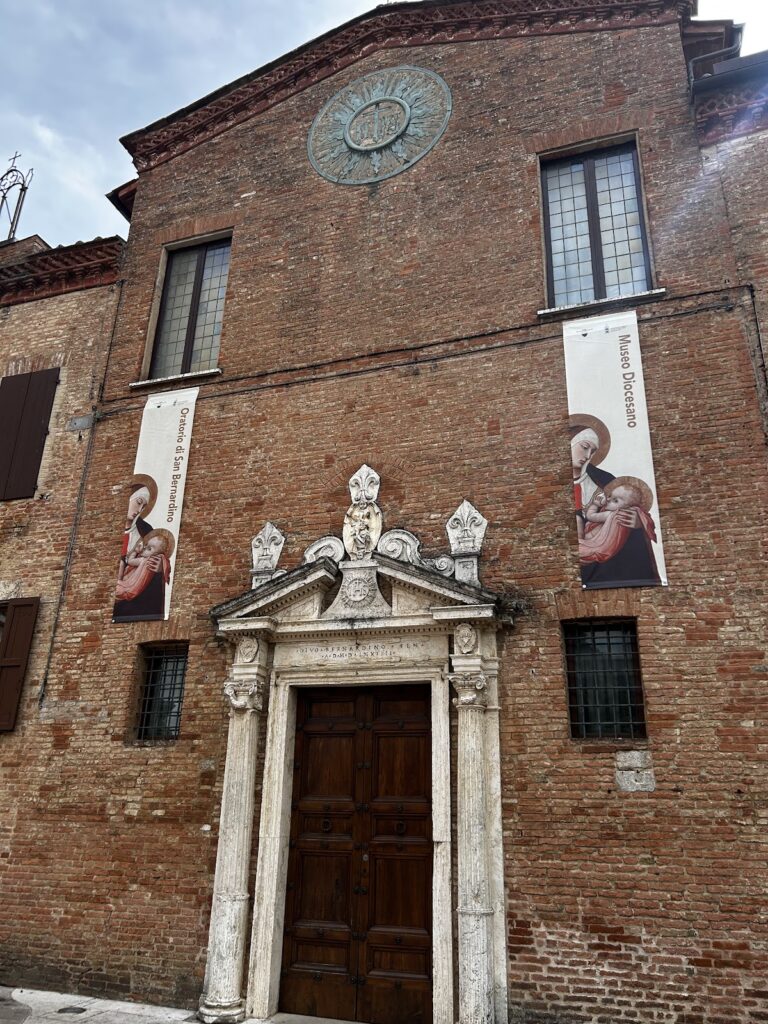
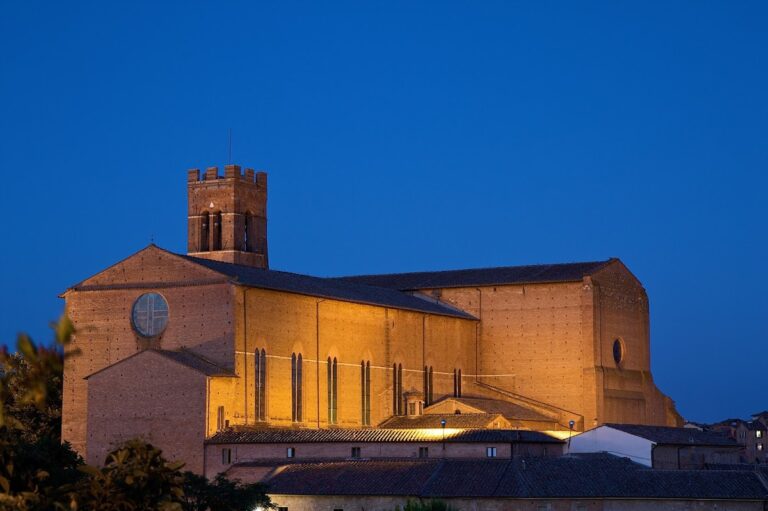
The basilica stands on the Colle della Capriola in Siena’s Scacciapensieri district, northeast of the historic center and outside the city walls. Its exterior is faced entirely in terracotta. A dome dominates the building, rising from a tall, windowless cylindrical drum and ending in a lantern. The bell tower dates from 1719. The facade has a low triangular pediment above a high cornice, a splayed circular rose window, and one entrance portal beneath a pitched-roof portico supported by square terracotta piers.
Inside, restrained Renaissance forms combine white plastered walls with structural and decorative elements in pietra serena, a gray sandstone widely used in central Italian Renaissance architecture. The single nave is divided into two bays and surrounded by eight side chapels, four on each side. Sail vaults cover the nave bays. A triumphal arch opens into the square presbytery, which is surmounted by the dome and ends in a quadrangular apse. The apse contains Mascioni pipe organ opus 708, made in 1955. Beneath the dome, the central high altar carries a modern wooden Crucifix.
The counterfacade contains two glazed-terracotta circular medallions by Andrea della Robbia, showing St. Louis of Toulouse and St. Bonaventure. At the base of the triumphal arch, niches hold glazed-terracotta figures of the Announcing Angel and the Virgin Annunciate, probably made around 1485.
Chapel paintings and sculpture
Right-hand chapels
The first chapel on the right contains a fresco begun by Giomo del Sodoma and completed by Bartolomeo Neroni. The painting was transferred from the Chapel of the Cross near the convent. The second chapel holds a sixteenth-century sculptural Pietà, or Lamentation over the Dead Christ among Saints, by Giovanni di Paolo Neri.
The third chapel on the right contains a triptych, a multi-panel altarpiece, by Sano di Pietro showing the Madonna and Child with Saints Jerome and Bernardine. It dates from the second half of the fifteenth century, around 1460. The adjacent chapel contains another triptych by Sano di Pietro, the Coronation of the Virgin with Saints Francis, Jerome, Bernardine, and Augustine, dated 1450 to 1460. It replaced an arched altarpiece by the Master of the Osservanza, whose predella, the horizontal lower section of an altarpiece, is now reunited with it in the National Gallery of Siena.
Left-hand chapels
The left-hand chapels include a dismembered polyptych, a multi-panel altarpiece, by Andrea di Bartolo, dated 1413. Its larger panels depict St. John the Baptist, St. Francis of Assisi, St. Peter, and St. John the Evangelist. The second chapel on the left contains Andrea della Robbia’s Assumption of Mary.
Other interior works include Pietro di Francesco Orioli’s fresco of the Enthroned Madonna with St. John the Baptist and St. Jerome. A triptych of the Madonna with Saints Ambrose and Jerome, dated around 1436, is attributed to the Master of the Osservanza. Works attributed to Girolamo di Benvenuto and Pietro di Giovanni d’Ambrogio are also associated with the chapel decoration.
Crypt and convent spaces
Crypt and sacristy
The crypt lies beneath the church and is oriented opposite to the upper church. It contains or is associated with the Petrucci family burial place, including the grave of Pandolfo Petrucci. The graves of Giacomo Cozzarelli, Guidoccio Cozzarelli, Francesco di Giorgio, Pietro di Francesco Orioli, and Bernardino Perfetti are also located there. The sacristy, designed by Giacomo Cozzarelli, contains the Petrucci coat of arms and a polychrome terracotta group representing the Lamentation over the Dead Christ.
Cloisters and refectory
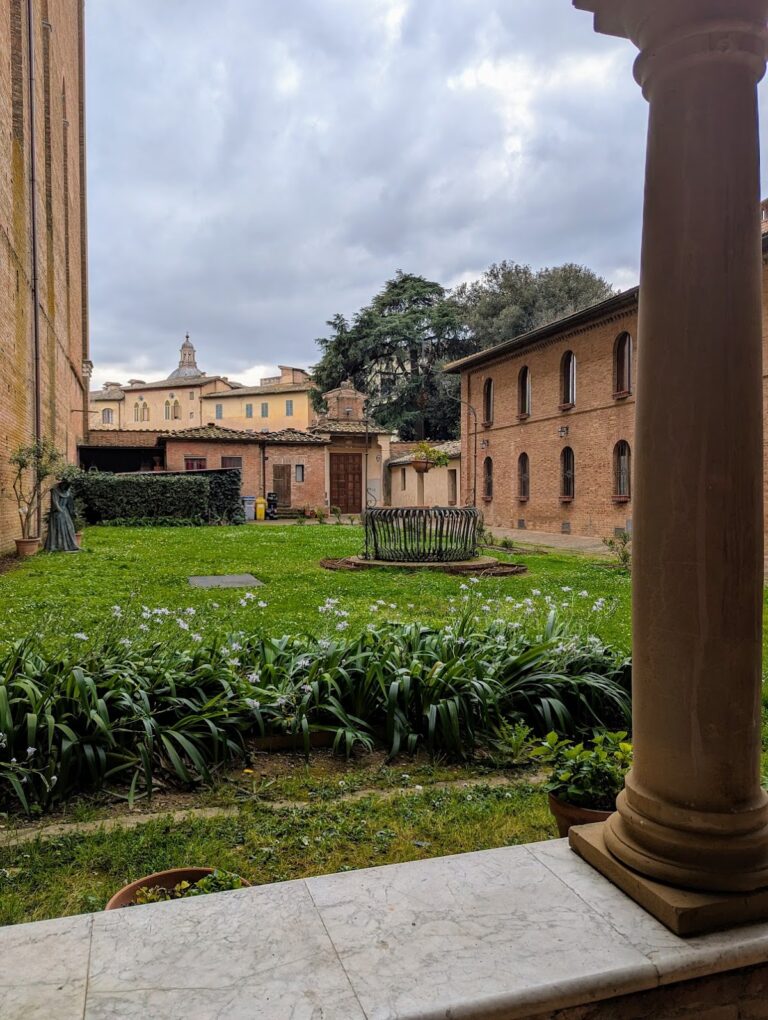
The convent extends beside the basilica and is organized around three cloisters, covered ambulatories surrounding open courtyards and connecting the principal rooms of a religious house. The oldest is the southern cloister, which adjoins the Loggia di Pandolfo. The central or largest cloister dates from the late seventeenth century, with construction recorded from 1683 to 1694, and contains a wellhead or cistern dated 1722. The third is the sixteenth-century infirmary cloister.
The refectory was built between 1696 and 1704. It contains Francesco Franci’s large canvas of the Last Supper, painted around 1710. The Oratorio di San Bernardino contains the reconstruction of Bernardine’s cell and a bust of the saint attributed to Vecchietta.
Museum and library collections
Aurelio Castelli Museum
The Aurelio Castelli Museum contains Girolamo di Benvenuto’s detached fresco of the Last Judgment, originally made for the crypt at the beginning of the sixteenth century. Its holdings also include the head of a Crucifix by Lando di Pietro, formerly on the high altar and almost completely destroyed in the 1944 bombing; a fifteenth-century reliquary associated with St. Bernardine; Antonio Federighi’s 1476 funerary monument to Niccolò Piccolomini; and Francesco d’Antonio’s reliquary of St. Bernardine, dated 1462. A manuscript of Albertus Magnus’s De Animalibus is also held there.
A nineteenth-century inventory recorded further works formerly or historically associated with the church. These included organ doors painted by Lorenzo Feliciati, frescoes by Apollonio Nasini and Tommaso Nasini, terracotta statues by Gioco di Gambassi on the high altar, sculptures by Giuseppe Mazzuoli the Younger, a Crucifix painted by Bartolomeo Neroni, four canvases by Franellini, glazed-terracotta Annunciation reliefs by the Della Robbia, and choir paintings by Pietro di Giovanni and Ansano di Pietro.
The same inventory listed a 1413 painting of St. Petronilla by Taddeo Bartoli, a St. Philomena by Boschi, frescoes by Franchini and Antonio Nasini, a St. Bernardine by Montorselli, and an altarpiece by Luca della Robbia. It also noted works by Giacomo Cozzarelli, the tomb of Pandolfo Petrucci, paintings by Margaritone d’Arezzo, Stefano di Giovanni, Alessandro Casolani, and Ramacciotti, and an elaborate 1472 urn by Francesco d’Antonio associated with St. Bernardine’s vestments.
Library
The library holds approximately 28,000 books dating from 1400 to 1900. Aurelio Castelli compiled its first inventory in 1876. Among its holdings are five fifteenth-century incunabula, early books printed before 1501, including St. Bernardine’s Sermones del Evangelio aeterno of 1489.