Basílica de San Gregorio Ostiense: Baroque Sanctuary in Navarre


Site at a Glance
- Rating
- 4.6
- Popularity
- Low
- Country
- Spain
- Primary era
- Early Modern
- External website
- Open
- Eras represented
- Medieval, Early Modern
- Civilizations
- Kingdom of Navarre, Spanish
- Site type
- Religious
- Remains
- Basilica
On this page13 sections
History
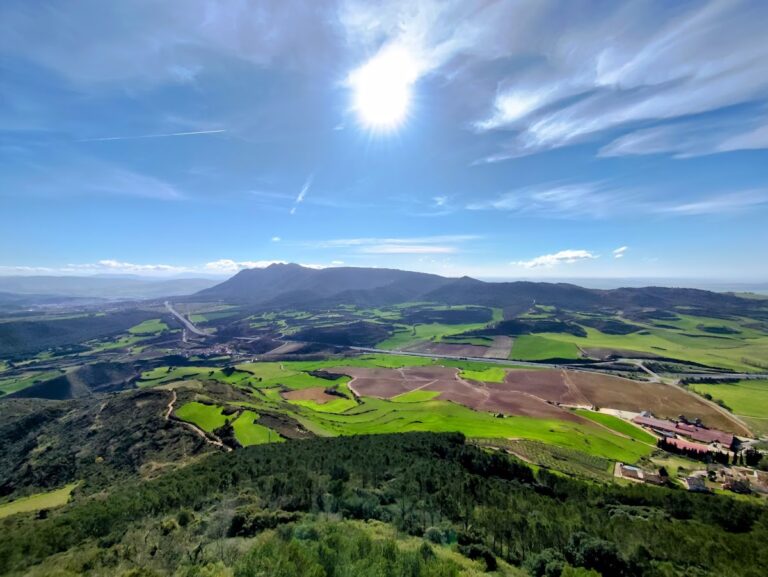
Basílica de San Gregorio Ostiense is a Catholic minor basilica in Spain, located at Sorlada in Navarre on the Alto de Piñalba beside the Way of Saint James. Its present Baroque complex was built between 1694 and 1771, replacing earlier religious buildings and preserving the sanctuary’s long association with Saint Gregory Ostiense.
From San Salvador to Saint Gregory
The site first appears in written evidence in 1075, under the dedication San Salvador de Pinnana. In that year, Sancho IV of Pamplona, also known as Sancho Garcés IV, donated the monastery to Santa María de Nájera. The original San Salvador hermitage later gave way to a church dedicated to Gregory Ostiense around the middle of the thirteenth century. Only limited traces attributed to that building survive within the present church.
Gregory Ostiense was traditionally identified as a cardinal and bishop of Ostia, a papal librarian, and a papal representative. According to the tradition surrounding the sanctuary, Pope Benedict IX sent him to the Kingdom of Pamplona in 1039 during the reign of García of Nájera, an eleventh-century king of Pamplona. Gregory was believed to have died at nearby Logroño in 1044.
A later tradition states that the tomb of Gregory was found in the mid-thirteenth century by Pedro Ximénez de Gazólaz, bishop of Pamplona, and Sancho de Axco, bishop of Bayonne, after they saw miraculous lights. Another version relates that Gregory’s remains were being transported on a donkey when the animal died on the Alto de Piñalba. A church was then built over the place where the remains were deposited. The reason for the change in dedication is unknown, although devotion to healing saints and the sanctuary’s connection with a secondary branch of the Way of Saint James may have helped encourage it.
The brotherhood and the spread of devotion
A brotherhood dedicated to Saint Gregory is recorded in a 1268 ecclesiastical accounting register known as the Libro del Rediezmo. From the fourteenth through the nineteenth century, the Brotherhood of Saint Gregory Ostiense became a major socioreligious institution in Navarre and one of the most prominent brotherhoods of its kind in the Iberian Peninsula.
Devotion to Gregory spread from the Berrueza Valley across Navarre, Álava, La Rioja, and other parts of Spain. He was regarded as a protector of cultivated land and harvests, especially against agricultural pests. Rural communities came to the sanctuary for water associated with his relics, seeking protection for their fields and relief from certain illnesses. The sanctuary’s influence was particularly strong from the sixteenth to the eighteenth centuries, while its devotional importance had diminished by the present day.
In 1624, the Benedictine friar Andrés de Salazar published a history of Gregory Ostiense that promoted devotion to the saint, defended the importance of his relics, and explained the religious basis of the water collected by the faithful. The brotherhood financed an edition of 1,500 copies. Salazar also recorded 56 communities in Navarre, La Rioja, and Aragon that had made vows to Gregory and paid the church for blessed water intended for their fields.
In 1756, King Ferdinand VI requested that the reliquary travel through Teruel, Valencia, Alicante, Murcia, Extremadura, and Andalusia as an aid against a severe locust plague. This journey reflects the sanctuary’s wider agricultural role during the period when communities sought the saint’s protection for their crops.
War, rebuilding, and heritage protection
The Alto de Piñalba gave the sanctuary a strategically important position as well as a religious function. The site suffered damage in the early sixteenth century during the Castilian conquest of Navarre, a military campaign through which Castile took control of the kingdom. The church and its associated buildings were later transformed into the monumental complex that survives today.
Construction of the present complex began in 1694 and continued until 1771. The basilica was declared an Asset of Cultural Interest in Navarre on 29 August 2012. It belongs to the Archdiocese of Pamplona and Tudela and is administered by the Marist Brothers resident in nearby Ancín.
Remains
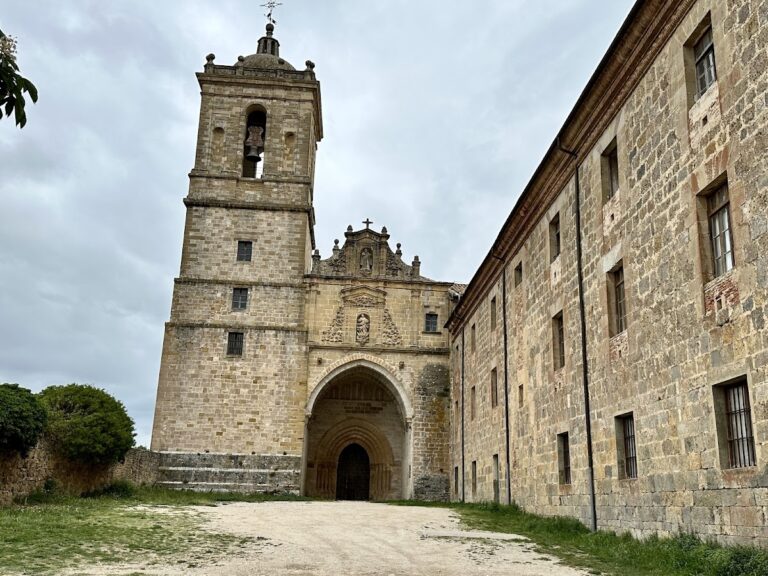
The basilica is a Baroque stone building arranged on a Latin-cross plan. Its transept has an unusual trefoil, or three-lobed, form. Solid ashlar walls and a complex grouping of volumes give the exterior a strongly faceted appearance, because curved interior spaces, including the apse and transept arms, become polygonal forms on the outside.
Earlier fabric and the main interior
The earlier San Salvador hermitage has no surviving remains. Vestiges attributed to the thirteenth-century church are preserved in the Gospel-side wall of the present building. That earlier church may have had pre-Romanesque or early Romanesque origins and may itself have been built in the eleventh century, although the extensive rebuilding of the seventeenth and eighteenth centuries probably obscured the intermediate phases.
The nave is divided into four bays by tall pedestals and composite capitals supporting a classical cornice. Above them is a barrel vault, a continuous semicircular ceiling, strengthened by paired transverse arches and decorated with coffering. The apse and the arms of the trefoil transept are semicircular inside but polygonal externally, producing the unusual contrast between the interior plan and the exterior massing.
Entrance and tower
Monumental portal
The monumental entrance portal stands on the Epistle side, the traditional church side associated with the reading of the Epistle. Work began in 1691, and the portal was executed between 1694 and 1713. Vicente Frías and his workshop participated in its construction, which was continued by his widow, Francisca de Larraona. Juan Antonio San Juan directed the sculptural work from 1710.
The portal is organized into five vertical sections and two superimposed tiers resting on a double base. Solomonic columns, whose shafts twist upward, and pillars with composite capitals frame the tiers. Niches at the sides contain images of Saint Peter and Saint Paul. Its abundant plaster ornament has deteriorated over time, and its design recalls the Renaissance portal of the Church of Santa María in Viana.
Three-level tower
The monumental tower was erected around 1718 by Juan de Larrea, a Biscayan master then living in Falces, in collaboration with the stonemason Ignacio de Ondaiza. Lucas de Mena, a retable-maker from Estella, produced decorative elements including the pinnacles and capitals of the uppermost level.
The tower’s two lower levels are rectangular, while the upper level is octagonal. Their decoration follows the classical orders from bottom to top: Doric, Ionic, and Corinthian. This three-level arrangement gives the tower a carefully graduated architectural profile within the larger complex.
Retables, sculptures, and pulpits
Rococo retables
Three Rococo retables occupy the arms and central area of the transept. Attributed to Silvestre de Soria, they were made between 1765 and 1769 and gilded by Santiago Zuazo. Rococo was an eighteenth-century style associated with light, delicate, and highly ornamental decoration.
The main retable contains a niche with the titular saint above a pedestal. The pedestal supports the chest containing Gregory Ostiense’s remains and the silver reliquary. Saint Dominic of the Causeway and Saint John of Ortega accompany the central figure. The other two retables are dedicated to Saint Isidore the Farmer and Saint Joachim.
Saints and iron pulpits
The three principal sculptures date from 1768 and were made by Roberto Michel. Two iron pulpits stand on the piers of the transept. Miguel Barrera, an ironworker from Pamplona, made them in 1777.
Relics, water, and interior painting
The basilica preserves relics of Gregory Ostiense together with a silver reliquary shaped as the saint’s head. A reliquary is a container designed to preserve or display relics. This one has an opening at the top and another at the bottom. Water could be poured through the upper opening with a funnel and collected after passing through the reliquary, giving physical form to the sanctuary’s devotional practice.
Communities in Navarre and elsewhere sought this water for their fields. Visitors gave alms and received certification of its authenticity. The practice connected the surviving relics and furnishings with the agricultural devotion that shaped the sanctuary’s regional influence. A mural depicting the locust plague is also recorded among the interior decoration.
Nearby sites