Bairat Temple: An Early Circular Buddhist Shrine in Rajasthan
Site at a Glance
- Rating
- 4.6
- Popularity
- Low
- Country
- India
- Primary era
- Classical
- Eras represented
- Classical
- Civilizations
- Mauryan
- Site type
- Religious
- Remains
- Temple
On this page7 sections
History
Bairat Temple is a Buddhist chaitya-griha, or worship hall centred on a stupa, at Virat Nagar in Rajasthan, India. Built during the reign of Ashoka in the 3rd century BCE, it belonged to the Mauryan period and formed part of an important Buddhist centre in the ancient Matsya region.
Ashoka and the Buddhist centre
The temple’s date and Buddhist affiliation are closely associated with the Bairat-Calcutta Minor Rock Edict, also called the Bhabru Edict, which dates to around 250 BCE. Ashoka was the Mauryan emperor whose reign was closely linked with state support for Buddhism and the spread of Buddhist institutions and inscriptions. In the Matsya region, which earlier traditions connect with Vedic sacrifices, the presence of this shrine indicates that Buddhism had developed a substantial centre during the Mauryan period.
The wider establishment included the Bairat sangharama, a monastic community of monks and nuns. Ashoka’s support helped Buddhist institutions become more visible in the region, while the scale and character of the remains point to the growing public presence of Buddhism. The Bairat edicts reinforce this setting. They include the Bairat Edict and the Calcutta-Bairat Edict, both found near the temple.
The Bairat edicts
The Calcutta-Bairat Edict was discovered in 1840 by Major Burt and later transferred to the Asiatic Society of Bengal in Calcutta, from which its name derives. It is an unusual Buddhist inscription because Ashoka expresses reverence for the Buddha, the Dharma, meaning the Buddha’s teaching, and the Sangha, the Buddhist monastic community. The text recommends several Buddhist scriptural passages for study and repeated hearing by monks, nuns, laymen, and laywomen. The Bairat inscriptions also played a role in James Prinsep’s 1837 efforts to decipher Brahmi, the ancient script used for many of Ashoka’s inscriptions.
Decline and archaeological investigation
Buddhist activity at Bairat later declined. In the 7th century, the Chinese Buddhist monk and pilgrim Xuanzang visited India and wrote that Buddhism at Bairat was less popular than he had expected. In modern times, the site was investigated by Alexander Cunningham, Carlleyle, Bhandarkar, and Dayaram Sahni. The Archaeological Survey of India maintains the remains.
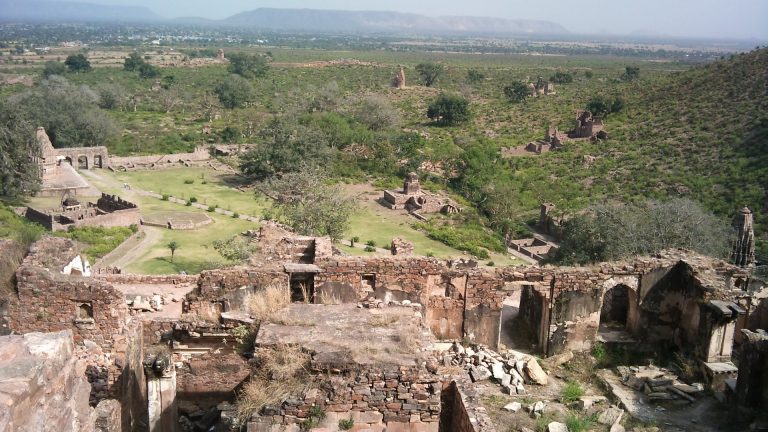
Bairat Temple is now in ruins, while portable archaeological material from the site has been removed. Its circular design has made it an important marker in the history of Indian architecture, since it is regarded as the earliest known circular Buddhist shrine.
Remains
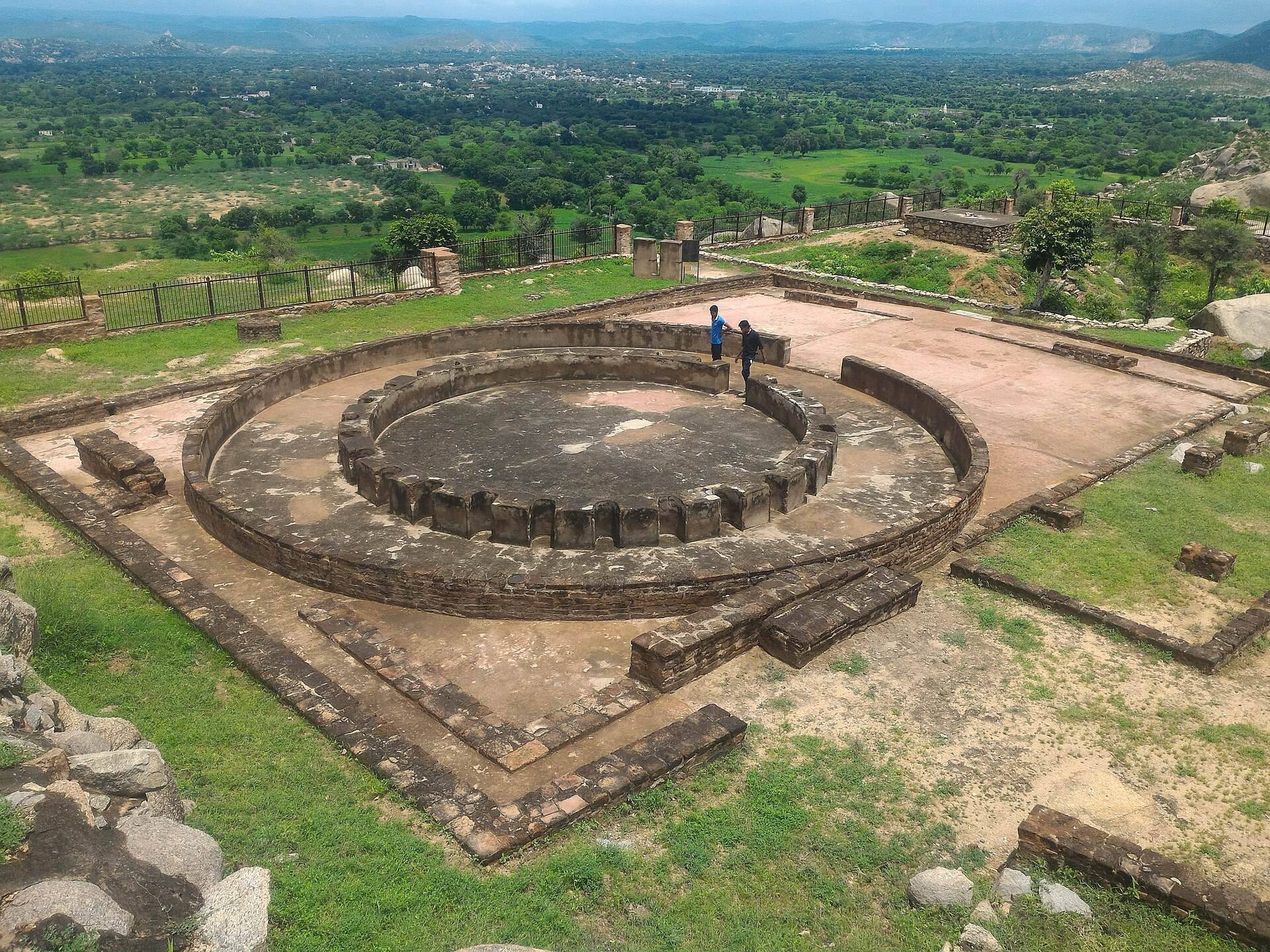
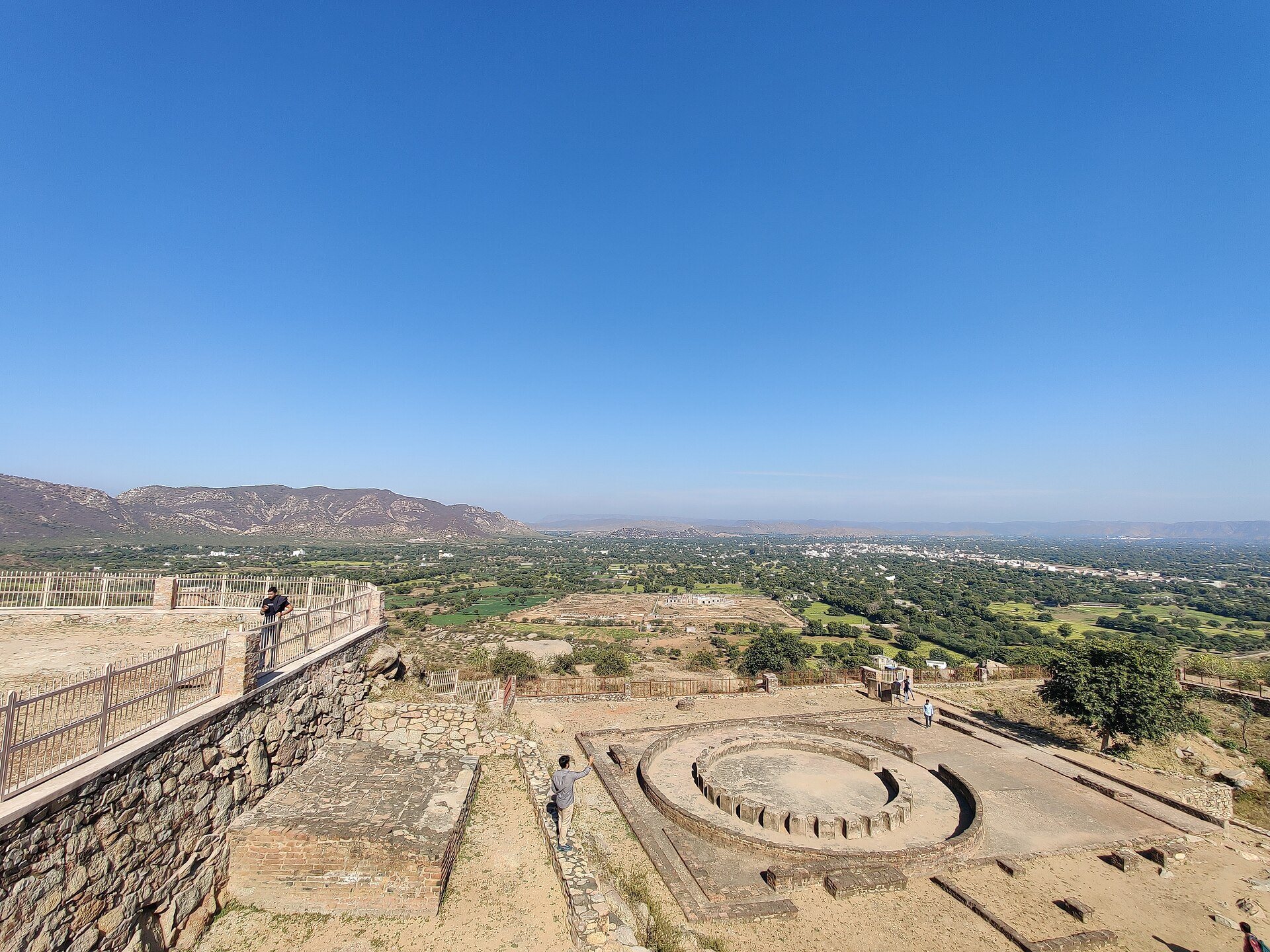
The temple stands on Bijak-ki-Pahari, or Hill of the Inscription, about one mile southwest of Viratnagar. It was a freestanding circular shrine enclosed by a rectangular boundary wall, of which only the foundation survives. The circular building measured approximately 5.6 metres across and was built around a central stupa about 1.6 metres in diameter. The shrine stood on a lower platform, while an attached monastery occupied an upper platform.
The circular shrine
A ring of 26 octagonal wooden pillars surrounded the central stupa. Crevices in the surviving masonry indicate where the pillars once stood. Fire-burnt bricks formed the structure, and the brickwork was coated with lime plaster. Panels alternated with the wooden supports, creating two circular paths for circumambulation, the ritual practice of walking around a sacred object while keeping it to the right.
The arrangement produced two concentric circles in the plan, with the stupa at the centre. The original appearance has been partly reconstructed through comparison with near-contemporary representations at Bharhut and with circular rock-cut temples at Kondivite, Tulja, and Guntupalli. The design has also been compared with the Greek tholos, a circular building, although circular hut forms from the local tradition have been proposed as a more likely source of inspiration.
The monastery and wider complex
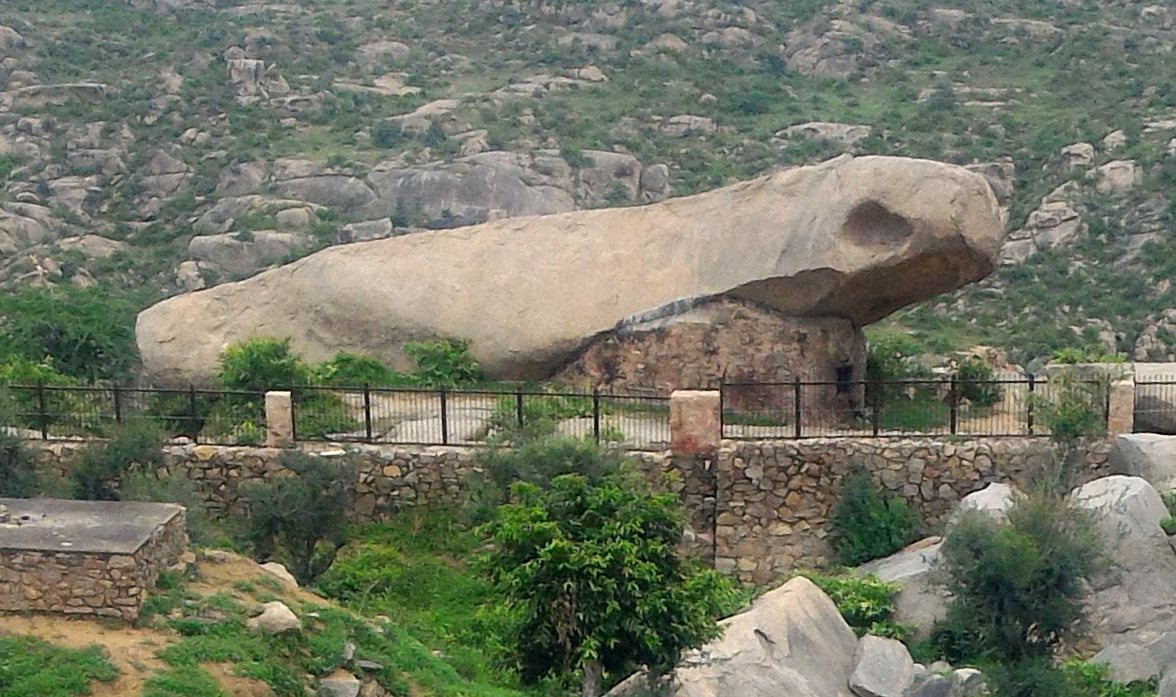
The monastery on the upper platform contained cells large enough for one monk or nun each. Together with the shrine, it formed part of a broader archaeological complex that included a circular stupa on Bijak hill and numerous remnants of Ashokan pillars.
Pottery jars, lamps, and other portable antiquities were found at the site and have since been removed. The circular temple and the stupa are now highly deteriorated, while the surviving foundations, masonry crevices, platforms, and enclosure trace the relationship between the shrine, its circumambulatory spaces, and the monastic establishment.