Badia a Coltibuono: A Vallombrosan Abbey in Italy
Site at a Glance
- Popularity
- Medium
- Country
- Italy
- Primary era
- Medieval
- Eras represented
- Medieval, Early Modern
- Civilizations
- Grand Duchy of Tuscany, Holy Roman Empire, Republic of Florence
- Site type
- Religious
- Remains
- Monastery
On this page10 sections
History
Badia a Coltibuono is an abbey in Italy, founded in 1049 by the Florentine Firidolfi family. Its church combines medieval Romanesque and early modern Baroque features. The site may have been occupied by Etruscans, an ancient people of central Italy whose civilization preceded Roman rule, roughly 2,000 years ago. A church there is known from the mid-10th century.
Foundation and Vallombrosan community
Around 1051, the abbey may have been given to Giovanni Gualberto, an Italian monk who founded the Vallombrosan order, a Catholic congregation in the Benedictine tradition. Vallombrosan monks began building the monastery that year. The complex stood within the parish district of Saint Peter in Avenano.
Documents from the early 12th century confirm the monastery’s connection to the Vallombrosans. In 1115, Pope Paschal II issued a papal bull to Adimaro, abbot of Vallombrosa, affirming the monastery’s place in the order. An act made in 1122 by Conrad of Scheyern, margrave of Tuscany, provides further evidence of the affiliation.
Wealth and Florentine protection
Donations made the monastery increasingly prosperous in later centuries. At its height, it controlled the Abbey of Ardenga, the Abbey of Spineta, and the Monastery of Saint James in Siena. From 1239, the Republic of Florence, the republican government of the Florentine city-state, protected the abbey. It flourished in the 15th century under the protection of Lorenzo de’ Medici, a prominent Florentine statesman and Renaissance patron.
The abbey’s revenues later led to its administration and income being granted to Cardinal Giovanni de’ Medici, along with those of the Abbey of Passignano. The cardinal was not necessarily part of the resident monastic community; he later became Pope Leo X. The monks also established vineyards and olive groves and planted the silver-fir woods around the property. Reforestation was renewed in the 19th century.
Suppression and private ownership
On 29 September 1810, amid celebrations for the birth of Napoleon Bonaparte’s son, who held the title King of Rome, a decree ordered the removal of monks and other religious from all monasteries. Badia a Coltibuono was suppressed and sold to Giovanni Calamai, a wealthy merchant from Livorno who owned nearby farms. The monastery became a farm, while the church served as a parish church. Parishioners rallied around Father Ilarione Parenti, the only monk left and the parish priest. He resisted eviction, including confronting French soldiers sent to remove him. Calamai later leased the abbey to Giovanni Checcacci of Montevarchi.
After the Napoleonic period, Calamai faced creditors following failed financial speculations. In 1816 he organized a lottery that offered landholdings, including the abbey, as prizes, but the scheme fell short of its aims. The property passed to Count Giovanni Giraud, a Roman adventurer accused of fraud after apparently obtaining the winning ticket. Giraud soon sold it to Prince Stanislaus Poniatowski, nephew of Poland’s last king.
Poniatowski married Cassandra Luci in 1830. After his death, Cassandra and her children spent the family fortune financing performances and operas, and their debts led to the abbey’s sale in 1846 to Guido Giuntini. Before completing the purchase, Giuntini secured guarantees from the Vatican against a possible return of the Vallombrosan monks.
Later use
After passing through several owners by inheritance, the property came to the Stucchi Prinetti family. It now operates as a wine and olive-oil estate, producing organic goods as well as Chianti Classico, Riserva, and white wines.
Remains
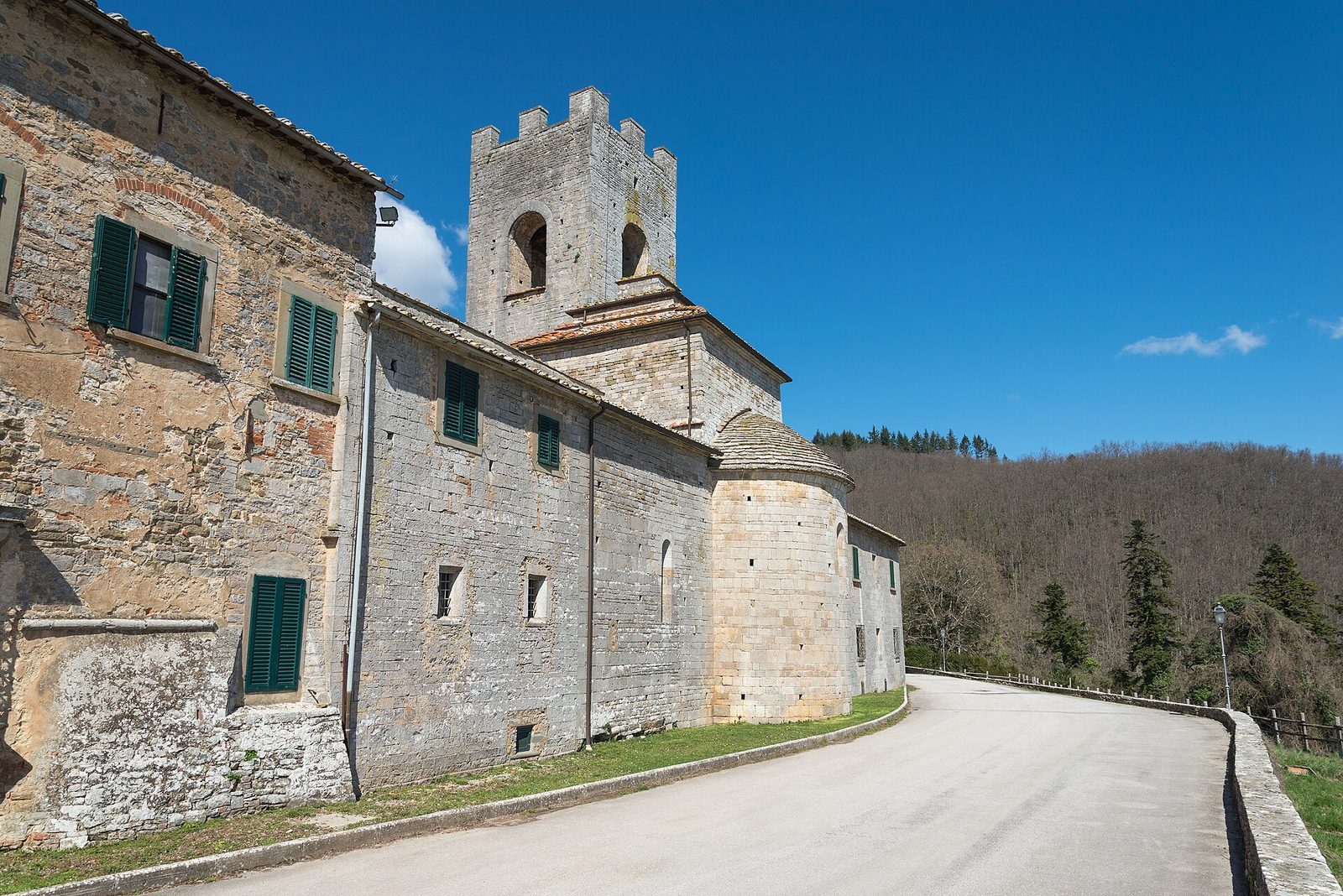
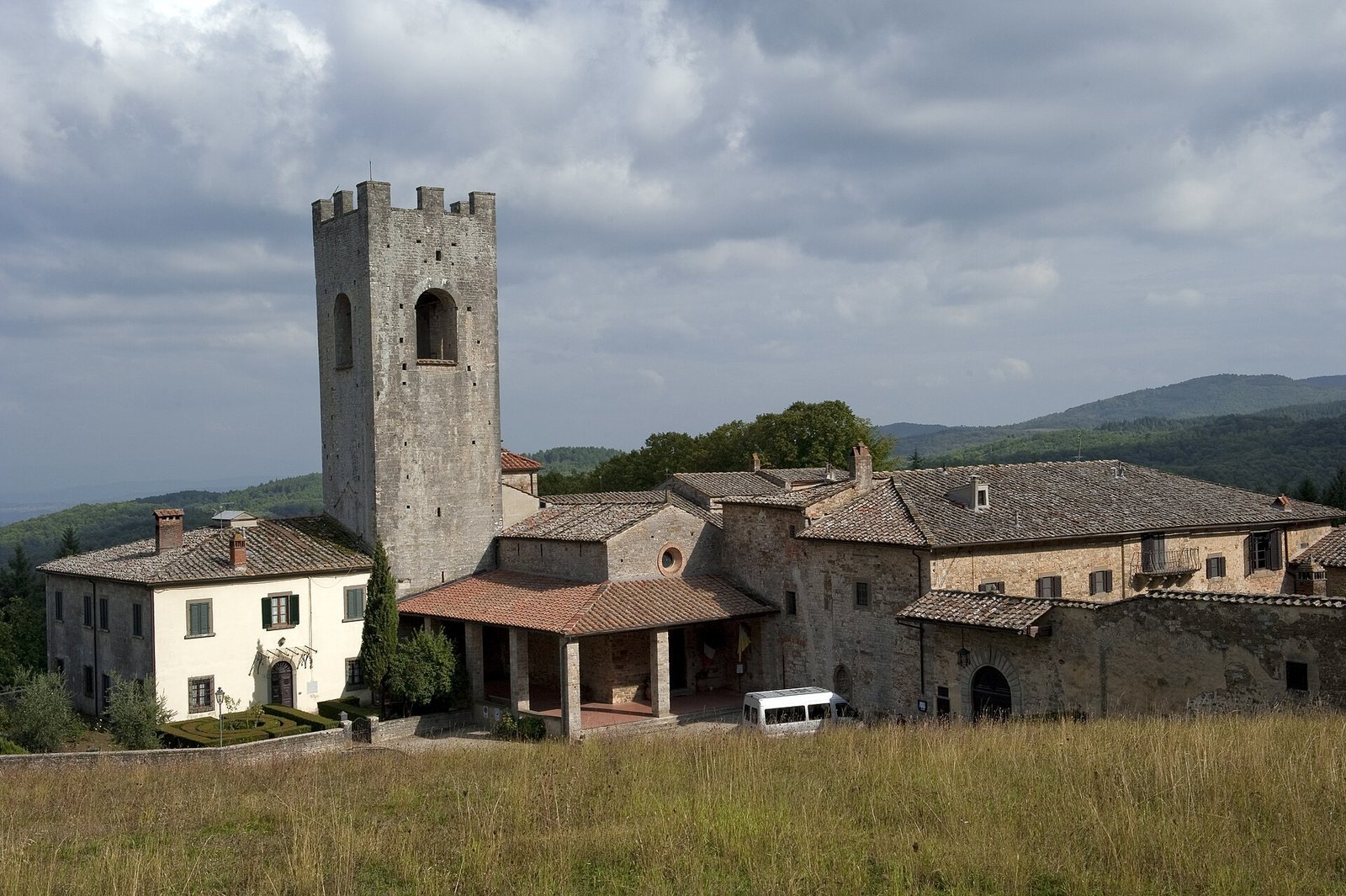
The surviving complex includes the abbey church and bell tower, former monastic buildings, a restored enclosed garden, and extensive silver-fir woods. The church has a cross-shaped plan, while its different sections preserve contrasting masonry and later interior decoration.
The church
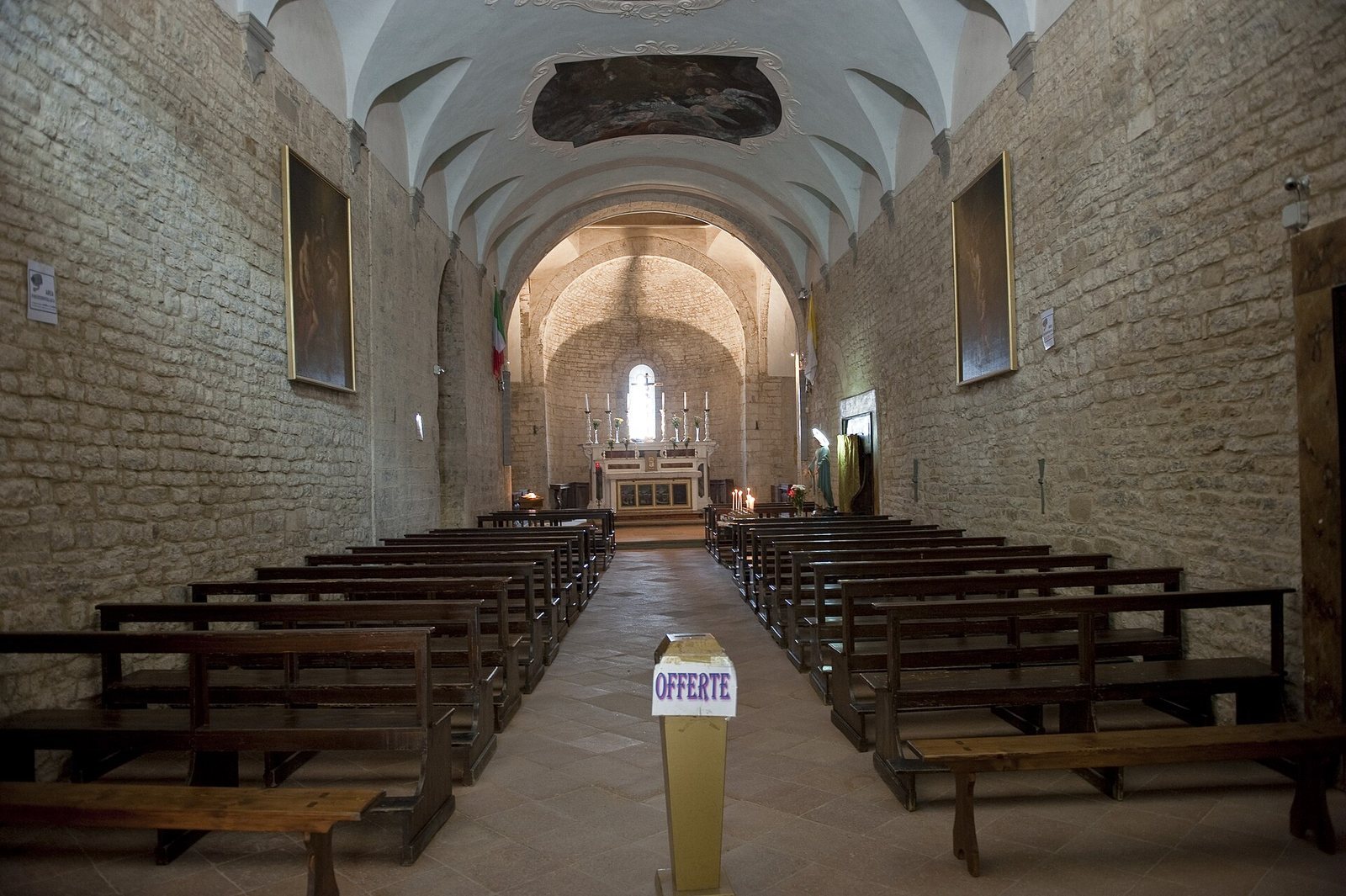
Dedicated to Saint Lawrence, an early Christian deacon and martyr, the church has a single rectangular nave, the main body of the building, ending in a semicircular apse, the curved sanctuary end. Crosswise arms form the transept, and a dome rises above the crossing, where the nave and transept meet. A four-sided tiburio, a tower-like structure enclosing the dome above the crossing, rises over it; its stepped roof gives the exterior a pagoda-like outline.
The nave’s walls are faced with roughly worked river pebbles. Its 18th-century vault-like ceiling carries late-Baroque frescoes and plaster decoration, while the transept retains its original barrel vaults. The transept, apse, and bell tower are built of local limestone in regular horizontal courses. Beneath the high altar lie the remains of Blessed Benedetto Ricasoli, who died in 1107. The title Blessed denotes formal beatification and recognition for public veneration.
Bell tower and portico
Begun in 1160, the massive bell tower stands to the left of the church. Four large windows, each with a single opening, occupy its upper part. Its proportions relate closely to the dome-covering structure and apse, while contrasting with the church’s modest length. A modest portico fronts the church and continues along its left side.
Monastic buildings
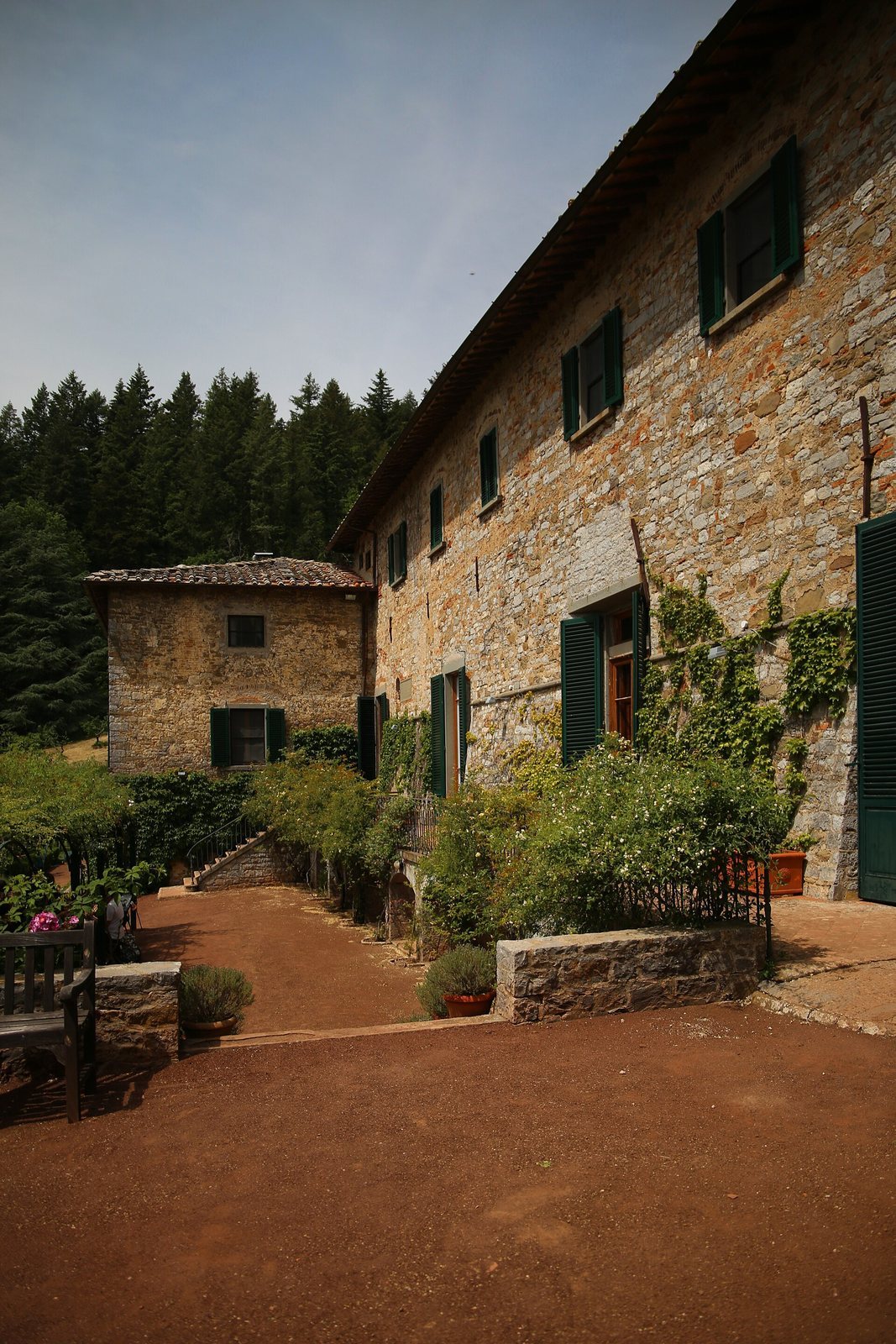
A doorway to the right of the church facade leads into the monastery, now a 19th-century country residence. The cloister, a covered walkway around a courtyard, and the refectory, the monks’ communal dining room, retain forms dating to the 15th and 16th centuries.
Garden and grounds
The restored garden follows the pattern of an enclosed medieval garden. Geometric box hedges divide it into sections planted with aromatic and medicinal herbs. A rectangular stone basin stands at its center, and its paths are paved with pietra serena, a grey Tuscan sandstone. Long grapevine pergolas line some of the outer paths.
A cedar of Lebanon beside the abbey stands 20 metres tall and has a trunk circumference of 7 metres. It is listed among Tuscany’s monumental trees. Extensive silver-fir woods surround the property.