Aydon Castle: A Medieval Fortified Manor House in Northumberland


Site at a Glance
- Rating
- 4.5
- Popularity
- Low
- Country
- United Kingdom
- Primary era
- Medieval
- External website
- Open
- Eras represented
- Medieval
- Civilizations
- English
- Site type
- Domestic
- Remains
- Castle
On this page11 sections
History
Aydon Castle is a medieval English fortified manor house near Corbridge in the United Kingdom, begun in stone in 1296 during the thirteenth century. It developed from an earlier timber hall and became the principal residence of Robert de Raymes, later acquiring defensive works in response to conflict along the Anglo-Scottish border. Today, it is regarded as an excellent example of a thirteenth-century English fortified manor house.
Origins and the Scottish Wars of Independence
A timber hall occupied the site before Hugh de Raymes, a major merchant from Suffolk, purchased the land between 1293 and 1295. After Hugh’s death in 1295, his son Robert completed the acquisition in 1296 and made Aydon Hall his principal residence. Robert moved his household to Aydon partly because the Scottish Wars of Independence created opportunities connected with military activity. These conflicts involved Scottish resistance to English claims of authority over Scotland and brought raids and sieges to the border. Robert fought in Scotland in 1297 and 1298 and is believed to have taken part in the Battle of Falkirk in 1298 against forces led by William Wallace.
Construction of the original stone manor began in 1296. Robert initially built without defensive works, but in 1305 he received a licence to crenellate, meaning formal permission from the Crown to add battlements and other fortifications. The crenellations may have enhanced the building’s status, but the increasing danger from Scottish raids soon required more substantial protection. Further fortification work took place in 1311 and 1312 as Scottish forces raided English territory. Aydon repelled at least two Scottish attacks, although the surrounding area was damaged.
Capture, Destruction, and Rebuilding
The English defeat at Bannockburn in 1314 brought a new crisis. Scottish forces captured Aydon in 1315 after its governor surrendered, then pillaged, burned, and severely damaged the manor. English raiders damaged it again in 1317 while looting what the Scots had left. A further Scottish attack, led by David II in 1346, also caused serious damage.
Robert de Raymes had been captured at Bannockburn, and the destruction of his home, together with the 500-mark ransom paid for his release, left him financially ruined. He died in 1324 with little property, and the estate was then regarded as worthless. His son, Robert II de Raymes, inherited Aydon, rebuilt the damaged fortifications, and strengthened the defences destroyed during the Scottish capture. After Robert II’s death in 1349, ownership passed to Nicholas de Raymes, who attempted to restore the family’s former fortunes.
Later Ownership and Use
The de Raymes family eventually sold the estate, which changed hands several times. It passed to the Carnaby family in 1448, the Collinson family acquired it in 1654, John Douglas acquired it in 1702, and it passed to the Blackett family through marriage in 1751.
From the seventeenth century onward, the castle was used as a farmhouse. George Bates occupied it in the early nineteenth century, and in the 1830s Sir Edward Blackett commissioned restoration and refurnishing work. The building also gained a reputation as an unlucky place because of tragic deaths among some residents. In the 1930s, three children from the owners’ family died in a fire, an episode described as possibly legendary.
Farm use ended in 1966, when Aydon Hall opened to the public as a historic site. It is now owned and operated by English Heritage. The building is a Scheduled Ancient Monument, a monument protected under English law for its archaeological or historical importance, and a Grade I listed building, the highest level of listing protection in England.
Aydon was formerly a township within Corbridge parish. It became a civil parish in 1866, had a population of 10 in 1951, and was abolished on 1 April 1955 when it was merged with Corbridge.
Remains
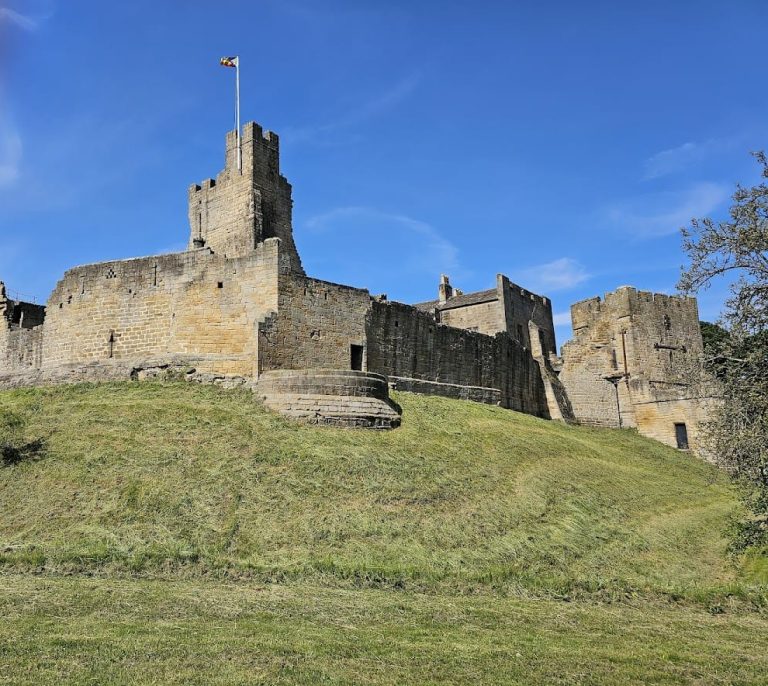
Aydon Castle stands on a rocky spur overlooking three sides of the Cor Burn, a tributary of the River Tyne. The surviving complex combines an early domestic manor with defensive additions made and strengthened during the early fourteenth century. The building is restored and survives as a publicly accessible historic site.
Early Manor Buildings
Timber Hall and Chamber Block
The earliest arrangement consisted of a timber hall with a two-storey chamber block. This timber building preceded the stone manor and established the domestic form of the site before Robert de Raymes began rebuilding in stone.
Stone Manor and Hall Range
The first stone structure was begun in 1296, followed shortly afterward by a two-storey hall range. These elements formed the principal residential core of Aydon Hall. The manor initially lacked defensive works, so its early physical character was that of a substantial residence rather than a fully fortified stronghold.
Defensive Additions
Crenellations
The building later received crenellations, or battlements, after Robert de Raymes was granted a licence to crenellate in 1305. These additions gave the manor a more fortified appearance and were followed by further defensive construction during the border conflicts of 1311 and 1312.
Strengthened Fortifications
Robert II de Raymes rebuilt and strengthened the fortifications after the Scottish capture, burning, and severe damage of 1315. The surviving building therefore reflects both its original thirteenth-century residential design and the defensive changes imposed by warfare in the early fourteenth century.