Ashmolean Museum: Oxford’s University Museum of Art and Archaeology
Site at a Glance
- Popularity
- Very High
- Country
- United Kingdom
- Primary era
- Classical
- Eras represented
- Stone Age, Bronze Age, Iron Age, Classical, Medieval, Early Modern, Modern
- Civilizations
- Ancient Greek, Anglo-Saxon, Celtic, Egyptian, Minoan, Mycenaean, Roman, Scythian, Sumerian, Thracian
- Site type
- Museum
On this page15 sections
History
Foundation and the first museum
The Ashmolean Museum is a university museum in Oxford, United Kingdom, founded around the collection given to the University of Oxford by Elias Ashmole in 1677. Its first building was constructed from 1678 to 1683, and the museum opened on 24 May 1683. It is described as Britain’s first public museum and, after the University of Basel’s museum of 1661, the world’s second university museum. Naturalist Robert Plot became its first keeper.
Ashmole had obtained the collection from John Tradescant the Elder and his son, John Tradescant the Younger, gardeners, travellers, and collectors. Their holdings included coins, books, engravings, and geological and zoological specimens. The collection also included a stuffed dodo, described as the last one seen in Europe. Moth damage led to the bird’s body being destroyed in 1755, while its head and one claw were kept.
New buildings and institutional change
A new building on Beaumont Street was constructed between 1841 and 1845 for the University Galleries. Arthur Evans, keeper from 1884 to 1908, found that about half of the Ashmole collection had been lost under earlier management and that the original museum had been used as examination rooms. Evans’s excavations in Crete also brought archaeological finds to the museum.
Antiquities collector Charles Drury Edward Fortnum offered his collection on the condition that the museum be put on a sound footing. His donation of £10,000 enabled an extension to the University Galleries and the transfer of the Ashmolean collection there in 1894. In 1908, the Ashmolean and University Galleries merged as the Ashmolean Museum of Art and Archaeology. The Tradescant collections had moved to the Pitt Rivers Museum in the 1880s.
After its collections and specimens were transferred to other museums, the original Broad Street building, later called the Old Ashmolean, served as offices for the Oxford English Dictionary. From 1924, it housed the Museum of the History of Science. Its displays included scientific instruments given to Oxford by Lewis Evans, including an extensive collection of astrolabes, instruments used to model celestial positions. In 1921, a bequest from Charles Buller Heberden funded the museum’s coin room, named the Heberden Room in his honour.
Expansion and recent history
The Beaumont Street building received Grade I listed status in 1954, England’s highest protection category for buildings of exceptional architectural or historic interest. The Chinese Picture Gallery opened in 2000. The Bodleian Art, Archaeology and Ancient World Library, formerly the Sackler Library, opened in 2001 and incorporated the Ashmolean’s older library collections, supporting work in classical civilization, archaeology, and art history.
A major redevelopment from 2006 to 2009 was designed by architect Rick Mather and exhibition-design company Metaphor. The museum reopened on 7 November 2009. New galleries for ancient Egypt and Nubia opened on 26 November 2011, bringing objects out of storage and more than doubling the number of coffins and mummies on display. The project redesigned four Egypt galleries and extended the restored Ruskin Gallery, previously used as the museum shop. A University Engagement Programme, established with a 2012 grant, later developed the use of the collections in teaching and research through teaching curators and a programme director.
On 31 December 1999, thieves used scaffolding on a neighbouring building to reach the museum roof and steal Paul Cézanne’s landscape Paysage d’Auvers-sur-Oise, valued at £3 million. They left other works untouched. As the painting was never offered for sale, a commissioned theft was suspected; it has not been recovered. In 2010, several Oxyrhynchus papyri in the museum’s holdings were alleged to have been stolen and sold to the Museum of the Bible.
The museum’s collections continued to grow through purchases and gifts. In 2012, it acquired Édouard Manet’s Portrait of Mademoiselle Claus, painted in 1868, after a public fundraising campaign; the work was accepted through the British scheme that allows cultural objects to be transferred in place of inheritance-tax payments. That year, the museum also received 500 gold and silver objects assembled by dealer Michael Welby, including Renaissance silverware. In 2013, art historian and collector Michael Sullivan bequeathed more than 400 works, including paintings by Chinese artists Qi Baishi, Zhang Daqian, and Wu Guanzhong. A gallery is dedicated to Sullivan and his wife, Khoan. Taiwanese sculptor Ju Ming’s Taichi Arch was given to the museum that year in Sullivan’s memory.
In October 2014, the museum received John Constable’s Willy Lott’s House from the Stour, also known as The Valley Farm. The building depicted in it appears from another viewpoint in Constable’s 1821 painting The Hay Wain, now in the National Gallery. That month, Micheál and Elizabeth Feller gave the museum 61 historic English embroideries spanning the seventeenth century. The museum secured J. M. W. Turner’s The High Street, Oxford through public fundraising in 2015. Painted in 1810, it is described as Turner’s only full-size townscape in oils.
New galleries for Victorian art opened in May 2016. In 2017, the museum acquired a group portrait by William Dobson, painted in Oxford around 1645 during the English Civil War, a conflict between Royalists and Parliamentarians. It depicts Prince Rupert, Oxford governor Colonel William Legge, and Colonel John Russell, commander of Rupert’s elite Blue Coats. The museum also acquired the Watlington hoard, found in South Oxfordshire in 2015. Its more than 200 Anglo-Saxon coins include rare examples issued by Alfred the Great of Wessex and Ceolwulf II of Mercia. In 2024, the Ashmolean acquired Fra Angelico’s The Crucifixion with the Virgin, Saint John the Evangelist and the Magdalen, painted in the early 1420s.
A claim for the return of an artwork was made in 2020. In 2024, the museum agreed to return a roughly 500-year-old bronze statue of Thirumangai Alvar, a Hindu poet and saint. The museum had bought it at auction in 1967. The Indian High Commission in the United Kingdom claimed the statue had been stolen from a temple in Tamil Nadu in 1957.
Remains
Museum buildings
The Old Ashmolean
The original museum building stands on Broad Street and is known as the Old Ashmolean. Its architectural attribution remains uncertain, with Christopher Wren and Thomas Wood both proposed as its designer.
The Beaumont Street building
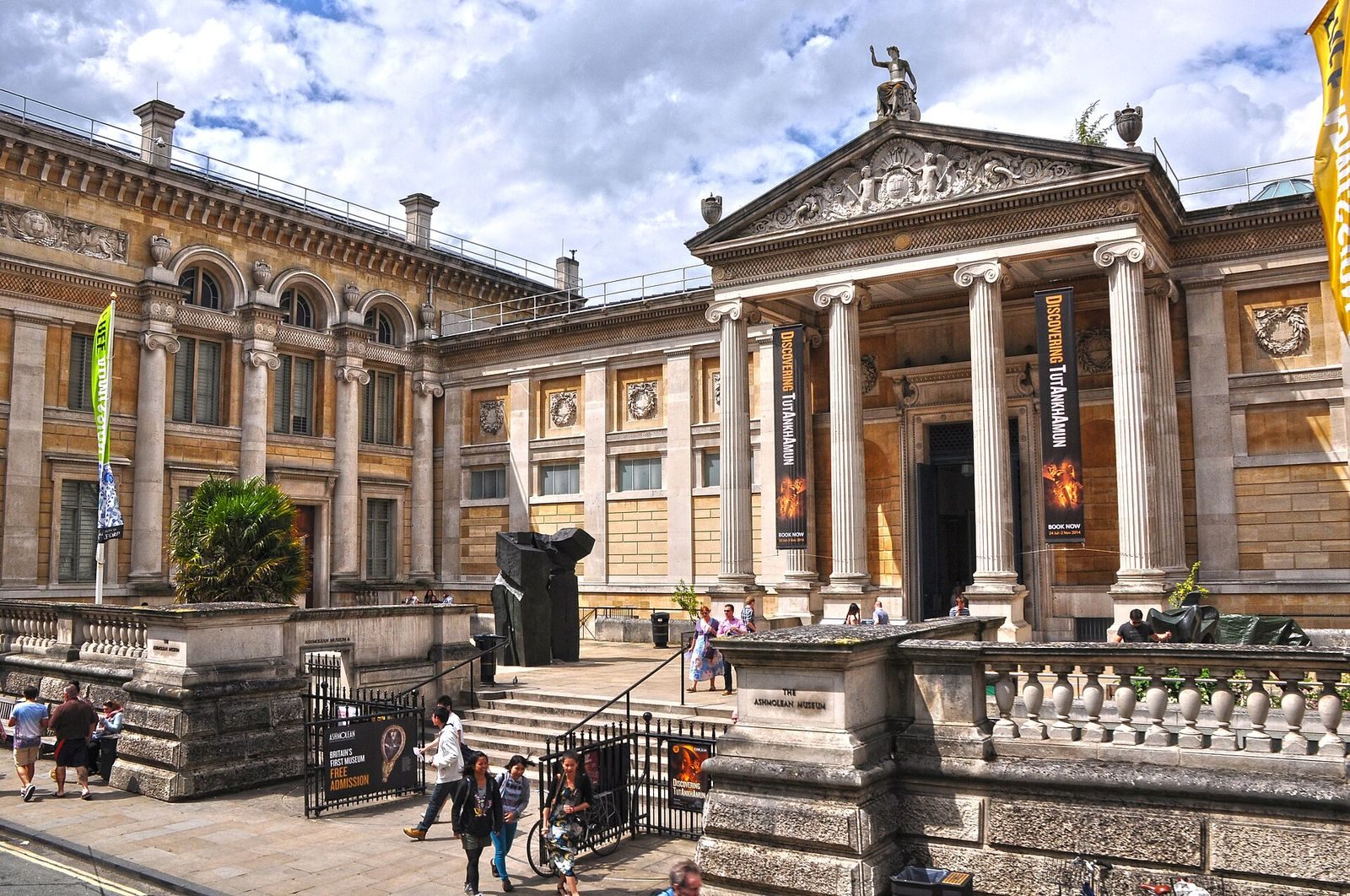
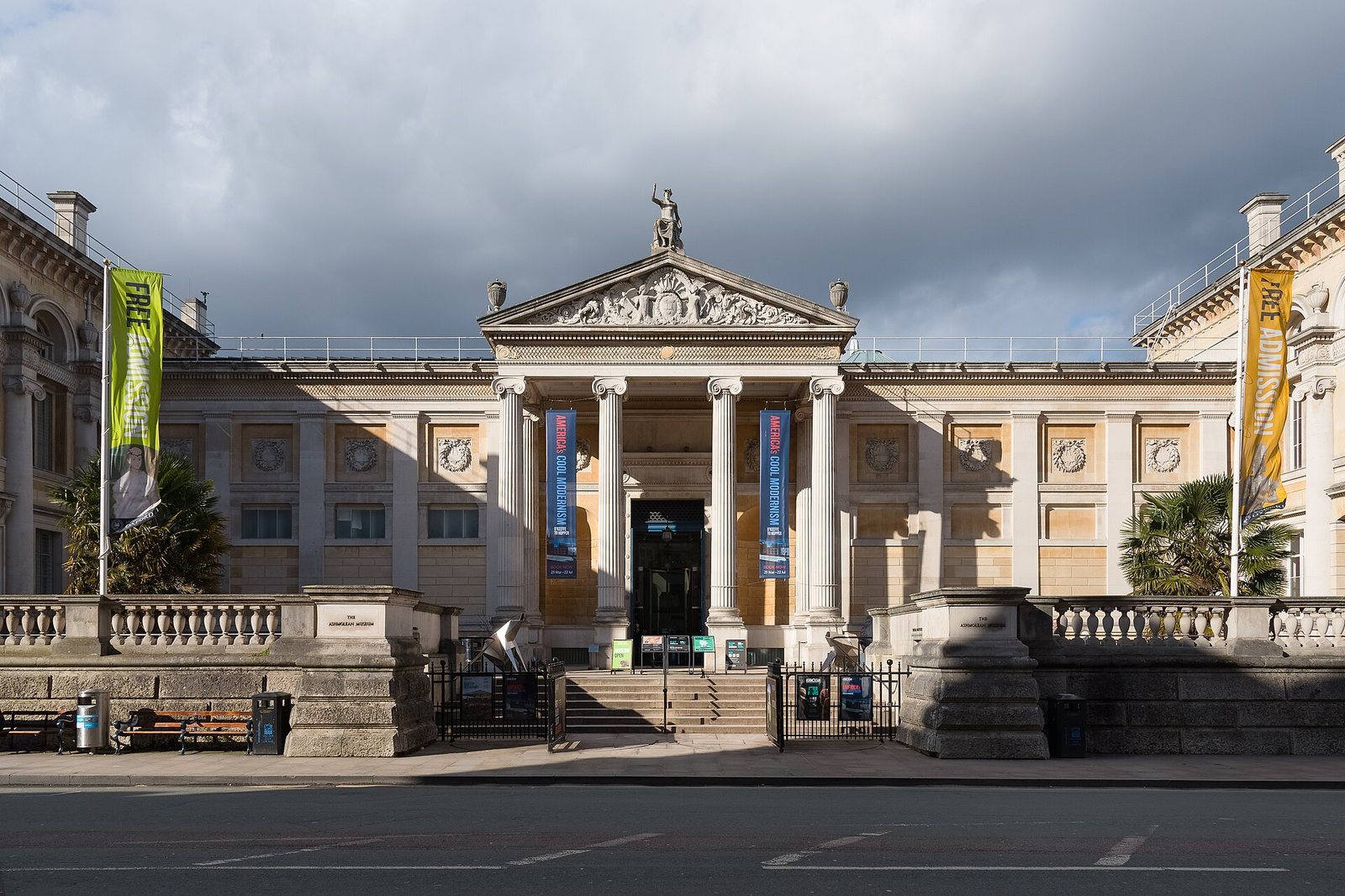
Charles Cockerell designed the Beaumont Street building for the University Galleries in a classical style. The 2006–2009 redevelopment expanded it from three floors to five, doubled the display area, and added conservation studios and an education centre. At the corner of Beaumont Street and St Giles’ Street, the wing occupied by the Taylor Institution uses the Ionic order, a Greek style of column design.
The Chinese Picture Gallery
Designed by van Heyningen and Haward Architects, the Chinese Picture Gallery was fitted into a lightwell, an internal shaft that brings daylight into a building, and partly integrated into the listed museum. Its roof was designed to support future construction. Apart from Cockerell’s original spaces, it was the only part of the museum retained in the 2006–2009 rebuilding. It houses Chinese paintings and is also used for loan exhibitions and contemporary Chinese art. It is the only British museum gallery devoted to Chinese paintings.
Archaeological collections
Egypt and the Near East
The Egyptian and Nubian holdings range from prehistoric Egypt and the Early Dynastic Period, an early phase of Egypt’s dynastic history, to later material. They include the Narmer and Scorpion maceheads, the Shrine of Taharqa, a sarcophagus with Anubis, and works depicting Amenhotep IV’s daughters Neferneferure and Neferneferuaten, dated to about 1360 BC. Nubia is the historical region along the Nile south of Egypt. The museum’s Near Eastern holdings include cuneiform tablets, written with wedge-shaped marks. Much of this collection came from the Oxford–Field Museum Expedition to Kish in Iraq between 1923 and 1933. Named examples include the Kish tablets and the Sumerian King List, an ancient text listing Sumerian rulers.
Mediterranean antiquities and inscriptions
Greek and Minoan pottery, from the Bronze Age civilization of Crete, forms part of the archaeological holdings, alongside Roman sculpture and a second-century AD statue of Apollo. The Parian Marble, an ancient Greek chronological inscription, survives in a lower portion; the Metrological Relief shows measurements used in ancient Greece. The museum also holds more than 30 late Roman gold-glass pieces from the Catacombs of Rome. Its Wilshere Collection of these objects is the third largest, after those of the Vatican and the British Museum.
Other objects include the Crondall hoard of Anglo-Saxon gold coins, discovered in 1828; a Mycenaean helmet and gold ring; and a hoard of Thracian objects from Dalboki in central Bulgaria. Scythian antiquities from Nymphaeum in Crimea and the Abingdon Sword, an Anglo-Saxon sword found south of Oxford, are also held here. The sole surviving Pococke Kition inscription was used by Jean-Jacques Barthélemy in deciphering Phoenician. Swedish runestones, stones bearing runic inscriptions, include U 104 and U 1160. King Charles XI of Sweden gave both to the English king in the late seventeenth century. They were shipped to Oxford in 1687 and later entered the Ashmolean.
Papyri and other historical objects
The museum holds a large group of Oxyrhynchus papyri, ancient documents written on papyrus and found in Egypt, including manuscripts of the Old and New Testaments. Other historical objects include the lantern carried by Guy Fawkes in 1605, a Celtic silver coin from the British Isles, and a bishop’s hooked staff associated with Richard Fox and dated to about 1500. The collection also includes a posie ring, engraved with a short motto, and ceremonial dress associated with T. E. Lawrence and a ceremonial cloak associated with Chief Powhatan.
Art and applied collections
Paintings, drawings, and decorative works
The art holdings include drawings by Michelangelo, Raphael, and Leonardo da Vinci, and paintings by artists such as Paolo Uccello, Titian, Anthony van Dyck, Peter Paul Rubens, Claude Lorrain, Samuel Palmer, John Singer Sargent, and Pablo Picasso. The collection includes Pre-Raphaelite works, associated with a nineteenth-century British artistic movement, and maiolica, a type of tin-glazed pottery. Other named works include Uccello’s Annunciation, attributed to him, Van Dyck’s Descent from the Cross, and sketches by Raphael. The 96 still-life paintings given in the Daisy Linda Ward bequest of 1939 include works by Clara Peeters, Adriaen Coorte, and Rachel Ruysch.
The Pissarro Family Archive, donated in the 1950s, contains paintings, prints, drawings, books, and letters by Camille Pissarro, Lucien Pissarro, Orovida Camille Pissarro, and other family members. The Great Bookcase, designed by William Burges, is an important example of Victorian painted furniture. Ju Ming’s Taichi Arch stands on the museum’s main forecourt.