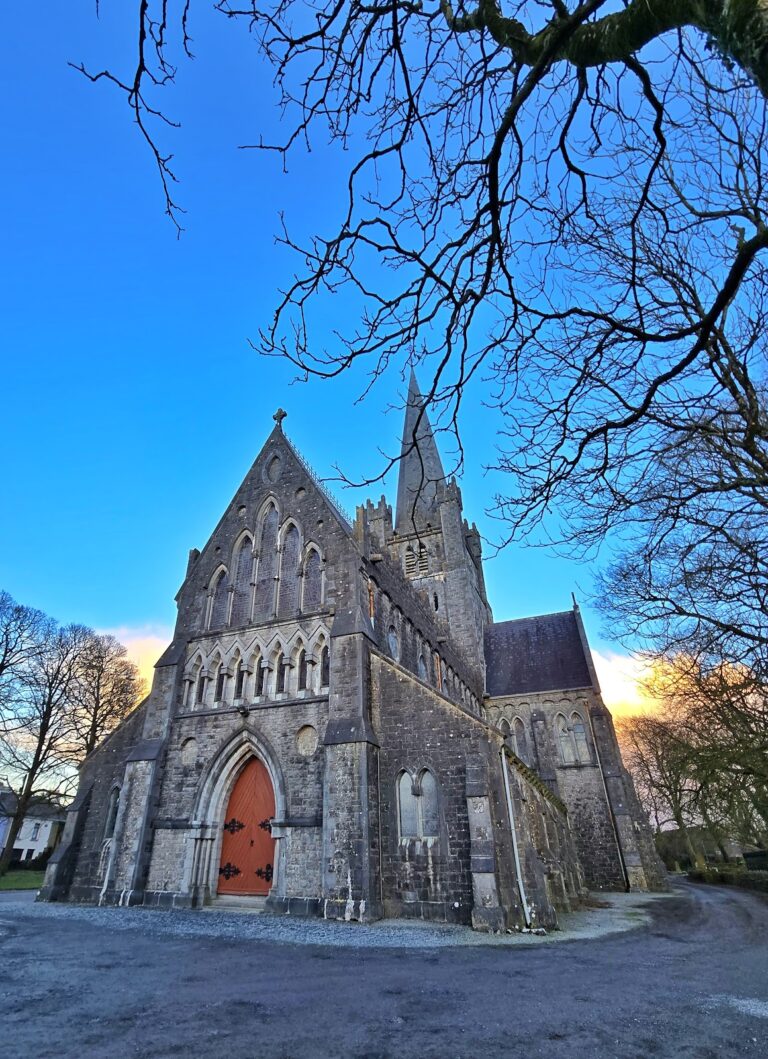
Ashford Castle, County Mayo: A Medieval and Victorian Estate Castle



Site at a Glance
- Rating
- 4.7
- Popularity
- Medium
- Country
- Ireland
- Primary era
- Modern
- External website
- Open
- Eras represented
- Medieval, Early Modern, Modern
- Civilizations
- British, English, Irish, Norman
- Site type
- Domestic
- Remains
- Castle
On this page10 sections
History
Ashford Castle, County Mayo, is a medieval and mainly Victorian castle in Ireland near Cong, at the border of County Mayo and County Galway. The castle stands on the County Galway side of Lough Corrib and was established in 1228 by the Anglo-Norman House of Burke beside the perimeter of a monastic site. Its long development brought together medieval defensive buildings, an eighteenth-century hunting lodge, and Victorian Gothic Revival additions.
The de Burgo stronghold
The de Burgo family, whose name later developed into Burke or Bourke, held Ashford for more than three and a half centuries. The family belonged to an Anglo-Norman aristocratic dynasty established in Ireland after the Norman expansion. During the late sixteenth century, the de Burgos became involved in a fierce conflict with the forces of Sir Richard Bingham, the English Lord President of Connaught, an office responsible for English administration in the province of Connacht.
After a truce, the castle passed to Bingham in 1589. He added a fortified enclave within the castle precincts, extending the site’s military character during a period of conflict and political change in western Ireland.
The Browne estate
Dominick Browne received the estate through a royal grant in either 1670 or 1678. In 1715, the Browne family formally established the Ashford estate and built a hunting lodge in the manner of a seventeenth-century French chateau. A branch of the family still lived at the castle in the late eighteenth century, and their agent Thomas Elwood was recorded as residing there in 1814.
The Guinness transformation
Sir Benjamin Guinness purchased the estate through the Encumbered Estates’ Court in 1852. This nineteenth-century court was created to facilitate the sale of heavily indebted Irish estates. Guinness enlarged the property to 26,000 acres, approximately 110 square kilometres, built new roads, planted thousands of trees, and added two large Victorian extensions.
After his death in 1868, the estate passed to his son Arthur Guinness, 1st Baron Ardilaun. Ardilaun expanded the castle in the Neo-Gothic style, a revival of medieval Gothic forms that commonly used features such as pointed arches and battlements. He developed extensive woodlands and supervised the rebuilding of the entire west wing. The work, designed by James Franklin Fuller and George Ashlin, joined the early-eighteenth-century eastern section to two western towers from the de Burgo period. Battlements were added throughout the castle.
Ardilaun also invested in the wider regional infrastructure connected with the estate. He subsidized steamboat services on the Upper Lough Corrib, particularly the Lady Eglinton service linking local villages with Galway City, helping to increase regional commerce. The Cong Canal, intended to connect Lough Mask and Lough Corrib, failed because it could not retain water. Ardilaun was widely regarded as an improving landlord during the late-nineteenth-century Land Wars, conflicts in Ireland involving tenant farmers, landlords, rents, and land ownership. In 1880, he took his title from Ardilaun Island, part of the Lough Corrib estate.
From private estate to hotel
The castle later passed to Ardilaun’s nephew Ernest Guinness. In 1939, Noel Huggard bought the property and opened it as a hotel. Huggard was an Irish hotelier, and under his ownership Ashford became associated with country pursuits including angling and shooting.
In 1951, the grounds of Ashford Castle and nearby Cong served as settings for much of The Quiet Man, directed by John Ford and starring John Wayne and Maureen O’Hara. The castle and surrounding estate provided part of the film’s backdrop, linking the property to one of the best-known cinematic representations of western Ireland.
John Mulcahy bought Ashford in 1970 and directed a major restoration and expansion. During the early 1970s, he added a new wing that doubled the building’s size, constructed a golf course, and developed the grounds and gardens. An Irish-American investment group, including Chuck Feeney and Tony O’Reilly, acquired the castle in 1985. The group sold it in 2007 for €50 million to Galway property investor Gerry Barrett and his family.
Bank of Scotland (Ireland) placed the property in receivership in November 2011. Receivership is a legal and financial arrangement in which an appointed receiver manages property or a business for creditors while operations may continue. The hotel remained open under the management of the Tifco Hotel Group, and the receiver and long-serving manager Niall Rochford reported that it remained profitable during this period. Staff accepted pay reductions of 20 to 30 percent to help preserve the operation.
The property was offered for sale in October 2012 at an estimated value of about €25 million. Red Carnation Hotels purchased it in May 2013 for €20 million. In January 2014, the new owners acquired neighbouring Lisloughrey Lodge with plans to incorporate it into the resort. A major refurbishment began in early 2014, and the castle reopened in April 2015 as part of its transition from receivership to luxury-hotel operation.
Ashford Castle is now operated as a five-star luxury hotel and belongs to The Leading Hotels of the World. It is a protected structure. Its history has also been shaped by public access issues. In September 2011, electric gates were installed and closed a centuries-old public right of way across a bridge near the castle. About 150 local residents and estate residents, local councillors, and Éamon Ó Cuív protested, and a related legal case concerning obstruction of the right of way was heard in December 2011.
Notable associations
Ashford has hosted members of royalty, political figures, entertainers, and other public figures, including the Prince of Wales, later King George V, and his wife, the future Queen Mary; John Lennon; George Harrison; Oscar Wilde; President Ronald Reagan; Prince Edward, Earl of Wessex; Senator Ted Kennedy; John Wayne; Maureen O’Hara; Robin Williams; Brad Pitt; Pierce Brosnan; and Prince Rainier III of Monaco with Grace Kelly. The golfer Rory McIlroy married Erica Stoll at the castle on 22 April 2017.
Remains
Ashford Castle combines medieval and Victorian fabric built largely in limestone. Its surviving layout brings together two western towers from the de Burgo period, the eastern section derived from the early-eighteenth-century hunting lodge, and the nineteenth-century west wing that connects these earlier elements. The wider historic estate includes roads, woodland, gardens, and a golf course developed during successive phases of estate improvement.
Medieval towers and eastern lodge
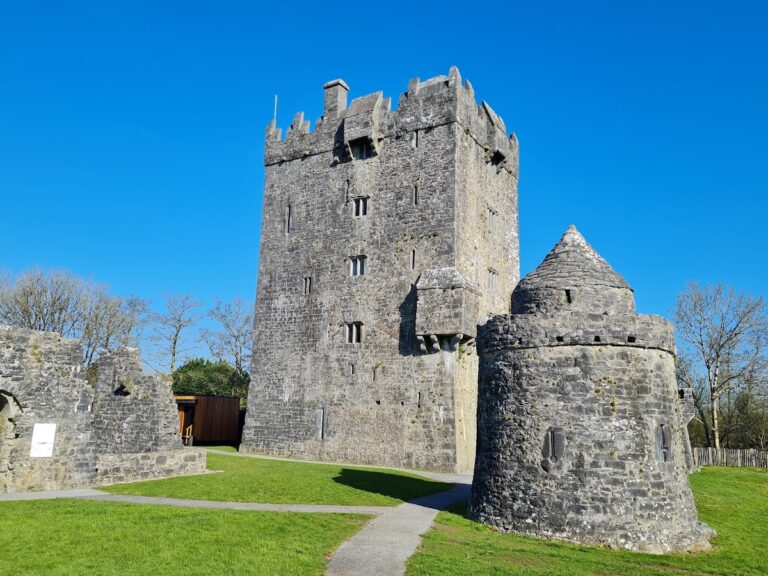
The two western towers are remnants of the castle associated with the de Burgo period. Their incorporation into the later building preserved the medieval core within the expanded Victorian composition. At the eastern end, the early-eighteenth-century hunting lodge survives as part of the castle. It was built in the manner of a seventeenth-century French chateau, reflecting the Browne family’s transformation of the property after they established the Ashford estate in 1715. Double-headed eagles remain visible on the roof as the Browne family coat of arms.
Victorian west wing
The west wing was rebuilt in the nineteenth century to designs by James Franklin Fuller and George Ashlin. The construction joined the eastern eighteenth-century section to the two medieval western towers, creating the combined medieval and Victorian building seen today. Battlements were added across the castle as part of the Neo-Gothic expansion, giving the later work historically inspired defensive detailing.
Estate landscape and later fabric
The castle’s physical setting was reshaped during the Guinness period and later improvements. Sir Benjamin Guinness expanded the estate to 26,000 acres, built roads, and planted thousands of trees. Lord Ardilaun continued the development of extensive woodlands, while the grounds and gardens were further developed during John Mulcahy’s ownership. Mulcahy also added a new wing in the early 1970s, doubling the building’s size, and constructed a golf course within the estate.
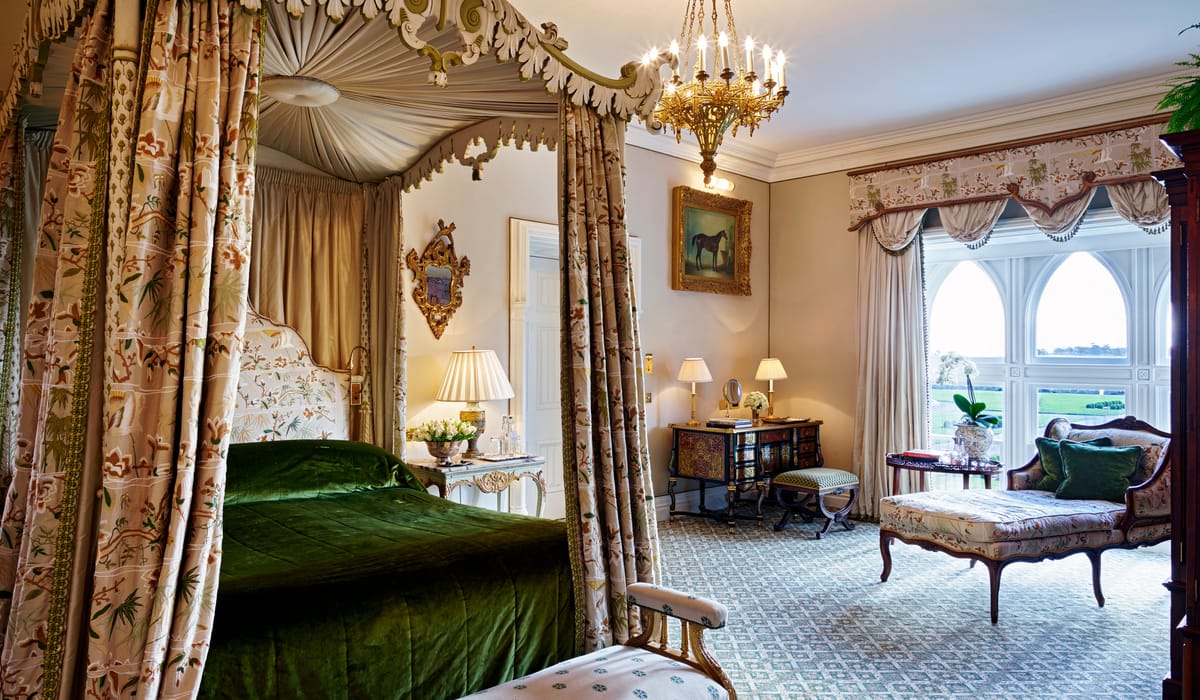
The 2014 to 2015 refurbishment renewed the castle’s fabric by replacing all 820 windows, installing a new lead roof, and repointing the stonework. Approximately €47 million was spent on the restoration. The castle now contains 83 bedrooms, including six suites. A proposal for 13 penthouse bedrooms and 30 lodges in the grounds was not completed.
The castle grounds and surrounding estate also retain their association with The Quiet Man. John Ford used them, together with nearby Cong, as filming locations in 1951, making the landscape part of the surviving cultural history associated with the property.