Asclepieion of Athens: An Ancient Greek Healing Sanctuary
Site at a Glance
- Popularity
- Medium
- Country
- Greece
- Primary era
- Classical
- Eras represented
- Classical, Medieval
- Civilizations
- Ancient Greek, Byzantine, Roman
- Site type
- Religious
- Remains
- Sanctuary
On this page17 sections
History
The Asclepieion of Athens was a Greek healing sanctuary on the southern slope of the Acropolis in Greece, founded in 420/419 BCE during the Peloponnesian War, the conflict between Athens and Sparta and their allies. Its foundation inscription names Telemachos Acharneas as the founder and records the establishment of the sanctuary and its altar. The foundation may have been prompted by the plague that struck Athens from 430 BCE and returned through 426 BCE.
Foundation and religious life
The cult of Asclepius, the Greek god of healing, came to Athens from Epidauros, an ancient Greek city with an important sanctuary dedicated to him. A sacred serpent associated with the god was summoned for the founding rites in response to an oracle, and Hygieia, a goddess of health, was also installed. The transfer took place during the Eleusinian Mysteries, religious rites held at Eleusis, and passed through the Eleusinion sanctuary in Athens. The Kerykes, a family with priestly duties at Eleusis, may have opposed establishing the new cult in this important part of the city.
Worshippers sought cures through incubation, a rite in which they slept in a sacred place hoping for healing or guidance in a dream. The Epidauria, a festival marking the sanctuary’s foundation, became a state festival and was part of Athens’ calendar by the mid-fourth century BCE. An Asklepieia festival was also added, held six months later on the day before the Dionysia, festivals honoring Dionysus. From the mid-fourth century BCE until the reign of Augustus, Rome’s first emperor, priests of Asclepius were chosen annually by lot in a cycle based on Athenian tribes. In the Roman period, priests instead held office for life.
Classical, Hellenistic, and Roman periods
The sanctuary remained active from the late fifth century BCE. It was expanded and updated in the late Classical period, broadly the fifth and fourth centuries BCE, and in the Hellenistic period, which followed Alexander the Great’s death in 323 BCE. Inscriptions and inventories describe its administration, treasury, furnishings, offerings, and arrangements for healing and accommodation.
During the Roman imperial period, the complex was reorganized and acquired monumental additions. Its healing role continued, as shown by anatomical offerings and dedications associated with the sanctuary.
Churches and later occupation
In the fifth or sixth century CE, a large, three-aisled church dedicated to the Holy Anargyroi occupied the sanctuary. The name refers to saints associated with healing without payment. The church reused the ancient temple and altar, much of the Doric colonnade, and a Roman-period colonnade. During the Byzantine period, the medieval eastern Roman Empire, two smaller churches successively occupied the basilica’s position, in the eleventh and thirteenth centuries. The later church served as the principal church of a small monastery. A church dedicated to St George the Alexandrian was built somewhat farther east in the eleventh or twelfth century and was later destroyed in modern times.
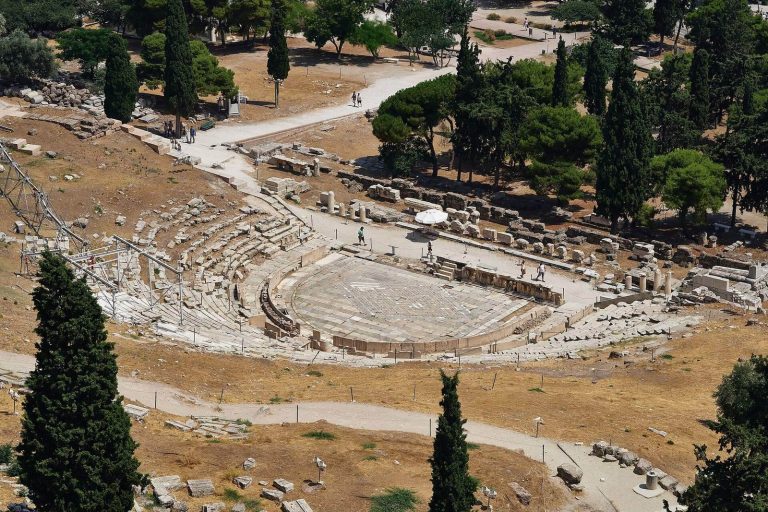
In the thirteenth century, the Rizocastro fortification was built at the foot of the Acropolis. Its section between the Odeon of Herodes Atticus and the Theatre of Dionysus, called the Serpentze bastion, remained in use during the first Ottoman period, from 1456 to 1687. The Haseki Wall enclosed the entire southern slope in 1778, by which time substantial earth deposits already covered its monuments. A small settlement remained in the southeastern part of the area until it was expropriated and demolished in the 1960s to enable archaeological clearance.
Excavation and conservation
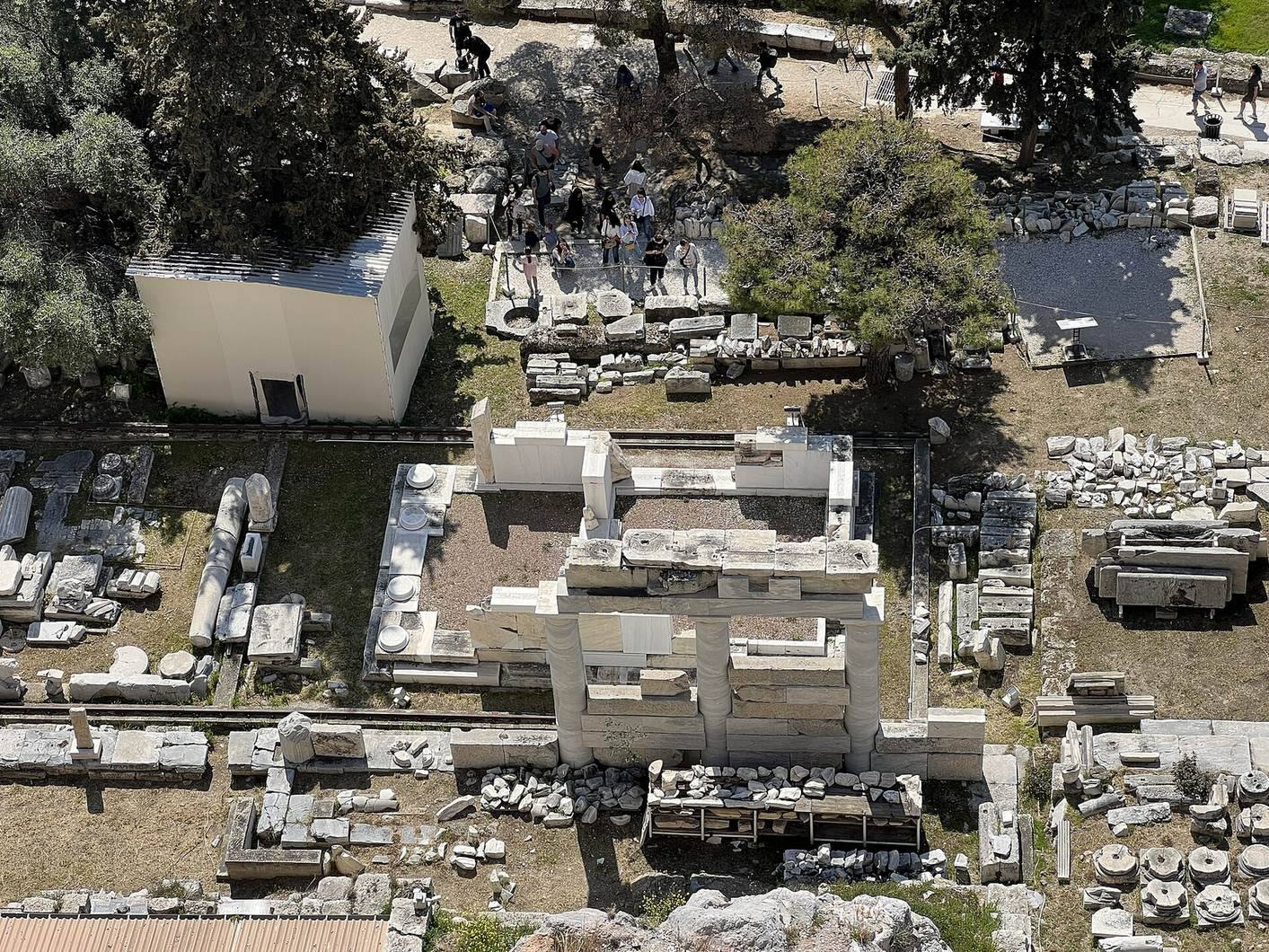
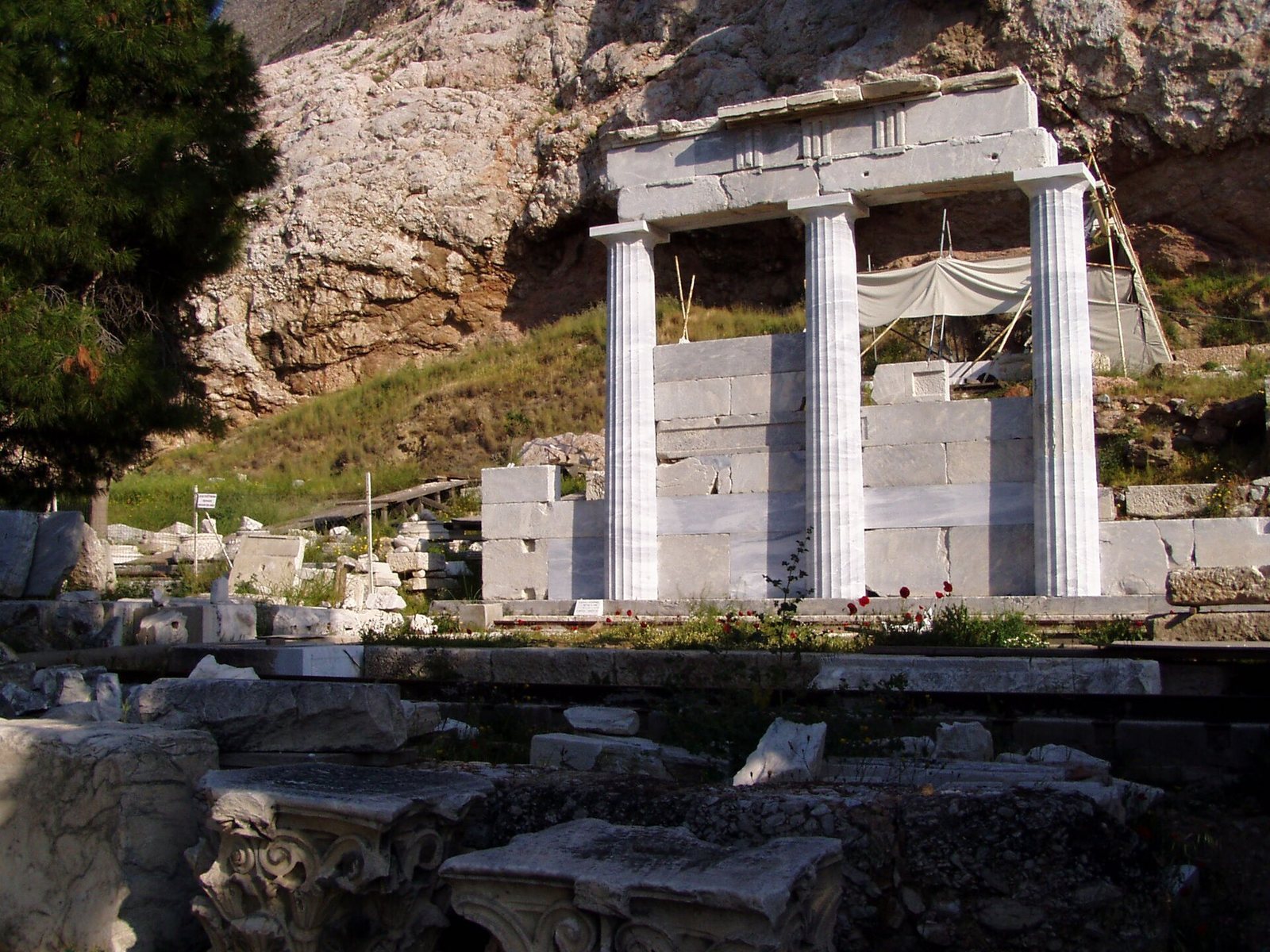
The Athens Archaeological Society investigated the southern slope in 1848–1858 and again in 1862–1867. The Asclepieion’s remains were extensively exposed in 1876–1879, alongside the Stoa of Eumenes. Work to consolidate the slopes and monuments took place from 1980 to 1993. The Doric stoa and offering pit were partly reassembled from surviving pieces in 2002–2005, and partial reassembly of the temple began in 2011. The Asclepieion is included in the Acropolis of Athens UNESCO World Heritage property, inscribed in 1987.
Remains
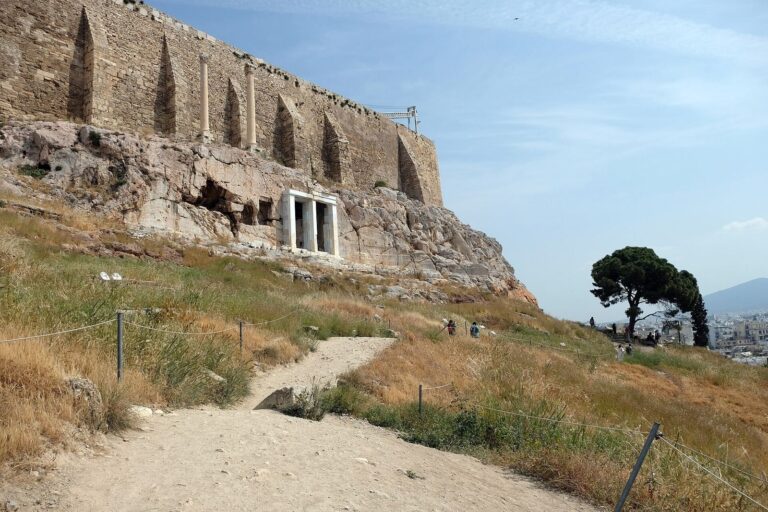
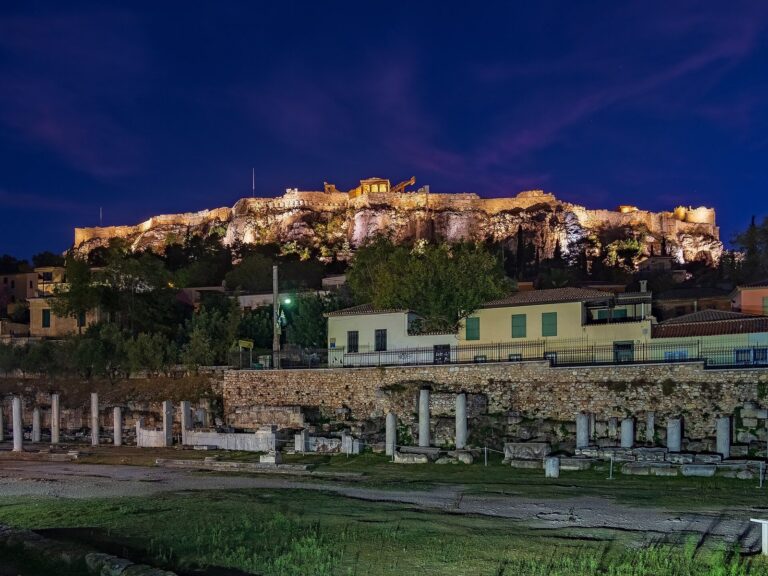
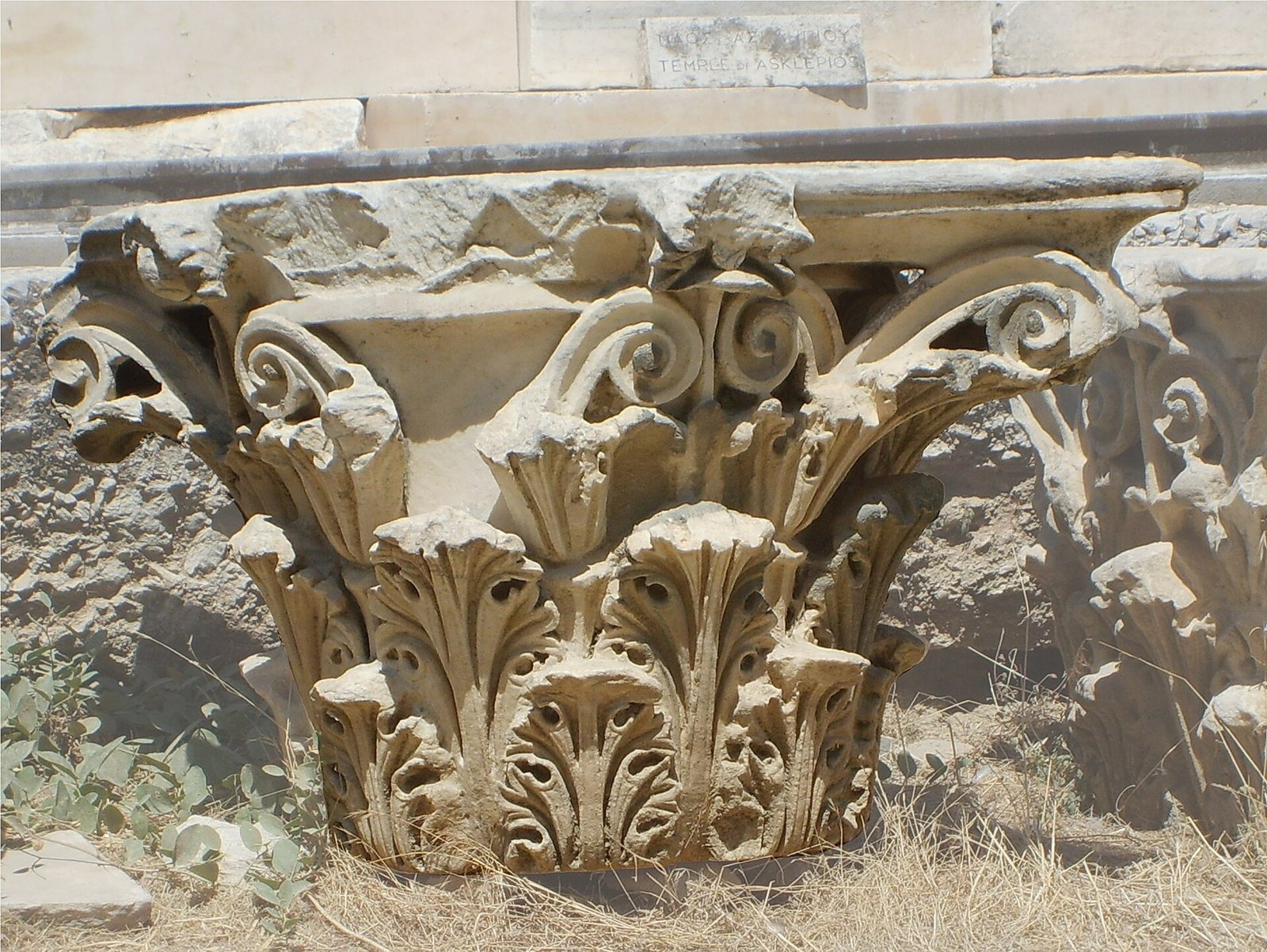
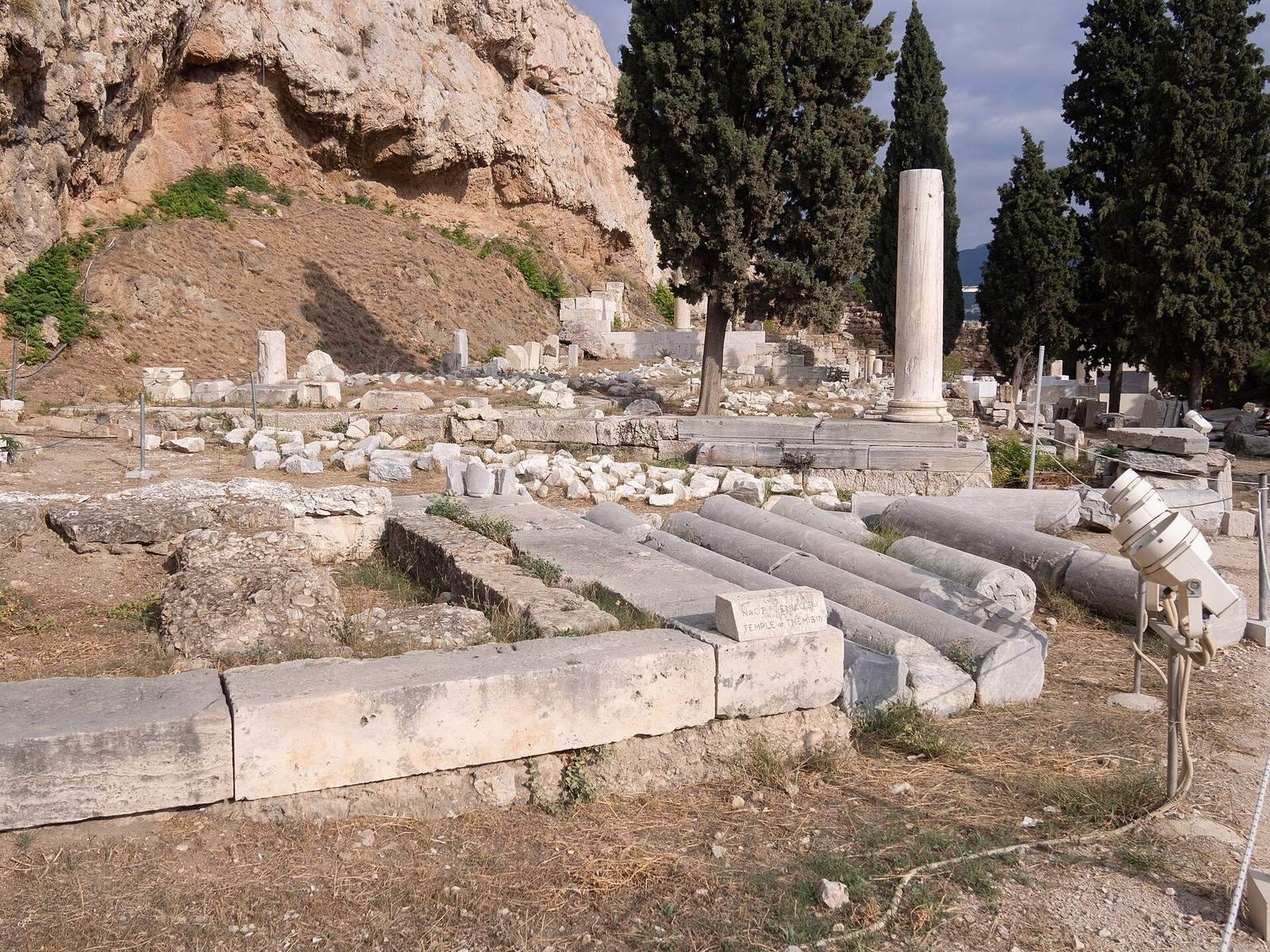
The sanctuary occupied terraces against the Acropolis’s southern rock face, between the Theatre of Dionysus to the east and the Pelargikon, an ancient defensive wall, to the west. It lay beside the route rising from the theatre toward the Acropolis gateway, the Propylaea. Surviving features include foundations of the temple and two roofed colonnades, sections of the enclosure, a spring cut into the rock, and a ritual offering pit.
Enclosure
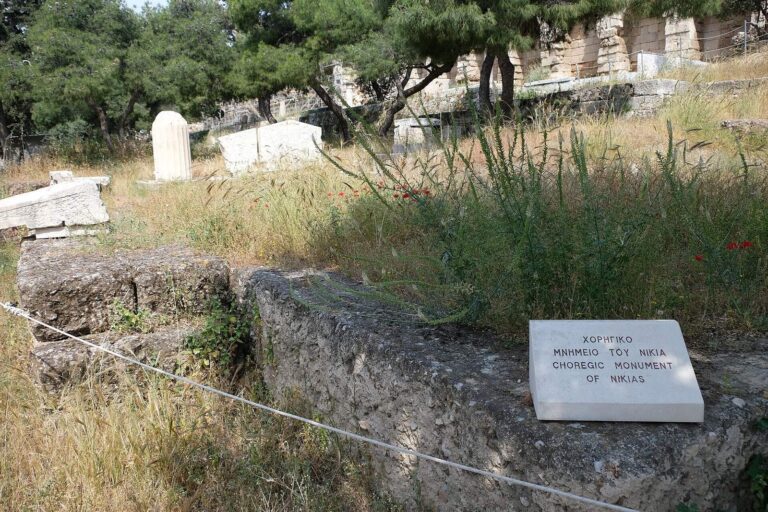
The enclosure wall surrounded the temple and altar. At its southeastern corner, upright wall stones from the Archaic-Classical period survive. They are 64 cm high, 90 cm to 1.12 m long, and 29 cm thick at the base, narrowing to 22 cm at the top. Their outer faces bear 15 vertical grooves, each 3 cm high and spaced 2 cm apart; the same treatment appears on more than 20 blocks found in the sanctuary. The surviving south and east sides measure 6.19 m and 4.66 m. Rock cuts indicate that the eastern wall originally extended 13.72 m. An opening, 85 cm wide, was added on the south side in Late Antiquity, the transition from the later Roman world to the early medieval period. The stones’ upper surfaces are 107.14 m above sea level, consistent with the ancient sanctuary floor; the Peripatos, a path around the Acropolis, ran about 80 cm lower outside the eastern wall.
Temple and altar
The small temple held a cult statue, and its façade faced the route toward the Propylaea. A temple dedicated to Asclepius and Hygieia is dated to the first century BCE. The second-century CE writer Pausanias described statues of Asclepius and his children there. An eastward extension is attributed to the third century CE. Foundations of an east-facing temple and a structure thought to be an altar survive at the site.
Colonnades
Northern Doric stoa
The northern stoa, a roofed colonnade, was a two-storey building about 50 m long. Its façade had 17 Doric columns, a Greek style with relatively plain column forms, while six columns stood inside. An inscription dates the building to 300/299 BCE. Its columns, made of Hymettian marble from Attica, stood about 2.80 m high to the capitals. The architrave, the horizontal structure above the columns, used two blocks in each space between columns. The building provided accommodation and a place for incubation, with additional room for visitors on the upper floor.
Western stoa
The second stoa stood west of the temple and dates to the last quarter of the fifth century BCE. It contained four rooms and had ten Ionic columns, a Greek style distinguished by scroll-shaped capitals. It served as a dining hall and as lodging for priests and visitors.
Spring and offering pit
Sacred spring
At the eastern end of the Doric stoa, a small cave in the rock held a natural spring used in purification and healing practices. Masonry structures incorporated the cave, which remains recognizable beside the stoa.
Bothros
At the western end of the Doric stoa, a circular well or pit occupied a square room built into the cliff with polygonal masonry. The feature, also called a bothros, was an offering pit for votive and organic deposits, and could be reached from the stoa’s second floor. Its date remains uncertain, with proposed dates in the late fifth century BCE or around 300 BCE. A cover rested on four columns set 3.40 m apart from center to center; the pit’s internal diameter was 2.85 m.
Entrance and dedications
Western entrance
A monumental entrance on the sanctuary’s western side connected it to the roadway to the south. It was renovated during the Roman period.
Reliefs and offerings
The foundation monument of Telemachos was a marble pillar carved on both sides, with reliefs showing Asclepius arriving from Epidauros and being received by Telemachos. Its inscription concerns the sanctuary’s founding. The pillar is now in the Acropolis Museum. Other finds there include the Relief of the Doctors, depicting scenes related to healing, and a votive relief of Asclepius and Hygieia. Numerous figurative and anatomical offerings also came from the sanctuary. They include an eye dedicated by Praxias around 350–300 BCE, as well as offerings shaped as an eye, breast, ear, and leg.