Church of the Life-Giving Trinity, Mikshino: An Orthodox Church Complex in Russia
Site at a Glance
- Popularity
- Very Low
- Country
- Russia
- Primary era
- Modern
- Eras represented
- Modern
- Civilizations
- Russian
- Site type
- Religious
- Remains
- Church
On this page8 sections
History
The Church of the Life-Giving Trinity, Mikshino, is an Orthodox church in Russia whose stone building dates to 1845 and follows the classical style. Its dedication refers to the Christian belief in one God as Father, Son, and Holy Spirit. The church belongs to a complex that developed around Mikshino’s role as a local settlement and parish center.
Landholding and early records
Members of the Chertovsky service class, whose land was held in return for military or administrative duties, owned Mikshino as an estate during the first half of the fifteenth century. In the pre-Muscovite period, it belonged to Mikhail Semyonovich Berdenev, a boyar, or high-ranking noble, aligned with the pro-Moscow faction among Novgorod’s boyars. After 1481, the grand prince of Moscow, the principality’s ruler before the tsarist era, confiscated the village.
Mikshino first appears in a 1545 land register for the Tver half of the Bezhetskaya Pyatina, an administrative district used for land records. The register treated Mikshino and Selishche as names for the same settlement and listed the village under two sons of a Chertovsky landholder. It also noted a wooden church dedicated to Joachim and Anne, who are traditionally regarded as the parents of Mary, and described Mikshino as the center of a local settlement within the Nikolsky Stuchevsky church district.
Karelian settlement and church building
In the second half of the seventeenth century, the Nikolsky Stuchevsky district became part of the ruler’s palace lands, territories held directly by the ruler. Karelians, a Finnic people associated with Karelia and neighboring regions, settled there after migrating from lands transferred to Sweden following the Time of Troubles, a period of political upheaval in Russia in the late sixteenth and early seventeenth centuries. A census in 1668–69 counted 32 populated places, 101 households, and 267 male residents in the district; it also listed 40 wastelands leased to Karelians.
In 1768, a wooden Trinity Church was moved to Mikshino from Znamenskoye in Novotorzhsky district. After it fell into disrepair, the stone church was built in 1845. A second stone church, dedicated to the Presentation of the Lord, a Christian feast commemorating Jesus being presented at the Jerusalem Temple, had been built by 1871.
During the nineteenth century, Mikshino was among the larger settlements in the Tver Karelian area, with about 400 to 600 residents. Its parish comprised ten villages and 270 households, with 1,046 men and 1,108 women, all Karelians. In 1881, a fence, gates, and guardhouse were added around the church grounds. The bell tower’s third tier was rebuilt in 1894.
Closure and later restoration
Both churches closed in 1938. Restoration of the Presentation Church began in 2007. The Trinity Church remains inactive.
Remains
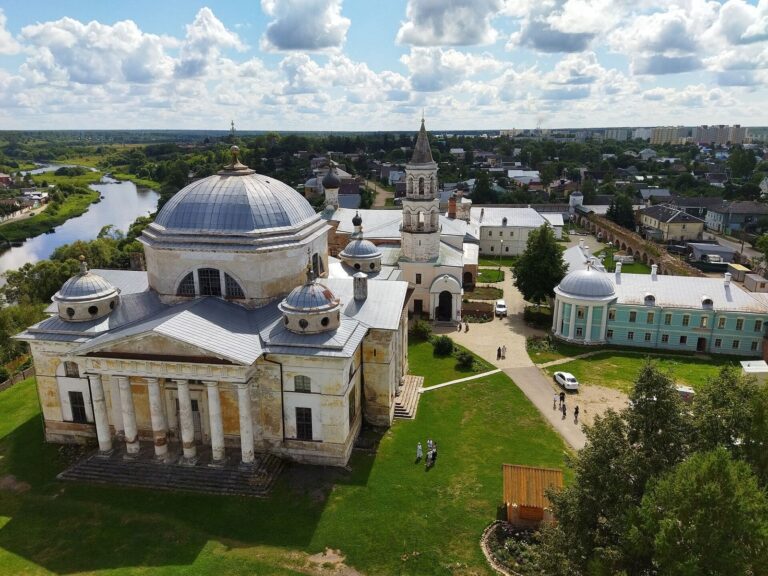
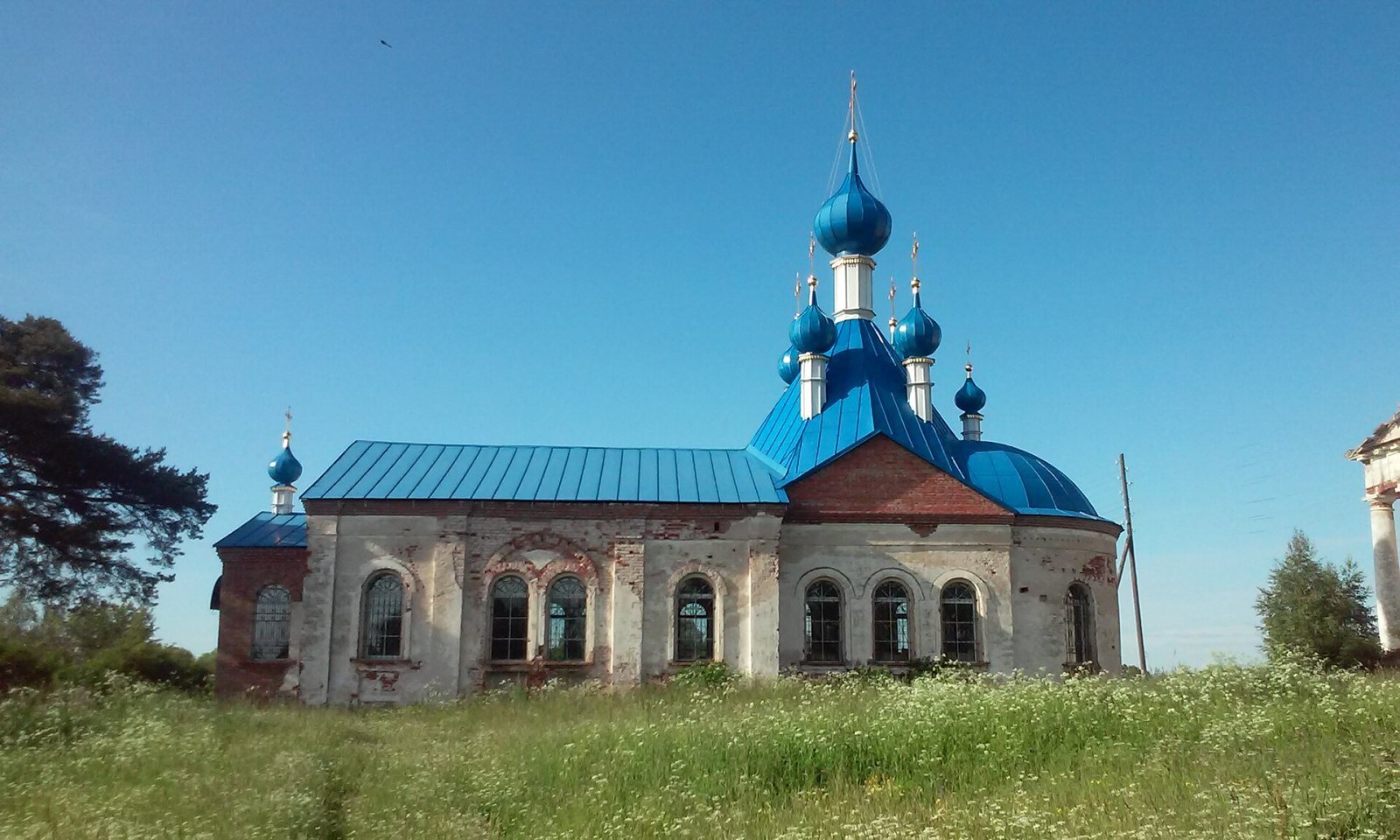
The complex comprises the Trinity Church, the Presentation Church, and surviving sections of the churchyard enclosure. The buildings represent classical and neoclassical design.
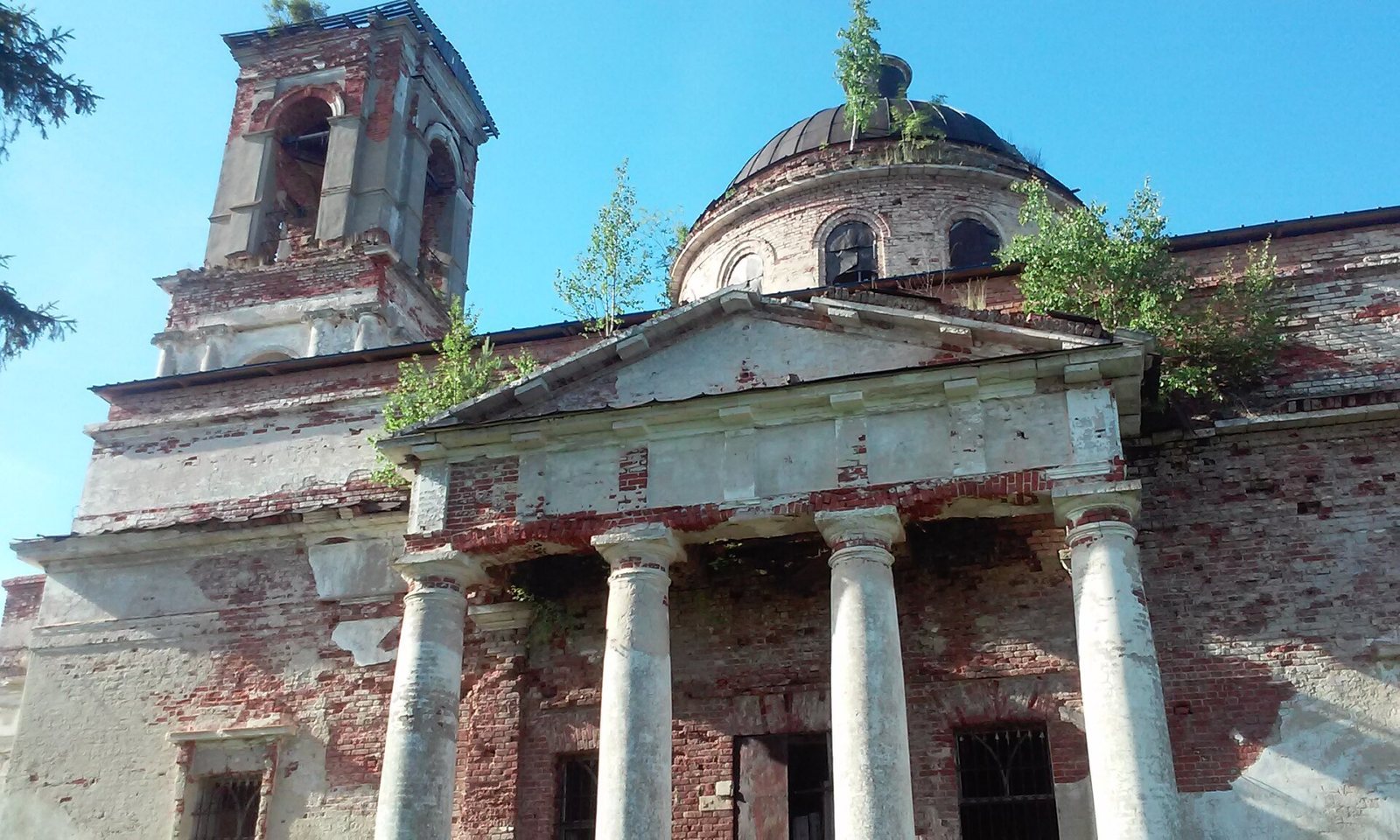
Trinity Church
The church’s main structure rises from a square-plan lower block into a rotunda, a circular upper space. Roofed porticoes supported by columns extend from three sides. Inside are side chapels, smaller places of worship, dedicated to Joachim and Anne and to Cosmas and Damian, early Christian saints traditionally associated with healing. Remnants of frescoes, paintings made on plaster, and cast-iron window grilles survive. The building is in poor condition, with a substantially damaged roof and a bell tower that has lost its upper section.
Presentation Church
The Presentation Church follows the neoclassical style. Repairs during the 2000s reconstructed its lost roof and vaulted ceilings.
Churchyard enclosure
Sections of the churchyard enclosure and its gates survive as part of the complex.