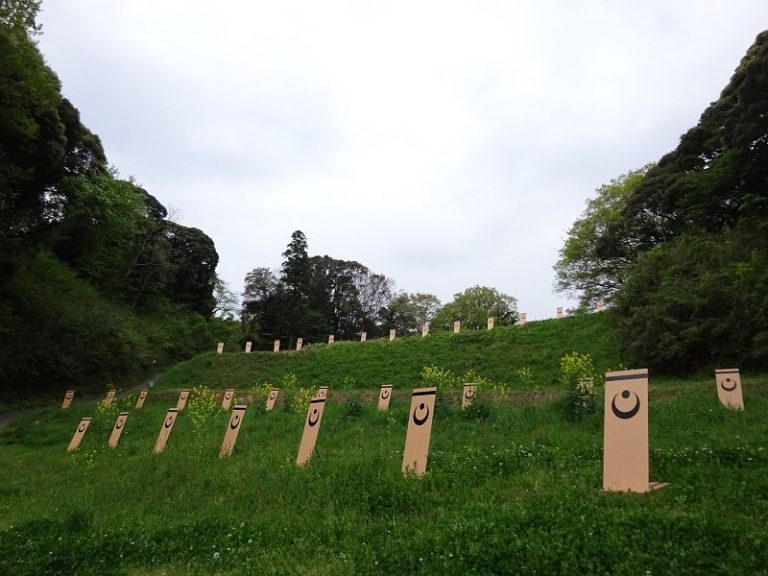
Asamayama kofun: A Keyhole-Shaped Burial Mound in Japan
Site at a Glance
- Popularity
- Medium
- Country
- Japan
- Primary era
- Medieval
- Eras represented
- Medieval
- Civilizations
- Yamato
- Site type
- Burial
- Remains
- Burial Mound
On this page13 sections
History
Asamayama kofun is a keyhole-shaped burial mound in Japan, commonly dated to the late sixth or early seventh century, although some interpretations place it in the second quarter of the seventh. A keyhole-shaped tomb has a rounded rear section and a rectangular front, a form used in Japan from the third through seventh centuries. The tomb’s date matters to the chronology of this form, since a later date would place its construction near the end of the tradition.
Formation of the cemetery group
Construction in the cemetery group began in the second quarter of the sixth century, and 114 tombs have been identified there. Asamayama kofun was the group’s largest keyhole-shaped tomb and is understood as its principal burial, alongside tombs associated with other local leaders. The group’s builders are thought to have been the chiefs of Inba. The person buried at Asamayama may have belonged to their ruling lineage.
Before the late sixth century, leaders connected with a tomb group to the south appear to have held regional primacy. From the late sixth century, authority is thought to have shifted toward the chiefs associated with Asamayama and the cemetery group. Later large square tombs, including Iwaya, followed Asamayama in the group’s sequence.
Regional authority and connections
The tomb’s location and burial furnishings have been interpreted as signs of the buried leader’s growing influence and ties to the Yamato court, the early Japanese central ruling power, or to powerful families in central Japan. The local chiefs are thought to have strengthened their position by controlling movement along the Katori Sea, a route from Shimosa toward Hitachi and the northeast.
A Buddhist temple was founded north of the tomb in the middle to late seventh century, and the chiefs associated with the cemetery group are thought to have arranged its construction. Buildings were also constructed at the Katori and Kashima shrines around this time. These developments have been interpreted as indications that the Yamato court valued routes across the Katori Sea toward Hitachi and the northeast.
The nearby Ohata archaeological complex may have been the administrative headquarters of Hanyu district. Its proximity to the tomb group has been taken to suggest that the local ruling lineage retained influence as district officials after the introduction of the ritsuryo system, a government organized through administrative and penal codes.
Later disturbance and modern investigation
The tomb was robbed during the Heian period (794–1185). Surveys by the Chiba Prefectural Board of Education’s Cultural Affairs Division in 1979–81 measured the surviving mound and helped establish its regional scale. Further survey work followed in 1994, with an internal radar survey in January 1995. Excavations of the mound and moat took place from July to September 1996, and the burial facilities were investigated from September 1996 to February 1997. The work clarified the tomb’s late place in the cemetery group’s sequence and revealed unusual arrangements of burial objects.
Iwaya tomb received national historic-site designation in 1941. In 2009, the protected area was expanded to include Asamayama kofun and neighboring tombs, and the designation was renamed to encompass the cemetery group and Iwaya.
Remains
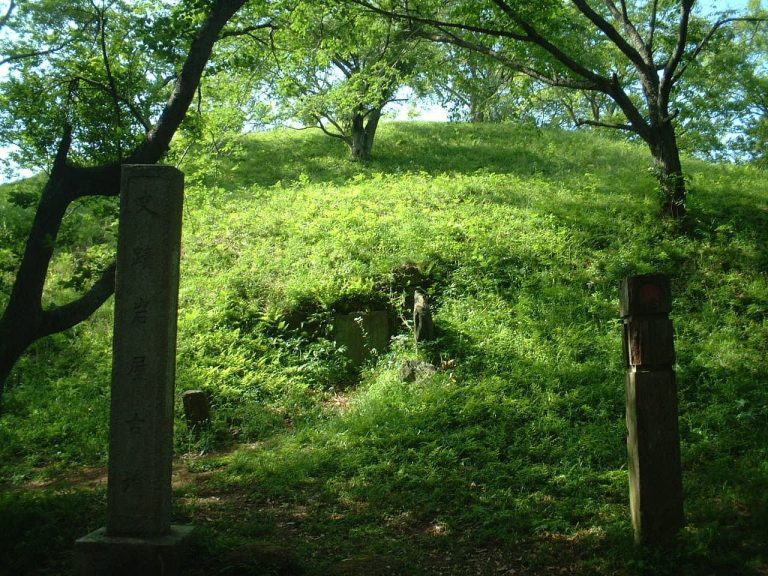
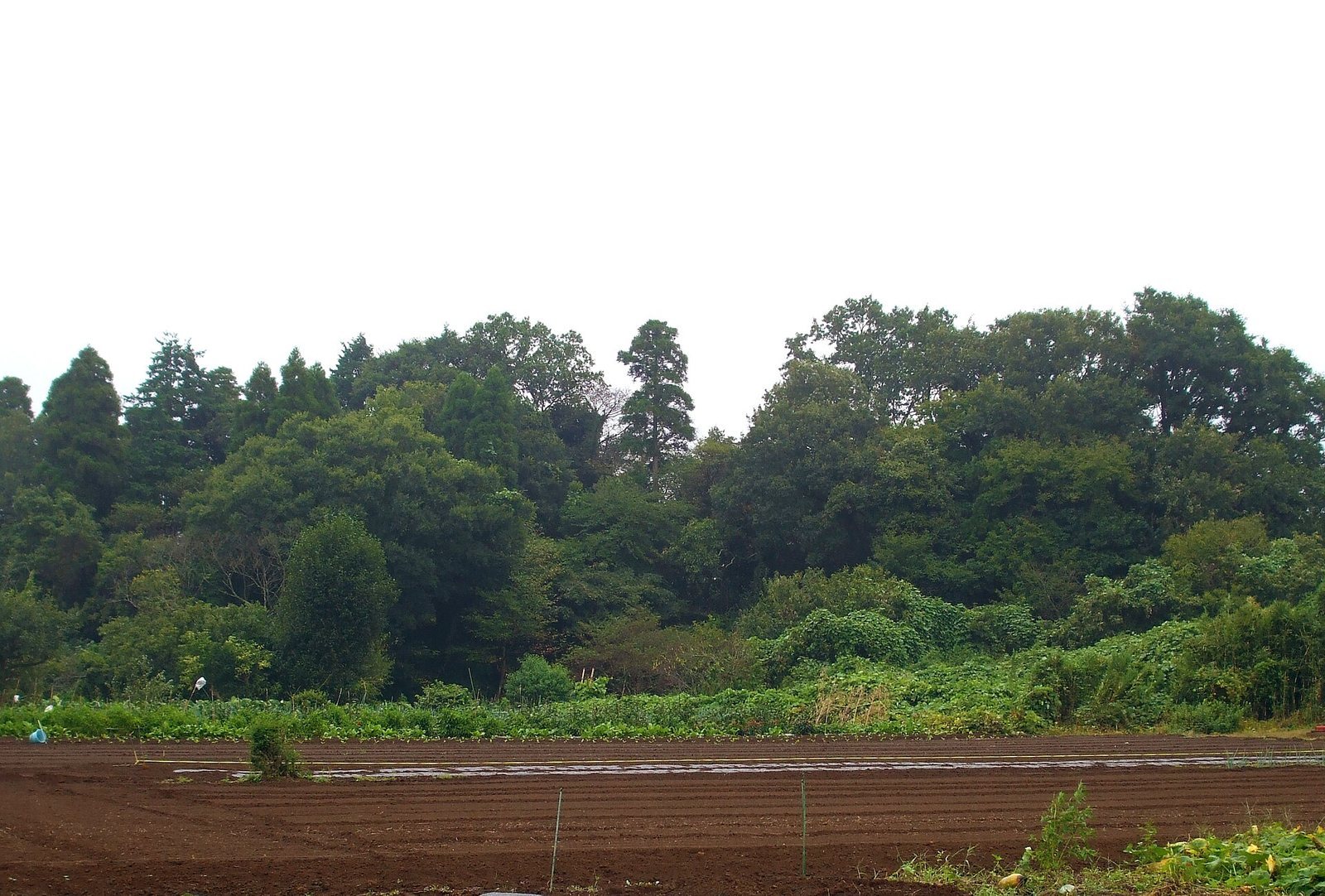
The tomb stands at the head of a valley on the eastern side of a rise on the Shimosa Plateau, east of Lake Inba. At the time of its construction, a stream began in this area and flowed toward the Katori Sea. The mound’s rounded rear and short rectangular front were built in three tiers, with a corridor-style stone burial chamber opening on the south side of the rear section.
Mound and moat
The mound’s original length is estimated at about 78 metres; a 1979–81 survey measured the surviving mound at 66 metres. Including the surrounding moat, the tomb extends about 93 metres. Its first and second tiers were low, while the third rose higher. The original height is estimated at about 7 metres at the front and 6.7 metres at the rear. The moat was approximately 7–8 metres wide and 1.3 metres deep. It may not have continued around the northwest side, where the plateau rises; the mound’s base there is thought to have been levelled.
Shrines and farming have altered the mound. A shrine on the north side of the rear section removed part of it, while cultivation cut into much of the rear section’s west side, the adjoining front section, and parts of the front end and east sides. Another shrine occupies the rear summit, where about 1.4 metres of earth was added. As a result, the rear section now appears higher than the front.
Burial chamber and forecourt
Stone chamber
The chamber measures 6.68 metres long, up to 2.34 metres wide, and up to 2.01 metres high. Stone partitions divide it into a passage, a front chamber, and a rear chamber. Its walls were built from schist slabs, including large blocks. The stone is thought to have come from around Mount Tsukuba, possibly transported by water across the Katori Sea. Slabs paved the front chamber apart from its entrance, where smaller stones were used; the rear chamber also had a slab floor. White clay covered the passage and both chambers. A coffin made from the same type of schist stands in the rear chamber, and white clay was applied inside it.
Forecourt
The area in front of the chamber was levelled using rammed earth, soil compacted in successive layers. Its construction alternated soil containing stone fragments and clay with loam. Layers of black and yellow clay-rich earth were also compacted along both sides of the forecourt, and may have continued beside the chamber. Three postholes were dug after the ground had been levelled; they may have held posts used during funerary rites.
A pit west of the forecourt measured about 6 by 5 metres and was more than 3 metres deep. It predates construction of the chamber and is thought more likely to have been part of the levelling work than a ground-purification rite, though the latter interpretation has also been proposed.
Burial deposits and objects
Forecourt deposits
Two main deposits were found in the forecourt. The upper layer contained fragments of iron horse gear and swords, probably moved out of the chamber during the Heian-period robbery. A lamp dish from the middle Heian period lay in the upper fill of the passage near a cluster of fragments, possibly where robbers sorted objects they had taken.
The lower deposit held many iron armour plates, gilt-bronze horse gear, silver fittings, earrings, iron horse equipment, and arrowheads. Almost all the tomb’s principal finds apart from the crowns came from this area. The objects may have been transferred from the chamber soon after the burial, or they may have been placed in the forecourt as part of the original burial. Sue ware, high-fired pottery made in the Tokai region, was also found in the forecourt and is dated to the middle to late seventh century. It is thought to have been placed where it was recovered. Only a small number of objects came from the lower passage fill.
Front chamber
Finds from the front chamber lay mainly on or just above its floor slabs. They included gilt-bronze and iron horse gear, openwork fittings, iron armour plates, nails, and traces of lacquer. Some gilt-bronze horse gear toward the rear may have stayed in its original position, while other objects appear to have been moved soon after burial. Stone fragments in the lower fill suggest that parts of the chamber were deliberately packed with earth. The lacquer traces indicate that a lacquered wooden coffin may have stood here; the lacquer was applied directly to the wood and appears to have been insufficiently refined. Such coffins are uncommon in the Kanto region, where the only other regional example noted is at a tomb in Gyoda, Saitama.
Rear chamber
Earth fill in the rear chamber is thought largely to have been introduced after the stone coffin was installed. Finds were concentrated in two layers. The upper layer contained a sword and gilt-bronze sword fittings. The lower layer held a gold-decorated ornamental bow, earrings, a gilt-bronze crown ornament, and a silver crown.
The excavated objects also include gilt-bronze and silver openwork fittings, swords, gilt-bronze and iron horse gear, lamellar armour made from joined metal plates, an axe, a small knife, iron arrowheads, Haji ware pottery, iron nails, and lacquer remains. The crown ornament, silver crown, and gilt-bronze horse gear are considered products of the first half of the seventh century. The openwork fittings, which show Buddhist artistic influence, and the arrowheads are also dated to that half of the century. The sword and armour are among the few finds assigned to the early seventh century, while the Sue ware from the forecourt provides the latest dated group of objects, from the middle to late seventh century.