Arnstein Castle: A Frontier Fortress and Later Manor in Germany
Site at a Glance
- Popularity
- Medium
- Country
- Germany
- Primary era
- Medieval
- Eras represented
- Medieval, Early Modern, Modern
- Civilizations
- Holy Roman Empire
- Site type
- Domestic
- Remains
- Castle
On this page7 sections
History
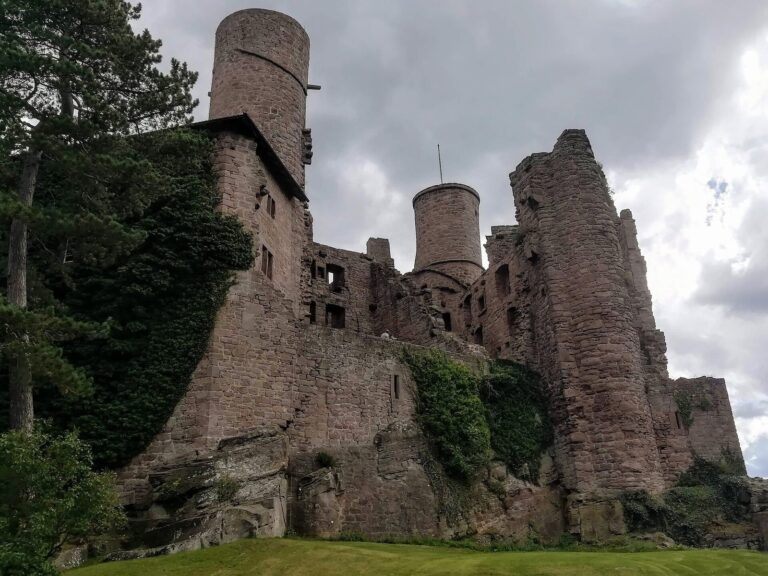
Arnstein Castle stands on a narrow ridge near Eichenberg in Germany and probably began in the 12th century as a frontier stronghold against Brunswick and the Mainz-controlled Eichsfeld. Arnold von Berlepsch is associated with its construction in 1149 and is thought to have given the castle its name. Arnstein may also have been one of eight fortified places along the lower Werra mentioned by the Thuringian chronicler Johannes Rothe.
Frontier castle and territorial transfer
At the end of the Thuringian-Hessian War of Succession, a conflict over territorial inheritance, Henry the Illustrious, ruler of Thuringia from the Wettin dynasty, transferred the eight places to Henry I of Hesse in 1264. The agreement with Sophie of Brabant, who was advancing her son’s claim to Hesse, required Henry I to give up further inheritance claims in Thuringia.
Pledges and changing holders
The castle was repeatedly pledged, giving its holders control of the property or its revenues as security for a debt. In 1337 the Lords of Rusteberg held Arnstein in this way and carried out robberies from the castle. Their actions provoked the Archbishop of Mainz, Henry III of Virneburg, and the ruler of Hesse. The two joined forces in 1342, expelled the Rustebergs, and installed the Lords of Berlepsch in their place.
In 1366 the Hessian ruler gave the Berlepsch family priority in receiving pledge funds for further building at Arnstein. Pledgeholders named in 1371 included Arnold and Hans von Berlepsch, Odomar von Bodenhausen and his wife Mechthild von Rusteberg, and the brothers Thilo and Heinrich von Rusteberg. Arnstein was destroyed in 1396 and rebuilt. From 1434 it was a Hessian fief, or land held from a superior lord, under the Lords of Bodenhausen. They succeeded the Rustebergs through marriage and inheritance after the family’s male line ended in the 1430s. The Bodenhausen family held the estate until its bankruptcy in 1938.
Manor, destruction, and rebuilding
Around 1600, the castle was demolished and replaced by a three-storey manor house built to resemble a castle. Troops under Tilly devastated it in 1623 during the Thirty Years’ War (1618–1648), a major European conflict. By about 1750 the building was badly dilapidated. French occupation and Prussian artillery fire brought its complete destruction in 1760, during the Seven Years’ War (1756–1763), another major European conflict. At the beginning of the 19th century, rebuilding transformed the deteriorated buildings and massive late-medieval structure into a two-storey castle.
Remains
Castle and ridge
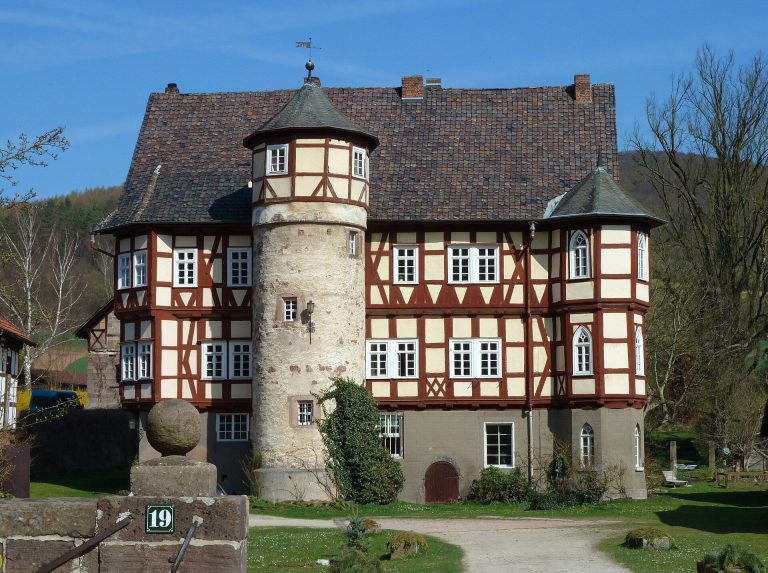
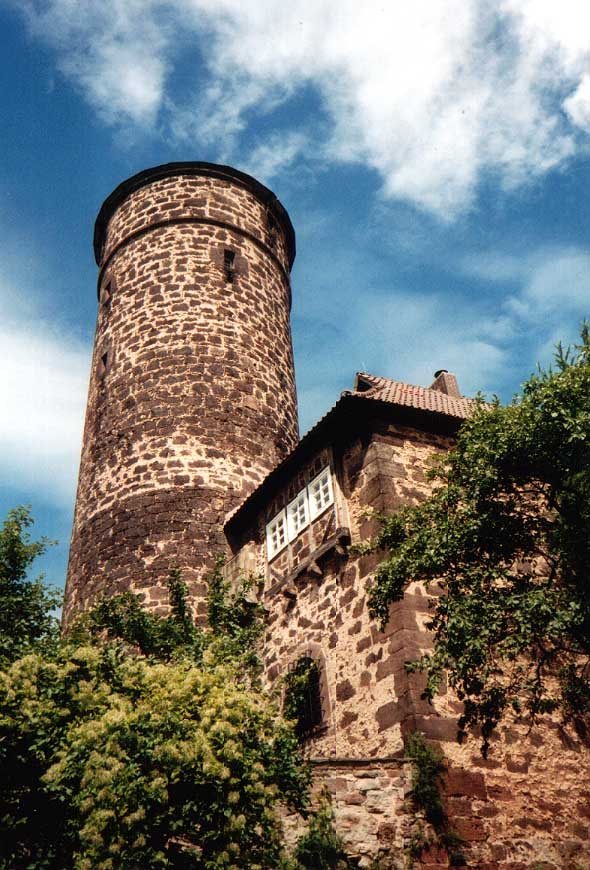
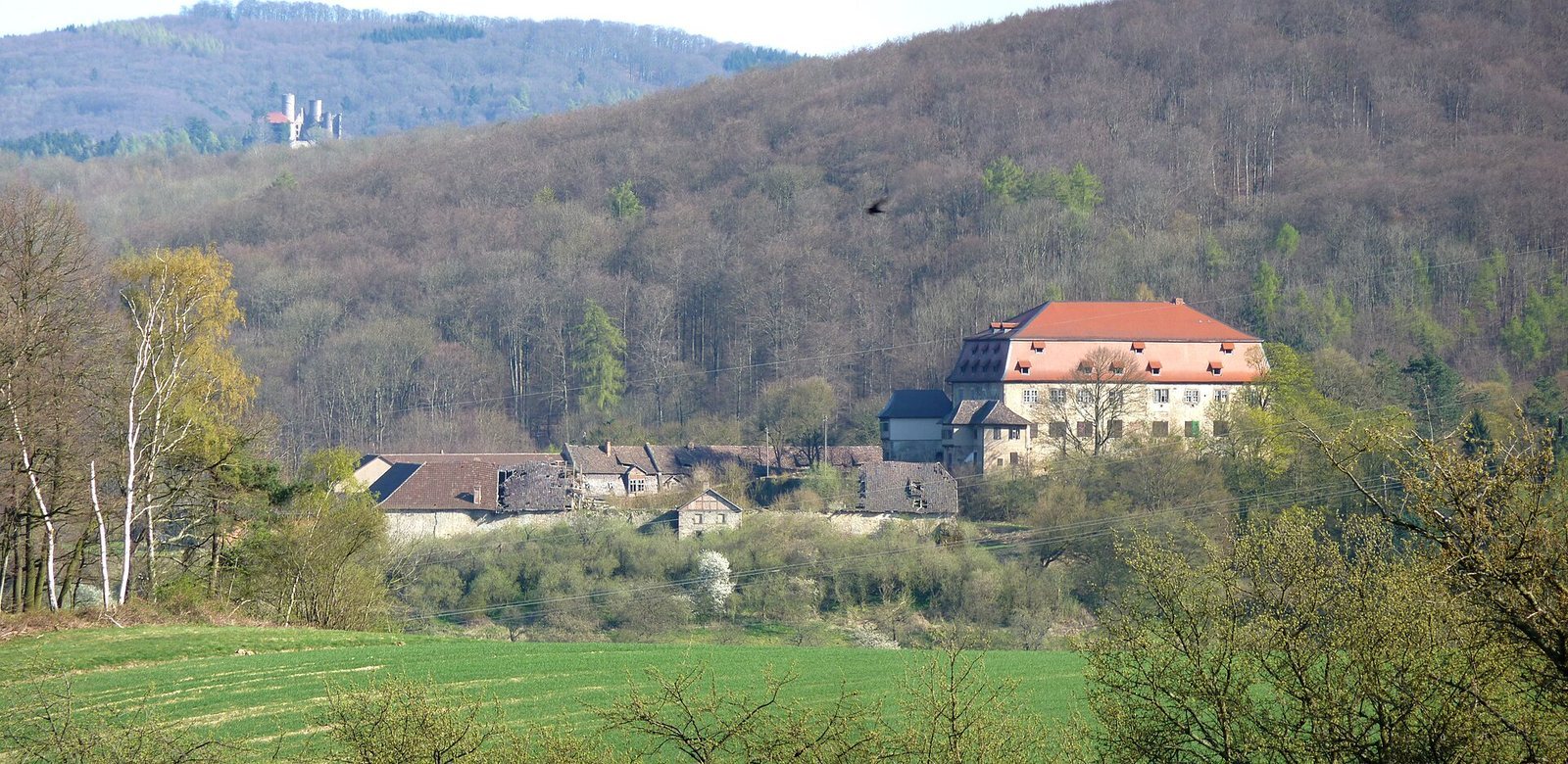
The complex occupies a narrow, partly wooded ridge at 263 metres above Germany’s standard elevation datum. The ridge rises southeast above the Karlsbach, a tributary of the Werra flowing from Eichenberg. Southwest of the ridge, a stream descending from the southeast joins the Karlsbach. The present castle is a rectangular, two-storey building made of roughly shaped rubble stone, with more regularly cut stones strengthening its corners. Its entrance has a Baroque portal, in a European architectural style associated with the 17th and 18th centuries, and the roof has a steep lower slope characteristic of a mansard roof. A terraced garden was added around 1804.
Farmyard and pavilions
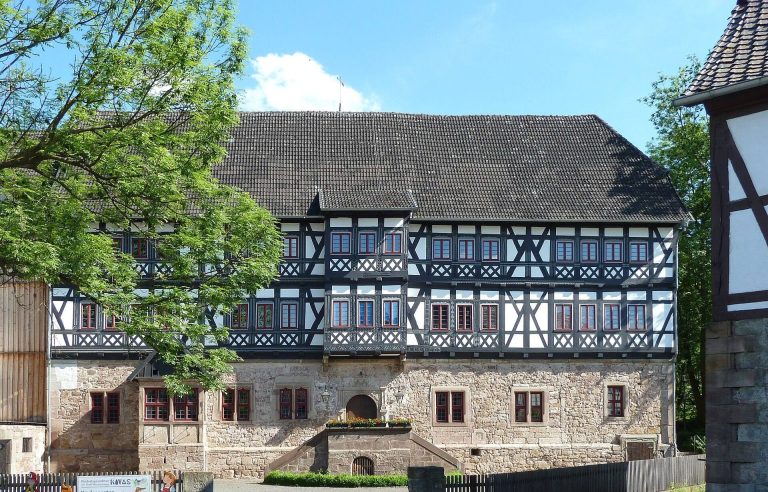
A large farmyard with two wings, dating to the 19th century, lies north of the castle. Small pavilions flank the short end of the building that faces the farmyard. Both belong to the rebuilding phase around 1600 and have solid lower storeys and half-timbered upper storeys, where a visible timber frame is filled between its members. Their upper levels include ornamented sills and infill timbers. The western pavilion serves as a gatehouse. The complex is neglected.