Aremberg Castle: Medieval Hill Castle and Fortress in Germany


Site at a Glance
- Rating
- 4
- Popularity
- Very Low
- Country
- Germany
- Primary era
- Early Modern
- External website
- Open
- Eras represented
- Medieval, Early Modern, Modern
- Civilizations
- Holy Roman Empire
- Site type
- Military
- Remains
- Castle
On this page8 sections
History
Aremberg Castle is a ruined medieval hill castle in Germany, built on the densely wooded Aremberg during the twelfth century for its strategically advantageous position. The mountain rises to about 623.8 metres in the Ahr Hills of the Eifel, above the settlement of Aremberg. The site was first mentioned in 1166 under the name Arberg and later became the political center of the imperially immediate lordship of Arenberg, a territory that held its status directly from the Holy Roman Emperor rather than through an intermediate ruler.
The Arenberg Lordship
Although the lordship was small, the Arenberg family increased its influence at the Vienna court. Its members rose in rank from counts to princes and eventually to dukes. The castle therefore served not only as a stronghold but also as the principal seat of a family whose position within the imperial political system was steadily expanding.
Fortress Expansion in the Sixteenth and Seventeenth Centuries
From 1564, the castle underwent a fundamental renovation and expansion under the direction of the Jülich fortress architect, probably Johann I von Pasqualini. A larger early modern fortress was then connected with the family’s advancement under the Habsburgs, the European ruling dynasty whose emperors shaped the status and alliances of many imperial territories. The Arenbergs became Imperial Counts in 1549 and sovereign dukes in 1644.
The later expansion was initiated and designed in 1642–1643 by Antoine of Arenberg, a member of the family who had become a Capuchin friar, a member of a reform branch of the Franciscan order. He directed the work until 1660, when Father Mansuet of Neufchâteau took over construction supervision with the assistance of Lieutenant Billaut. The fortress was considered complete by 1674.
In 1642, Hessian troops commanded by Major General Rosen besieged the fortification. Its capture was prevented by the arrival of Spanish relief forces under Count Ernst von Isenburg. After the Peace of Nijmegen, a series of treaties concluded in 1678–1679 that ended several European conflicts including the Franco-Dutch War, the duke dismissed the garrison.
French Occupation and Demolition
Three years later, French troops under Jehannot de Bartillat captured the nearly undefended fortress. They seized 46 iron cannons, about 10,000 pounds of gunpowder, more than 3,300 iron cannonballs, approximately 4,000 grenades, and 306 muskets. The French military engineer and marshal Vauban inspected the position and concluded that the French king had no reason to maintain it.
The French nevertheless planned to enlarge Aremberg as a base for between 2,000 and 3,000 soldiers. Poorly executed demolition changed the water balance of the mountain and caused the castle wells to dry up. The occupiers abandoned the site after one year, while extensive further demolitions left the fortress unusable.
Palace, Abandonment, and Later History
Around 1720, the fourth duke, Léopold Philippe, rebuilt the complex and converted it into a palace. Plans prepared around 1750 and during the second half of the eighteenth century for a new palace in the village or in the valley below the hill were never realized. On 13 October 1794, after a French soldier demanded accommodation for his general, a commissioner, and several officers, the ducal family left the estate and moved to the Netherlands.
Jean Gaspard Villmart purchased the “castle on the Aremberg” in 1803 and had it demolished in 1809. Remains from the castle’s successive building phases survived. A few years later, the German writer, poet, and historian Gottfried Kinkel visited the ruins and later described the site and the poverty of the Aremberg population in his book Die Ahr, published in 1846.
A viewing tower was erected on the former castle grounds in 1854, using stone taken from the castle complex. Surrounding tree growth has prevented it from serving as a lookout for decades. The museum once housed in the tower no longer exists, and the tower is now locked.
Remains
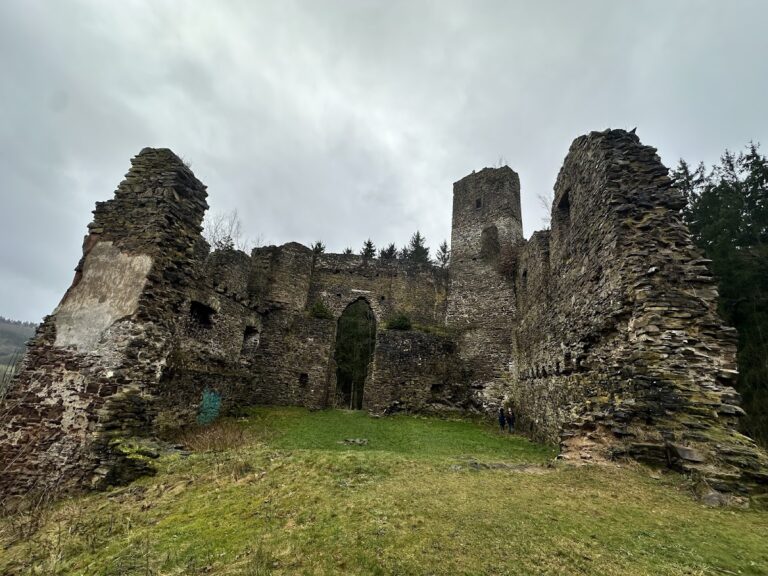
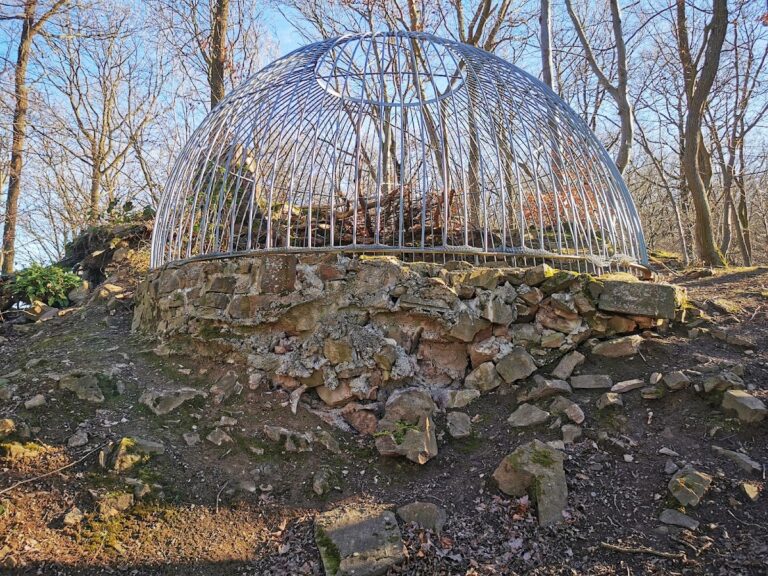
The surviving site occupies the summit area of the wooded Aremberg, a Tertiary volcano, meaning a landform formed during the geological period traditionally placed before the Quaternary. The remains consist of elements from the medieval castle, the early modern fortress, the later palace complex, and the nineteenth-century viewing tower. The physical layout is represented especially by portions of the moat and its bank or wall, along with fortress bastions and surviving trees from the former garden.
Moat and Fortress Works
Parts of the moat remain on the former castle grounds, together with sections of its bank or wall. The site also retains bastions, projecting parts of a fortification designed to let defenders cover the surrounding walls and approaches. These surviving elements belong to the early modern fortress and preserve parts of its defensive organization after the large-scale demolitions that altered the complex.
Garden and Viewing Tower
Twelve lime trees survive from the former castle garden. Near a point at roughly 623 metres above sea level stands the approximately 17-metre-high viewing tower built in 1854 from reused stone taken from the castle complex. The growth of surrounding trees obstructs its view, so it is no longer usable as a lookout. Its former museum has also disappeared, while the tower itself remains locked.