Archaeological Museum of Paros: A Museum of Cycladic Antiquities



Site at a Glance
- Rating
- 4.4
- Popularity
- Low
- Country
- Greece
- Primary era
- Classical
- External website
- Open
- Eras represented
- Stone Age, Bronze Age, Classical
- Civilizations
- Ancient Greek, Mycenaean, Roman
- Site type
- Museum
On this page25 sections
History
The Archaeological Museum of Paros is a museum of Cycladic antiquities in Parikia, Greece, founded and opened in 1960 to preserve archaeological material from Paros and the surrounding islands. Its collections range from the Neolithic period to the Roman period and include original Archaic and Classical sculptures produced by Parian workshops, along with finds from settlements, cemeteries, sanctuaries, and rescue excavations in the town.
Creation and expansion
Before the museum was established, the island’s archaeological discoveries were kept in the Basilica of Panaghia Katapoliani. When Paros’s secondary school was built during the 1950s, part of the project was planned specifically to house archaeological collections. A museum wing and courtyard were then created on municipal land. Nikolaos Zafiropoulos, the first archaeological official responsible for organizing the collections, arranged the initial displays, which consisted mainly of sixth- and fifth-century BC statues.
Excavations soon produced more material than the original facilities could accommodate. A second wing was begun immediately and completed toward the end of the 1960s. During the 1970s, the northern half of the connecting portico was enclosed for additional objects, including the monumental statue of Artemis Delia. The collections were reorganized through archaeological work led by Photeini Zapheiropoulou, the second official in charge of the museum’s antiquities. Yannis Kourayos joined the excavation and museum work in 1986 and also contributed to this reorganization.
Repairs and an extension followed in 1995. The administrative department moved from the first wing to a purpose-built building at the southwest entrance of the courtyard. The former administrative area was consequently adapted for the Hellenistic sculpture collection. The museum is administered by the Greek Ministry of Culture through the Twenty-First Ephorate of Prehistoric and Classical Antiquities, an administrative office responsible for the protection and management of antiquities.
Collections from prehistoric Paros
The museum preserves material from Saliagos, an island settlement dating approximately to 5300–4500 BC and described as the oldest known Neolithic site in the Cyclades. Its objects include painted terracotta vessels shaped like chalices, obsidian tools brought from Milos, and the steatopygous figurine known as the Fat Lady of Saliagos. The collection also includes objects from the kastro of Parikia dating approximately to 2300–1600 BC, among them a large geometric storage vessel from the second half of the third millennium BC. Nearby are a similar vessel and a large marble Cycladic mixing vessel from the first half of the third millennium BC.
Material from the Early Cycladic cemetery at Plastiras, in the Bay of Naoussa, dates approximately to 3200–2400 BC. It includes marble vessels such as kraters, used traditionally for mixing wine and water, and shallow ritual bowls, one of which retains traces of colour. Incised terracotta objects from the Kampos cemetery include a vessel conventionally called a frying pan, dated approximately to 2800–2700 BC. The museum also presents finds from the twelfth-century BC Mycenaean acropolis of Koukounaries, including marine-decorated terracotta cups and storage vessels, bronze and bone tools, and weapons. The site was later occupied again, and a fragment showing two fighting men dates to the second quarter of the seventh century BC.
Sanctuaries, cemeteries, and the ancient town
A large part of the collection derives from archaeological rescue excavations in Parikia. Other material came from the ancient cemeteries, sanctuaries, and settlements of Paros, as well as from Antiparos and Despotiko. Island pottery from the twelfth to the fifth centuries BC was made locally or imported from elsewhere in the Aegean. A funerary stele found by Nikolaos Zafiropoulos at Synoikismos in 1960 is among the earliest known examples in the collection. Dating to the beginning of the seventh century BC, it shows a woman in profile, wearing a peplos and seated on a throne. In 1983, Photeini Zapheiropoulou discovered a seventh-century BC cemetery at the same locality.
The Delion was a sanctuary dedicated to Apollo Delios and Artemis, Apollo being associated with prophecy, music, and civic religion, and Artemis with hunting and the wilderness. Objects from the sanctuary date from the eighth to the fourth centuries BC and include sculpture, architectural pieces, inscriptions, pottery, glazed ceramic objects known as faience, figurines, seals, jewelry, ivory objects, and amulets. Some were produced locally, while others came from Corinth, Attica, Rhodes, Egypt, and Phoenicia. Many objects excavated at the Delion before the Second World War disappeared during the conflict.
The museum also preserves finds from the sanctuary at Aghios Panteleimon, the open-air sanctuary at Kounados, the cemeteries of ancient Parikia, and other sites on Paros and Antiparos. These collections are especially valuable for the number of original Archaic and Classical sculptures from Parian workshops. Many works of these periods are otherwise known chiefly through later Hellenistic or Roman copies.
Memorials, inscriptions, and later discoveries
The Parian Chronicle is a third-century BC chronological inscription that arranged events in sequence from mythological time into the historical period. It probably stood near the Archilocheion, the hero shrine or commemorative monument of Archilochos, an Archaic Greek lyric poet associated with Paros. The inscription may have served an educational purpose in the gymnasium beside the monument. Two fragments found in the kastro of Parikia in 1627 are now in the Ashmolean Museum in Oxford. Another fragment, discovered in 1897, was given to the museum by the Varouhas family, and the Paros collection also contains two casts of the Oxford pieces. The fragment kept in Greece consists of 134 lines and records events from 1582 BC, in the time attributed to the mythical Athenian king Cecrops, to 264/263 BC, when Diognetos was eponymous archon of Athens.
A Roman mosaic depicting the Labours of Herakles was discovered beneath the Basilica of Panaghia Katapoliani during restoration work in the 1960s. Herakles was the Greek mythological hero whose legendary tasks formed a canonical cycle. The mosaic showed that the area had previously contained a gymnasium still in use in the early fourth century AD. A Byzantine church was later built there, before the construction of the basilica. The discovery therefore changed the understanding of the earlier uses of this part of Parikia.
Through its two wings, courtyard, portico, and chronological galleries, the museum brings together evidence from the Neolithic period through Roman rule. Its physical arrangement and its original Parian sculpture have made it an important provincial museum, while its collections preserve the artistic, religious, funerary, and civic history of Paros and its neighboring islands.
Remains
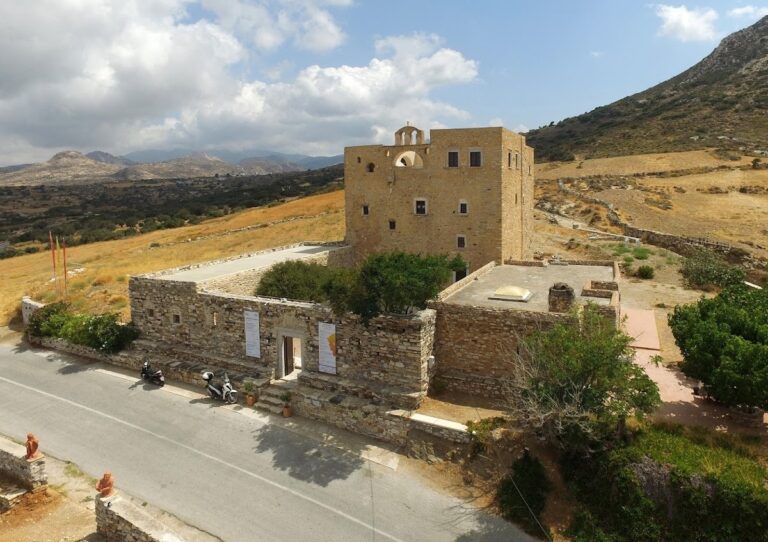
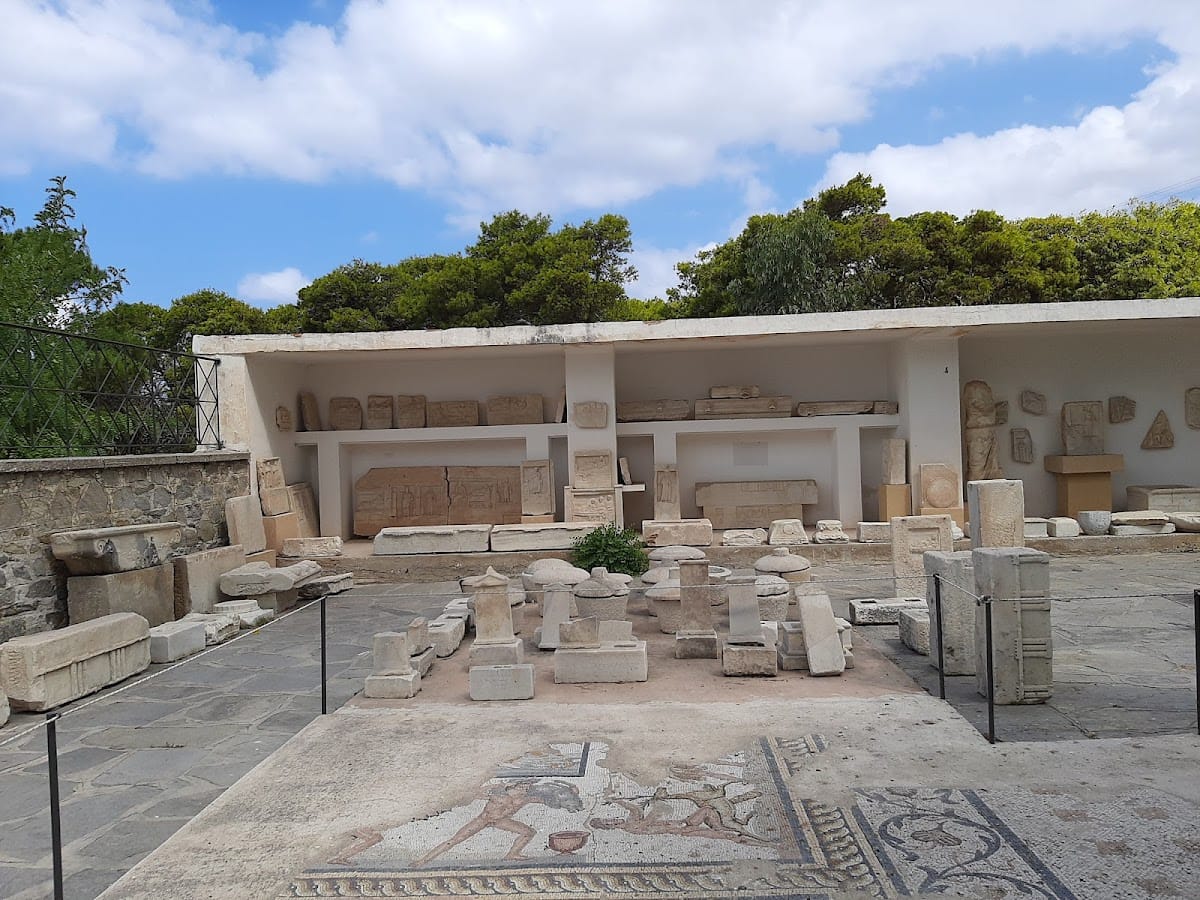
The museum consists of two wings arranged around a large central courtyard. The wings occupy the south and east sides of the enclosure and are connected by a portico rather than communicating directly with one another. The portico was originally open along its length, but its northern section was later enclosed and fitted with display niches. The courtyard was partly designed for the presentation of sculpture and architectural fragments among Cycladic vegetation and in natural light. Its western wall was kept low, allowing views across the elevated museum site toward Parikia and particularly toward the Basilica of Panaghia Katapoliani.
Courtyard and funerary monuments
Roman sarcophagi
Architectural fragments are displayed in planted areas outside the museum along the pedestrian street rising from the port. Three Roman sarcophagi stand beside the western wall. Dating to the second or third century AD, they served as family tombs and reflect funerary practice on the island during the Roman period. Their carved sides show funerary banquets or seated deceased persons, while their gabled lids were made to support portraits of the dead.
Stelae, urns, and archaic vessels
The central courtyard contains funerary stelae, sarcophagi, marble funerary urns, statues, and architectural elements. On its southern side are Archaic anthropomorphic sarcophagi, sometimes called Phoenician sarcophagi. They were probably Greek, although a Phoenician workshop has also been proposed, and they reflect Paros’s contacts with the ancient Near East. A fifth-century BC boundary stele from near the marble quarries bears the inscription “Boundary of the city.” Five other stelae marked the limits of the sanctuary of Apollo Delios.
A circular Hellenistic funerary altar decorated with garlands and bull’s heads was found in the foundations of the Basilica of Panaghia Katapoliani. The courtyard also contains marble funerary urns from the fourth and third centuries BC and a sixth-century BC Archaic Cycladic storage vessel known as a pithos.
Portico monuments
Artemis Delia
The portico, also called the Portico of Artemis Delia, contains the reconstructed monumental statue of Artemis found in 41 pieces between the nineteenth century and the 1970s at the sanctuary of Apollo Delios. The statue originally stood in the temple’s principal inner chamber. It wears a chiton and himation and is 2.74 metres high. Including its base, its total height has been estimated at between 3.10 and 3.70 metres. Dated to about 490–480 BC, the figure is attributed to Parian workshops and occupies a transitional position between the rigid form of the Archaic kore, a standing female youth, and the more natural movement of Classical sculpture. The statue is in poor condition.
Archilocheion and inscriptions
Another part of the portico is devoted to the Archilocheion. Its only preserved Ionic capital dates to the sixth century BC and was inscribed in the fourth century BC with a statement identifying it as the tomb of Archilochos, erected by Dokimos son of Neokreon. The capital probably supported a sphinx. Other inscriptions, dating from the third to the first centuries BC, refer to Archilochos, the oracle of Delphi concerning the construction of his hero shrine, and later restoration accounts. One of these inscriptions was reused as a tombstone in the third century AD.
The portico also contains inscriptions recording honorific decrees and grain taxes, a column fragment dedicated to Zeus the Avenger, and a column fragment thought to preserve a list of athletes. Two carved upper molding fragments from the temple of Apollo Delios, dated to the end of the fifth century BC, show a lion’s head and flowers. A second-century BC fragment showing a bull or calf attacked by a lion was found in the port of Parikia beside a large fragment of an Archaic horse statue.
Archaic and Classical sculpture
Wing A and the Gorgon of Paros
Wing A contains Archaic and Classical sculpture. Its central work is the Gorgon of Paros, a Parian-marble figure dating from the middle or final quarter of the sixth century BC. It was found during the 1990s in a sanctuary of about 400 square metres at Aghios Panteleimon, east of Parikia and outside the ancient fortifications. The figure may have served as an acroterion, a sculptural ornament placed at the apex or corners of a temple roof, on a lost Corinthian-type building.
The winged figure is shown just after landing. She holds a serpent in her left hand, and the serpent coils around her waist like the belt of her scaled chiton. Her hybrid appearance combines a feminine body and hair with a monstrous face, protruding tongue, fangs, and bulging eyes. The museum also displays fragments of sixth-century BC kouroi and korai, Archaic standing male and female youths, together with Archaic stelae and inscriptions. A sixth-century BC votive relief from the open-air sanctuary at Kounados shows a bearded male figure. The lower part of a stele dated to 490–480 BC preserves the body of a young woman visible through her clothing and illustrates the Severe Style, the early Classical style of Greek sculpture.
Reliefs and votive sculpture
Two reliefs dating from about 500 BC probably came from the altar or frieze of the Archilocheion and were reused in the construction of the Basilica of Panaghia Katapoliani. One shows a lion or panther devouring a bull. The other depicts Archilochos reclining at a symposium or funerary banquet, accompanied by a seated figure who may be his wife and a standing young slave. Military equipment and a lyre appear behind them.
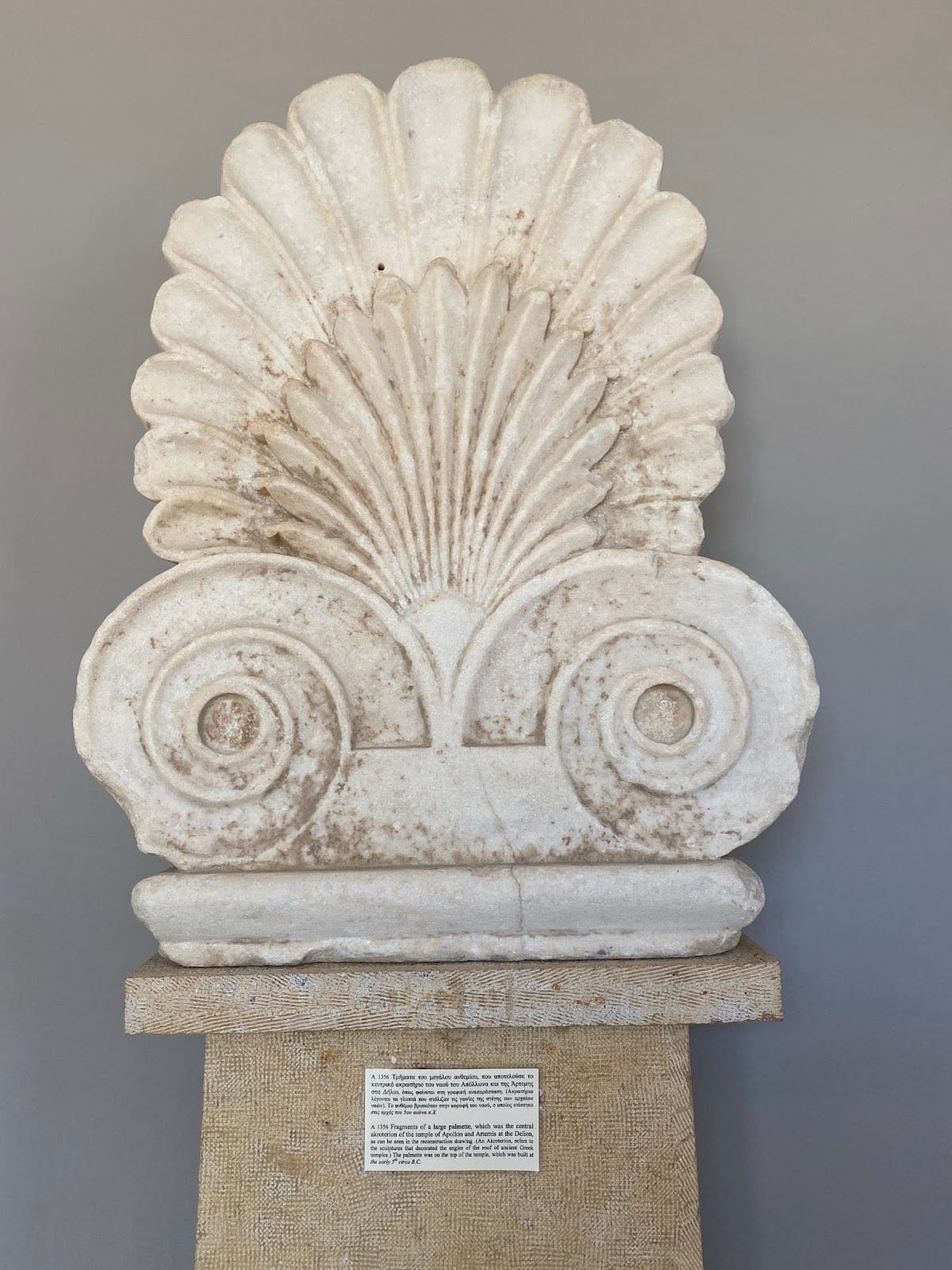
Other works in Wing A include a funerary relief of a running Gorgon from the beginning of the sixth century BC, a palmette from the top of an elaborate funerary stele dated to 480 BC, and early fifth-century BC roof ornaments from the Delion. These include a sphinx torso and pieces of a monumental palmette. Thirty-six fragments assembled in 1976 reconstruct the feet and lower legs of Athena Promachos, a walking goddess. The statue dates to approximately 480–470 BC, is carved from Parian marble, and wears a peplos considered Laconian in style.
A second marble statue, 1.57 metres high, represents a seated goddess and probably dates to the beginning of the fifth century BC. Found in pieces near Angairia on the southeast coast of Paros in 1885, it shows the goddess wearing a heavy chiton and himation. She sits on a cushion placed on a throne, with her feet on a small footstool. The head and arms are missing. The figure may represent Artemis, who was worshipped near the place where it was found.
Funerary and athletic images
Wing A also contains fragments of kouroi from the second half of the sixth century and the beginning of the fifth century BC, the lower part of a fifth-century BC hoplite statue, and a painted marble disk showing a discus thrower. The red-and-gold disk was found in 1983 in a tomb at Vitzi, one of the ancient cemeteries of Parikia. It served as the lid of the vessel containing an athlete’s ashes and dates to the middle of the fifth century BC.
Two large seventh-century BC amphorae from the ancient cemetery of Parikia were first placed as grave markers and later reused for child burials. Once considered Milesian, they are now attributed to a Parian workshop because equivalent vessels were found at Thasos, a colony founded by Paros. One amphora shows the Judgment of Paris, water birds, and a rider with two horses. The other depicts a farmer ploughing with two oxen and a hunter carrying a bow and quiver.
Nike Room
Nike statues
The room known as the Nike Room contains a Parian-marble statue of Nike, the Greek personification of victory, dated to 480–470 BC. Found shortly before 1885 in the kastro of Parikia, it lacks the head, wings, arms, and one foot. Its pose suggests that the left leg has just landed while the right leg is raised, and the right hand probably held the edge of the peplos. The statue may have commemorated a Parian victory over Athens in 489 BC or may have served as a temple roof ornament.
A second Nike from Antiparos dates to the end of the fifth century BC. Its head, arms, lower legs, and wings are missing. The sense of flight or running survives in the light garment that clings to the partly bare body and streams behind it.
Warrior and funerary reliefs
A fifth-century BC hoplite torso shows a warrior raising his missing right arm, probably to hold a shield before attacking. The end of his helmet crest remains visible on his back. A marble relief 1.20 metres high, dated to 440–420 BC, was found in 1996 at the Aghios Panteleimon sanctuary near a circular building interpreted as a hero shrine. It depicts a walking young woman holding two unidentified circular objects and may have formed part of a metope or pediment.
The room also contains the upper part of a pedimental funerary stele with antefixes, showing the head of a young man. The complete monument was approximately two metres high and dates to the middle of the fifth century BC. Its treatment of the hair and facial expression has been used to associate it with a Parian sculptor. A statue of Artemis dedicated by Aries, daughter of Teisenor, at the Delion dates to about 360 BC. The goddess wears a peplos and shawl, with braided hair surmounted by a polos, a tall cylindrical headdress.
Hellenistic sculpture and sanctuary material
The Hellenistic Sculpture Room, also called Room B, lies between the two wings. It contains Hellenistic sculptures, finds from excavations at Despotiko, and objects, principally terracotta votive figurines, from the sanctuaries of Eileithyia and Asklepios. Eileithyia was associated with childbirth, while Asklepios was the Greek god of medicine and healing. A funerary stele fragment shows a seated scribe, with traces of colour preserved on the depicted cloth and beard. A thirty-seven-line inscription lists women who financed the restoration of the sanctuary of Eileithyia.
Wing C: prehistoric to Roman collections
Early Cycladic material
Wing C is a large rectangular room arranged chronologically from prehistory to the Roman period. Its earliest display presents the Saliagos material, including painted terracotta chalice-shaped vessels, obsidian tools from Milos, and the Fat Lady of Saliagos, one of the oldest known Cycladic figurines. A case contains finds from the kastro of Parikia dating approximately to 2300–1600 BC. Between the cases stands a large geometric pithos from the second half of the third millennium BC.
The Early Cycladic display covers approximately 3200–2400 BC and includes marble kraters and shallow ritual bowls from the Plastiras cemetery. One bowl retains traces of colour. Incised terracotta objects from the Kampos cemetery include the vessel called a frying pan, dated approximately to 2800–2700 BC. Many Plastiras-type figurines were stolen from the museum in 1992, leaving a small number in the collection.
Koukounaries and island pottery
Material from Koukounaries includes terracotta kylikes, or drinking cups, skyphoi, or deep drinking cups, and stamnoi, or storage vessels, decorated with marine imagery. Bronze and bone tools and weapons accompany them. Other cases contain pottery from Parikia and the wider island, dating from the twelfth to the fifth centuries BC. The vessels were produced locally or imported from other parts of the Aegean.
The collection includes the Synoikismos funerary stele, found in 1960 and dated to the beginning of the seventh century BC. Its worn low relief shows a woman in profile wearing a peplos and seated on a throne. Other vessels from the Vitzi cemetery date from the eighth to the fifth centuries BC and were made locally or imported from Corinth and Rhodes. Geometric vases from the eighth century BC came from the communal tomb known as the polyandrion.
Delion and Classical collections
Displays from the Delion contain eighth- to fourth-century BC ceramics, faience, animal and human figurines, stone seals, copper and ivory jewelry, and amulets. Egyptian faience scarabs appear among objects from external production centres. Nearby are fragments of Archaic Parian marble sculpture, including a life-size unfinished kouros head, the torso of a small kore, and a head that may represent a kore or a sphinx.
Classical and later cases include imported black-figure and red-figure Attic vases from the Vitzi cemetery, fifth- and fourth-century BC mirrors, Roman glass vessels from the first and second centuries AD, and everyday objects such as strigils, jewelry, and toys. The eastern wall displays mostly fragmentary Parian-marble statues, sculptures, funerary stelae, and inscriptions. Among them are an Artemis statue lacking its head, arms, and lower legs; a fifth-century BC stele of a bearded man in a himation, whose missing right hand probably held a staff; and a fifth-century BC stele of a woman in a peplos with bent arms and upturned palms. She probably held an object once painted on the stone.
Inscriptions and later funerary works
Two male marble heads include a possible fourth-century BC representation of Asklepios and an unfinished male portrait from the late Hellenistic period. The museum’s fragment of the Parian Chronicle dates to the middle of the third century BC and is the only surviving fragment of the inscription still in Greece.
Additional funerary monuments include a stele fragment showing a hoplite at the prow of a ship, a third-century BC stele depicting Dionysos with a bird and a bunch of grapes beside a dog, and another third-century BC funerary-banquet stele retaining traces of red paint. A third- or second-century BC stele shows a farewell scene within a naiskos, a small shrine-like frame used in funerary representation. Later objects include a marble relief of Eros in flight, dating from the first to the third century AD and possibly made for a sarcophagus, a shoe-shaped vessel from approximately 650–600 BC, and an imported Corinthian vessel shaped like a rooster from approximately 600 BC.