Arakelots Monastery: An Armenian Apostolic Monastery and School in Taron
Site at a Glance
- Popularity
- Medium
- Country
- Turkey
- Primary era
- Medieval
- Eras represented
- Medieval, Early Modern
- Civilizations
- Armenian, Ottoman
- Site type
- Religious
- Remains
- Monastery
On this page14 sections
History
Arakelots Monastery was an Armenian Apostolic monastery near Arak village, about 11 km southeast of Muş in eastern Turkey. Arakelots means “Holy Apostles.” The monastery was also called Ghazaru vank, after its first abbot Yeghiazar, and Gladzori vank, after the nearby gorge known as Wolf’s Gorge. Its Turkish name is Arak Manastırı.
Foundation and learning
A late medieval tradition dated the monastery’s foundation to 312 and credited Gregory the Illuminator, the early Christian leader traditionally associated with bringing Christianity to Armenia, with bringing relics from Rome for safekeeping. These were said to include the left arms of Peter and Paul and the right arm of Andrew, relics that account for the monastery’s name. The earliest verifiable building phase dates to the second half of the 11th century, under the Tornikians, a branch of the Armenian noble Mamikonian family that ruled Taron from 1054 to 1207. The monastery’s completion is dated to the 11th–12th centuries. An inscription on a carved cross-stone records renovation in 1125, and the complex expanded and underwent further destruction and repair in later centuries.
The monastery became a center of learning. Translation work associated with it is traced to the fifth century, while its school flourished in the 11th and 12th centuries under the teacher and chronicler Poghos Taronetsi. From 1271 to 1281, the school prospered under Nerses Mshetsi. He later moved to Syunik and established the University of Gladzor in 1280.
Political change and destruction
Turco-Mongol dynasties ruled Taron between the 13th and 16th centuries. In the 14th century, invasions by Tamerlane, the Central Asian conqueror also known as Timur, destroyed the monastery. The Ottoman Empire annexed the region in the mid-16th century.
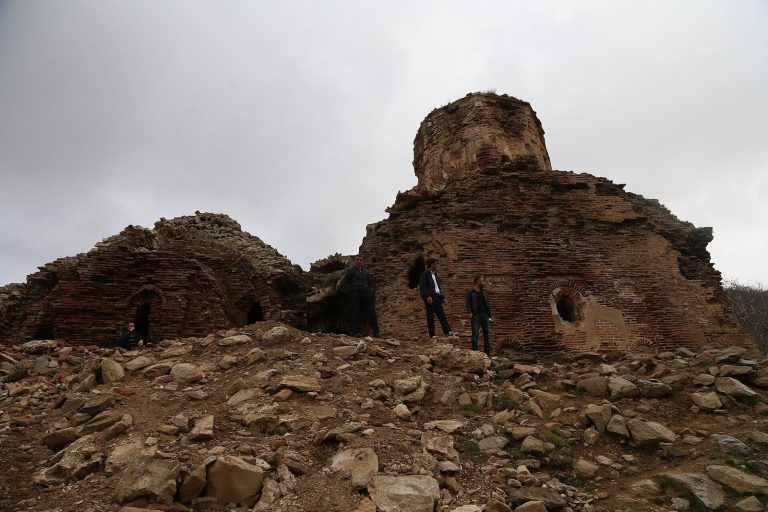
In November 1901, Armenian irregular fighters and Ottoman forces clashed in and around the monastery. The monastery was attacked and abandoned during the Armenian genocide of 1915. It remained standing into the 1960s, and its main church and chapels were still in reasonably good condition in 1960. Soon afterward, an official from Muş apparently had the buildings dynamited.
Remains
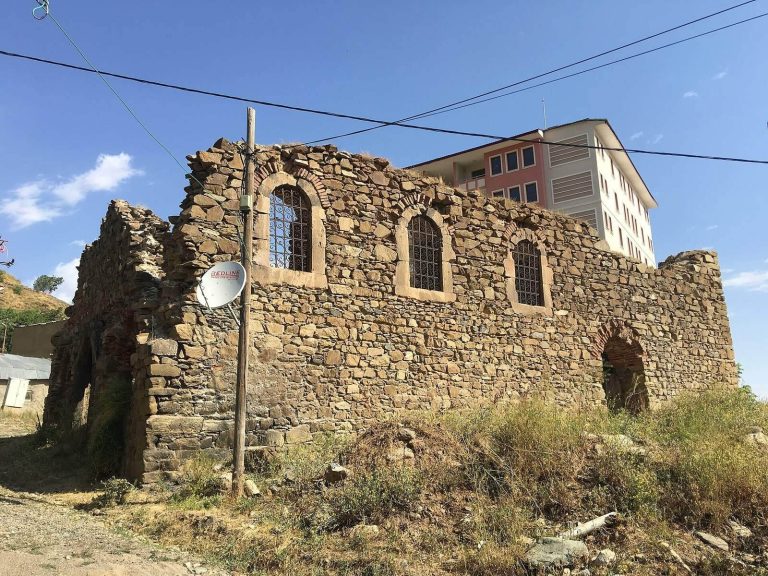
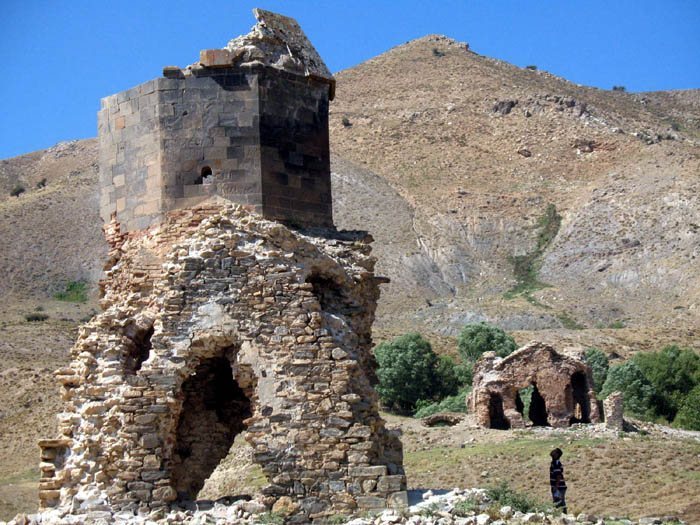
The monastery complex comprised a main church, two chapels, an entrance hall and a bell tower, enclosed by a wall built in 1791. Its surviving fabric is now in ruins. The buildings combined brick and mortar construction with carved stone features.
Main church
St. Arakelots, the main church, was built of brick and mortar in the 11th century. Its cross-shaped interior formed a four-lobed plan within a rectangular exterior. Continuous arched ceilings covered the four arms and the corner chapels, which rose two storeys on the east and west sides. The church had a single entrance on its west side. A dome once covered the central space, supported by corner structures that carried it above the square plan and by an octagonal base. The dome was restored in 1663 but later collapsed. Wall paintings decorated the interior, and human figures, probably apostles, can still be made out in the semi-circular sanctuary end. The church was renovated in 1614.
Other structures and monuments
Entrance hall
A rectangular entrance hall, called a narthex, was added in 1555 by the abbot Karapet Baghishetsi.
Bell tower and enclosure
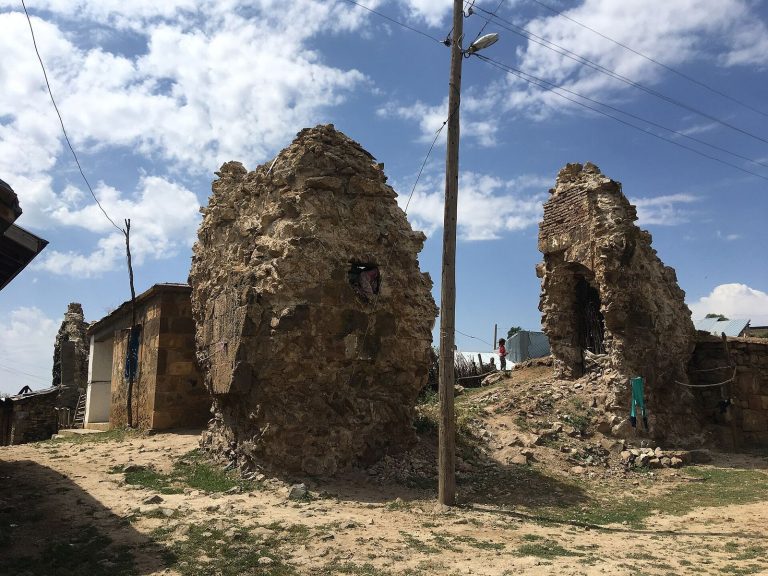
The bell tower stood west of the church. Ter Ohannes, a learned Armenian churchman, built it in 1791 as a three-storey structure topped by a circular, eight-column arrangement. Only its lowest storey survives. An earlier bell tower may have stood at the monastery and been destroyed. The enclosing wall was also built in 1791.
Chapels and carved cross-stones
St. Stepanos Chapel stood south of the main church. Built in 1663 on the foundations of a 14th-century church, it had a single aisle ending in a semi-circular sanctuary and is now partly buried in rubble. Ruins of St. Gevorg Chapel lie on the monastery’s north side. Nine inscribed 11th-century Armenian cross-stones once stood on the eastern side of the complex.
Courtyard burials
Movses Khorenatsi, traditionally regarded as a major Armenian historian, and David the Invincible, an Armenian philosopher, are believed to have been buried in the monastery courtyard.
St. Tadevos Chapel
About 300 m northeast of the monastery walls, St. Tadevos Chapel dates to the 13th or 14th century. It was well preserved, with carefully polished volcanic stone on the exterior and brickwork inside.
Movable remains
Wooden church door
The church’s wooden door was made in 1134 by Grigor and Ghukas. Its carved panels show historical scenes rather than religious subjects. The front probably depicts a prince holding a scepter in his right hand. During World War I, German archaeologists apparently removed the door, intending eventually to take it to Berlin. In 1916, after Russian forces took control of the region, the archaeologist Smbat Ter-Avetisian found it among goods abandoned by retreating Ottoman forces. He and a group of migrants took it to the Museum of the Armenian Ethnographic Association in Tbilisi. In the winter of 1921–22, Ashkharbek Kalantar transferred it to the newly founded History Museum of Armenia in Yerevan.
Mush Homiliarium
The Mush Homiliarium, a collection of sermons, was made at Avag Monastery near Yerznka, now Erzincan, between 1200 and 1202. The scribe Vardan Karnetsi wrote it on vellum, prepared animal skin, and Stepanos decorated it. It is the largest known Armenian manuscript. It originally contained 660 pages; the present volume has 601 pages and weighs 28 kg. A non-Armenian judge who had stolen the manuscript sold it to Arakelots in 1204 for 4,000 silver coins raised by local people. It remained at the monastery from 1205 until 1915, when it was taken to Tbilisi in two parts. Seventeen pages are now in Venice and one in Vienna. Two pages separated in 1918 were transferred from Moscow’s Lenin Library to Yerevan in 1977. The manuscript is now kept at the Matenadaran in Yerevan.