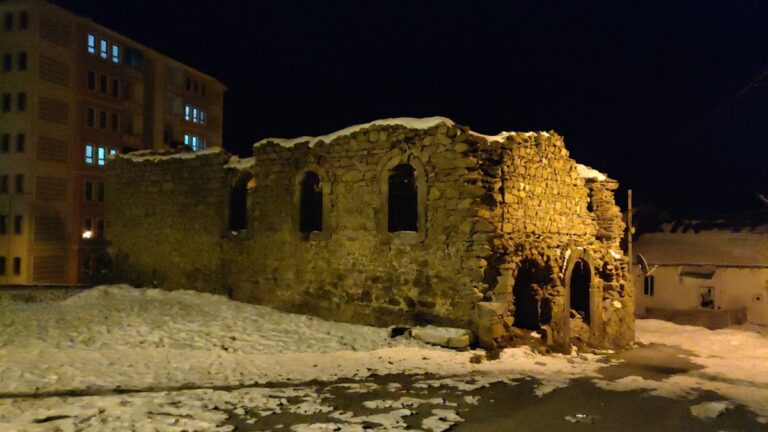
Saint Karapet Monastery: Armenian Religious Center of Taron


Site at a Glance
- Rating
- 4.1
- Popularity
- Very Low
- Country
- Turkey
- Primary era
- Early Modern
- Eras represented
- Medieval, Early Modern, Modern
- Civilizations
- Armenian, Ottoman
- Site type
- Religious
- Remains
- Fortified Monastery
On this page19 sections
History
Saint Karapet Monastery was an Armenian Apostolic monastery in Türkiye, situated about 30 kilometers northwest of Mush in the historic region of Taron. Also called Glakavank and the Monastery of the Nine Springs, it was associated with the veneration of John the Baptist and became the religious center of Taron. Its traditional foundation was placed in the early fourth century, although another historical interpretation dates its establishment to the rise of monasticism in Bagratid Armenia during the 940s.
Foundation and early traditions
The name Saint Karapet means “Holy Precursor” and refers to John the Baptist. Armenian tradition held that Gregory the Illuminator founded the monastery after the conversion of King Tiridates III of Armenia. According to this account, Gregory brought relics of John the Baptist and Saint Athenogenes from Caesarea and established a martyrion, a shrine associated with the relics or burial place of a saint.
The foundation tradition also placed earlier pagan worship at the site. One account associated its cult images or temples with Gisane and Demeter, while another connected them with the Armenian deities Vahagn and Astghik. Popular belief later maintained that demons were confined beneath the monastery and would be released by John the Baptist at the Second Coming.
Zenob Glak, a Syriac archbishop, was traditionally regarded as the monastery’s first father superior. He was sometimes identified with the author of the History of Taron, but that work is generally attributed to the otherwise unknown John Mamikonean and is considered a later composition, probably written to promote the monastery’s preeminence. Its narrative presented five Mamikonian princes as John the Baptist’s “Holy Warriors”: Mushegh, Vahan, Smbat, Vahan Kamsarakan, and Tiran.
Medieval development
The Mamikonians, the princely house associated with Taron, acted as defenders of the monastery and claimed John the Baptist as their patron. Saint Karapet later served as their sepulchral abbey. Atanas Taronatsi, a sixth-century chronicler associated with the compilation of the Armenian calendar, also served as father superior.
The monastery’s possessions expanded during the seventh century, but an earthquake reduced its buildings to ruins. It was rebuilt afterward, and the chapel of Saint Stephen was founded. A school was established there in the late ninth century, after the creation of the medieval Bagratid Armenian kingdom. The scholar Hrachia Acharian proposed that Mesrop Mashtots, traditionally regarded as the inventor of the Armenian alphabet, may have studied at the monastery, although this remains a possibility rather than an established fact.
In the eleventh century, Grigor Magistros built a palace within the complex. A fire in 1058 destroyed the palace and the Church of Saint Gregory, whose roof was made of wood. After the death of Sokmen II Shah Armen in 1185, Muslims attacked the monastery, killed Archbishop Stepanos, and caused the monks to leave for a year.
Ottoman and Persian-period changes
The chapel of Saint Karapet was built in the mid-sixteenth century. From the sixteenth through the eighteenth centuries, the monastery frequently sheltered Armenians fleeing the Ottoman-Persian Wars. Several earthquakes affected it during the eighteenth century, and Persian troops destroyed the Church of Saint Karapet in the 1750s.
An earthquake in 1784 destroyed the main church, the refectory, part of the bell tower, and the southern wall. A complete reconstruction followed in 1788. The work enlarged the gavit, an entrance hall or annex used for religious and sometimes civic purposes, and renewed the bell tower, monks’ cells, scriptorium, ramparts, and other parts of the complex.
Renewal in the nineteenth century
Kurdish gangs seized and looted the monastery in 1827, destroying furniture and manuscripts. From 1862, under Father Superior and Taron prelate Mkrtich Khrimian, Saint Karapet entered a period of renewed prosperity. Khrimian created a council to direct donations toward community projects, despite opposition from monks and wealthy Armenians that included two attempts on his life.
In the same year, Khrimian founded the largely secular Zharangavorats school. Its students included the fedayi Kevork Chavush and Hrayr Dzhoghk, the singer Armenak Shahmuradyan, and the writer Gegham Ter-Karapetian. From April 1, 1863, to June 1, 1865, the monastery also housed publication of The Eaglet of Taron, a modern-Armenian journal edited by Garegin Srvandztiants. Its 43 issues sought to raise Armenian national consciousness. Khrimian left in 1868 after becoming Armenian Patriarch of Constantinople.
By 1890, Saint Karapet controlled extensive woodland, arable land, and three farms. Together, the farms held about 1,000 goats and sheep, 100 oxen and cattle, 60 horses, 20 donkeys, and four mules, maintained by 156 servants. An orphanage founded beside the monastery in 1896 included a school for 45 children and a library.
Decline and destruction
Kurdish threats and Ottoman government suspicions restricted the monastery’s activities by the 1890s. It was looted during the Hamidian massacres in 1895, and its buildings were deteriorating by the beginning of the twentieth century. The decline continued until the First World War.
During the Armenian genocide of 1915, Saint Karapet sheltered large numbers of Armenians escaping deportation and massacre. Turkish forces and Kurdish irregulars besieged the monastery, while those inside resisted for more than two months. Approximately 5,000 Armenians were massacred near the monastery wall. Clarence Ussher and Grace Knapp reported that 3,000 men, women, and children were killed in the courtyard on the orders of a German officer. The monastery was then burned, looted, and sacked.
Russian troops and Armenian volunteers temporarily took control of the area in 1916. They transferred approximately 1,750 manuscripts to Etchmiadzin and saved an eighteenth-century silver reliquary containing the right hand of John the Baptist. Turkish forces recaptured the area in 1918, after which the monastery ceased to function as both a spiritual center and an architectural monument.
Religious and cultural memory
Until the First World War, Saint Karapet was a major pilgrimage center for Armenians from throughout Armenia. Believers regarded the shrine as extraordinarily powerful and associated it with healing physical and mental illness. The epithet “Sultan Saint Karapet of Mush” expressed its perceived status as the lord and master of Taron. From the twelfth century until its destruction, it was also the seat of the Diocese of Taron, whose Armenian population numbered approximately 90,000 around 1911.
Annual celebrations included Vardavar and the Assumption of Mary. These events brought gatherings with horse races, tightrope walking, and gusan competitions, in which secular Armenian performers presented songs and verse. The monastery was also a traditional destination for Armenian ashughs, professional folk poet-musicians. The eighteenth-century ashugh Sayat-Nova was recorded as having visited Saint Karapet to seek divine grace.
The monastery continued to shape Armenian literary and musical memory after its destruction. Raffi mentioned it in the 1866 novel Salbi, Hovhannes Tumanyan described it in the 1890 poem The Morning of Taron, Paruyr Sevak referred to it in the 1959 poem The Ever-Tolling Bell Tower, and Khachik Dashtents portrayed a winter scene there in the 1979 historical novel The Call of the Ploughmen. Numerous songs were dedicated to Saint Karapet.
The site remained abandoned until the 1960s, when Kurdish families settled there. Stones from the monastery and its cross-stones were reused in houses and other local buildings, while other stones were removed for construction. In May 2015, Aziz Dagci, president of an Armenian cultural and solidarity organization, appealed to Turkey’s Ministries of Culture and Interior for reconstruction of the monastery and removal of 48 houses and six barns occupying its former location. In 2016, he stated that an eviction order had been issued but was not being implemented by the governor of Mush.
Remains
Saint Karapet was arranged as a large, fortress-like enclosure protected by strong walls. Nineteenth-century observers described a massive entrance, a spacious courtyard, a prominent bell tower and porch, white-marble façade slabs with bas-reliefs, and irregular stone buildings rising at different angles. The main church stood with four chapels to its east, while religious, residential, educational, and agricultural functions occupied other parts of the enclosure.
Churches and chapels
Main church
The principal church was dedicated to the Holy Cross. Rather than following the usual form of an Armenian church, it was a large hall believed originally to have served as a zhamatun, a chamber or annex used for communal, civil, and religious purposes. It was built mainly from gray stone and supported by 16 columns. A gavit stood in front of it and was enlarged during the reconstruction of 1788.
Eastern chapels
Four chapels stood east of the main church: Saint Astvatsatsin, or the Holy Mother of God; Saint Stephen; Saint Karapet; and Saint George. The chapels of Saint Karapet and Saint Stephen had domes raised on high cylindrical drums and covered by conical roofs. Saint Astvatsatsin was assigned to Syriac, or Assyrian, monks for the feast of Saint John. By 2001, traces of two chambers of the Saint Stephen chapel remained among the foundations and ruined walls.
Bell tower and associated buildings
A three-storey bell tower was built in the eighteenth century and partly destroyed in the earthquake of 1784 before being renovated in 1788. The wider complex included monks’ cells, a refectory, accommodation for pilgrims, a nineteenth-century prelacy building, a monastic school, a scriptorium, ramparts, and the entrance annex. Some of the surviving ruins were being used as barns by 2001.
Doors, manuscripts, and reliquary
Monumental wooden doors
Two monumental walnut doors from the monastery bear the date 1212. Carved by the artist Sarepion, they measure 185 by 115 centimeters and carry elaborate, carefully designed decoration. An Istanbul-based German artist discovered them in 1976. A private collector in Canada acquired them through Christie’s in 1996, and they were displayed at the Metropolitan Museum of Art in 2018.
Relics and manuscripts
Russian troops and Armenian volunteers removed approximately 1,750 manuscripts from Saint Karapet in 1916 and transferred them to Etchmiadzin. They also saved an eighteenth-century silver repoussé reliquary containing the right hand of John the Baptist. These objects preserve material links with the monastery’s religious role after the buildings themselves were destroyed.
Silver cross
An Armenian-style silver cross offered at auction in 2013 was attributed by its seller to Saint Karapet Monastery and valued at $70,000. The attribution was unverified, since the seller provided little information and the available evidence established only that the object was delicate silver work.
Burials and surviving fabric
Mamikonian tombs
Tombs associated with Mamikonian princes, including Mushegh, Vahan the Wolf, Smbat, and Vahan Kamsarakan, were reportedly located near the southern wall. Their surviving physical condition is not established.
Ruined enclosure
By 2001, the physical remains consisted of foundations, ruined walls, and traces of two chambers belonging to the Saint Stephen chapel. Stones from the monastery and Armenian cross-stones had been embedded in village walls or reused in other local construction. The surviving fragments represent the reduced remains of an enclosure that once combined churches, chapels, monastic quarters, schools, workshops, and defensive walls.