Aparan Basilica: An Early Christian Church in Armenia


Site at a Glance
- Rating
- 4.9
- Popularity
- Very Low
- Country
- Armenia
- Primary era
- Classical
- Eras represented
- Classical, Modern
- Civilizations
- Armenian
- Site type
- Religious
- Remains
- Basilica
On this page11 sections
History
Aparan Basilica, also known as the Holy Cross Church and Kasagh Basilica, is an early Christian church in Aparan, Armenia, built in the fourth or fifth century in the Armenian Christian tradition. A. Sahinyan placed its construction at the beginning of the fourth century. Affiliated with the Armenian Apostolic Church, it formed part of an early Christian architectural complex in the historic Nig district of Ayrarat, a major province of Armenia.
Early Christian origins
The basilica is traditionally connected with the Gntuni princes, an Armenian princely family. They are said to have substantially rebuilt the church in the early fourth century, during the period when Christianity became the official religion of the Armenian kingdom under the Arsacid dynasty. The building may have replaced a pagan temple converted for Christian worship, and it may also have served as a place of prayer within an Arsacid royal palace complex.
The wider complex included another church of the fifth century and additional structures. The Kasagh Basilica is regarded as one of two major monuments associated with the Gntuni princes in the region. Its name as the Holy Cross Church derives from a relic of the True Cross formerly kept there. Eyewitness testimony holds that the relic survived until the period of state atheism, after which its whereabouts became unknown.
Parish life and communal history
The church remained connected with the religious life of Aparan into the nineteenth and twentieth centuries. Father Martiros served as its first nineteenth-century priest. Following his death in 1860, his son, Father Sahak, served until 1918 together with his younger brother, Father Raphael. Father Raphael had been ordained in 1902 by Mkrtich Khrimian, also known as Mkrtich I, the Catholicos of All Armenians.
In 1918, as Esad Pasha’s army advanced toward Aparan and Yerevan, a priest celebrated an open-air Divine Liturgy for local fighters before they moved to defensive positions. Father Raphael continued serving the community during the Bolshevik period and died on January 17, 1946, aged 92, after baptizing newborns in Aparan. Father Hovhannes continued baptisms and funeral rites until his death in 1959.
In the late 1940s, the church was desecrated and converted into a collective-farm warehouse. It returned to the local parish in 1959 through the efforts of the parish council and its chairman, the blacksmith Seno Mayilyan. Spiritual administration of the Aparan area was assigned to Father Harutyun Yesayan in 1974, and parish life revived under Father Mkrtich, who became spiritual pastor in 1989.
Excavation, reconstruction, and renewed worship
Archaeological excavations directed by the architect A. Sahinyan took place from 1944 to 1948. Restoration work followed in 1981. From autumn 1992, Divine Liturgy was celebrated about once a month, and on major feasts, beneath the church’s south wall while reconstruction continued. The church reopened for worship on November 30, 1996, although financial difficulties prolonged the completion of the work.
The church was assigned to the newly established Aragatsotn Diocese in 1996. The Sahak-Mesrop spiritual, cultural, educational, and charitable association undertook its reconstruction and reopening, and was formally registered as a public organization in 1998. Father Harutyun Yesayan Jr. became pastor after the reopening. In 1997, Archbishop Navasard Kchoyan ordained deacons at the church.
Father Virap Ghazarian assumed pastoral duties on February 22, 2001, celebrating his first Divine Liturgy in memory of Vardanank, the Armenian religious and national commemoration linked with the fifth-century Battle of Avarayr and resistance to forced religious conversion. He served for about thirteen years before being transferred to Ukraine, after which Fathers Oshin Hayrapetyan and Mushe Vahanian succeeded him. Father Harutyun Yesayan had transferred to churches in Ashtarak and Talin in 2001.
The final reconstruction and improvement phase began in autumn 2001. After completion and beautification works, the church was reconsecrated on May 5, 2002. Father Mambre Paturyan celebrated the first Divine Liturgy in the rebuilt church. The basilica is recognized as a cultural monument of Armenia and remains a functioning church. A heritage listing places the beginning of construction in the fourth century and gives 1693 as a completion date, without identifying the construction phase to which that date refers.
Remains
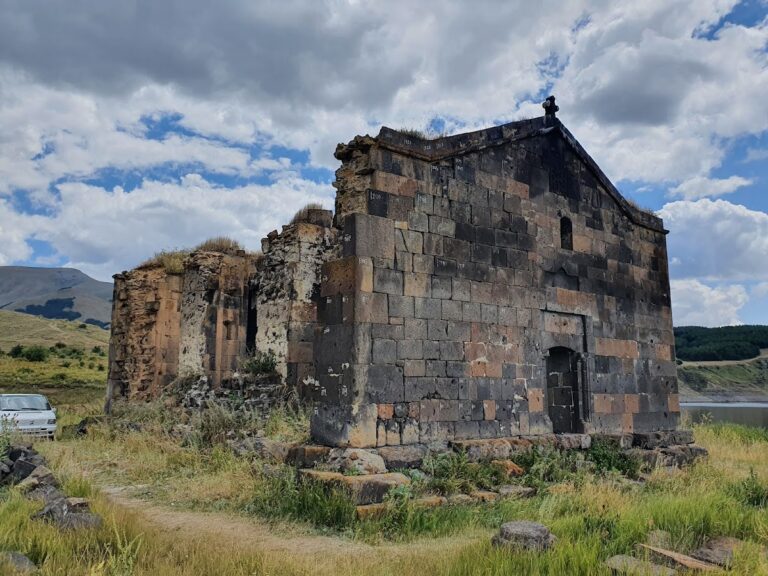
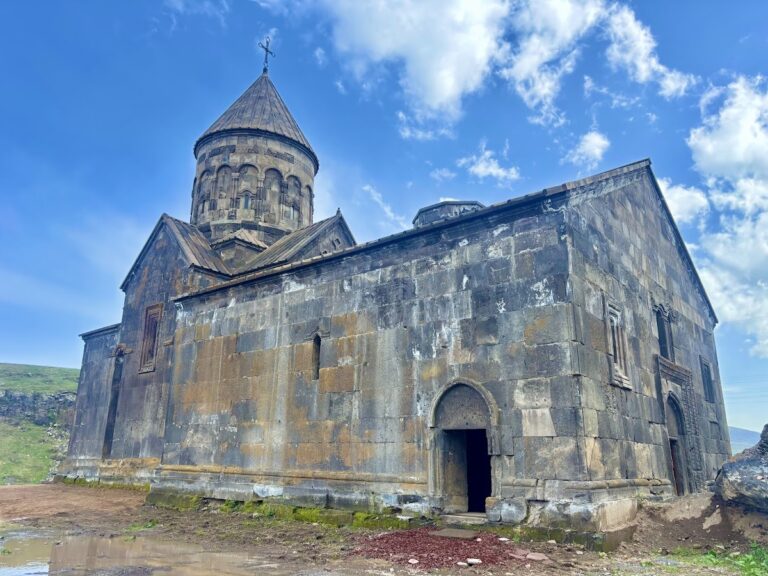
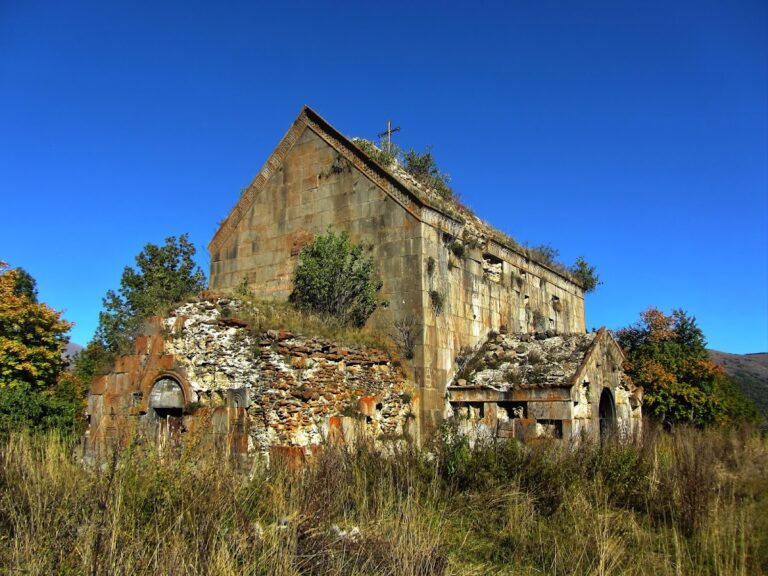
Aparan Basilica is a single-nave, undomed basilica built from large black and gray tuff blocks on a rectangular east-west plan. Its eastern end contains an interior horseshoe-shaped apse, a rounded or polygonal church termination that commonly contains the altar, while an exterior pentagonal apse projects beyond the main hall. The walls survive to their full height, together with the altar and remains of supports, vaults, arches, and portals. The principal surviving building stands near the sources of the Kasagh River and is the main surviving structure of its architectural complex.
Main basilica
Walls, entrances, and windows
The exterior has restrained but strongly articulated wall surfaces, with openings and projecting portals shaping the stonework and its patterns of light and shadow. Four entrances opened into the main hall, including three architecturally elaborate portals. Their lintels are regarded as exceptional examples of sculpture. Lighting came from one window in each of the east and west walls and from three stylistically ornamented windows in the south wall.
Roof and interior
The original vaulted roofs were lost during the medieval period. A roof was restored in 1877, while the later rebuilding used roof tiles whose forms reproduce surviving fifth-century tiles. The reconstructed interior contains a platform, a Holy Altar, and a baptismal font designed to correspond with the character of the building. Wall paintings of the four Evangelists and the Holy Altar were consecrated during the 2002 reconsecration.
Associated buildings and archaeological features
Northern structures and inter-church hall
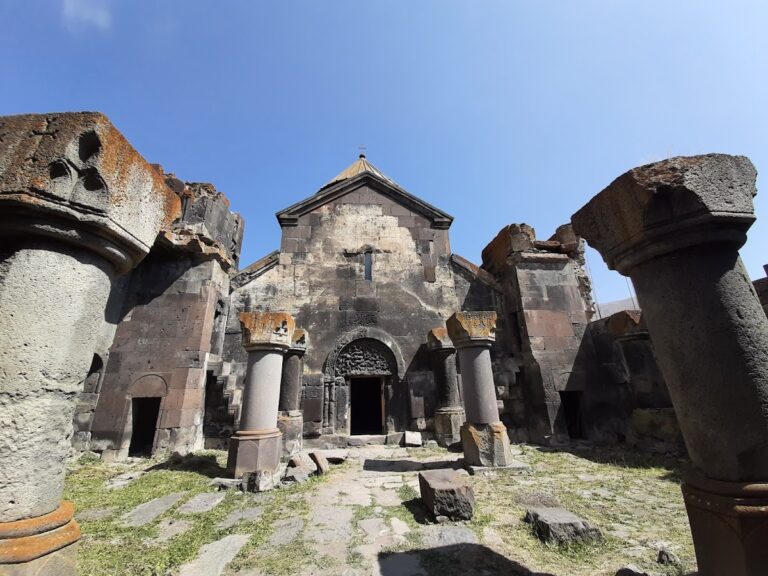
A hall was built between two churches in the complex and probably served as a school or seminary. An attached northern hall and the smaller church joined to its northern side are completely ruined, while the foundation walls of a fifth-century church survive. Excavations exposed both the attached northern structure and the single-nave basilica to its north. Architectural fragments indicate that the complex once contained further kinds of buildings, although their surviving remains are not part of the present structure.
Memorial monuments and excavated finds
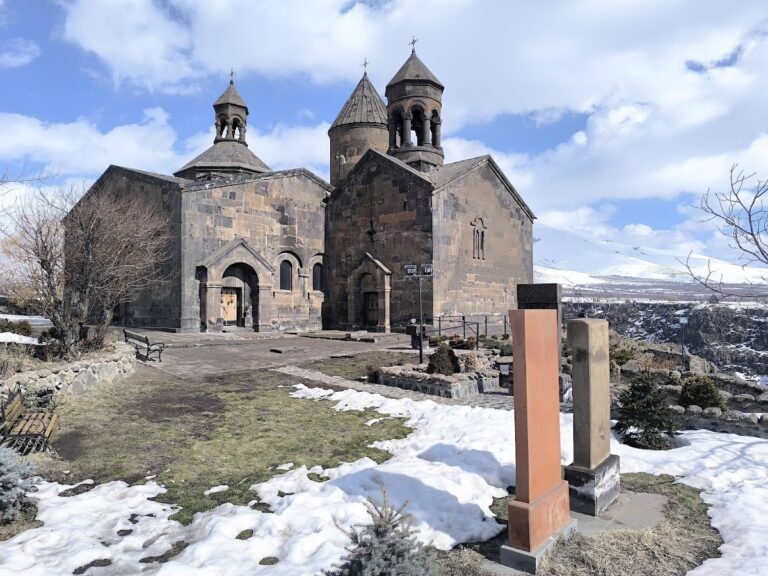
The complex was decorated with early Christian four-sided memorial columns and Armenian cross-stones, known as khachkars. A khachkar was found and reinstalled during the final landscaping and improvement works. Three sculpted capitals discovered in the excavations are now held in the State History Museum of Armenia.
The excavated objects include a gold tetradrachm, an ancient coin denomination valued at four drachms, issued under the Seleucid king Antiochus VII Euergetes. Other finds comprise Byzantine gold coins from the tenth century, Byzantine copper coins from the tenth or eleventh centuries, and Georgian copper coins associated with Queen Tamar.
Nearby sites