Antimachia Castle: A Hospitaller Fortress on Kos


Site at a Glance
- Rating
- 4.3
- Popularity
- Medium
- Country
- Greece
- Primary era
- Medieval
- Eras represented
- Medieval, Early Modern
- Civilizations
- Crusader, Knights Hospitaller, Ottoman
- Site type
- Military
- Remains
- Castle
On this page12 sections
History
Antimachia Castle is a medieval fortress on Kos, Greece, built by the Knights Hospitaller, a Catholic military-religious order that controlled Rhodes and nearby Aegean territories, in the fourteenth century. The first written reference names Grand Master Helion de Villeneuve as its builder between 1337 and 1346, although the fortress is believed to have occupied the site of an earlier Byzantine watchtower. It formed part of Kos’s defensive network with Neratzia and Paleo Pyli, controlling the island’s southern coast, the sea passage between Kos and Nisyros, and movement between the northern and southern parts of the island.
Hospitaller administration and refuge
In 1383, an assembly of the Hospitaller Order established Antimachia as a prison for knights convicted of serious crimes or abuses of authority. The fortress also became a refuge for people from nearby settlements during Ottoman pirate raids in the fifteenth and sixteenth centuries. After Neratzia and other defensive positions were abandoned, about 12,000 islanders withdrew to Antimachia, Paleo Pyli, and Kefalos.
The castle endured a major Ottoman siege in June 1457. Ottoman forces attacked for 23 days, while 15 Hospitaller knights and about 300 local inhabitants defended the fortress. Fifteen defenders were killed. Ottoman losses were approximately 1,000 dead and more than 2,000 wounded. The besieging army later plundered and heavily damaged settlements and buildings on Kos before withdrawing.
Rebuilding and Ottoman rule
An earthquake damaged the fortress in 1493. During the administration of Grand Master Pierre d’Aubusson, the Order considered replacing it with a fortress elsewhere, but economic considerations prevented the relocation. Repairs were completed in 1494. Further rebuilding and modification followed under several Hospitaller grand masters, including Helion de Villeneuve, Pierre d’Aubusson, and Fabrizio del Carretto. These interventions, together with later Ottoman changes, produced six construction and rebuilding phases.
After the Hospitaller defeat at Rhodes in 1522, the Ottoman Empire, the Turkish-ruled empire that took control of Kos at that time, incorporated the island and Antimachia Castle into its territory. A small Ottoman garrison occupied the fortress, and a mosque stood within its walls. The settlement inside the enclosure was abandoned during the nineteenth century as its inhabitants moved to nearby Antimachia. The Ottoman military presence ended in 1871.
Earthquake damage and protection
Two twentieth-century earthquakes transformed the surviving site. The earthquake of 8 February 1926 measured 5.4 on the Richter scale, while the earthquake of 23 April 1933 measured 6.6. Together they destroyed most of the remaining buildings. The fortress walls and two churches survived. Antimachia Castle is now designated an archaeological monument of Greece.
Remains
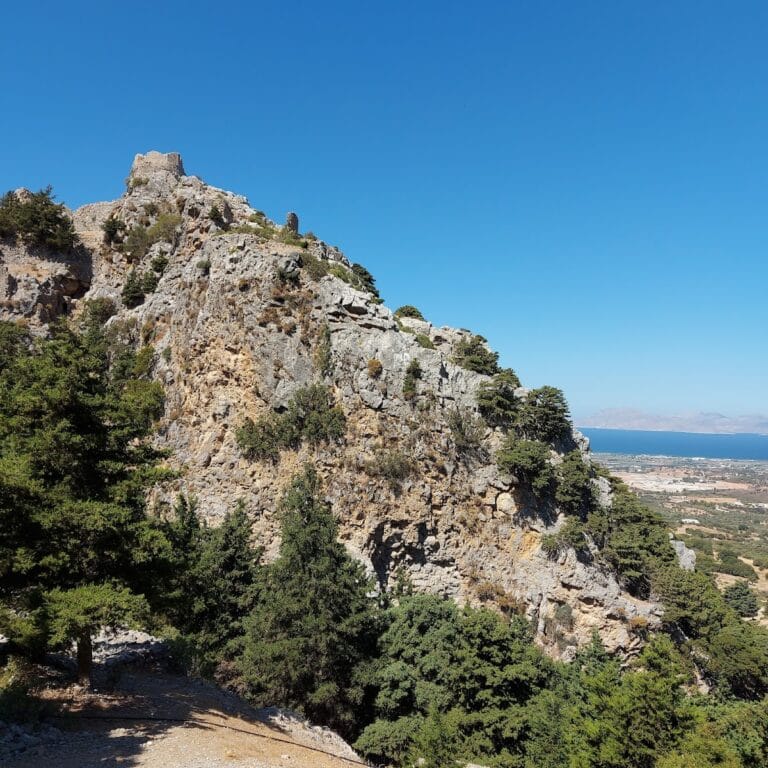
Antimachia Castle occupies a mountainous plateau in central Kos, about 3 kilometres from Antimachia and approximately 170 metres above Kardamena Bay. Ravines and cliffs surround the site, while its southern and eastern sections rest on rock. The enclosure covers about 2.625 hectares. A defensive wall approximately 970 metres long follows the terrain and creates an irregular polygonal plan.
Walls and entrance defences
The walls consist of layers of large natural stones bonded with lime mortar. Those on the northern side, where the ground is level, are more heavily fortified than the southern walls, which follow uneven rocky terrain. Crenellations, the raised sections of a battlement, and deep, sloping embrasures, or openings for observation and attack, form part of the defences. No major towers are distinguishable, and the enclosure was essentially towerless.
Principal entrance
The principal entrance lies on the northwestern side. A large horseshoe-shaped barbican, an external fortified work protecting an entrance, was added under Grand Master Fabrizio del Carretto and completed in 1520. A marble Hospitaller emblem is set above the entrance. Pierre d’Aubusson’s coat of arms and the date 1494 appear above the inner gate, marking the rebuilding of the walls. A stone slab bearing three coats of arms, including del Carretto’s, and the date 1520 was probably added later. The cornice indicates that machicolations, openings used for defence above an entrance, once stood above the gateway.
Religious buildings
Agios Nikolaos
The single-nave chapel of Agios Nikolaos has an apse, a rounded eastern end, and dates from the sixteenth century. Parts of its fifteenth- and sixteenth-century frescoes, wall paintings applied directly to prepared plaster, survive.
Agia Paraskevi
The single-nave church of Agia Paraskevi was built in 1705 and survived the twentieth-century earthquakes.
Panagia Eleimonitrias
Only ruins remain of the church of Panagia Eleimonitrias. A mosque also stood within the enclosure during the Ottoman period.
Settlement and water supply
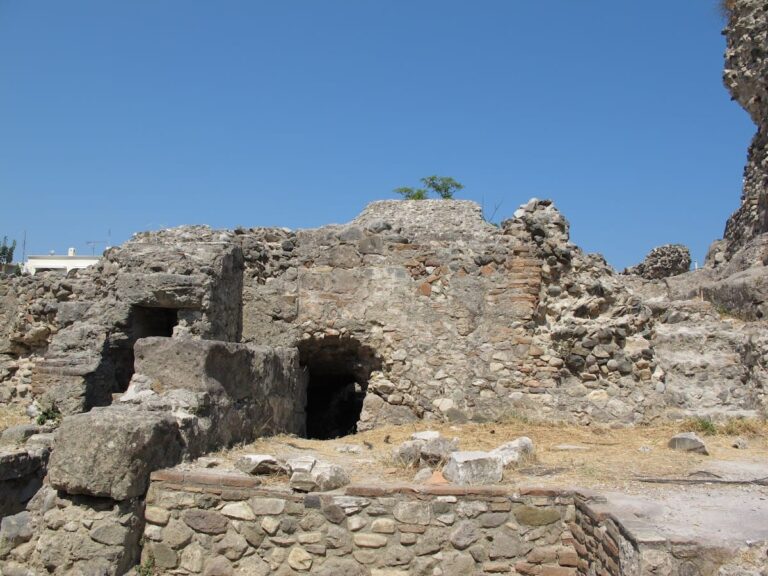
The size of the enclosure indicates that it contained a settlement. The fortress later incorporated the village of Antimachia, and ruins of the former settlement remain within and around the walls. Several water cisterns, built tanks for collecting and storing water, and the foundations of individual buildings survive inside the enclosure. Most internal structures were destroyed by the earthquakes of 1926 and 1933, while the two surviving churches and some cisterns remain among the principal elements of the interior.