Çandır Castle: A Medieval Armenian Fortress in Türkiye

Site at a Glance
- Rating
- 4.4
- Popularity
- Very Low
- Country
- Turkey
- Primary era
- Medieval
- External website
- Open
- Eras represented
- Medieval
- Civilizations
- Kingdom of Cilicia
- Site type
- Military
- Remains
- Castle
On this page6 sections
History
Çandır Castle is a medieval Armenian fortress in Türkiye, north of Mersin, at the site identified with Paperon, also known as Barbaron. Its earliest history remains uncertain, although many historians cautiously connect it with the Byzantine fortress of Papirion or Paperon mentioned in relation to Emperor Zeno in the fifth century. The traditional attribution of that fortress to Zeno includes the claim that he took refuge there during part of his flight, but archaeological evidence confirming the identification has not been found.
Armenian Cilicia and Het’umid power
Çandır rose to prominence between the twelfth and fourteenth centuries under the Armenian Kingdom of Cilicia, a medieval Armenian state in southeastern Anatolia and the eastern Mediterranean. During this period it became a center of Het’umid authority. The Het’umids were the kingdom’s ruling dynasty, and the castle’s position enabled it to control two routes toward Central Anatolia, including one leading to Lampron, another major Het’umid stronghold. This strategic position helped make Çandır an important political and military base.
The fortress served as a residence for Armenian nobles and kings. It was also the home of Sempad the Constable, a prominent nobleman, scholar, diplomat, and military official at the Cilician Armenian court. The title Constable referred to a high military office. After the Armenian period, control of the castle passed successively to the Karamanids, the Mamluks, and the Ottoman Empire.
Survey and present administration
Robert Edwards surveyed Çandır Castle in 1979, and his archaeological and historical assessment, published in 1987, included a detailed plan of the fortress. The property is now held by Türkiye’s Ministry of Culture and Tourism. A fire-watch facility was established within the castle by the General Directorate of Forestry, adding a modern function to the historic enclosure.
Remains
Plateau, entrance, and enclosure
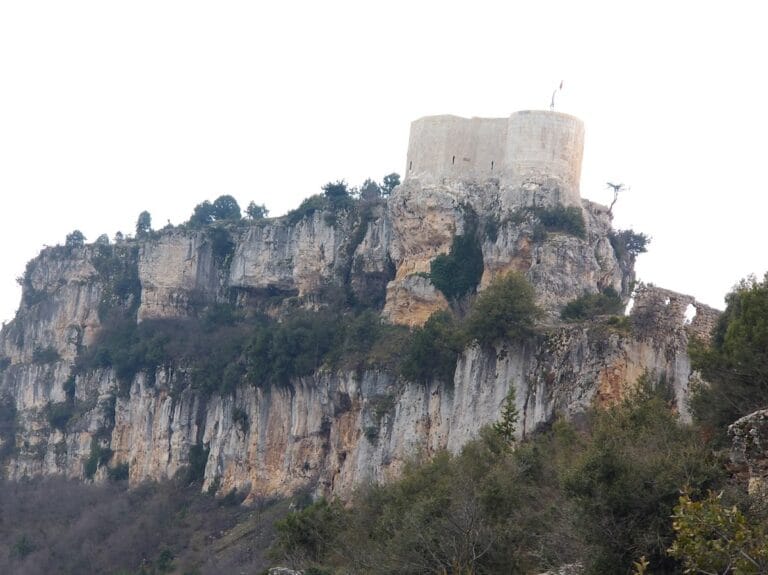
The fortress occupies an isolated, steep-sided plateau, or mesa, in the Taurus Mountains at about 1,125 metres above sea level. Located east of Ayvagediği and Gözne Castle and approximately 40 kilometres from Mersin, the elevated rock formation rises sharply above its surroundings. Its natural form apparently reduced the need for separately built defensive towers. Most walls and buildings are ruined, but parts of the fortifications and bastions survive within the extensive enclosure, which contains numerous building remains.
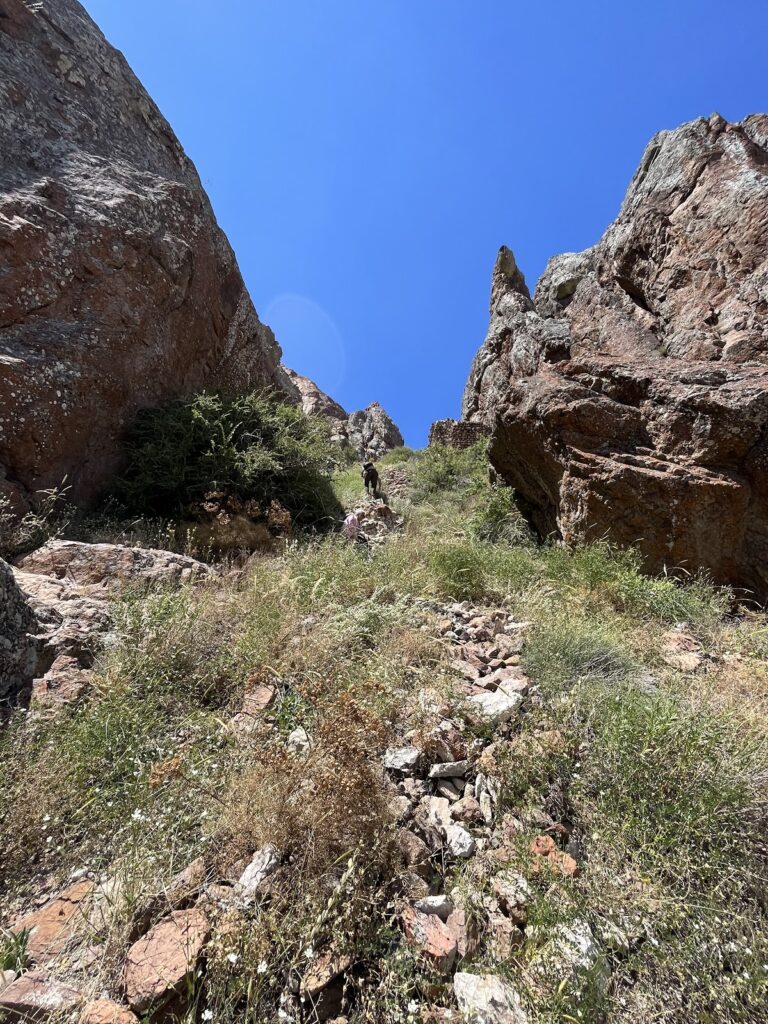
The sole entrance is reached by a narrow staircase cut into the plateau’s vertical side. The rock-cut passage has about 140 steps and is partly vaulted. A parallel inclined plane probably allowed goods to be hauled up to the fortress. Further stair remains on the southwestern side descend toward a natural water source, connecting the elevated enclosure with the surrounding terrain.
Principal buildings
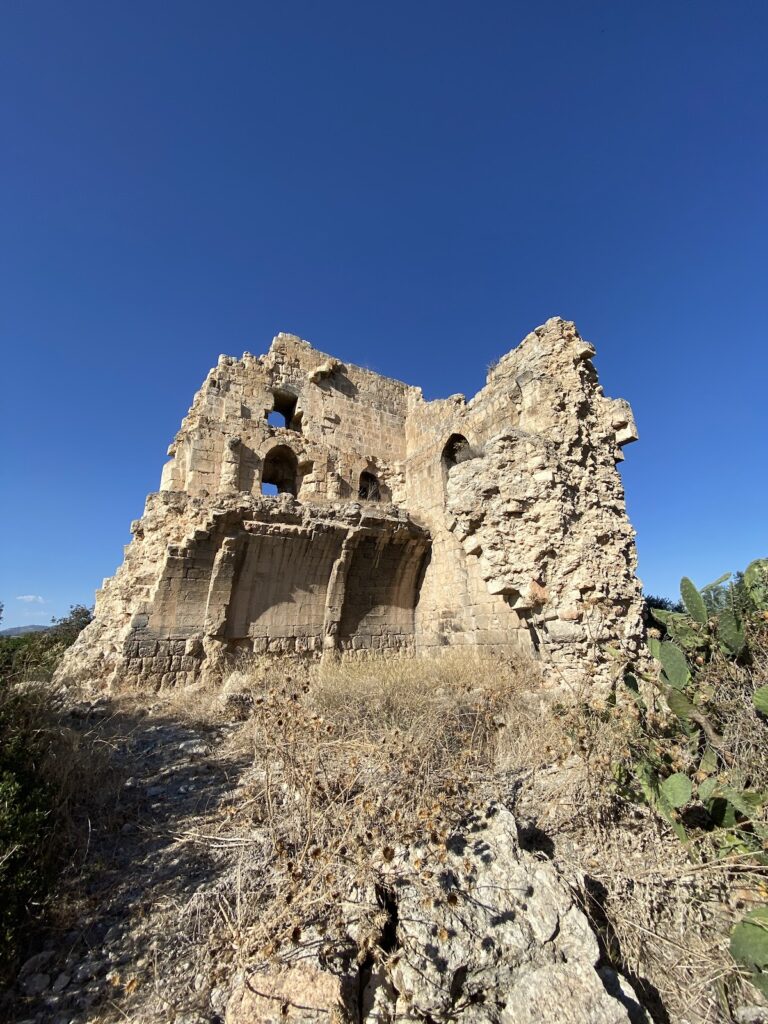
The two most prominent surviving buildings are a two-storey residence and a church. Both were constructed from finely executed polished stone. The church survives only in part. Its southern exterior wall carried an Armenian dedicatory inscription stating that Sempad the Constable completed the building in 1251 in honour of his father. The inscription was still present at least in the mid-1930s but had disappeared by 1946.
A small house for a fire warden was built inside the castle, and forestry authorities later established a fire-watch tower or facility there. These structures belong to the site’s modern use, while the ruined residence, church, enclosure, and access works preserve the principal physical evidence of its medieval Armenian occupation.