Ancient Baths at Royat: A Roman Bath Complex in France
Site at a Glance
- Popularity
- Very Low
- Country
- France
- Primary era
- Classical
- Eras represented
- Classical
- Civilizations
- Roman
- Site type
- Sanitation
- Remains
- Baths
On this page8 sections
History
Roman-period use
The ancient baths at Royat are a Roman bath complex whose surviving remains lie in Chamalières, France, about 3 km southwest of Clermont-Ferrand. Built in Roman Gaul, they stood in the territory of the Arverni, a Gallic people of central Gaul, and outside Augustonemetum, the Roman-period name for Clermont-Ferrand. Their construction date is unknown, but they were probably used during the High Empire, the earlier period of Roman imperial rule. Their status is uncertain, and they may have served a nearby secondary settlement that has not been confirmed.
Installations in the area point to ancient use of its hot springs. Cremation burials found at Chamalières and Royat may have belonged to the proposed settlement. The baths’ later history is unclear: their abandonment date is unknown, and their fate during the Late Empire, the later phase of Roman imperial rule, is not established.
Early accounts and modern investigations
The baths were mentioned from the fourteenth century. In 1575, the French writer François de Belleforest described their imposing walls. By the early seventeenth century, people recognized the remains as baths and called them “Caesar’s Baths.”
Work on a modern thermal establishment began uncovering ancient remains in 1852, but records were often imprecise and the locations of finds were poorly established. Expansions of the modern complex and construction of a railway viaduct in 1878 destroyed important remains without a prior survey. Alexandre Petit took part in excavations from 1878 to 1882 and made a plan of the visible remains in 1884. Still the most complete known plan in the twenty-first century, it depicts a complex that has never been fully excavated. The baths have been listed as a historic monument since 1889. A study begun in 2009 examined the standing masonry to check earlier records and distinguish original fabric from later restoration.
Remains
Layout and rooms
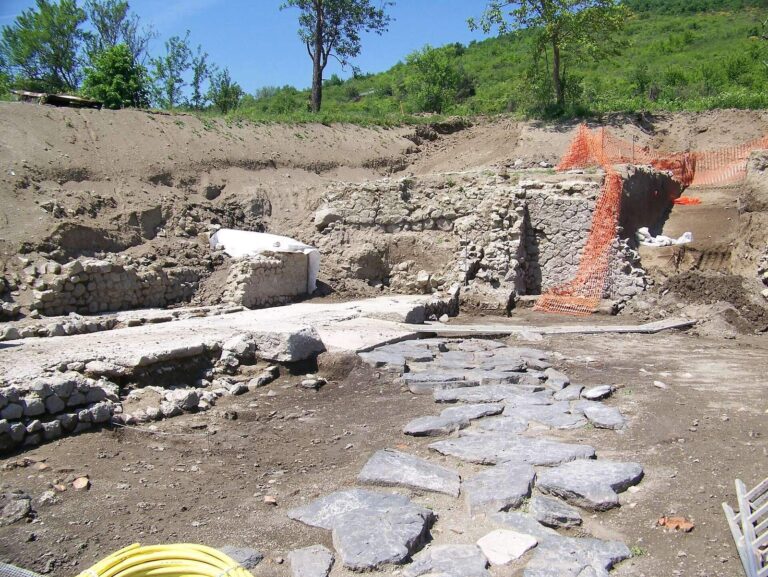
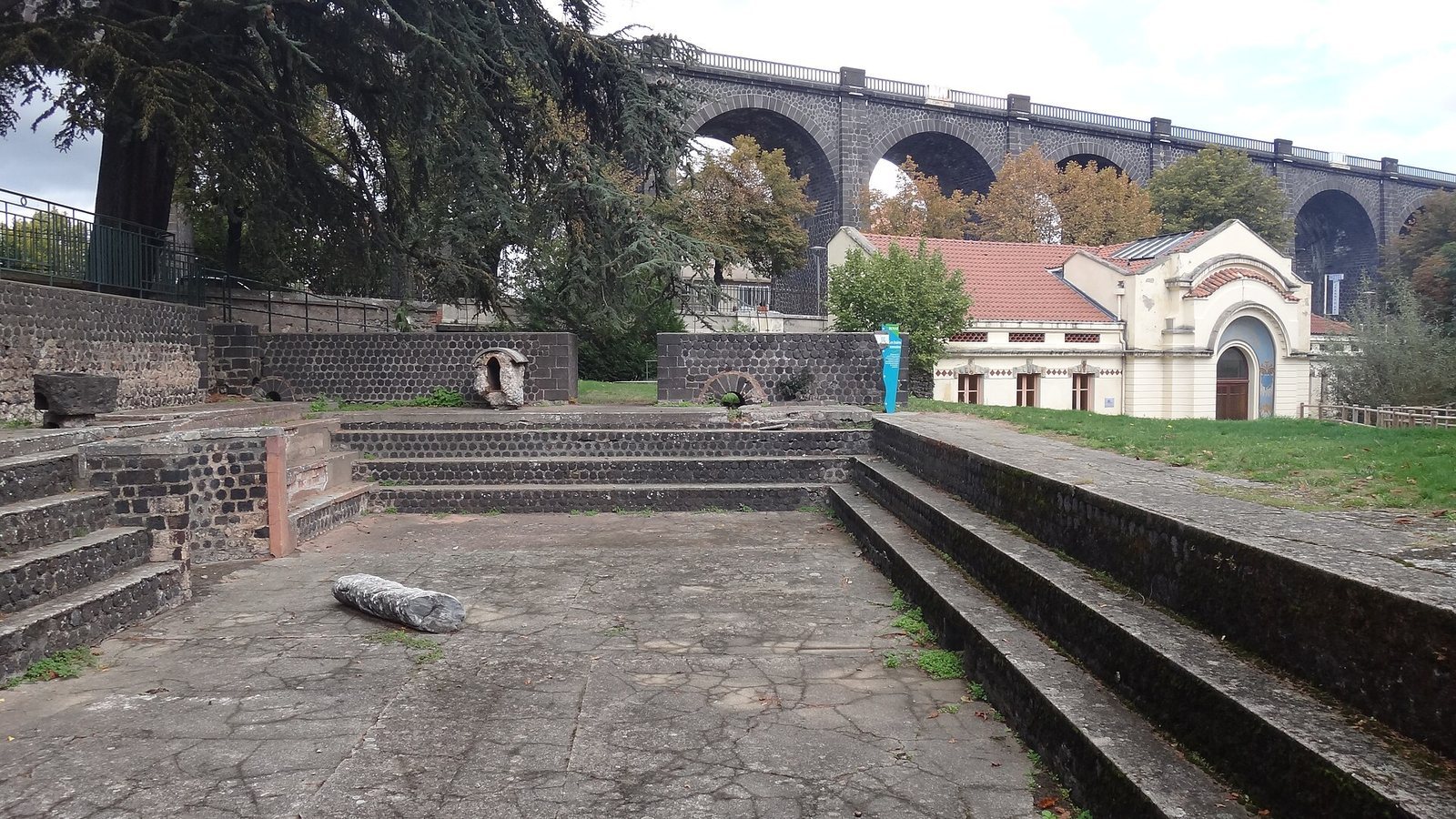
The baths are estimated to have covered 2,800 m², although only part of their full footprint has been identified. Three pool rooms formed a row, with four other rooms to the north. The surviving pool’s roughly dressed volcanic scoria blocks are arranged in a hexagonal pattern.
Pool rooms
The three rooms in the row are interpreted as cold rooms. One pool remains visible, measuring 16 by 8 m. Two steps run around its perimeter, and two rounded recesses are set into its western long side. Its masonry was covered with crushed-tile mortar and marble slabs. Reconstructed sections use different materials, and some openings do not always match their original positions. In the twenty-first century, part of a room adjoining the pool was also visible.
Rooms to the north
Underfloor heating in the four rooms north of the pool rooms indicates that they served as hot rooms. Two additional rooms may have been a warm room and a furnace room, though these identifications are uncertain.
River and thermal setting
The known ancient remains lie within present-day Chamalières. The modern thermal establishment extends across Royat and Chamalières, beside the Tiretaine River, and covers much of the ancient site. Five springs on both sides of the river are captured to supply the modern baths.