Allée couverte du cimetière aux Anglais: A Neolithic Passage Tomb in Vauréal, France
Site at a Glance
- Popularity
- Low
- Country
- France
- Primary era
- Stone Age
- Eras represented
- Stone Age
- Civilizations
- Unclassified
- Site type
- Burial
- Remains
- Tomb
On this page11 sections
History
Allée couverte du cimetière aux Anglais is a Neolithic covered passage tomb in Vauréal, France, associated with the Seine–Oise–Marne cultural group, an archaeological grouping of the region. The Neolithic was a prehistoric period associated with farming and polished stone tools. The tomb’s exact construction date is uncertain, but it was used as a burial place for about 1,000 years.
Neolithic burial and later traditions
The monument had been known locally for centuries and was partly plundered. It has been called the “Cemetery of the English” since the 14th century, a name associated with English occupation during the Hundred Years’ War, a series of conflicts between England and France from the 14th to the 15th centuries. The human remains found in the tomb are Neolithic. The name may also reflect a possibility that English forces buried important people there during the war and the siege of Pontoise, but this explanation is unconfirmed.
A local monograph proposed that Carneaux, the place-name, came from Latin words meaning “flesh” and connected the tomb with sacrifice by Druids, religious specialists in ancient Celtic societies. This antiquarian interpretation is not evidence that sacrifices took place at the monument.
Excavation and recognition
An excavation in 1827 exposed an archaeological layer that remained fairly intact despite earlier plundering. The French antiquarian and historian Amédée de Caix de Saint-Aymour excavated the site in 1867. Archaeological investigations took place during the 1970s, followed by further excavations in 2018 and 2021.
The tomb appears on Vauréal’s coat of arms, created in 1943. It was classified as a French historic monument in 1969 and restored in 1972.
Remains
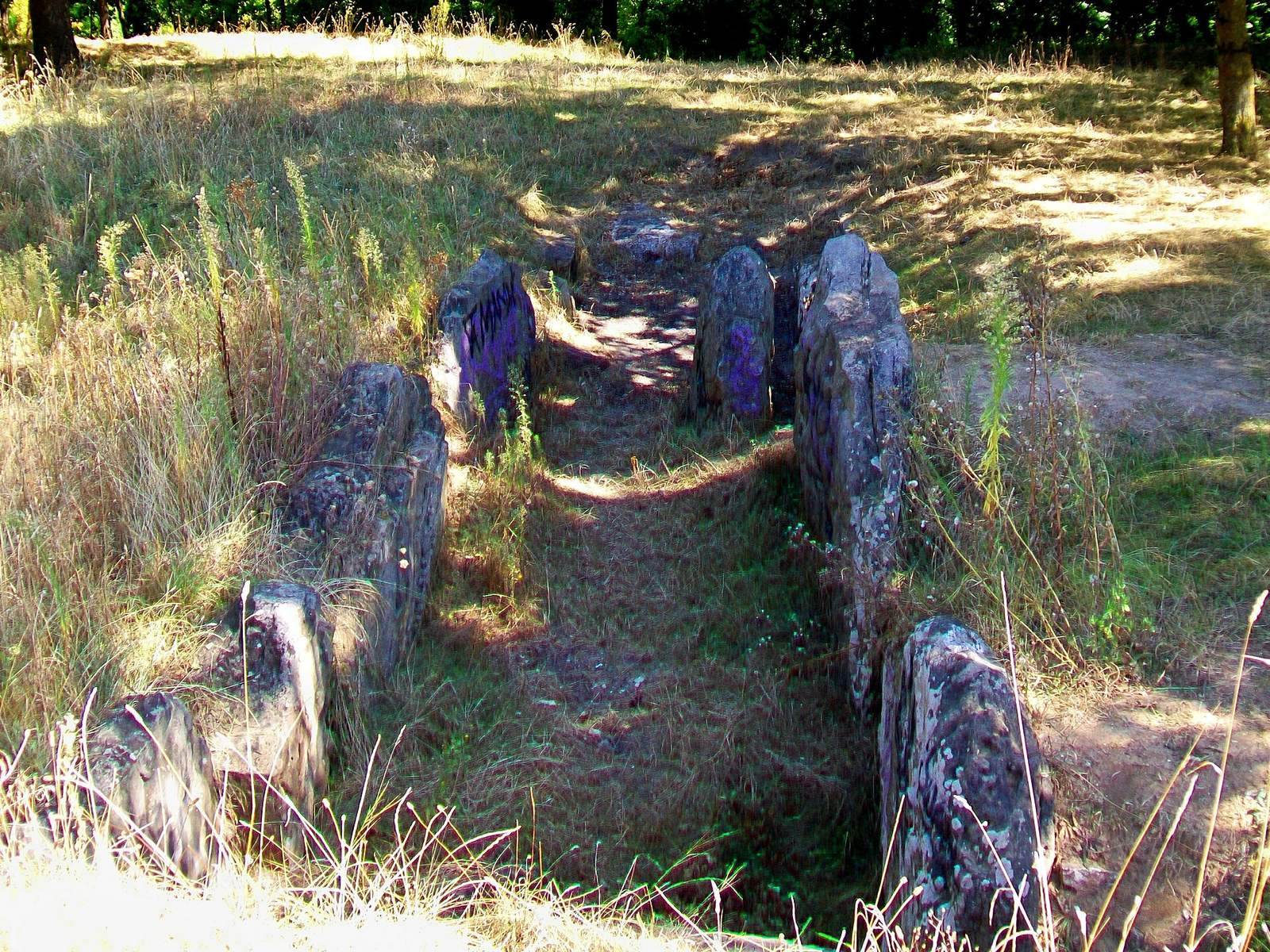
The monument survives as a long stone chamber aligned east–west, near the top of a hillside in the Bois des Loctaines, at a place called Carneaux. At about 85 metres above sea level, it overlooks a bend in the Oise. Its entrance faces east toward the valley.
Chamber and construction
Stone chamber
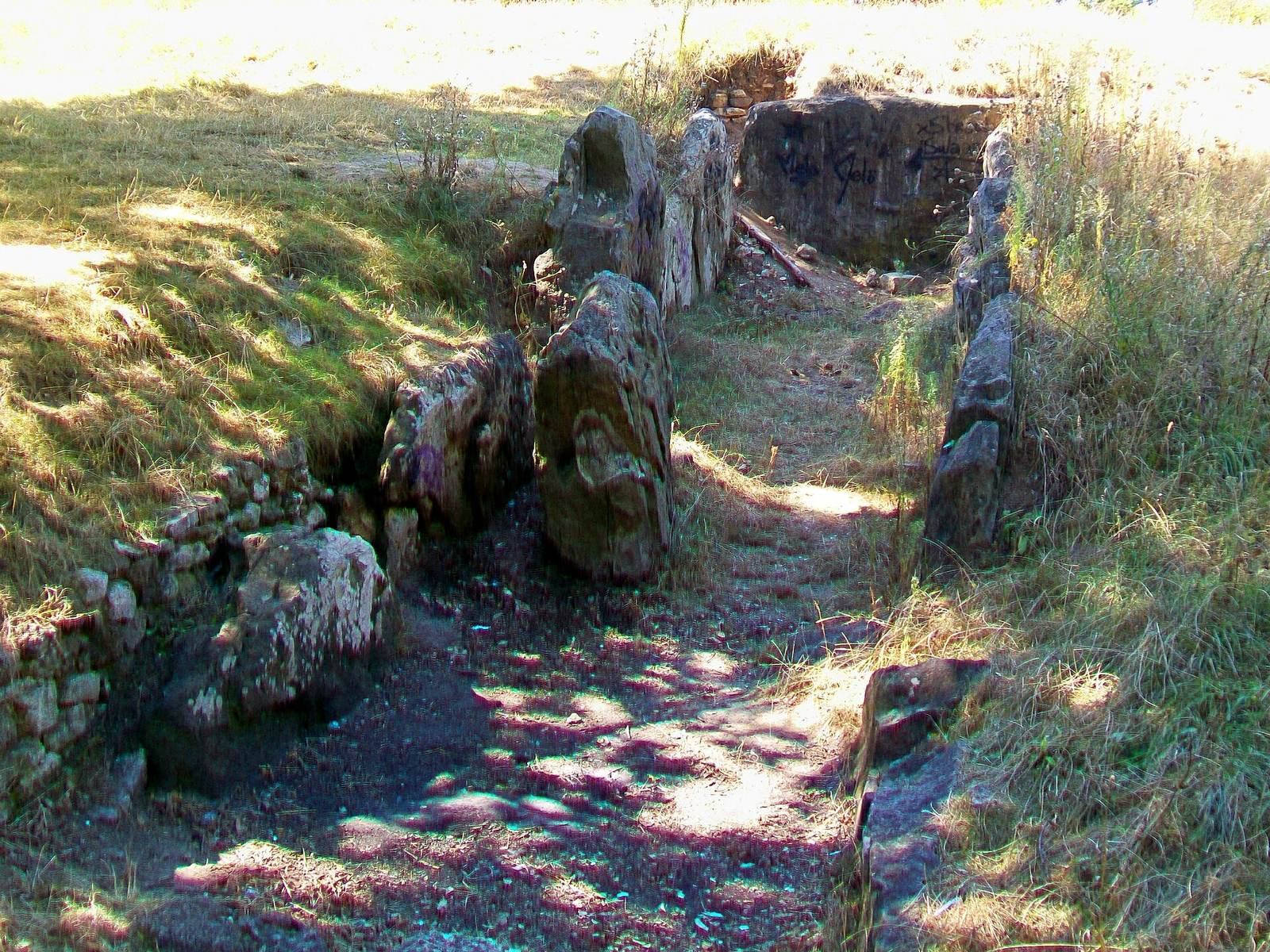
The surviving chamber is described as about 14 metres long and 2.3 metres wide. More precise measurements give a north side of 13.10 metres and a south side of 12.40 metres, with a width of about 2.40 metres. Its walls are made from large upright stones, including three more than 3 metres high and two more than 2 metres high. The stones are sandstone from the Bartonian, a stage of the Eocene. Most are local layered sandstone; two mottled stones came from the Hautil massif and may have been chosen for their appearance. Some slabs weigh as much as 5 tonnes.
The upright slabs rest on limestone plates. Stonework fitted without mortar reinforces parts of the walls, probably to stabilize the sandy ground, and smaller fitted stones fill gaps between slabs. One massive end slab is about 3 metres wide, 2 metres high above ground, and 0.50 metres thick.
Floor and partitions
Two low cross-walls made of stone fitted without mortar divide the chamber into three sections. They stand about 0.50 metres high, level with the floor, and were intended to limit erosion. The floor was paved throughout with stone slabs, two of which were uncovered in 2018. The tomb is also described as originally having three chambers separated by partitions.
Entrance and roof
The entrance slab is made of fine-grained limestone. It has an opening about 0.60 by 0.45 metres, shaped like an oven mouth and framed by a recessed border. A smaller hole, about 10 centimetres high and 8 centimetres wide, lies roughly 25 centimetres below the slab’s top and may have formed part of a closing system. An engraving on the slab may depict a boat. Fragments of the original were found several hundred metres north of the tomb during work in the 1970s. The original is held at the museum in Guiry-en-Vexin, and a concrete copy stands at the site.
Beam sockets in the upright stones suggest that a wooden roof preceded a stone covering. A plan drawn in 1827 shows four slabs crossing the chamber, which may have been roof fragments. The roof stones may have been taken for building material well before the 1867 excavation. The tomb was probably once buried beneath the surrounding sandy soil; erosion later stripped this away and exposed the entrance from the valley.
Burials and grave goods
Human remains
The archaeological layer was 0.30 to 0.40 metres thick and contained human bones, flint, charcoal, and other objects. Many of the bones remained in anatomical position, and five skeletons lay against the chamber walls. An early estimate based on 25 skulls and long bones put the number of burials at about 40. Later assessments attributed remains of at least 75 people to the excavations. More than 2,000 teeth were recovered and assigned to 43 individuals; investigations in the 21st century brought the identified total to about 100. Allowing for bones that have disappeared, an estimated 300 to 400 people may have been buried in the tomb during its use.
Most of the individuals were adults, though children were also buried there. The oldest were about 60 to 65 years old, and most appear to have died at an advanced age. Signs of violent death are rare. Some bones show osteoarthritis, one case of tuberculosis was identified, and one skull bears a hole made by trepanation, a procedure that opens the skull.
Objects buried with the dead
Grave goods included polished stone axes, flint cores, dagger fragments, and arrowheads, as well as ornaments such as beads and pendants. Finds also included an axe-shaped fibrolite amulet. One female skeleton retained a complete necklace of nearly 300 beads made from bone, horn, and slate, together with a jadeite axe amulet. Objects from the tomb are held at the Val-d’Oise departmental archaeological museum in Guiry-en-Vexin. Material collected by de Caix is held at the museum in Senlis.