Velenje Castle: A Medieval Fortress and Museum in Slovenia


Site at a Glance
- Rating
- 4.7
- Popularity
- Medium
- Country
- Slovenia
- Primary era
- Early Modern
- External website
- Open
- Eras represented
- Medieval, Early Modern
- Civilizations
- Duchy of Styria, Habsburg, Holy Roman Empire
- Site type
- Domestic
- Remains
- Castle
On this page7 sections
History
Velenje Castle is a medieval hilltop fortress above Velenje in Slovenia, built in the mid-13th century and later transformed into a Renaissance residence. Construction is dated to around 1270, while a document from 1264 already records the castle as the property of the Königsberg family, known in Slovene as the Kunšperk family. Together with the nearby Šalek and Ekenštajn castles, it controlled routes from the Celje Basin toward Carinthia.
Medieval origins
The castle belonged to a succession of noble families during the Middle Ages. In 1322, Friedrich von Königsberg pledged it to Herdegen and Friedrich von Pettau. Ownership later passed among the Pettau, Lichtenberg, Wagen von Wagensberg, and von Sauer families, as well as lower-noble owners. Archaeological excavations also show that prehistoric communities inhabited the Šalek Valley before the castle was built. Since the Middle Ages, the valley has been known as the “Valley of Castles” because more than twenty castles were constructed there.
Religious and architectural change
The Lichtenberg and Wagen von Wagensberg families supported Lutheranism, the Protestant Christian movement associated with the reforms of Martin Luther, in the Šalek Valley. The Wagen von Wagensberg family also reshaped the medieval fortress into a Renaissance residence, introducing a style based on classical forms, arcades, and more comfortable aristocratic interiors. The von Sauer family completed these alterations after purchasing the castle in 1603. They retained it until 1797.
Later owners and public use
During the 19th century, Velenje Castle successively belonged to representatives of the lower nobility, briefly to the de la Fontaine d’Harnoncourt-Unverzagt family, and then to Karl and Bianca Adamovich de Csepin. The Adamovich de Csepin family sold it in 1918 to the Coronini von Cronberg family of Gorizia, the castle’s last private owners. It served as the summer residence of the Counts Coronini until 1943, when the German authorities evicted its occupant.
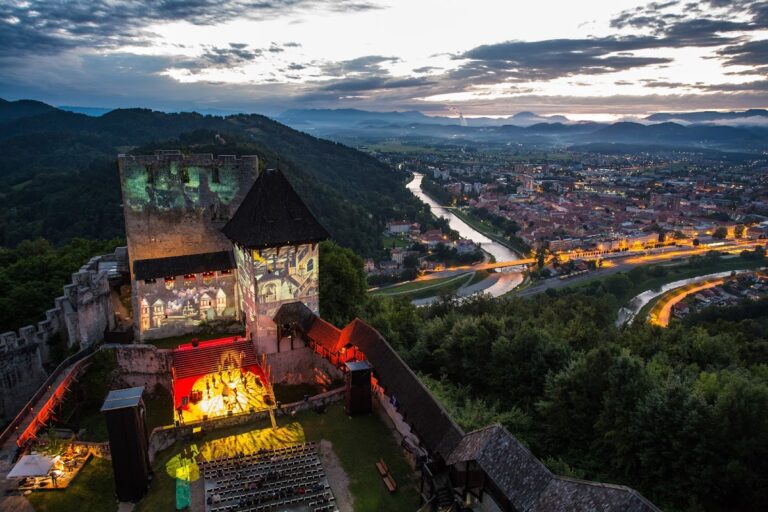
After the Second World War, the castle became government property. Further renovation took place after 1957, and the building now houses a museum of art and culture with permanent exhibitions. The castle precincts are also used for cultural and music festivals.
Remains
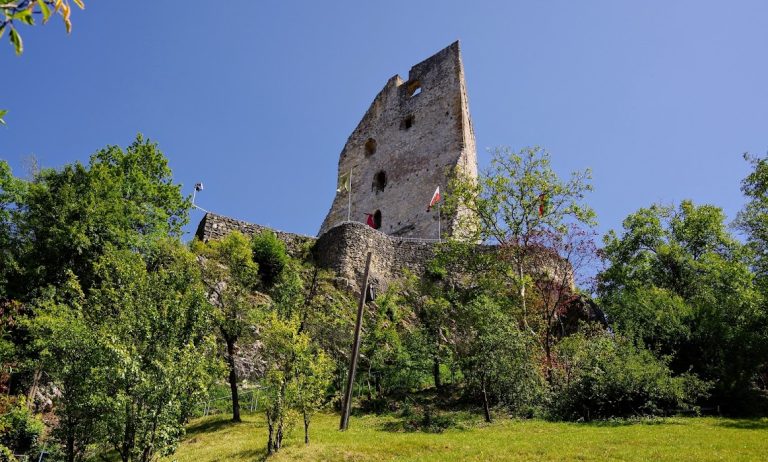
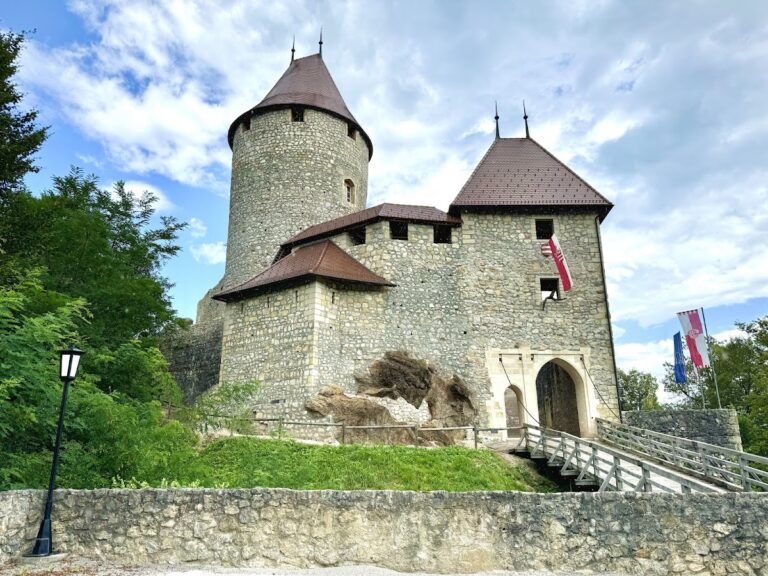
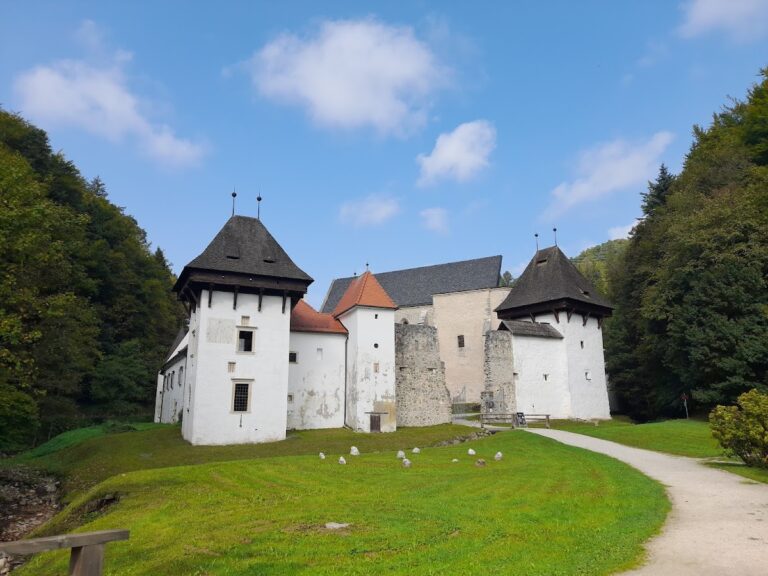
Velenje Castle occupies the summit of a rounded hill west of Velenje and follows the natural shape of the ground. Its enclosing wall has five projecting points and surrounds a large courtyard. The surviving complex combines elements of the irregular medieval fortress with the expanded residential layout created during the Renaissance.
Fortifications and residential complex
The original mid-13th-century fortress had an irregular plan, a small tower in the northwestern corner, and a narrow residential building along its southern side. A substantial round defensive tower was added at the southwestern corner during the Late Gothic period, the later phase of medieval Gothic architecture. It remains the principal surviving reminder of the medieval building phase.
During the High Renaissance, the mature phase of Renaissance architecture, the castle acquired the basic form visible today. Renaissance arcades were added, the enclosing wall was enlarged with a roundel, a rounded projection incorporated into a defensive wall, and an eastern extension was built. The northern wall was demolished and replaced by a new wing containing a staircase that has continued to provide access to the interior. Residential buildings occupy the southeastern corner and include basement cellars.
The courtyard contains a well, a large flowerbed, and an elegant arcade. A triangular defensive fortification or tower forms part of the northeastern wall. A flag commemorating the Wagen von Wagensberg family stands in the courtyard, while the coat of arms of the Adamovich de Csepin family is set into the southern wall of the residential wing.
Museum collections and displays
The castle museum includes galleries with 1,000 African art objects donated by the Czech-born sculptor Frančišek Foit. The collection includes furniture, jewelry, musical instruments, masks, puppets, and carved sculptures. Other displays present contemporary art by Slovenian artists and objects connected with the history of the Šalek Valley from the Roman period through the Middle Ages and the Baroque era, a later European style known for elaborate decoration and richly ornamented religious and secular works.
The museum also preserves remnants of two mastodons and Baroque works from St. George’s Church in Škale. Reconstructed representations of a 20th-century grocer’s shop and a 1930s inn, together with a model of a coal mine, interpret aspects of regional life and industry. The Slovenian Coal Mining Museum lies near the castle and includes deep coal-mining shafts presented as visitor attractions.
Nearby sites