Alba Iulia Fortress: A Habsburg Star Fortification in Romania


Site at a Glance
- Rating
- 4.8
- Popularity
- Very High
- Country
- Romania
- Primary era
- Early Modern
- External website
- Open
- Eras represented
- Early Modern
- Civilizations
- Habsburg
- Site type
- Military
- Remains
- Citadel
On this page7 sections
History
Earlier Fortifications
Alba Iulia Fortress stands on the sites of two earlier strongholds. The first was the Roman legionary fortress of Apulum, occupied by Legio XIII Gemina, a Roman military unit associated with the settlement. A medieval citadel later occupied the same location and was known as Belgrad, also rendered as Balgrad.
Habsburg Construction
The present fortress was constructed under Habsburg rule in Transylvania. Work began on 4 November 1715 and was completed in 1738, during the reign of Charles VI, the Habsburg ruler and Holy Roman Emperor after whom the citadel was named. The fortress formed a strategic defensive point on the military frontier against the Ottoman Empire. About 20,000 serfs took part in its construction, which was estimated to cost 3 million florins.
Conservation
Restoration and conservation have returned the fortress to a restored condition. These interventions helped preserve the Habsburg citadel and the layers of earlier fortification beneath it.
Remains
Fortifications and Gates
The fortress occupies the center of Alba Iulia and has a star-shaped plan with projecting bastions. Its defenses follow the Vauban style, a system in which angled bastions allowed defenders to cover the walls with intersecting fire. The fortifications were built over the remains of the Roman camp of Apulum and the medieval citadel. Gate I is one of the named gates within the surviving citadel complex.
Buildings within the Citadel
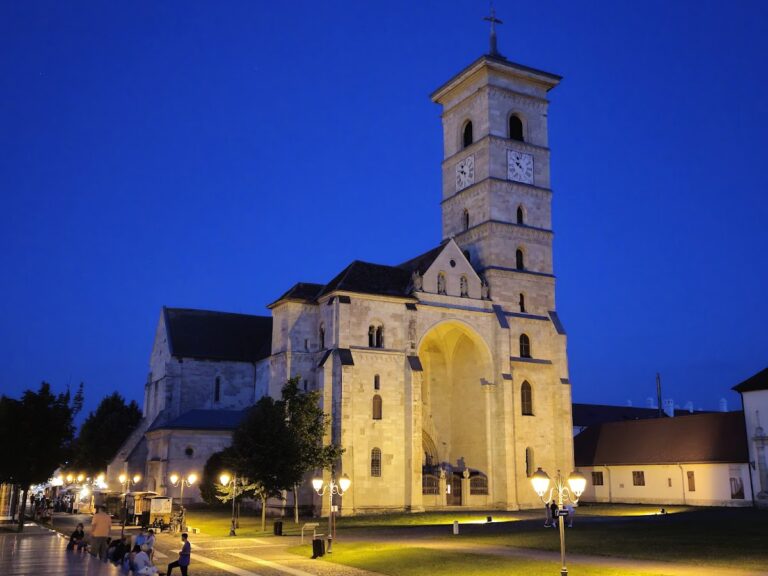
The built remains include a Catholic cathedral, an Orthodox cathedral, and the National Museum of Union. A university occupies the former Apor Palace, while the former Commissariat has been adapted for use as the Hotel Medieval. Together, these structures form part of the architectural complex contained within the fortress.