Rockfleet Castle: A Sixteenth-Century Tower House in Ireland


Site at a Glance
- Rating
- 4.3
- Popularity
- Low
- Country
- Ireland
- Primary era
- Early Modern
- Eras represented
- Early Modern
- Civilizations
- English
- Site type
- Military
- Remains
- Castle
On this page8 sections
History
Rockfleet Castle is a sixteenth-century tower house in Ireland, near Burrishoole west of Newport in County Mayo. Built around 1550, it combined domestic accommodation with defensive features and later became closely associated with Gráinne Ní Mháille, widely known in English as Grace O’Malley, a sixteenth-century Irish maritime leader linked to the O’Malley clan and resistance to English authority.
Construction and the Burke family
The castle was built in the middle of the sixteenth century for Sir Richard Burke, also known as Richard de Burgo. He held land around Burrishoole and the nearby Dominican monastery. His Irish nickname, “Iron Dick,” may have been connected with his ownership of a nearby ironworking facility.
In 1566, Richard Burke married Gráinne Ní Mháille. She initially lived with him at Rockfleet and used the tower as a refuge. Her fleet of twenty ships was based there, an association that may have contributed to the castle’s name and helped give the site strategic importance.
Gráinne Ní Mháille at Rockfleet
After Burke died in 1583, Gráinne continued to live at Rockfleet. When the English captured part of her fleet and her brother, she entered negotiations to secure his release. She later abandoned her resistance, and Rockfleet consequently lost its former strategic importance.
The castle passed to the Arbuthnot family in the eighteenth century. During the first half of the twentieth century, Owen O’Malley, a direct descendant of Gráinne Ní Mháille, bought the deteriorating building and restored the tower after the Irish Civil War. The property later came into the possession of a United States ambassador to Ireland.
Memory and protection
It has been suggested that Gráinne Ní Mháille may have died at Rockfleet, although this remains uncertain. A local legend says that treasure once kept in the castle was buried in the surrounding fields. According to the story, anyone who finds it encounters the Headless Horseman and suffers disastrous consequences. Rockfleet is listed as an Irish National Monument under the Guardianship category, a legal arrangement for the protection and care of a historic or archaeological site that does not necessarily mean the State owns it. The castle is also identified as privately owned.
Remains
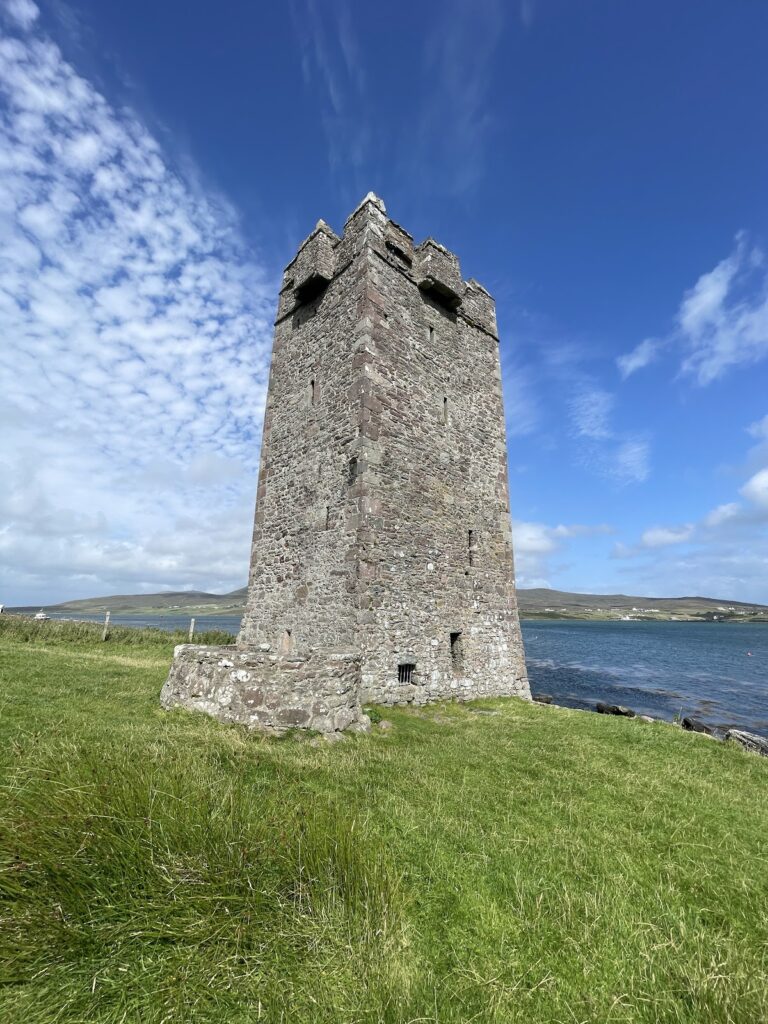
Rockfleet is a square stone tower about 18 metres high, standing at the mouth of a narrow sea inlet on the northern shore of Clew Bay, roughly seven to eight kilometres west of Newport. It faces the drumlins of Clew Bay and occupies ground affected by recurring high tides, flooding, waterlogging, and marsh formation. These conditions made a sustained siege difficult. The building is principally constructed of stone, with brick also among its materials.
Tower and defensive openings
The four-storey tower has thick masonry walls and limited openings. Its principal openings are narrow loopholes or gun slits, while the upper living quarters are arranged within the tower. The structure is crowned by a gabled roof and parapet. Two small masonry turrets project above the parapet. These are bartizans, or small projecting turrets that provided defensive positions and views over the surrounding area.
Interior arrangement
The floors are made from thick oak planks. Access from the ground floor to the first floor is through an opening in the ceiling reached by an ordinary wooden ladder, while stone spiral stairs connect the higher storeys. A fireplace on the uppermost floor indicates that this level probably served as the principal living area for the occupants.
Access and repair
A metal footbridge was installed in 2015 from the adjacent meadows to the entrance because high tides made the doorway particularly difficult to reach. Exterior repair work in 2017 improved deteriorated brick joints.
Nearby sites