Agios Athanasios Macedonian Tombs: A Funerary Complex in Greece
Site at a Glance
- Popularity
- Medium
- Country
- Greece
- Primary era
- Classical
- Eras represented
- Iron Age, Classical, Medieval
- Civilizations
- Byzantine, Kingdom of Macedon
- Site type
- Burial
- Remains
- Necropolis
On this page14 sections
History
The Agios Athanasios Macedonian Tombs are a funerary complex near Thessaloniki, Greece, with monumental chamber tombs built in ancient Macedonia, including examples dated to the late fourth century BC and façades in Doric and Ionic forms. A Macedonian tomb is a monumental chamber grave associated with ancient Macedonia, often covered by an earthen mound. The wider necropolis preserves burials from the Archaic period, before Classical Greece; the Hellenistic period, after Alexander the Great; and the Byzantine period, when the Eastern Roman Empire ruled from the medieval era.
Ancient funerary landscape
The necropolis reflects funerary activity over a long span of time. In the Macedonian era, the surrounding territory belonged either to Heraclea or to Chalastra. Nearby Toumba Topsin was occupied from the Neolithic through the Hellenistic period and probably marks the location of ancient Chalastra.
Archaeologist David Grant has proposed that the necropolis may have served as the burial ground of the Antipatrids, a Macedonian ruling family descended from Antipater, a general and regent under Alexander the Great. This remains a proposal rather than an established identification.
Excavation and protection
Archaeological investigation began in 1966 under Greek archaeologist Fótis Pétsas. The other two mounds came to attention during road construction between Thessaloniki and Veria in the 1960s. Greece designated the complex an archaeological site in 1969. A cist tomb, a burial chamber made from stone slabs, beneath the third mound was briefly examined in 1980; a Macedonian tomb there, later called Tomb IV, was identified in 1982.
Large-scale excavations in the Agios Athanasios area began in 1992, led by the 16th Ephorate of Prehistoric and Classical Antiquities, a regional Greek archaeological service. The work followed Thessaloniki’s selection as European Capital of Culture for 1997. Investigators first concentrated on the initial mound, continuing there through 1993. They discovered Tomb III on the principal mound in spring 1994, then carried out a major excavation of the third mound in summer 1995, studying its main tombs and Byzantine graves.
Structural and presentation work on the principal mound in the mid-2010s provided protection from the weather and improved the monument’s condition.
Remains
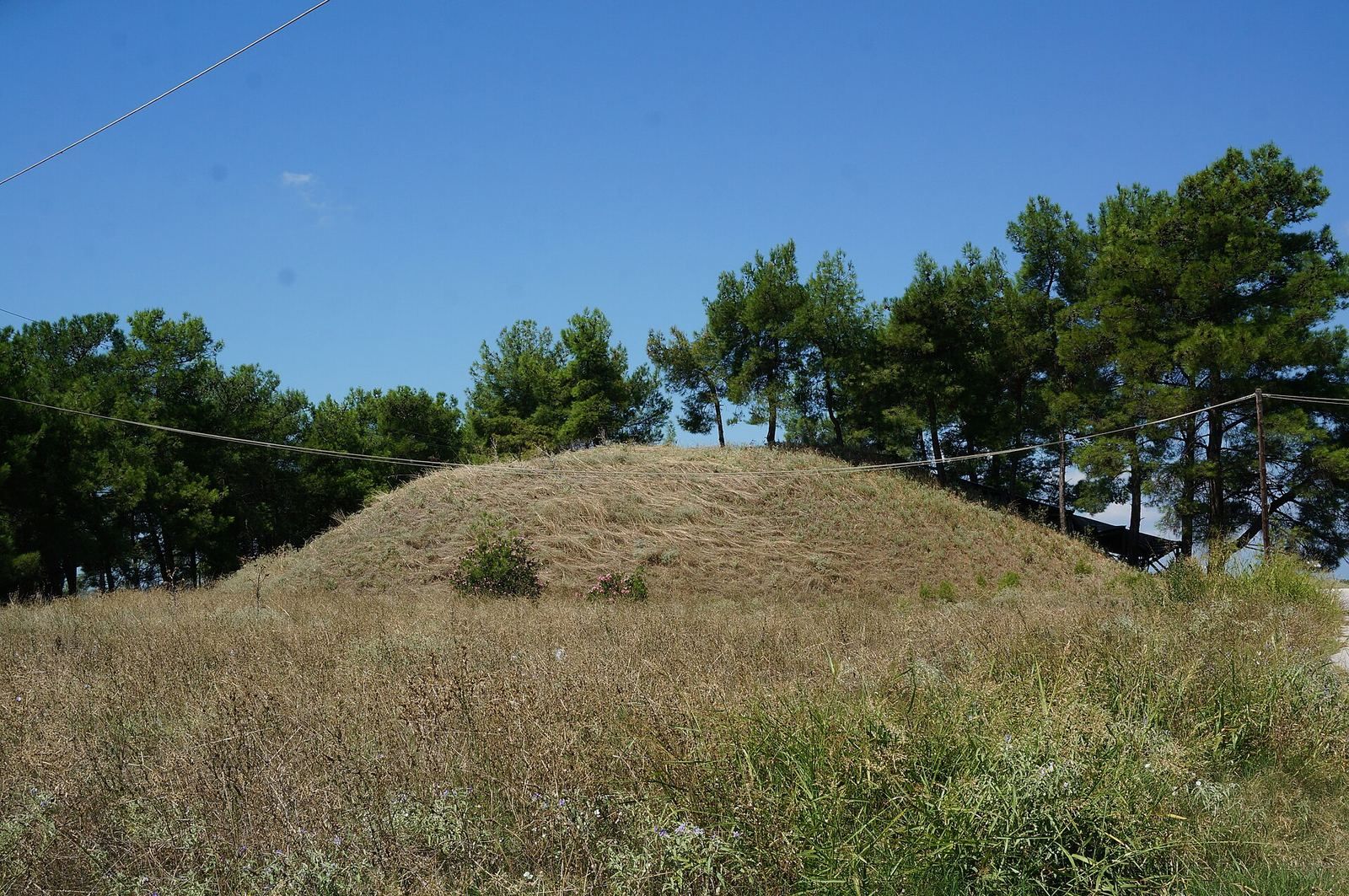
The necropolis is arranged across three earthen mounds, about 20 km west of Thessaloniki. Together they contain four Macedonian chamber tombs and numerous other ancient and Byzantine burials. The first mound lies about 800 m northeast of Toumba Topsin, across the A1 motorway. The principal, second mound stands about 2.7 km southeast of the first, and the third is about 600 m southeast of the second.
First mound
Tomb I
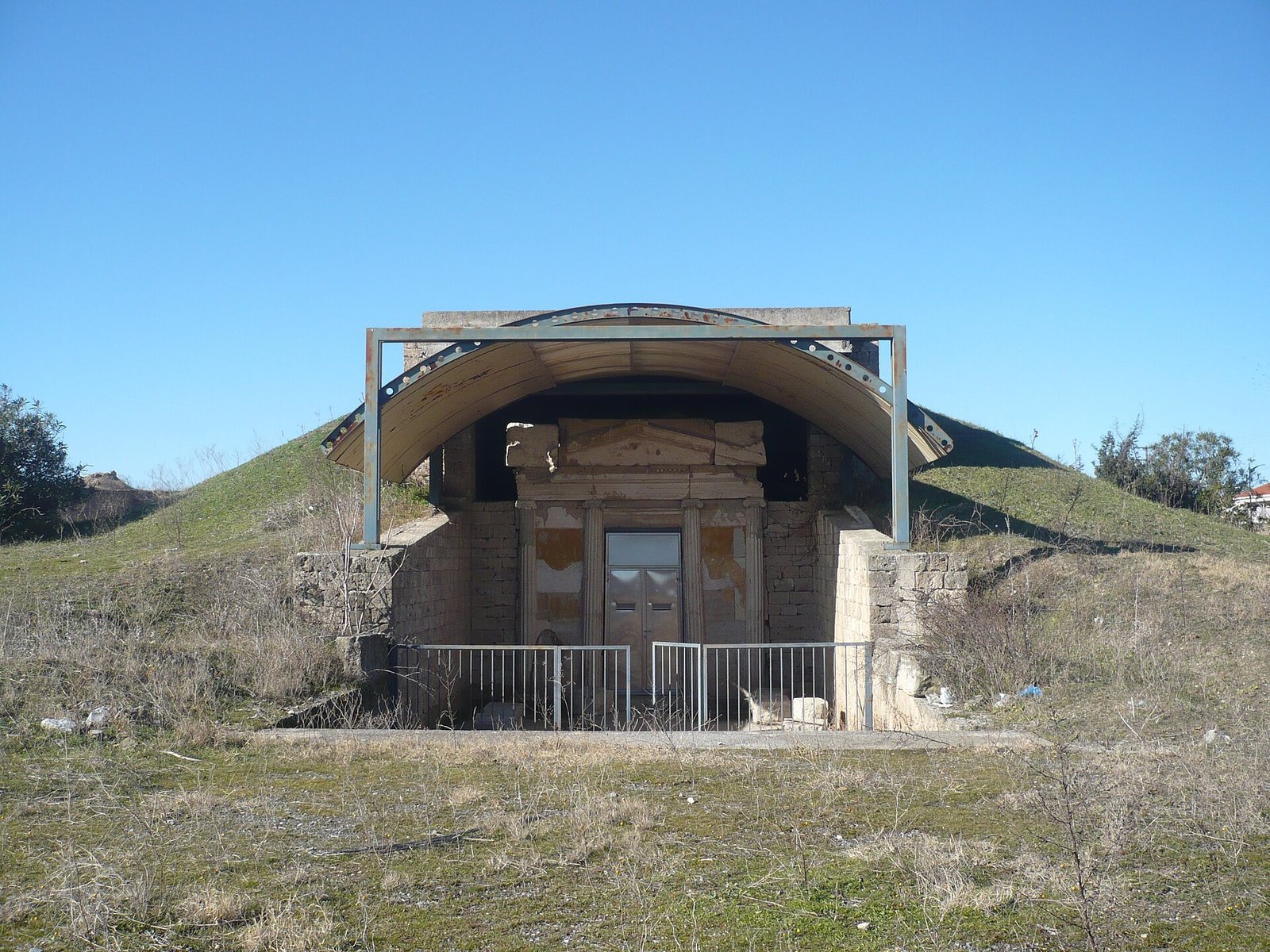
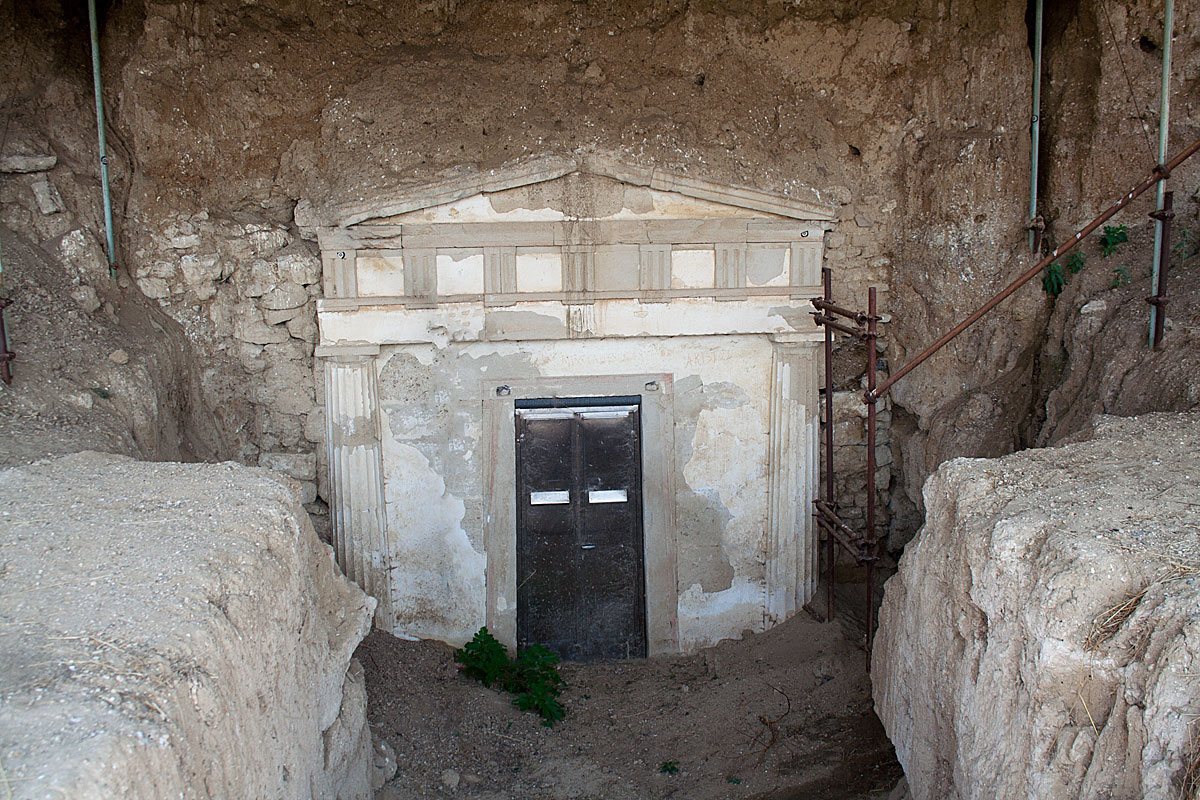
Tomb I has a Doric-style façade, using an ancient Greek architectural order, followed by an entrance room and a burial chamber separated by a double marble door. An approach passage in front of the façade was later widened. Two stone funerary beds and a chair inside the chamber suggest that more than one person was buried there.
Other first-mound burials
Three large stone-slab tombs at the mound date to the third century BC and had been looted before their discovery. Excavations also revealed six tombs from the sixth century BC and another looted stone-slab tomb, probably from the second half of the fourth century BC. By 1997, a total of 28 tombs had been recorded at the mound.
Finds associated with about ten tombs, concentrated west of Tomb I, included mainly Corinthian pottery, gold coverings placed over the mouths of the dead, a bronze Illyrian helmet, iron arrows, and swords.
Principal mound
Tomb II
Dating to the late fourth century BC, Tomb II has an east-facing façade that imitates Ionic Greek design. Four columns attached to the wall rise from a brick front coated in white mortar. A painted horizontal band above them uses perspective, and the triangular pediment is topped by elements resembling roof ornaments. The façade measures between 2.84 and 3.60 m wide and is about 2.5 m high.
The burial chamber measures about 2.4 m long, 1.45 m wide, and 1.7 m high. Its walls are blue-gray at the base, with a red band above. On a white background, a decorative band runs along the upper north, south, and west walls. Painted objects include a closed box with plant designs, a papyrus roll, leather shoes, sandals, and caps. Faint traces probably represent a dove, a small lidded container, and a mirror. A wooden coffin covered with silver leaf held the cremated remains of a woman.
Tomb III
Tomb III, built from limestone in the late fourth century BC, lies 12 m below the center of the mound. Although it was looted in antiquity, its elaborate frescoes survive and are regarded as among the masterpieces of ancient Greek painting. The façade, 5 m wide and 5.2 m high, is coated with plaster made to look like marble. Two flat, wall-attached supports frame a 35 cm-high painted band showing a formal Greek banquet.
Above the banquet scene, a horizontal beam supports alternating raised blocks and panels in the Doric pattern. The painted triangular pediment creates an illusion of depth and includes two mythical creatures with bird and lion features, floral designs, and a central gilded shallow bowl used for ritual pouring. A palm-leaf ornament crowns the center, with simpler ornaments at the two corners.
Two painted male figures occupy the lower façade, one on each side of the central area. They wear Macedonian-style hats and long cloaks and carry sarissas, the long pikes used by Macedonian soldiers. Brightly colored shields above them show a Gorgon, a monster from Greek mythology, on a pink field with an orange border, and a thunderbolt on red outlined in blue. A separate fresco depicts a military parade.
The square burial chamber measures 3 m on each side and 4.6 m high. Its lower walls are black, while the upper section is red, separated by a projecting white band. Above it, an 18 cm-high decorative band on a black background alternates ox-skull motifs and rosettes. Traces of a painted shield remain on the rear wall.
Finds include fragments of an ivory funerary bed and a gold coin worth a quarter stater, an ancient Greek denomination, bearing the image of Philip II, king of Macedonia from 359 to 336 BC. The burial also contained parts of a rigid iron body armor comparable to one attributed to Philip II, a Phrygian helmet, iron leg guards, a shield, a dagger, and arrowheads. This equipment points to an aristocratic man with a prominent military role. He was probably an eminent Companion, a member of the king’s elite and likely an elite cavalryman.
Other principal-mound burials
Two stone-slab tombs in the principal mound were unlooted, one in its eastern part and the other in its northwestern part.
Third mound
Tomb IV
Tomb IV is a single-chamber Macedonian tomb about 4.9 m high, dating to the late fourth or early third century BC. It was looted repeatedly. Three stone funerary beds stand against the chamber walls, facing the doorway.
Other third-mound burials
An early-third-century-BC stone-slab tomb yielded a gold olive wreath and a wooden chest containing the ashes of a young man. Excavations in the 1990s also recorded 46 shallow Byzantine graves, which contained abundant bronze jewelry.