Abbazia di San Gaudenzio: A Medieval Monastery and Parish Church in Tuscany


Site at a Glance
- Rating
- 4.6
- Popularity
- Very Low
- Country
- Italy
- Primary era
- Medieval
- External website
- Open
- Eras represented
- Medieval, Early Modern, Modern
- Civilizations
- Holy Roman Empire, Italian, Republic of Florence
- Site type
- Religious
- Remains
- Monastery
On this page15 sections
History
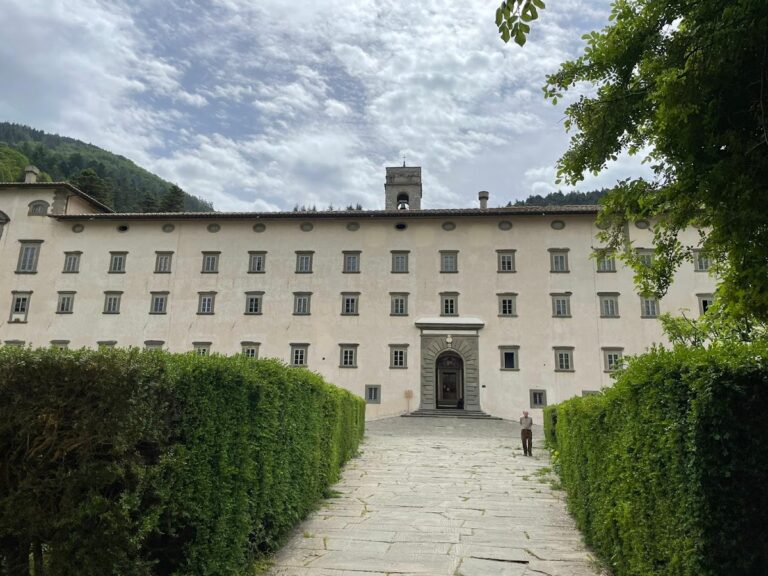
Abbazia di San Gaudenzio is a former Benedictine and Cistercian monastery in San Godenzo, Italy, founded in 1028 and centered on a Romanesque church. Located in the mountainous northeastern part of Tuscany, in the Mugello area toward Forlì, the abbey shaped the surrounding community and later became the parish church of the municipality.
Foundation and consecration
On 26 February 1028, Jacopo il Bavaro, bishop of Fiesole, founded a Benedictine monastery at San Godenzo. A local tradition places it on the site of an earlier chapel dedicated to Saint Gaudentius, a Campanian hermit traditionally believed to have lived during the fifth or sixth century. The new church was consecrated in 1070 by Bishop Trasmondo, Jacopo’s successor.
The monastery’s territory crossed the watershed between Tuscany and the lands toward Forlì, although most of it lay in Tuscany. San Godenzo itself developed around the abbey, whose religious presence helped define the settlement and its surrounding territory.
Cistercian rule and the Dante meeting
Between 1247 and 1258, the monastery passed from the Benedictines to the Cistercians, a Catholic monastic order that developed from the Benedictine tradition through a network of affiliated abbeys. Pope Alexander IV ordered the change in 1256, and the abbots of Chiaravalle della Colomba and Brondolo inspected San Godenzo in 1258. The abbey belonged to the filiation of Clairvaux, with Chiaravalle della Colomba listed as its mother abbey. In the Janauschek numbering system for Cistercian monasteries, San Gaudenzio was assigned number 654.
The abbey is closely associated with Dante Alighieri, the Florentine poet and author of the Divine Comedy. On 8 June 1302, it hosted a meeting of Florentine exiles, including Ghibellines, who supported the imperial political tradition in medieval Italy, and White Guelfs, one of the rival factions within the Florentine Guelf movement. Dante was among the representatives seeking an agreement with the Ubaldini, a powerful family in Florence and the Mugello area, to gain access to Florence, then controlled by the Black Guelfs.
The attempt failed and was followed by renewed conflict and the victory of the Black Guelfs. From the fourteenth century, the abbey was consequently known as “Dantesca,” linking its identity to the political gathering and Dante’s presence.
Servite administration and later changes
The monastery later declined and entered commendatory administration, a system in which an abbey’s revenues and nominal governance were assigned to a holder who might not live in the monastery. The monks eventually withdrew to the church of San Salvatore del Pino. On 23 May 1482, a papal bull issued by Sixtus IV transferred the complex from the Cistercians to the Servites of Florence’s Basilica of the Santissima Annunziata. The Servites, also known as the Order of Servants of Mary, are a Catholic religious order founded in Florence.
The Servites made San Gaudenzio the residence of their superior general and remained there until the Napoleonic suppression of the order around 1808–1809. After the abbey closed, its property was sold, and the church was partly converted into housing during the nineteenth century.
Earthquake, restoration, and wartime survival
The earthquake that struck the Mugello on 29 June 1919 led to restoration work directed by Ezio Cerpi. Between 1921 and 1929, the church was reshaped toward a Romanesque appearance. Baroque decorative additions were removed, while new furnishings and decorations in a neo-Romanesque style were introduced. The abbey title was restored in 1922, and by 1928 the church was serving as the parish church.
In 1944, fighting along the Gothic Line, a German defensive line in northern Italy during the Second World War, almost completely destroyed the settlement of San Godenzo. The church and monastery were spared because their founder, Jacopo il Bavaro, was of Bavarian origin. The former abbey is now a parish church in the Archdiocese of Florence, while its earlier institutional history was connected with the Diocese of Fiesole.
Remains
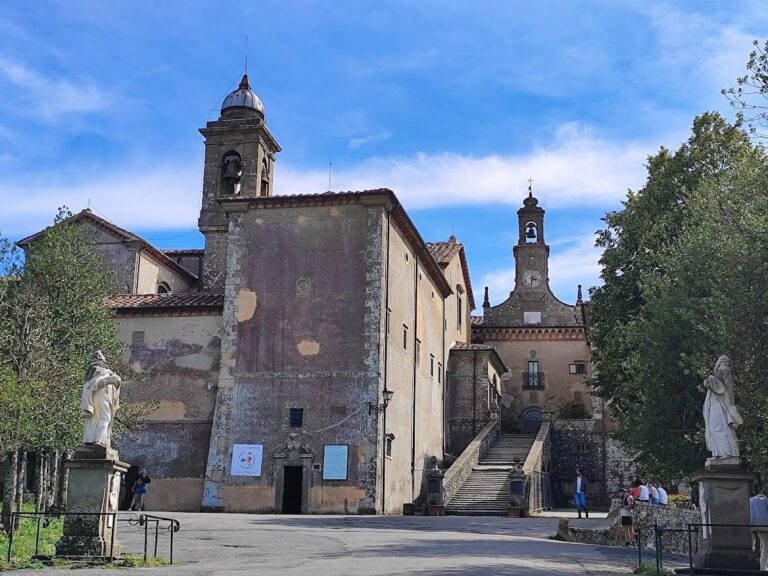
The surviving complex is organized around an oriented Romanesque basilica with three aisles and five bays. Its central nave rises beneath an open roof structure, while rounded arches and supporting piers divide it from the side aisles. A strongly elevated presbytery stands above a large crypt, and three semicircular apses complete the eastern end. A bell tower forms part of the complex, with the campanile previously constructed by Ezio Cerpi.
Basilica and underground spaces
Church interior
The church’s open-roofed nave and rounded arcades preserve the essential Romanesque arrangement, while the elevated presbytery gives the eastern end a pronounced vertical separation from the main body. The 1529 pulpit occupies the last pier on the right and carries the emblem of the Servites, who commissioned most of the church’s Renaissance works.
Crypt
The crypt lies beneath the church and is its oldest and best-preserved space. Low vaulted bays rest on six slender columns or colonnettes, whose capitals carry decorated forms that are partly figurative and partly cubic. At the rear stands a marble altar with inlaid decoration, added in 1929. Nearby, a metal reliquary contains the mummified body of Saint Gaudentius.
A Romanesque altar with Florentine white-and-green marble polychromy originally stood in the crypt. It was later placed before the crypt entrance, while the neo-Romanesque altar at the rear took the place of the older altar as the high altar.
Paintings, sculpture, and liturgical furnishings
Presbytery and apse
A polyptych, or multi-panel painted altarpiece, showing the Madonna with four saints was installed in the elevated presbytery in 1922 after the restoration. It is attributed to Bernardo Daddi and dated 1333, although its provenance remains uncertain. It may have come from a Benedictine nunnery in Florence or from San Salvatore al Monte.
The apse contains a mosaic of the Coronation of the Virgin among Angels and Saints. The Costman firm executed it in 1929 after a design by Giuseppe Cassioli. Dante, Beatrice, the idealized figure who guides him in the Divine Comedy, and Petrarch, the fourteenth-century Italian poet and scholar, are recognizable among the figures.
Saint Sebastian
To the right of the presbytery, in the apse and above a marble base with geometric inlay, stands a wooden statue of Saint Sebastian by Baccio da Montelupo. Dated 1506, the sculpture combines influences associated with Perugino and Filippino Lippi.
Left aisle and entrance
The left aisle contains Onorio Marinari’s painting Saints James and Philip Neri Adoring the Cross, dating to about 1665. Near the entrance is a neo-Romanesque baptismal font made in 1922 to Ezio Cerpi’s design. Behind it hangs an Annunciation attributed either to Franciabigio or, more recently, to Tommaso di Stefano Lunetti, and dated to around 1530. Its composition derives from Andrea del Sarto’s Annunciation for the church of San Gallo in Florence.
Former altarpiece by Andrea del Sarto
An Annunciation with Saints Michael the Archangel and Gaudentius by Andrea del Sarto formerly belonged to San Gaudenzio. Cardinal Leopoldo de’ Medici acquired it in 1627, and the painting is now held in the Galleria Palatina.
Grounds and surviving arrangement
The abbey was built on a restricted site, and its surviving arrangement includes a very small garden on the north side. The church, crypt, bell tower, presbytery, apses, and interior furnishings together preserve the principal physical components of the former monastic complex, whose present form combines medieval fabric with Renaissance works and the restorations carried out after the 1919 earthquake.
Nearby sites