Abbaye Toussaint d’Angers: A Roman Catholic Almonry and Augustinian Abbey
Site at a Glance
- Rating
- 4.6
- Popularity
- Very Low
- Country
- France
- Primary era
- Medieval
- Eras represented
- Medieval, Modern
- Civilizations
- French
- Site type
- Religious
- Remains
- Monastery
On this page7 sections
History
Abbaye Toussaint d’Angers is a former Roman Catholic almonry and Augustinian abbey in Angers, France, founded in 1040 in the Early Gothic tradition represented by its later church. An almonry was a religious institution that distributed assistance to the poor. Its foundation charter called it elemosinaria Omnorum Sanctorum, meaning the Toussaint almonry, and placed it under the authority of the Abbey of the Trinity of Vendôme.
From almonry to Augustinian abbey
At the beginning of the twelfth century, Toussaint became a canonical abbey of the Augustinian order. Augustinian canons were received there in 1108, and the first regular canons associated with the establishment are also dated to 1115. They came from the Diocese of Poitiers. These canons were regular clergy who lived in community according to the Rule of Saint Augustine, a monastic rule attributed to Augustine of Hippo.
Girard was regarded as the founder of the church. His burial lay beside those of the first two abbots, both named Robert. The first Robert became abbot in 1140, while the second governed the convent from 1207 to 1213. In 1166, Guillaume, abbot of Toussaint, attended the formal transfer of Saint Brieuc’s body to the Abbey of Saint-Serge-lès-Angers. Saint Brieuc was a Christian saint associated with the foundation of the bishopric of Saint-Brieuc in Brittany.
Rebuilding and modern preservation
The abbey church was rebuilt in the middle of the thirteenth century. In 1845, excavators found the graves of the two abbots named Robert near the portal of the present nave, beside Girard’s grave. Girard was identified there as the founder of the Toussaint church in 1028.
The ruined church has been protected as a historic monument since 1902. In 1925, the porch and ceremonial staircase received classified protection, while the cloister and courtyard were registered. The former abbey was restored and converted for museum use in 1984. The installation of the David d’Angers Museum, together with the transfer of the David d’Angers Gallery from the refectory of the Museum of Fine Arts of Angers, helped preserve the building from complete destruction. David d’Angers was a nineteenth-century French sculptor, and the museum and gallery present his works.
Remains
The former abbey church
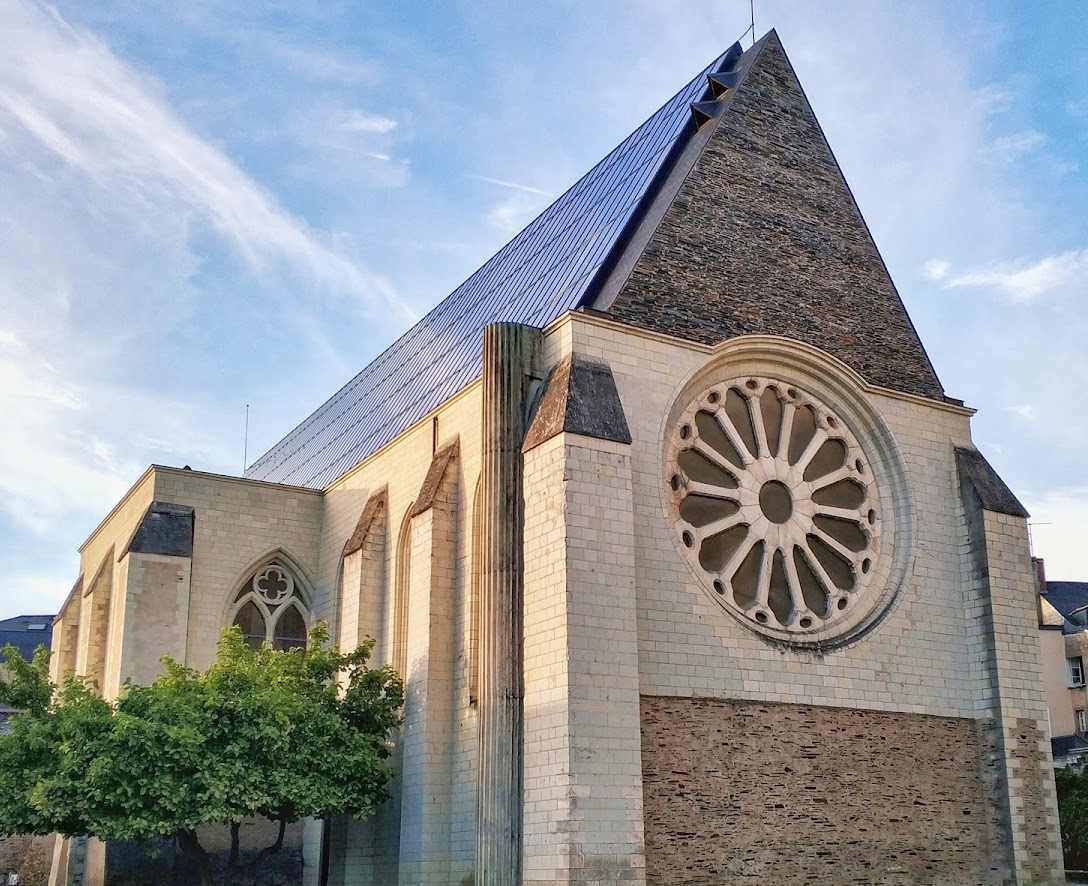
The surviving church is ruined and predominantly Early Gothic. Rebuilt in the mid-thirteenth century, it has a tau-shaped ground plan, with a long central axis crossed by a transverse section. During its conversion into the David d’Angers Museum, the building received a new timber roof framework covered by a glass roof. This intervention created the present museum setting while retaining the ruined church as the principal historic structure.
Cloister and courtyard
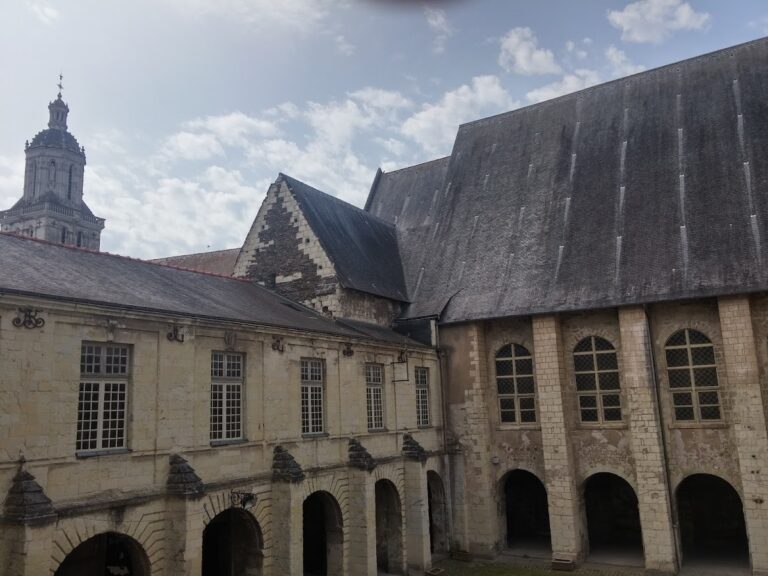
The former abbey complex also retains its cloister and courtyard. These spaces belong to the architectural ensemble surrounding the church and remain part of the former abbey’s surviving fabric.
Porch and ceremonial staircase
The porch and ceremonial staircase form another surviving part of the complex. Their protection in 1925 reflects their place within the historic entrance arrangement of the former abbey.