Elsey Abbey: A Former Women’s Religious House in Hagen, Germany


Site at a Glance
- Rating
- 4.2
- Popularity
- Very Low
- Country
- Germany
- Primary era
- Medieval
- External website
- Open
- Eras represented
- Medieval
- Civilizations
- Holy Roman Empire
- Site type
- Religious
- Remains
- Monastery
On this page12 sections
History
Elsey Abbey, in Hagen, Germany, was a women’s religious house founded in the early 1220s and dedicated to the Virgin Mary. It stood at Elsey, now part of Hohenlimburg, and developed from a religious community into a noble secular women’s chapter that lasted until its dissolution in 1811.
Foundation and ecclesiastical protection
The foundation was enabled by Countess Methildis of Holland, widow of Count Arnold of Altena-Isenberg. In 1222, she exchanged the newly built church at Elsey for her proprietary church at Bigge with Archbishop Engelbert I of Cologne. A charter issued in 1223 named her son, Count Friedrich of Altena-Isenberg, as co-founder and donor.
The founders’ family initially held the house’s advocacy rights, known as Vogtei, which were protective and administrative powers often exercised by a secular lord or founding family. After Friedrich was placed under imperial ban and ecclesiastical excommunication for his involvement in the killing of Archbishop Engelbert at Gevelsberg on 7 November 1225, Archbishop Heinrich I of Cologne took Elsey under his protection on 17 August 1227. The archbishop also freed the institution from the family’s advocacy jurisdiction.
The earliest records do not identify the order or corporation that occupied the new foundation. Its connection with the Premonstratensian Order, founded by Norbert of Xanten, appears from the second half of the thirteenth century. Elsey was initially led by a prioress. Later in that century, a provost, the male administrative head of the house, directed and represented the institution with the assistance of a prioress and the convent.
Premonstratensian administration and community life
Sixteen provosts are known by name between 1227 and the 1490s. Most came from ministerial families connected with the Counts of Limburg and the Counts of the Mark. Between 1270 and 1804, the names of 110 canonesses and chapter members were recorded. The community consisted largely of women from the landed lower nobility of the counties of Mark and Limburg.
Elsey’s kitchen estate, called the Küchenhof, supplied the community, while a ring wall enclosed the abbey buildings. The institution also maintained religious associations beyond its resident community. A prayer confraternity connected Elsey with Wedinghausen Premonstratensian Abbey near Arnsberg during the fourteenth and fifteenth centuries.
Three confraternities are associated with Elsey. The Brotherhood of Our Lady is first mentioned in 1375. A sacramental brotherhood is recorded between 1436 and 1457, while the Brotherhood of Saints Fabian and Sebastian appears from 1436. The latter admitted clergy and laypeople of both sexes and every social rank, from counts to housewives. Its death register, begun in 1523, contains 499 names. The brotherhoods were dissolved during the Reformation, and their income was transferred to the local poor.
Property disputes and economic growth
The chapter’s landholding grew through donations, particularly in the thirteenth century, and purchases during the fourteenth and fifteenth centuries. Its earliest recorded endowment, in 1223, included Friedrich of Isenberg’s pomerium et mansus Gerwini, together with the pledging of a mill and the Barme estate.
In 1266, Elsey purchased the Niederschulten farm at Langendreer from the Ovelacker family. Rutger of Horst donated the Schultenhof at Suntum near Bochum-Laer in 1293. Other possessions included Nagels Hof at Reh, purchased from Johann von Letmathe in 1405, and property in Hengsen, Sölde, Schüren, Wellinghofen, Laer, Oespel, Renninghausen, Wickede, Tiefendorf, and Genna at various times.
A dispute over two farms at Elsey also shaped the chapter’s history. Count Dietrich I of Limburg sold the farms to the abbey in 1274, but his grandson, Count Dietrich III of Limburg, later seized them. Archbishop Heinrich of Cologne threatened Dietrich with ban and excommunication on 6 April 1318, and the count eventually returned the farms. The conflict, known as the Abbey Feud, ended on 29 September 1318.
By the late eighteenth century, Elsey held 53 farms and smallholdings, along with extensive woodland and meadowland. Its nearby holdings included 20 farms at Elsey, seven each at Reh and Henkhausen, two each at Holthausen and Ergste, and one each at Haßley and Leckingsen. It was the third-largest landowner in the County of Limburg after the territorial ruler and the Lords of Brabeck at Letmathe.
Among the eleven chapters and monasteries of the Ruhr Department, Elsey ranked ninth in economic capacity, with average annual revenues of about 8,400 francs. The acquisition of Berchum manor in 1793 gave the chapter a voice in the diet of the County of Limburg.
From religious house to secular chapter
During the late fifteenth century, Elsey changed from a community of Premonstratensian canonesses into a secular noblewomen’s chapter, or Damenstift. This type of institution allowed aristocratic women to live under a religious constitution without taking the full, permanent vows of nuns. An abbess replaced the provost as head of the chapter’s worldly administration. The canonesses could hold personal property and leave the institution, including to marry, and Elsey increasingly served as a provision for noblewomen’s daughters.
Pastoral care passed to a parish priest in 1499. The priests occupied the chapter-owned Wiedemhof, an endowed residence and holding whose revenues supported the parish priest. Johann Friedrich Möller, who served from 1750 to 1807, became known beyond the counties of Mark and Limburg for his theological and historical writings and political engagement. Melchior Wilhelm Hülsemann served as the final priest before the chapter’s dissolution, beginning in 1808.
The Reformation brought Catholic, Lutheran, and Reformed members into the chapter. By 1753, the institution was entirely Protestant. From 1680, a salaried chapter official took over part of the administrative work formerly performed by the provosts. Friedrich Moritz Casimir Holtschmit was the last official in this role, serving until the end of 1811.
Fire and dissolution
During the Cologne War, a conflict over the control of the Electorate of Cologne, Elsey was plundered and burned in 1587. The curia houses and kitchen estate were rebuilt on their original site below the parish church, with the work continuing until the middle of the seventeenth century.
An imperial French decree dated 22 June 1811 dissolved the chapter during the reorganization of finances in the Grand Duchy of Berg. After French rule ended, Prussia administered Elsey’s estates, land, and assets from November 1813. Disputes over pensions for the last abbess and former canonesses were eventually settled. On 16 July 1825, an order by Oberpräsident Ludwig von Vincke transferred the former chapter’s estates and rights to Prince Emil Friedrich I of Bentheim-Tecklenburg, ending Elsey’s more than five-century history as an institution.
The Evangelical Lutheran congregation of Elsey remains a patronage congregation of the Prince of Bentheim-Tecklenburg in Rheda-Wiedenbrück. A patronage congregation is one whose patronage rights are held by a designated patron.
Remains
The historic complex includes a Romanesque parish church, five protected former curia houses of the canonesses, and the former chapter granary, now used as the sexton’s house. The original buildings stood within a ring wall, and the chapter’s kitchen estate occupied approximately 70 to 80 historical Morgen, regional units of land area whose exact modern equivalent varied.
Church and chapter buildings
Romanesque parish church
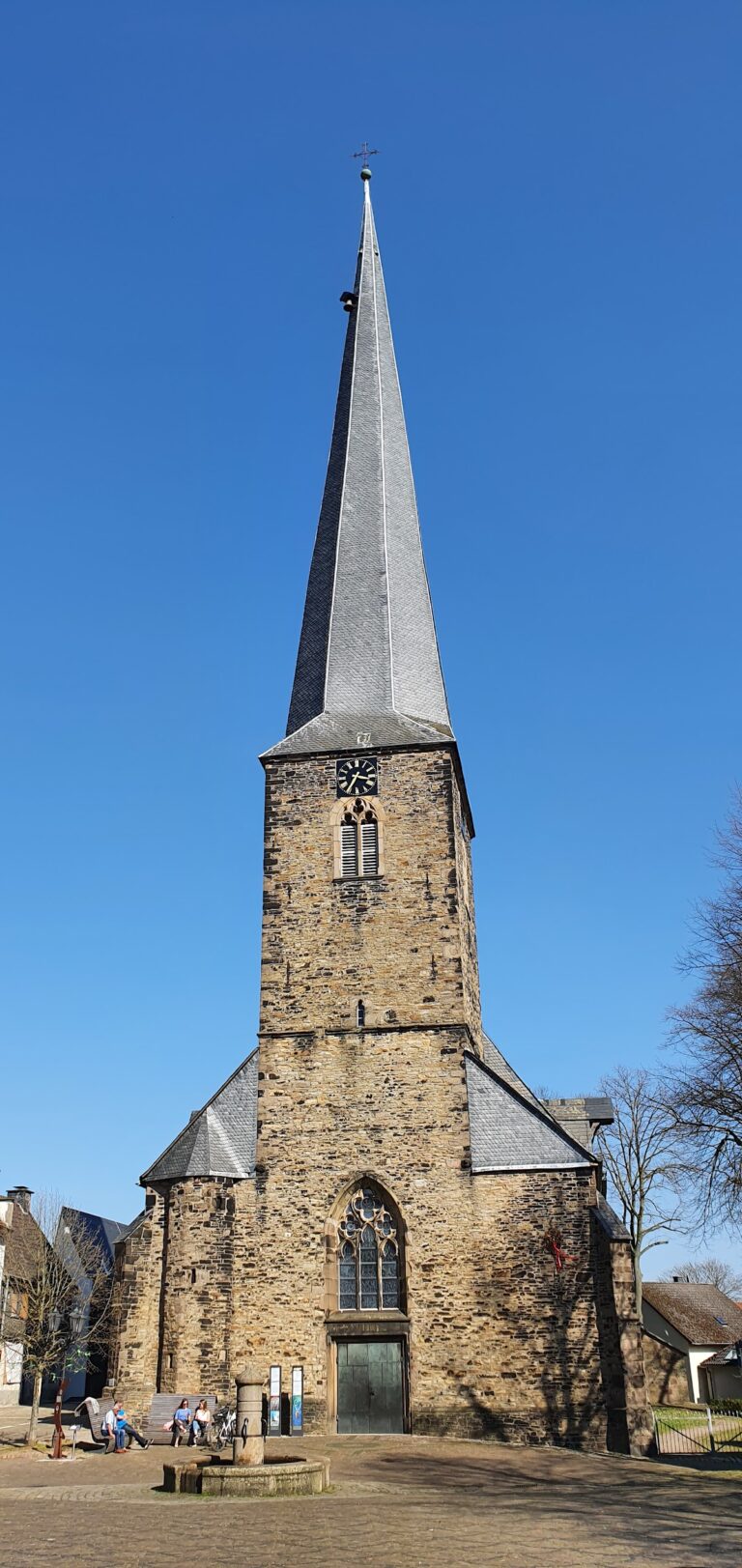
The parish church is a standing Romanesque building and a protected historic structure. Romanesque architecture uses the heavy masonry and rounded arches associated with medieval western Europe before the widespread adoption of Gothic forms. The church formed the principal ecclesiastical building of the former Elsey foundation.
Curia houses
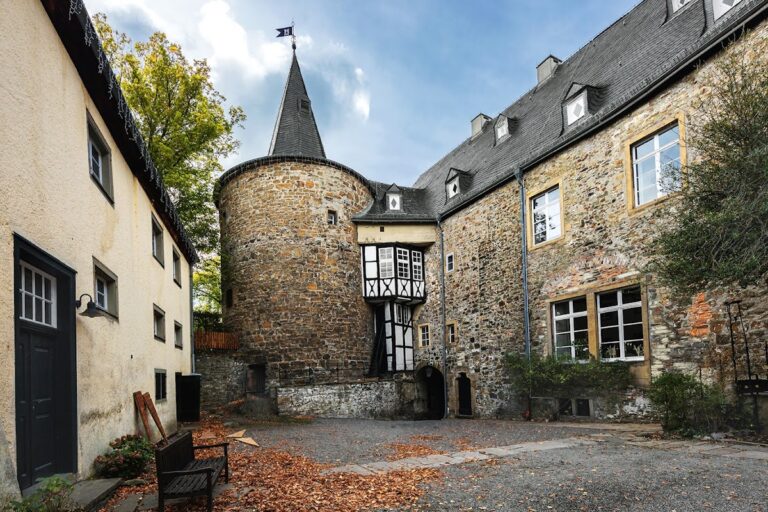
Five former curia houses survive as protected historic buildings. A curia house was the residence assigned to an individual canoness within the chapter. After the fire of 1587, the curia houses were rebuilt in their original location below the parish church, as part of the reconstruction that continued into the middle of the seventeenth century.
Former chapter granary
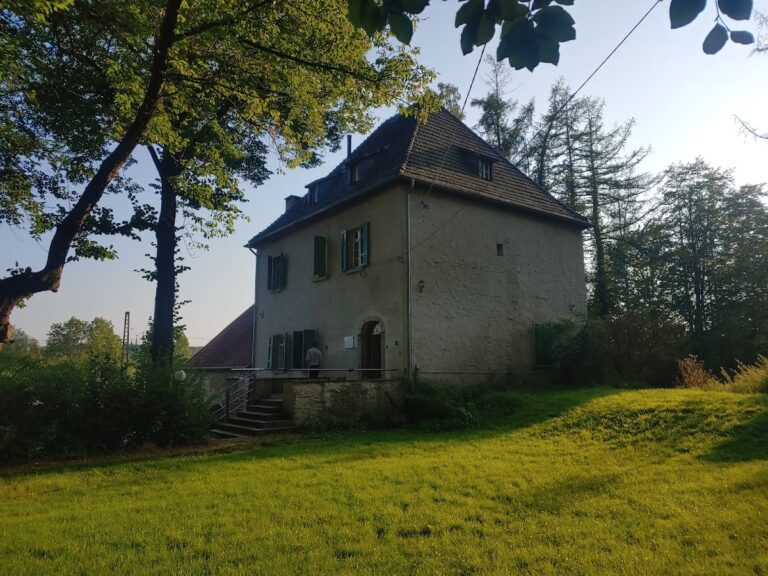
The former chapter granary survives as the sexton’s house and is also protected as a historic building. It belongs to the group of agricultural and residential structures that supported the chapter’s community and estates.
Rebuilt and altered estate buildings
The kitchen estate, or Küchenhof, served the community’s provisioning needs and was rebuilt below the parish church after the 1587 fire. Its later condition became structurally dilapidated, and it was demolished in 1960. A small half-timbered curia house at Im Stift 31 was demolished in 1973.