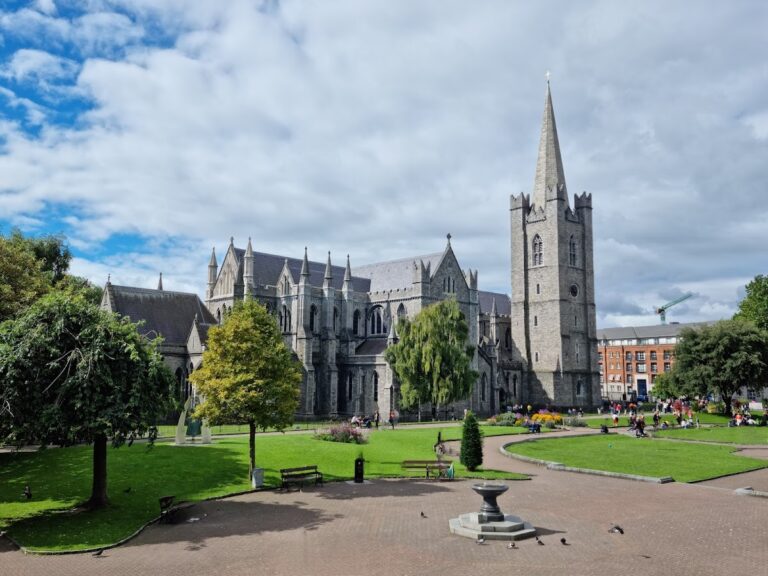
St Audoen’s Church, Dublin: A Medieval Parish Church of the Church of Ireland


Site at a Glance
- Rating
- 5
- Popularity
- Very Low
- Country
- Ireland
- Primary era
- Medieval
- External website
- Open
- Eras represented
- Medieval, Modern
- Civilizations
- English, Norman
- Site type
- Religious
- Remains
- Church
On this page10 sections
History
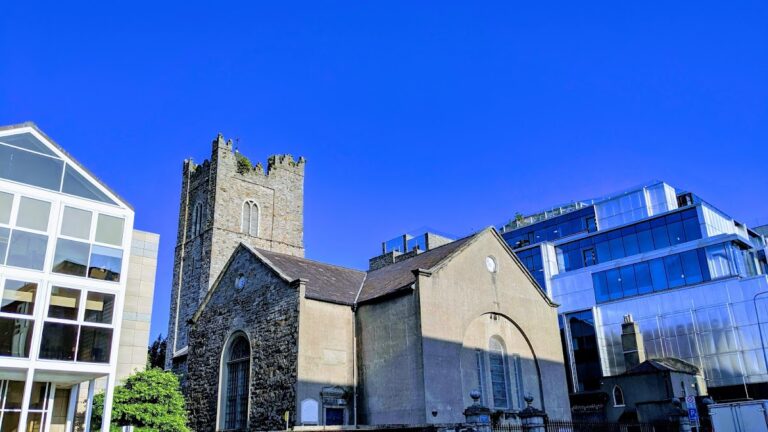
St Audoen’s Church, Dublin, is a medieval parish church in Ireland, founded by the Anglo-Normans in 1190 under John Comyn, archbishop of Dublin. It stands at Cornmarket, south of the River Liffey, near the centre of the medieval city, and remains Dublin’s oldest parish church still used as such. The church is dedicated to St Audoen, also known as Ouen, a seventh-century bishop of Rouen in Normandy. A Roman Catholic church of the same name stands beside it.
Foundation and medieval development
John Comyn may have established the church on the site of an earlier seventh-century foundation associated with St Columcille. The medieval building was altered soon after its foundation, when the nave was lengthened and narrowed. A chancel was added about a century later, extending the church’s liturgical arrangements.
St Audoen’s became closely connected with Dublin’s civic and religious institutions. In 1467, through the action of Archbishop Michael Tregury, it was made a prebend of St Patrick’s Cathedral. A prebend was an ecclesiastical office or income attached to service in a cathedral. The Lord Mayor and the city corporation attended the church on state occasions, while Dublin’s guilds also maintained strong links with the parish. The Tanners’ Guild occupied the tower, and the Bakers’ Guild, associated with St Anne’s Guild, occupied a college beside the church.
St Anne’s Guild and the Reformation
In 1430, Henry VI, Lord of Ireland, authorised a chantry dedicated to St Anne. A chantry was an endowed religious foundation established for regular prayers or Masses, often for the souls of founders and benefactors. Its founders and successors formed the Guild or Fraternity of St Anne, generally known as St Anne’s Guild. The guild survived the Reformation in Ireland, the sixteenth-century religious transformation that established Protestant state churches and restricted many traditional Catholic practices. It remained under Roman Catholic control and retained extensive properties despite investigations and court orders that continued until 1702.
During the sixteenth century, Archbishop George Browne promoted Henry VIII’s claim to supremacy over the Irish Church. Around 1544, the vicar of St Audoen’s became a Crown nominee, and in 1547 the state church appropriated the parish’s assets. After Mary I restored St Patrick’s Cathedral by charter in 1553, Robert Daly became St Audoen’s prebendary in 1555. When Elizabeth I later appointed Daly Bishop of Kildare, Roman Catholic ceremonies ceased at St Audoen’s.
Most parishioners nevertheless remained Roman Catholic. A separate Roman Catholic parish of St Audoen’s was established in 1615, but its members were compelled to worship secretly, chiefly in nearby Cook Street. Restrictions on Catholic worship, including the prohibition of Mass and the deportation, imprisonment, or execution of clergy, continued until the beginning of the nineteenth century.
Decline, damage, and parish life
The Protestant church and parish declined during the seventeenth century. By 1630 the building was regarded as decrepit, and repairs to the roof, steeple, and pillars were undertaken in the following years. Money was scarce because only sixteen Protestant houses remained in the parish. In 1671, Michael Boyle ordered the buttermilk market beneath the church to close, and in 1673 tombs and tombstones were ordered out of the building.
The tower suffered a gunpowder explosion on a nearby quay on 11 March 1597. During the Catholic Confederate Rebellion of the 1640s, townspeople could see distant fires from its summit. In 1733, two barrels of pitch were burned at the top of the tower to celebrate the election of Alderman Humphrey Frend. The church also remained part of the political and social life of Dublin. James Napper Tandy, whose family had a long association with St Audoen’s, was baptised there on 16 February 1739 and served as churchwarden in 1765. Oliver Bond, a Presbyterian and United Irishman, became Minister’s Churchwarden in 1787. The United Irishmen were a late-eighteenth-century movement seeking major constitutional and national change.
From the late eighteenth century, wealthy residents moved to the suburbs, a process accelerated by the Act of Union. Poorer Catholics moved into the vacated city houses, many of which became tenements. In 1813, the parish contained 1,993 males and 2,674 females, most of them Roman Catholic. By 1825, the church was described as ruinous, with very few Protestants remaining. Parts of the building were closed or left unroofed because substantial repairs could not be financed. Ancient tombs deteriorated, while memorials were removed or became illegible through exposure.
Study, restoration, and later parish history
Thomas Drew brought sustained architectural and historical attention to St Audoen’s in 1866. He prepared detailed plans, carried out excavations, and wrote a study of the church, receiving an award from the Royal Institute of Architects of Ireland for his plans. In 1873, rector Alexander Leeper urged that the church be reroofed and restored.
Extensive work on the tower and bells took place in the 1980s. A few years later, St Anne’s Chapel, which had stood roofless, was reroofed and converted into a reception centre with an exhibition on the church’s history. Conservation beginning in 1996 included excavation of a small but extensive part of the church and produced new evidence about its early history and construction. The detailed results were published in 2006. St Audoen’s is a National Monument of Ireland, and in 2012 its parish was merged with St Catherine and St James Church on Donore Avenue.
Remains
Medieval church fabric
The surviving medieval core consists of a nave altered after the initial foundation and a chancel added approximately a century later. The nave was lengthened and narrowed during the church’s early development, while the chancel formed a later addition to the medieval plan. Excavations in the nineteenth century also revealed a twelfth-century Anglo-Norman baptismal font, a baptismal basin made in the tradition associated with the Norman settlers established in Ireland after the twelfth-century intervention. The font is displayed in the church.
Tower, clock, and bells
The tower preserves a long sequence of repairs and rebuilding. It was repaired in 1637, partly collapsed onto the church roof in 1669, and was then rebuilt. Henry Aaron Baker remodelled it in 1826, further repairs were made in 1916, and the structure was made safe during the major restoration of 1982. Its earlier history includes the damage caused by the gunpowder explosion of 1597.
Six bells hang in the tower. Three date from 1423 and are among the oldest bells in Ireland. Two were cast in Dublin by John Murphy, in 1864 and 1880, while the treble dates from 1790 and came from Glasgow. After the tower was strengthened with concrete, the bells were overhauled and three were recast, including the tenor in memory of Alexander E. Donovan. They were not rung between 1898 and 1983 because of the tower’s fragile condition and are now rung weekly. The present clock was transferred from St Peter’s Church on Aungier Street after that church was demolished in the 1980s. Its clock face dates from the 1820s.
Chapels and memorials
St Anne’s Chapel stands beside the nave. Six separate altars were installed there and maintained with financial support from wealthy parishioners. The chapel later lost its roof and many of its monuments before being reroofed. Another chapel was built beside the nave in 1485 by Sir Roland Fitz-Eustace, Baron Portlester, in gratitude for surviving a shipwreck near the church.
The west-door porch contains fifteenth-century monuments to Fitz-Eustace and his third wife, Margaret, née D’Artois. Fitz-Eustace himself was buried at Cotlandstown in County Kildare. Peter Talbot, the Roman Catholic Archbishop of Dublin, is traditionally said to have been secretly entombed nearby after dying in prison in 1680.
Burials associated with the church include William Molyneux, Sir Thomas Molyneux and his son Capel, Edward Parry, Bishop of Killaloe, and Edward Parry’s sons John and Benjamin, who successively became Bishops of Ossory. Lady Frances Brudenell was also buried there. In the North Nave, a memorial to Sir William Sparke, who died in 1623, has Corinthian columns and a pediment. His widow, Mary Bryce, commissioned it.
Graveyard, Lucky Stone, and organ
The former graveyard has been converted into a recreation ground. It was the burial place of bishops, Dublin Lord Mayors, and members of the Ball, Bath, Blakeney, Browne, Cusack, Desminier, Fagan, Foster, Fyan, Gifford, Gilbert, Malone, Mapas, Molesworth, Penteny, Perceval, Quinn, Talbot, and Ussher families.
The main porch contains an early Celtic gravestone known as the Lucky Stone. It was kept in or near the church before 1309 and became associated with the belief that rubbing it brought luck. In 1309, John Le Decer placed it beside a marble drinking-water cistern at Cornmarket. Although it was stolen repeatedly, it returned to the neighbourhood. The stone disappeared in 1826 and was found twenty years later in front of the newly built Roman Catholic church on High Street.
St Audoen’s also houses an organ built in 1885 by Forster and Andrews of Hull. Trevor Crowe restored it in 2004. The instrument retains its original manual bellows and can still be played without electricity. A war memorial from the former St Matthias’ Church on Hatch Street was restored and moved to St Audoen’s in 2015.