San Francesco: A Franciscan Church in Montone, Italy


Site at a Glance
- Rating
- 4.5
- Popularity
- Very Low
- Country
- Italy
- Primary era
- Medieval
- Eras represented
- Medieval, Early Modern
- Civilizations
- Papal States
- Site type
- Religious
- Remains
- Church
On this page19 sections
History
San Francesco is a Roman Catholic church in Montone, Italy, built by the Friars Minor in the early fourteenth century in the architectural tradition of the mendicant orders. The friars settled there on 29 April 1308, establishing a Franciscan presence at a site formerly occupied by Castelvecchio, also called Capanneto, one of six medieval castles created to defend and control the valley between the Carpina and Tiber rivers. The church belongs to the Diocese of Città di Castello and remains closely associated with Montone’s religious and political history.
Foundation and Franciscan settlement
Before San Francesco was founded, the Benedictine Order was represented at Montone by the community connected with Sant’Ubaldo outside the walls. The Friars Minor, the Franciscan mendicant order founded by Saint Francis of Assisi, had previously been established there. In 1308 they moved to the Castelvecchio site during the pontificate of Clement V, with the consent of the Council of Vienne. Their settlement created a new religious center within the town’s medieval defensive landscape.
The church was decorated with frescoes from the beginning of the fourteenth century. Later campaigns covered the original work on three occasions, and the most accomplished artistic results belong to the fifteenth century. These successive decorations transformed the interior while preserving a visual record of Franciscan devotion, local patronage, and the changing political circumstances of Montone.
The Fortebraccio family and fifteenth-century patronage
San Francesco became the family church of the Fortebraccio family, whose members supported the Franciscan community and financed new altars, furnishings, and paintings. Their patronage brought the courtly culture of the household into the church. It also connected the building with Braccio da Montone, a condottiero, or military commander who led troops under contract in medieval and Renaissance Italy, and with his descendants.
Between 1423 and 1424, Braccio commissioned Antonio Alberti da Ferrara to paint episodes from the life of Saint Francis and scenes of the Last Judgment beneath the apse arch. Braccio attempted in the late fourteenth and early fifteenth centuries to remove central Italy from papal control, but he was defeated and killed at the Battle of L’Aquila in 1424. The church’s decoration therefore belongs to a period when Franciscan religious imagery and the political ambitions of Montone’s ruling family were closely intertwined.
In 1486, Count Carlo Fortebraccio had an altar built in the middle of the left wall as an ex voto, an offering made in fulfillment of a vow or in thanksgiving, for the birth of his son Bernardino. Bernardino later commissioned Bartolomeo Caporali of Perugia to complete the altar with a fresco. The surviving Fortebraccio emblems and images of subject cities further associate the church with the family’s military and political prominence.
Papal authority and later history
A late-fifteenth-century fresco contains the oak emblem of the Della Rovere family, the Italian papal house that produced Pope Sixtus IV and Pope Julius II. The emblem dates the work to 1477–1484, the years of Sixtus IV’s pontificate, when he regained possession of the County of Montone. It may also have expressed a warning against another attempt by the Fortebraccio family to free the territory from papal authority.
The church’s religious imagery continued to reflect Montone’s wider ecclesiastical setting. The parish was dedicated to Saint Gregory the Great, whose image appears inside San Francesco alongside Saint John the Baptist. Sant’Ubaldo, shown as a bishop of Gubbio, recalled the Benedictine presence that preceded the Franciscans at Montone.
Later centuries brought destructive episodes, including damage connected with the French occupation. The convent was temporarily closed in 1810 and became state property in 1866. Restoration in the 1990s rehabilitated the complex. Part of the former convent was converted into the present Picture Gallery and the Ethnographic Museum Il tamburo parlante, where works from San Francesco and other churches in the municipal territory are preserved.
Remains
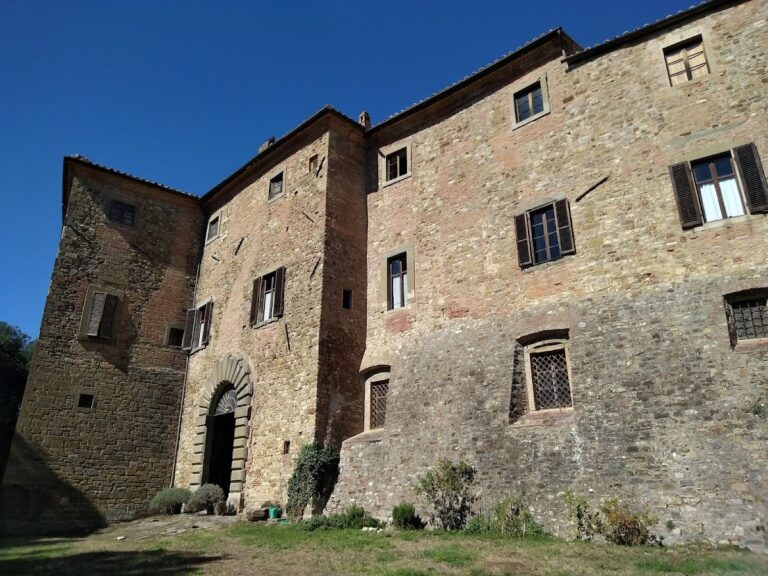
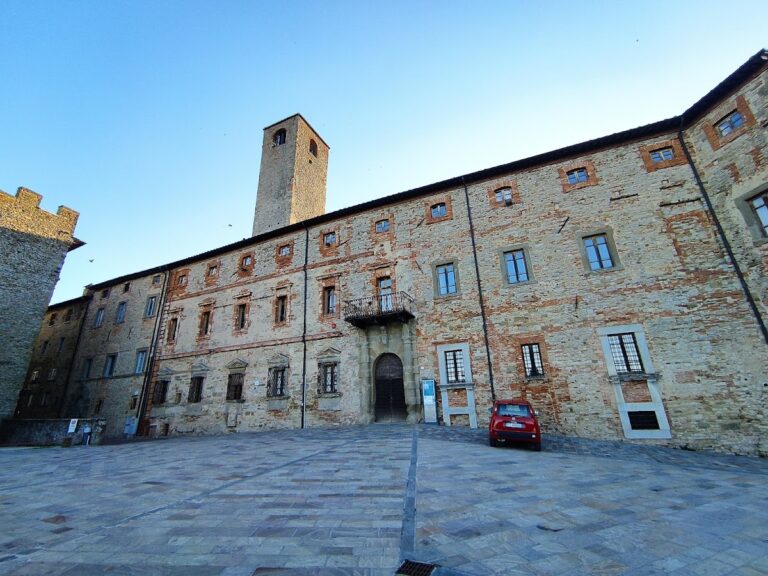
San Francesco follows the simple, linear plan characteristic of mendicant churches. It has a single nave, a westward orientation, a polygonal apse with ribbed vaults, and a roof carried by trusses. Light enters through three windows in the apse, including a central bifora, or two-light window divided by a central support, and through six narrow single-lancet windows in the side walls. The former convent adjoins the left wall, while a portico was added against the facade, probably in the seventeenth or eighteenth century.
Apse and Franciscan frescoes
Apse vault and Last Judgment
The polygonal apse ends in ribs that were originally finely painted. Its fresco cycle devoted to the life of Saint Francis is incomplete, but the surviving fragments preserve enough of the composition to reconstruct much of its arrangement. On the underside of the apse arch, or intrados, Christ the Judge appears with four angels carrying symbols of the Passion, including the column, the cross, and the lances. Beneath the angel with the column is Hell, while the souls of the elect look toward the light beneath the angel with the cross. A band of vegetal ornament borders the arch.
Apse lunettes and Fortebraccio emblem
The five apse lunettes, semicircular painted areas above the principal surface, show the risen Christ emerging victoriously from the tomb at the center, with the four Evangelists on either side. Above the central bifora is a partly preserved Fortebraccio coat of arms. It shows a black half-rampant ram on a gold field, accompanied by two cheetahs that represent the family’s military virtues.
Scenes from the life of Saint Francis
The left side of the apse contains scenes from Saint Francis’s life. They include his prayer before the Crucifix of San Damiano, the return of his clothes to his father, and the Stigmata at La Verna above the latter episode. On the right, coats of arms representing cities subjected by the condottiero appear above a scene of Pope Honorius III confirming the Franciscan Rule.
Entrance wall and left side
Counterfacade paintings
The counterfacade contains a face of Saint John the Baptist attributed to Berto di Giovanni, a pupil of Perugino, followed by an image of Saint Gregory the Great. The original composition probably also included the Virgin and Child, Saint Francis, and Saint John the Apostle. On the right side of the counterfacade is the lower surviving portion of a late-fifteenth-century Martyrdom of Saint Sebastian, stylistically dated to the 1490s and associated with the possibility of a visit by Perugino to Montone. Above it is an earlier fresco of Saint John the Evangelist and Saint Lucy by a Perugian-influenced painter of the second half of the fourteenth century.
Left-wall frescoes and Fortebraccio altar
The left wall preserves a fourteenth-century Madonna of Mercy by an Umbrian painter from the third quarter of the century. The opening made for the fifteenth-century Fortebraccio altar damaged fragments that include Saint Bernardino, painted by a local artist in the second half of the fifteenth century, and an unidentified Franciscan saint from the middle of the fourteenth century. The altar front, made by a late-fifteenth-century sculptor, originally held the Madonna of Mercy, also called the Gonfalone, by Bartolomeo Caporali. That painting is now kept in the Picture Gallery.
Other votive paintings on the left wall represent Saint Catherine of Alexandria, attributed to a Perugian painter of the late fourteenth century, a Madonna enthroned with the Child, Saint Sebastian, and an angel presenting Saint Sebastian with the palm of martyrdom. Above them is a late-fourteenth-century Birth of the Virgin, showing Saint Anne giving birth to Mary as part of a larger cycle devoted to the Stories of the Virgin.
Fortebraccio family niches
Two niches open in the section of the left wall leading toward the apse. One is associated with Giobbe di Bencivenni Fortebraccio and shows Saint Anthony of Padua, Bernardino of Siena, and the kneeling patron. Saint Christopher and Saint Sebastian appear on the inner surfaces of the niche. A partly legible inscription below commemorates the military virtues of Albertus, son of Giobbe Bencivenni Fortebraccio, who followed Count Carlo Fortebraccio in campaigns serving several Italian houses and principalities.
A separate edicule contains the Virgin enthroned with the Child, the beheaded Saint John the Baptist, Saint Peter Martyr on the inner surfaces, and Saint Francis. Behind the Virgin’s throne is the oak emblem of the Della Rovere family, the heraldic reference that links this fresco to the papal authority reasserted over Montone during the pontificate of Sixtus IV.
Right wall and civic furnishings
Right-wall frescoes
The right wall contains several fourteenth-century fragments, including a reading friar possibly painted by Antonio Alberti da Ferrara and therefore possibly dating to around 1423. These paintings were damaged when space was opened for Carlo Fortebraccio’s altar. Other frescoes show the Supper at the Pharisee’s House and Martha in the Kitchen, arranged between a banquet hall on the left and a kitchen on the right. Jesus, the Pharisee, Saint Peter, and Saint John sit around the table, while Mary Magdalene survives as a fragment of a halo at Christ’s feet.
Above the side door to the sacristy is Sant’Ubaldo, identified as a bishop of Gubbio and protector of the Benedictine Order that preceded the Franciscans at Montone. The image provides a direct visual connection between the church’s Franciscan identity and the earlier Benedictine presence associated with Sant’Ubaldo.
Magistrates’ Bench and choir
The Magistrates’ Bench beneath the right-wall frescoes is made of carved and inlaid walnut. Stefano Cambi, guardian friar of the convent, commissioned it in 1505. During the communal period, the municipal Priors, senior civic magistrates, sat there during liturgical functions. Its back is divided into two panels, with an inlaid grotesque-candelabra architrave, palmettes and vegetal scrolls on the arm dividers, and four framed panels with ribbon inlay. Its authorship has been attributed either to the maker of the choir or, less convincingly, to Antonio Bencivenni, who made the entrance portal.
The choir consists of thirteen carved walnut stalls, each with a back divided into two panels. Vase inlay decorates the upper panels, while acanthus scrolls appear on the arm dividers. The remaining parapets and kneeler are undecorated. Stylistic evidence places the choir in the final decades of the fifteenth century.
Portal and later wooden furnishings
Entrance portal
The two-leaf entrance portal combines carved and inlaid walnut and poplar. Antonio Bencivenni of Mercatello made it in 1519, as stated by the central inscription. Its ten panels include grotesque motifs in the two upper panels, Franciscan emblems in the lower panels, and six square panels filled with rosettes. The Franciscan symbols include the Alter Christus, meaning “another Christ,” and the Cross on the six-peaked mountain. A continuous braid band and a plain band interrupted by roundels with rosettes decorate the exterior.
Chest and pulpit
A high-backed chest donated by the Friars Minor Vincenzo and Alberto in 1601 forms part of the church’s wooden furnishings. Its back carries an inscription recording the donation and its date.
A mid-seventeenth-century woodcarver made the pulpit, which an Umbrian artist of the same period painted. It is carved, gilded, and oil-painted, and originally stood on the church’s left side on sandstone brackets. A small staircase in the cloister provided access. Five carved panels show Saint Francis at the center, Saint Anthony of Padua on the right, and Bernardino of Siena on the left, together with the Franciscan emblem and the emblem of Montone.