Vydubychi Monastery: A Medieval Orthodox Monastery in Kyiv


Site at a Glance
- Rating
- 4.9
- Popularity
- Medium
- Country
- Ukraine
- Primary era
- Early Modern
- External website
- Open
- Eras represented
- Medieval, Early Modern, Modern
- Civilizations
- Kievan Rus, Russian
- Site type
- Religious
- Remains
- Monastery
On this page17 sections
History
Vydubychi Monastery is a medieval Orthodox monastery in Kyiv, Ukraine, founded by Vsevolod Yaroslavich, a prince of Kievan Rus and son of Yaroslav the Wise, between 1070 and 1077. Its origins belong to the religious and political development of the late eleventh century, when Kyiv was the center of a medieval East Slavic polity ruled by the Rurikid dynasty. The monastery stood near Vsevolod’s suburban residence, the Krasny Dvor, and became the family monastery of his son Vladimir Monomakh and the Monomakhovich descendants.
Foundation and princely center
The first recorded mention of the monastery dates to 1070 in the Tale of Bygone Years, the principal surviving medieval chronicle of early Rus history. Construction of the masonry Church of Saint Michael began in the same year. The foundation was initially associated with Vsevolod’s name, but the monastery later took the name Vydubychi from the surrounding locality.
Several explanations have been attached to the name. The most familiar tradition connects it with the conversion of Rus under Vladimir the Great, whose baptism and Christianization of the realm are traditionally dated to 988. According to the legend, Vladimir ordered pagan idols, including Perun, the pre-Christian Slavic thunder deity, to be thrown into the Dnieper. People who followed the old faith called for the idols to emerge from the water, and the place where they reached the bank became known as Vydubychi. Other explanations associate the name with a pre-Christian crossing of the Dnieper in dugout oak boats, the area’s oak forest, or a supposed underground monastic community in the Zverinets Caves that emerged after Christianization.
During its first 120 years, the monastery became a center of secular and political life in Kyiv and was closely connected with the princely court. Princes conducted negotiations there, gathered troops, and prayed before military campaigns. The monastery also operated a ferry across the Dnieper. Its intellectual life was equally important. The abbot Sylvester and the monk Moisey contributed to the Tale of Bygone Years, and in 1116 Sylvester produced one of its redactions. A Kyiv chronicle was also compiled at the monastery.
War, religious administration, and decline
Vydubychi Monastery survived the invasions of Batu’s forces and of Andrei Bogolyubsky’s forces, although it was burned several times. After the thirteenth century, it lost much of its earlier political importance. Its fortunes improved during the seventeenth and eighteenth centuries, when military leaders and patrons of the arts financed new buildings and helped renew the ensemble.
The monastery’s religious administration changed after the Union of Brest in 1596. This agreement brought parts of the Eastern Christian hierarchy in the Polish-Lithuanian Commonwealth into communion with the Roman Catholic Church while retaining Eastern liturgy and traditions. Under the resulting Greek Catholic, or Uniate, administration, Vydubychi became the seat of the first three Greek Catholic metropolitans in Ukraine: Mykhajlo Rohoza, Ipatii Potii, and Yosyf Rutskyi. In 1635 it was returned to the Ukrainian Orthodox Church.
The transition was marked by conflict. In 1610, Ipatii Potii appointed Antony Hrekovych as abbot. Opposition from Cossacks and townspeople led to Hrekovych being bound and thrown into the Dnieper after his first service. During the Greek Catholic period, the monastery’s archives and administrative records were organized. They describe extensive estates that included fields, ponds, a pig farm, several gardens, the villages of Rozhny and Svynoidy, and a brickworks.
Monastic life practically ceased after Catherine II secularized church property by decree in 1764. Vydubychi gradually became a boarding institution and a necropolis for prominent people. Father Yakov, abbot from 1767 to 1774, compiled a detailed inventory, maintained income-and-expense books, prepared instructions for estate managers, and gathered copies of documents that had been lost.
Caves, restoration, and modern religious life
The Zverinets Caves were accidentally rediscovered in 1888. Earlier stories of a pre-Christian monastic community there had long been treated as historically unreliable. Examination of the caves revealed about 30 desiccated bodies. Their positions were interpreted as indicating death from dehydration and lack of air, and the most likely explanation is that monks seeking refuge during an attack were trapped and sealed inside.
During the Soviet period, the Institute of Archaeology of the Academy of Sciences of Ukraine occupied the monastery grounds until the mid-1990s. The ensemble underwent extensive restoration during that period, and partial restoration has continued at the monastery’s expense. Worship resumed in 1990. In 1992, supporters of the canonical Ukrainian Orthodox Church were expelled and the monastery was taken over by the Kyiv Patriarchate. The former choir, led by regent Dmytro Bolharskyi, moved to the newly opened Ionian Monastery. A monastery belonging to the Ukrainian Orthodox Church of the Kyiv Patriarchate operated at Vydubychi from 1997 to 2018. Since 2018, the monastery has formed part of the Orthodox Church of Ukraine, established through the unification of Ukrainian Orthodox jurisdictions.
Vydubychi remains an active monastery and is a monument of architecture of national significance in Ukraine. It stands within the grounds of the National Botanical Garden of the National Academy of Sciences of Ukraine. The complex also has a long association with Kyiv’s cultural history. Taras Shevchenko reportedly wished to be buried there, and many contemporaries understood his poem Testament as referring to the location. Kyiv authorities prohibited his burial in Kyiv or its environs, but detailed nineteenth-century sketches of the monastery made by Shevchenko survive. His 1844 etching Vydubychi Monastery in Kyiv, together with a drawing from the 1840s by Mykhailo Sazhin, is held by the National Art Museum of Ukraine.
Remains
Setting and early ecclesiastical buildings
The monastery’s ensemble faces the Dnieper to the east. Steep slopes planted with relict vegetation of the National Botanical Garden surround it on the other three sides. The surviving complex contains churches and later institutional buildings from several periods, with the oldest substantial fabric associated with the eleventh-century foundation and later structures reflecting the monastery’s renewal in the seventeenth and eighteenth centuries.
Church of Saint Michael
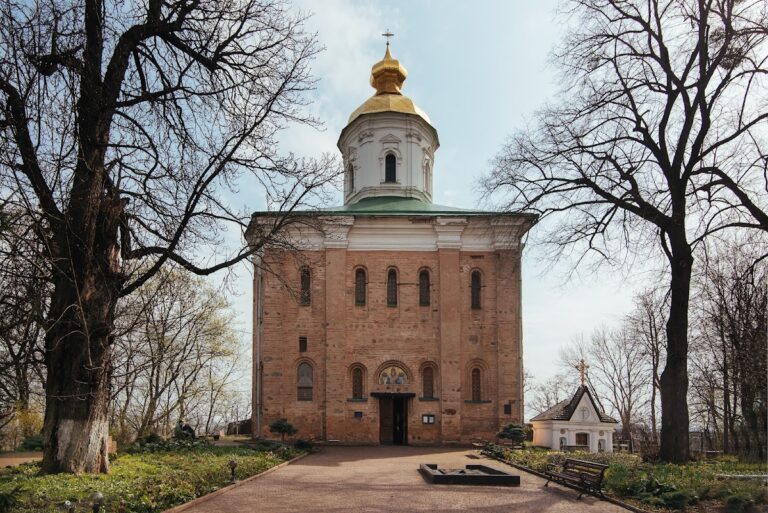
The Church of Saint Michael, also called the Church of the Archangel Michael, was begun under Vsevolod in the eleventh century. It was a cross-domed church, meaning that its central dome was supported by structural arms arranged around a cross. Three subsidiary chapels formed part of its original plan. Its walls used opus mixtum, a masonry technique combining different courses or materials, often brickwork with stone. Excavated foundations reveal the eastern part, while the principal surviving historic fabric belongs to the western part.
The Dnieper undermined the hill and the church built upon it. A retaining wall designed in the late twelfth century by the court architect Miloneg was intended to protect the building. In the sixteenth century, however, the wall and approximately half of the church collapsed into the river. The dome and the entire altar section were lost in that collapse. The church was reconstructed in Ukrainian Baroque style during the eighteenth century, with the work completed in 1769.
Funeral chapel
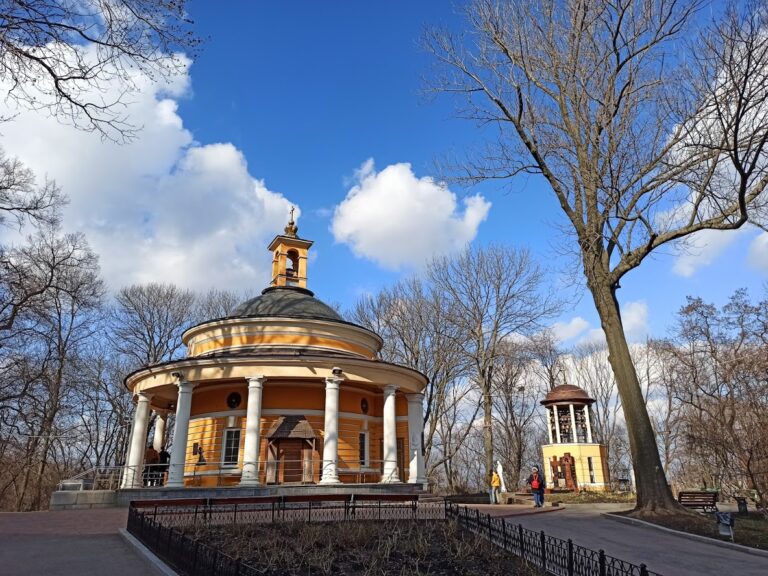
A separate chapel associated with Saint Michael stands on the south side of the former cathedral. Built in the middle of the seventeenth century, it served as a small building for funeral rites and remains a distinct part of the ecclesiastical group.
Baroque core of the ensemble
Saint George Cathedral
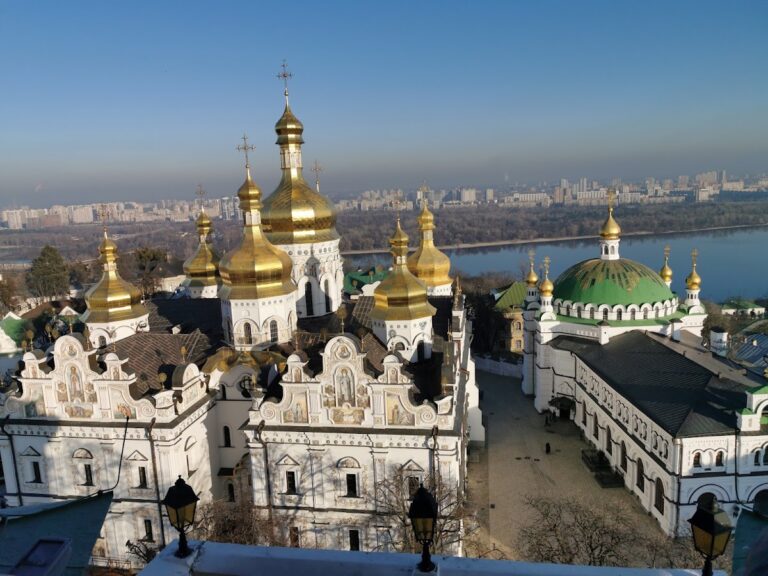
Saint George Cathedral is the compositional center of the monastery ensemble. Formerly known as the monastery’s Saint Michael Cathedral, it was built between 1696 and 1701 in Ukrainian Baroque, also called Cossack Baroque, an architectural style that developed in Ukraine chiefly during the seventeenth and eighteenth centuries. The cathedral has five domes. Mykhailo Myklashevskyi, a nobleman and colonel of the Starodub Regiment, financed its construction.
Myklashevskyi was buried in 1706 in a special crypt beneath the cathedral. His remains are still there. The crypt was restored in 2010 with assistance from one of his descendants, and the remains were placed in a new coffin.
Refectory and Transfiguration Church
The monastery refectory, a communal dining hall, is attached to the Church of the Transfiguration of the Saviour, also called the Saviour-Transfiguration Refectory Church. The church dates from 1691 to 1701 and, like the cathedral, was funded by Myklashevskyi. Together, the two buildings belong to the period when patrons and military leaders supported the monastery’s architectural renewal.
A fire damaged the refectory and church in spring 1760. Their ornamental entrance was subsequently renewed with carving and stucco. It is crowned by a figurative cartouche, an ornamental framed panel, bearing Myklashevskyi’s coat of arms. The cartouches and patron’s coat of arms that once stood above the western, southern, and northern entrances of the Saint Michael Church did not survive.
Bell tower and Saint Daniel’s Church
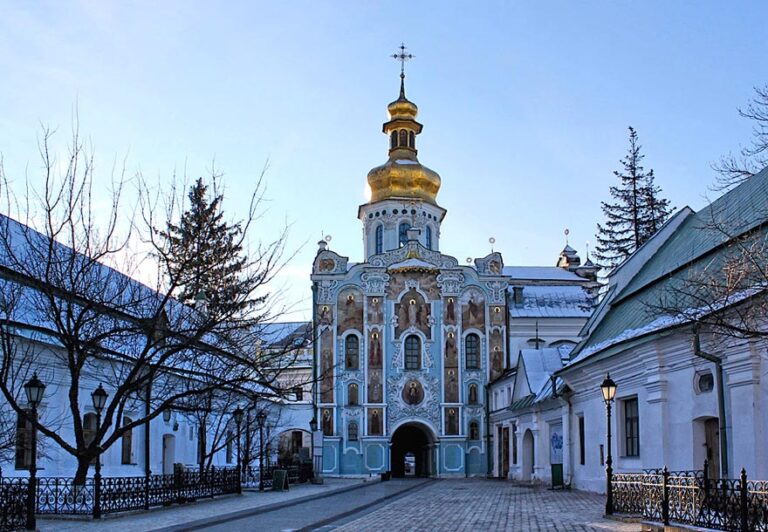
The bell tower was financed by Hetman Danylo Apostol, a hetman being a senior military and political leader in the Cossack territories, and built between 1727 and 1733. It was enlarged from 1827 to 1831. Originally designed as a gate tower, it began to lean and developed a major crack after the upper tier was added. The lower tier was consequently blocked with brick, and the gate was moved beside it. The tower contains a church dedicated to Saint Daniel the Prophet.
Later buildings and burial ground
Brotherhood Building
The Brotherhood Building was constructed between 1845 and 1851. It belongs to the later institutional development of the monastery, when the complex had already acquired functions beyond its medieval role as a princely and monastic center.
Abbot’s House
The Abbot’s House dates from the 1770s. It was designed by M. I. Yurasov and another architect, then rebuilt by E. F. Yermakov in 1896. The building forms part of the later administrative fabric of the ensemble.
Necropolis
The monastery’s necropolis is a physical component of the ensemble. It contains chiefly nineteenth-century scholars, artists, and public figures, including Nikolai Leliavsky, Konstantin Ushinsky, Yevgeny Afanasiev, Vladimir Betz, Bogdan Khanenko, Lev Yashvil, and Yakiv Handziuk, who commanded the First Ukrainian Corps in 1918. The burial ground preserves the monastery’s continuing connection with Kyiv’s intellectual, artistic, and public life.
Continuing monastic use
Vydubychi is an active religious complex as well as a group of historic buildings. Its present grounds include a pottery workshop, a vine-weaving workshop, a small rehabilitation center for people with drug dependencies, and a Sunday school serving children and adults. These functions occupy an ensemble whose churches, towers, administrative buildings, crypt, and necropolis preserve layers of history from medieval Kievan Rus through the modern Orthodox Church of Ukraine.
Nearby sites