Askold’s Grave: A Historic Park and Burial Site in Kyiv
Site at a Glance
- Popularity
- Very High
- Country
- Ukraine
- Primary era
- Modern
- Eras represented
- Modern
- Civilizations
- Russian
- Site type
- Civic
- Remains
- Park
On this page21 sections
History
Askold’s Grave is a historic park and burial site on the steep right bank of the Dnipro in Kyiv, Ukraine. It is traditionally associated with Askold, an early ruler of Kyivan Rus, the medieval East Slavic polity centered on Kyiv, and his burial in 882.
Early Rus traditions and the monastery
The Primary Chronicle, a medieval narrative of early Rus history, says Prince Oleg killed Askold and Dir after they took power in Kyiv. It places Askold’s burial on a hill then called Uhorsk, while Dir was buried elsewhere. Another tradition portrays the two men as lawful rulers descended from Kyi who were killed when Oleg seized the city. A separate tradition dates Askold’s baptism to 867 and says he took the Christian name Nicholas.
The chronicle attributes a church over Askold’s grave to Olma. Another tradition credits Princess Olga with building a wooden church there in the 10th century. Her son Sviatoslav destroyed it in 971, and Prince Vladimir restored it in 990. A women’s monastery was founded at the church in 1036. By the 15th century, a St. Nicholas Monastery was established at the site, where Orthodox monks are recorded in the 15th and 16th centuries.
The Hungarian Tract and the monastery’s later history
The Primary Chronicle connects the name Hungarian Tract to the Magyars, the people who formed the Hungarian nation, saying they stopped there during their migration toward the Danube. In 1151, Prince Izyaslav Mstislavich maintained his court in the suburb. During the 12th century, Prince Sviatopolk Iziaslavich buried his father-in-law Tugorkan, a Cuman khan, or ruler among the nomadic Cuman people, at the site.
In the 17th century, Kyiv scholars identified the monastery church with the chronicle’s church over Askold’s grave. Researchers in the 19th century associated the Hungarian Tract with the area around the monastery. The monastery continued until 1715, when Cossack hetman Ivan Mazepa, a senior political and military leader, moved it to a nearby hill and a new Baroque cathedral was built there. The name Askold’s Grave gained wider use in part through Mikhail Zagoskin’s novel and Alexey Verstovsky’s opera of that title.
The cemetery and nineteenth-century changes
A cemetery was established around the old St. Nicholas Church in 1715 for the monastery. From 1786 it also served the city. It became a prestigious burial ground, particularly in the late 19th and early 20th centuries, and held more than 2,000 burials. Those interred included prominent Kyiv residents, cultural figures, military veterans, and participants in the Napoleonic and Crimean wars, as well as First World War pilot Pyotr Nesterov.
In the mid-19th century, a proposal to demolish the church and cemetery was halted after Emperor Nicholas I intervened. Burials stopped for a period but resumed in the early 1870s. Repeated slope failures later made the cemetery dangerous, leading to roughly two decades of drainage and engineering work.
War, clearance, and changes to the park
Red Guards, armed groups aligned with the Bolsheviks, were buried at the cemetery in February 1918 after taking Kyiv. The following month, Ukrainian students killed in the Battle of Kruty, a 1918 fight against Bolshevik forces during the struggle for control of Ukraine, were buried there. They were later reinterred at Lukyanivka Cemetery. Later burials included Petliura’s Cossacks, and the Ukrainian struggle for independence brought several communal graves to the site.
Soviet authorities announced the cemetery’s closure on 31 May 1919. Its clearance and conversion into a park began in 1934 and continued through 1936. Most graves, crypts, and monuments were destroyed. Some gravestones were reused to pave paths, about fifteen statues were moved for art students to study, and a small number of burials were transferred elsewhere. St. Nicholas Church became a restaurant in 1936 and a park pavilion in 1938. The park was called Askold’s Garden from 1940.
During the Nazi occupation, the grounds served as a German military cemetery, which was cleared after the German retreat. Soviet troops who died during the defense and liberation of Kyiv were also buried there after 1945; their remains were transferred to the Park of Eternal Glory in 1957. In 2012 and 2013, remains of German soldiers buried at the site were exhumed and reburied elsewhere in Kyiv Oblast.
Religious return and modern commemoration
St. Nicholas Church returned to religious use in the early 1990s. A 1992 Kyiv administration decree transferred it to the Ukrainian Greek Catholic Church, an Eastern Catholic church that follows the Byzantine rite and recognizes the pope’s authority. Pope John Paul II visited the church in 2001.
In 1994, the National Writers’ Union of Ukraine and other civic organizations began promoting a pantheon of notable Ukrainians at the site. The idea drew renewed attention after the Revolution of Dignity, Ukraine’s 2013–2014 protest movement, and Russia’s 2022 invasion. A supporting petition reached 25,000 signatures in 2023.
Modern burials include civic activist Oleksandr Klitynskyi, killed in 2014; Donbas Battalion soldier Mark Paslawsky, killed at Ilovaisk in 2014; military commander Dmytro Kotsiubailo and pilot Andrii Pilshchykov, both killed in 2023; and servicemen and activists Pavlo Petrychenko, killed in 2024, and Liubomyr Sochenko, killed in 2025. The site serves as an unofficial memorial to Ukrainian soldiers, though it has not been formally established as a burial ground. The park is designated a nationally significant historical monument and a locally significant monument of garden-and-park art.
Remains
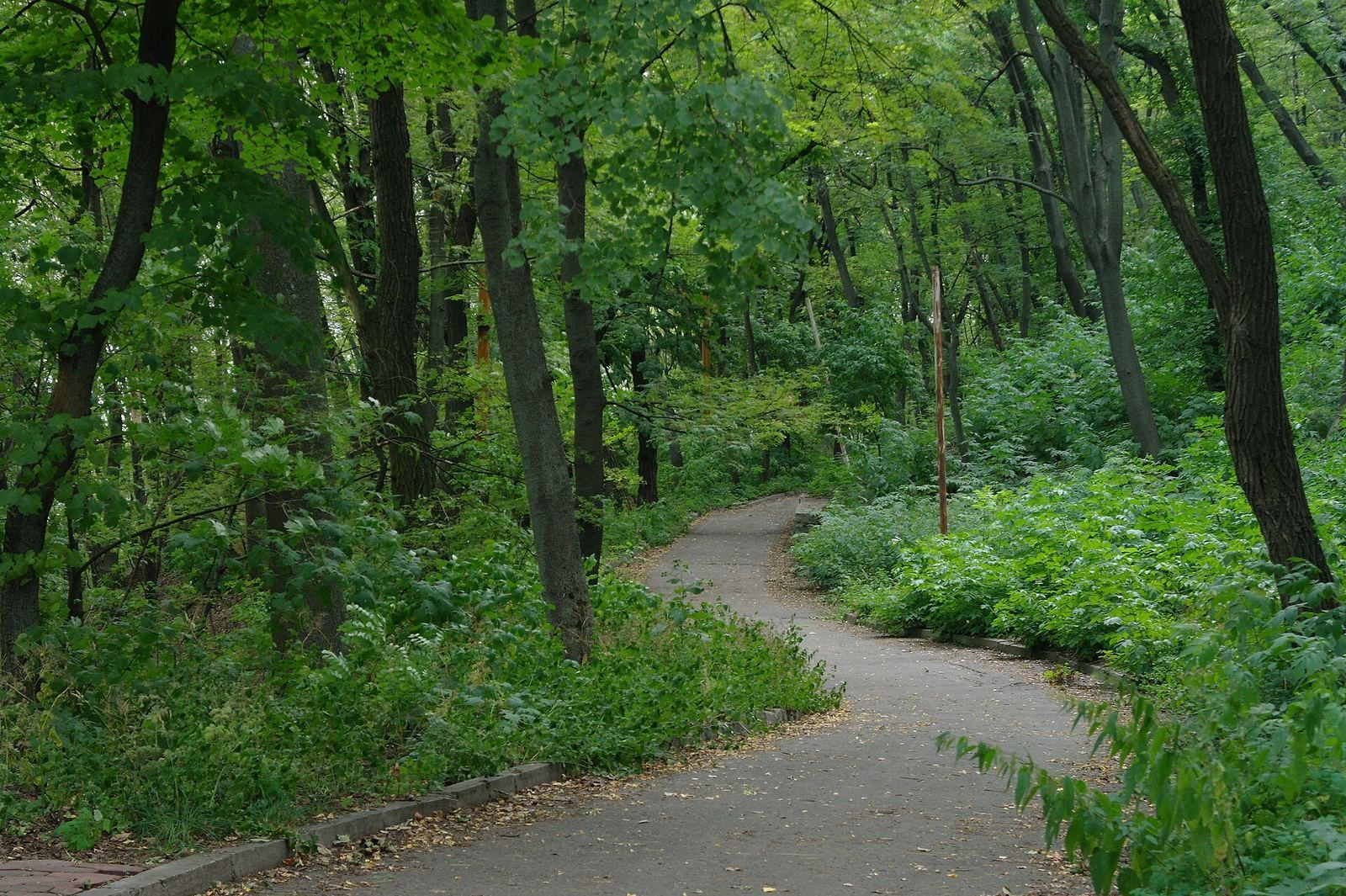
The park covers about 23.5 hectares on the steep right bank of the Dnipro. It occupies part of the river slopes between the Dnipro descent, Ivan Mazepa Street, and Mariinskyi Park, extends toward the Kyiv Pechersk Lavra, and adjoins the Park of Eternal Glory.
St. Nicholas Church
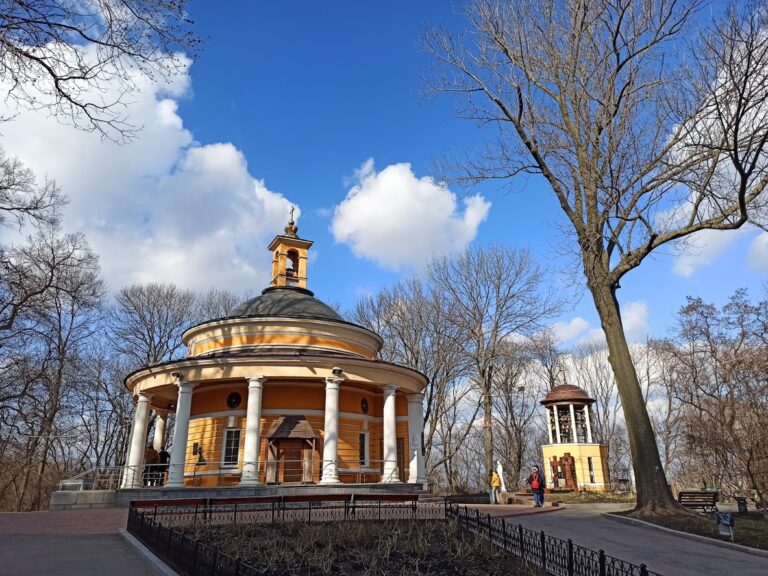
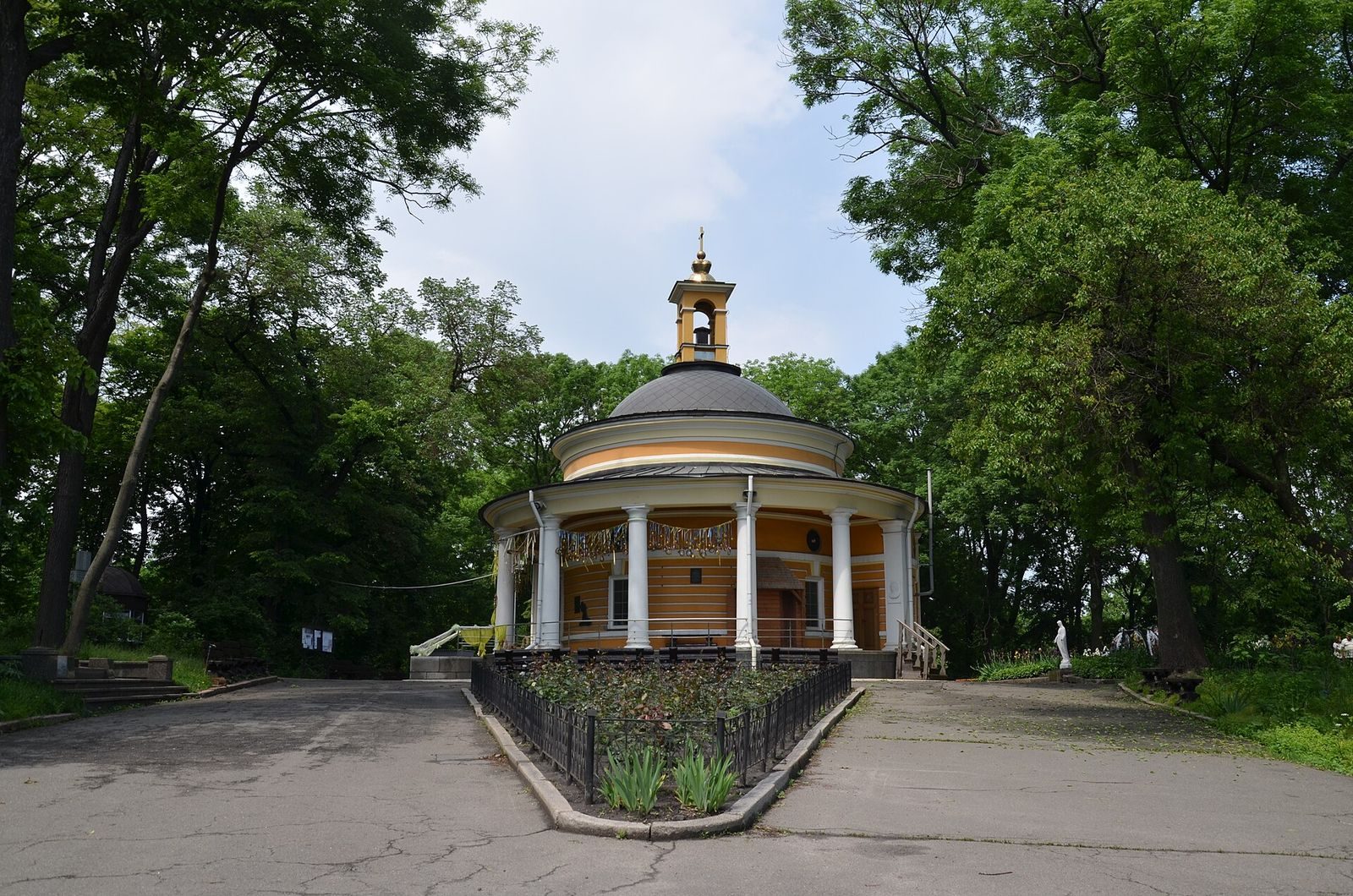
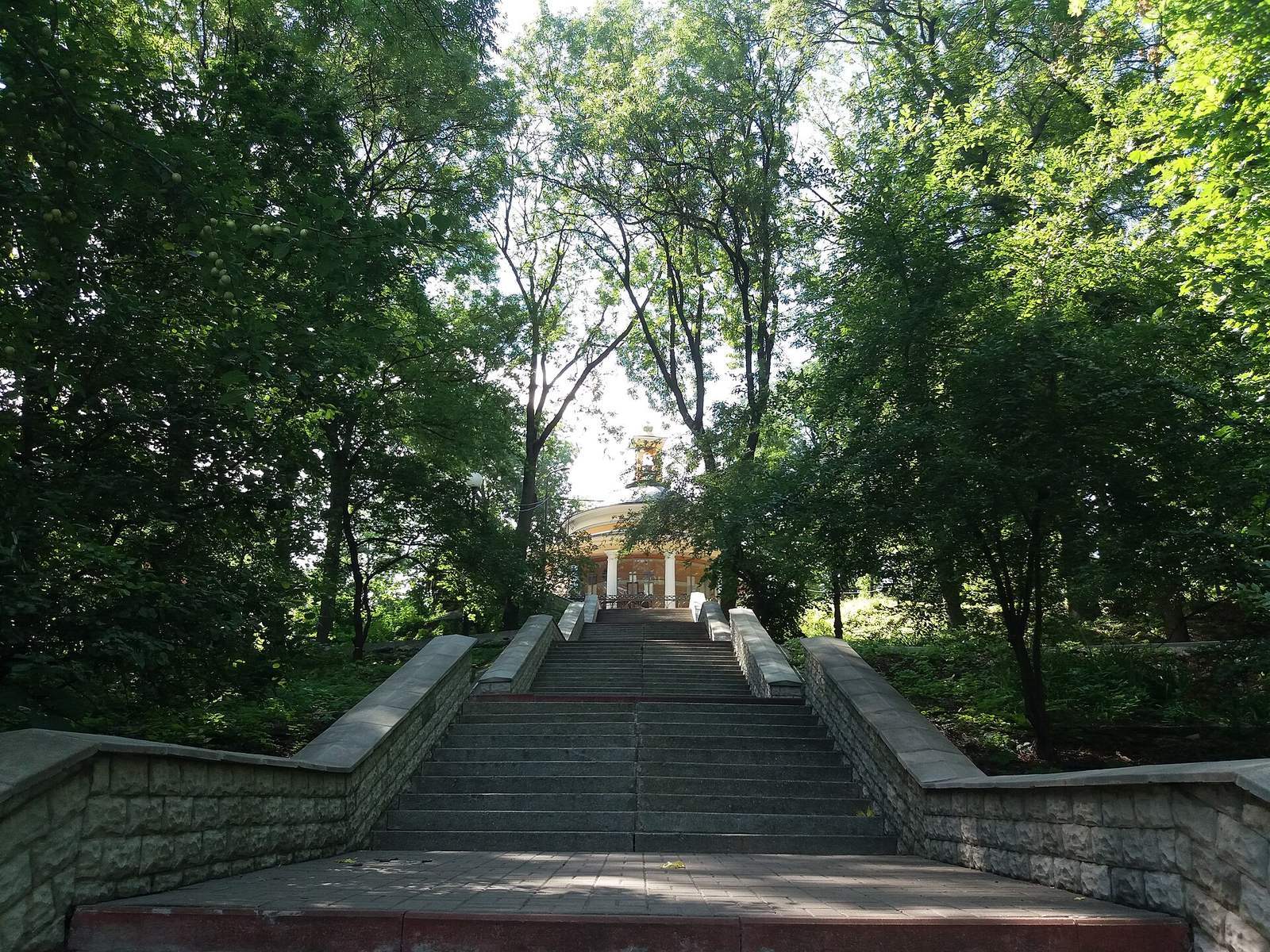
The surviving stone church was designed by Andrey Melensky and built around 1810 on the site of earlier religious buildings. Its Neoclassical design takes the form of a rotunda, or circular building. A flat dome in the Empire style, a monumental branch of Neoclassical design, was replaced in 1938 by an open colonnade of Ionic columns, a classical column form, with no roof. The church’s original appearance was restored in 1998. Askold’s tomb is in the basement. A 19th-century description mentions an ancient-looking stone sarcophagus in the chamber and the burial there of Prince Dimitri Kantakuzene, who died in 1820. Since 1866, an annual procession on 2 July from the nearby St. Nicholas Monastery has commemorated Askold at the tomb.
Cemetery traces and memorial burials
Former cemetery
The former cemetery had elaborate gravestones and substantial crypts. Isolated graves and the remains of two crypts survive. One crypt, associated with Major General N. M. Demidovsky of the Kuban Cossack military community, was used as a chapel in the 1990s. Burials transferred to other cemeteries included those of Nesterov, actors Mykola Solovtsov and Maria Hliebova, and patron Vasyl Tarnovsky.
Kruty memorials
A memorial to the students killed at Kruty includes a wooden cross and a stone plaque. A separate large cross at the site serves as a symbolic grave marker for those killed in the battle.
Military remembrance
A monument commemorating Ukrainian troops killed in the battles of Ilovaisk, Debaltseve, and Donetsk Airport was unveiled in February 2022. The grounds also contain graves of Ukrainian soldiers and other people buried there since independence.
Archaeological remains and the Hungarian Tract
Finds from the Hungarian Tract
Archaeological investigations in the Hungarian Tract found evidence of activity in the 9th century and a hoard of dirhams, silver coins used in several medieval Islamic states. Excavations also uncovered remains associated with a wooden palace of Izyaslav II, the 12th-century prince of Kyiv. An investigation in 1997 found a pottery complex dating from the middle to the third quarter of the 18th century, linked to a former Kyiv settlement.
Magyar migration marker
A marker commemorating the Magyar migration was erected in 1997 for the 1,100th anniversary of its mention in the chronicle. It was designed by architect Janos Vig.
Chapels and other commemorative features
St. Andrew Chapel
The chapel dedicated to St. Andrew the First-Called stands on the Dnipro bank. Built in 2000 and consecrated in 2002, it has a golden-domed design combining Ukrainian Baroque, a regional Baroque tradition, and Ukrainian Modern, a Ukrainian architectural style.
Additional Christian monuments
A separate monument honors St. Andrew the First-Called, and the grounds include a chapel dedicated to the Exaltation of the Cross, a Christian feast honoring the cross associated with Jesus’s crucifixion. A sculpture represents the Virgin Mary, the mother of Jesus in Christian belief.
Taras Shevchenko memorial
Unveiled on 9 March 2014, the memorial to Taras Shevchenko comprises a symbolic stone, a sketchbook, and a representation of his work. Its bronze artist’s equipment draws on his sketchbook and other memorial objects preserved at the National Taras Shevchenko Museum. The memorial recalls Shevchenko’s 1846 watercolor and sepia painting of Askold’s Grave on paper.
Way of the Cross
Created in 2014, the site’s symbolic Way of the Cross consists of 14 bronze relief sculptures mounted on wooden crosses along a route around the church.
Holodomor memorial
A partially rebuilt memorial commemorates victims of the Holodomor, the catastrophic famine in Soviet Ukraine in 1932–1933.