St. Martini (Emmerich): A Historic Collegiate and Parish Church in Germany


Site at a Glance
- Rating
- 4.5
- Popularity
- Low
- Country
- Germany
- Primary era
- Medieval
- External website
- Open
- Eras represented
- Medieval, Early Modern, Modern
- Civilizations
- German, Holy Roman Empire
- Site type
- Religious
- Remains
- Church
On this page15 sections
History
St. Martini is a Roman Catholic parish church in Emmerich am Rhein, Germany, begun around 1040 as a large early Romanesque collegiate church. Dedicated to Martin of Tours, a fourth-century Christian bishop and major saint in Western Christianity, it developed into both a religious institution and a civic center for the town.
Early collegiate foundations
The first church at Emmerich was probably founded by Saint Willibrord, an Anglo-Saxon missionary and the first bishop of Utrecht whose medieval cult was important in the Lower Rhine and Utrecht regions. By the ninth century, a collegiate chapter of St. Martin existed at Emmerich. Its earliest recorded mention dates from 914. The chapter was governed by a provost and contained fourteen canonries, including the provost, who also served as archdeacon of the Diocese of Utrecht.
Under Bishop Bernold of Utrecht, the collegiate institution and its church moved from the former St. Aldegundis parish church to the site of St. Martini. The independent town parish of St. Martini had existed since about 1300. The chapter controlled the church and its surrounding immunity, a protected ecclesiastical precinct, as well as much of the developing merchant settlement. It exercised judicial authority, influenced the appointment of the judge, and appointed chapter members to offices such as steward, testamentary executor, and procurator.
The chapter and the growth of Emmerich
Relations between the chapter and the merchants became strained. On 12 May 1233, after a conflict, the chapter placed itself under the protection of Otto II, Count of Guelders and Zutphen. Otto already held the office of advocate, a lay protector with legal and administrative responsibilities, and acted as mediator. In return, he received rights over the parish church, jurisdiction, tolls, coinage, and annual markets. These rights supported Emmerich’s elevation to town status.
Otto II’s successors swore in the collegiate church to respect the agreement. During the oath, they placed a hand on the Willibrord reliquary, traditionally known as the Ark of Saint Willibrord. This practice continued until Emmerich passed to Cleves in 1402. In 1333, tithes from newly cultivated land were granted to St. Martini to support memorial services and building work.
Romanesque construction and medieval damage
The new church begun around 1040 was conceived as a three-aisled basilica of tuff, with an eastern transept, a three-aisled choir, and a western facade with two towers. Flooding, floating ice, and other damage repeatedly affected the building. Damage is recorded in 1145, while the Rhine destroyed parts of the nave and west building in 1237 and 1238.
Further Rhine damage in 1370 left the eastern nave bay, choir, crossing, crypt, and subsidiary choirs. During the fifteenth century, the original northern transept arm was replaced by a two-aisled building with a north tower. Extensive renovation followed toward the end of that century, and a round tower was added on the south side of the western end. Around 1600, the southern transept received its curved gable.
Reformation, secularization, and reconstruction
During the conflicts between the Protestant Netherlands and Spain, St. Martini lost much of its former wealth. From 1628 to 1672, the church was used exclusively by the Evangelical Reformed community. Altars, sculptures, wall paintings, and stained-glass windows were lost or damaged during this period.
In the early nineteenth century, the western aisle was demolished, the rood screen, a partition separating the choir from the nave, was removed, and the floor was raised by about 1.10 metres. The side aisle was rebuilt in 1874. Napoleon I dissolved the collegiate chapter in 1811, but the parish continued.
War brought the church’s most destructive phase. Incendiary bombs caused a major fire on 7 October 1944. On 23 March 1945, shelling from the opposite bank of the Rhine struck the ruin 270 times, causing the vaults and tower to collapse. The church was reconstructed in substantially simplified form during the postwar decades, with major work continuing through the 1960s. The west facade was rebuilt in 1964.
A comprehensive restoration from 1976 to 1989 returned the floor to its earlier level, reinstated vaults in the Gothic parts, and reconstructed the high choir. The church treasury opened to the public in 1983 and contains ecclesiastical treasures from St. Martini and St. Vitus in Hoch-Elten. The church remains a protected historic monument and belongs to the Diocese of Münster.
Remains
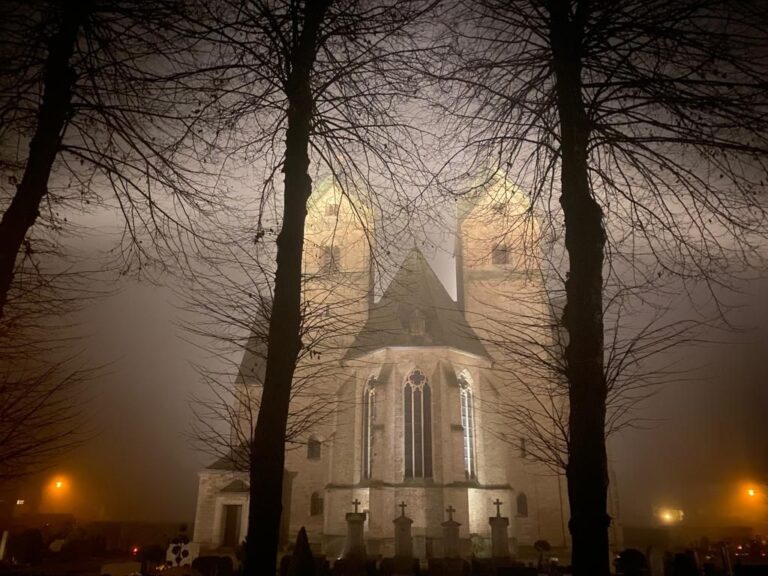
St. Martini combines an irregularly two-aisled Gothic nave with a projecting tower and a Romanesque high choir above a crypt. Brick and tuff are the principal building materials. The foundation church survives in the three-part choir, most of the crossing piers, and the crypt. The present arrangement also preserves later medieval and early modern additions alongside reconstructed postwar elements.
Romanesque choir and crypt
High choir and subsidiary choirs
The main choir and the flanking subsidiary choirs are semicircular inside and five-sided externally. The square section of the main choir is articulated by simple blind niches around the clerestory windows. Later tracery windows were cut into the apse and subsequently blocked. The side chapels have shallow, round-arched blind niches on their exteriors; those of the southern chapel were renewed in 1877 using earlier evidence.
The apse contains a heavily restored Romanesque pavement of white and blue Namur stone. Later vaults divided the side chapels into two storeys and destroyed their Romanesque frescoes. The lower storey of the northern subsidiary choir received wall, floor, and vault mosaics in 1898. Their medallions depict the Seven Sorrows of Mary. A stained-glass window representing the fifth sorrow, the death of Jesus, was destroyed during the Second World War and carefully reconstructed.
Crypt
The crypt is a three-aisled hall with a groin vault, formed by the intersection of two barrel vaults. It is reached through the subsidiary choirs. The upper storey of the northern subsidiary choir contains the museum-style treasury, linking the surviving underground space with the church’s collection of relics, liturgical vessels, sculpture, and other ecclesiastical objects.
Nave, transepts, and towers
Gothic nave and transepts
The two-aisled nave occupies the position of the former northern transept arm. Its Gothic sections have rib vaults, while the crossing, southern transept arm, high choir, and western nave bay have flat ceilings. The southern transept was later shortened by half. Its facade has a curved Renaissance gable and aligns with the southern side chapel and the bay of the surviving western aisle.
The massive north tower stands in front of the main nave and has three storeys. Remains of a portal and porch appear in the middle bay of the eastern exterior wall, while a framed portal is set into the tower’s east wall. Five of the six bases of the rood-screen piers removed in the early nineteenth century remain in the crossing before the ascent to the high choir. Additional fragments found when the floor was lowered are stored outside the church building.
Western round tower
A low round tower adjoins the western end. Its walls are up to 3 metres thick, and its resistance to floating Rhine ice gave rise to the popular name “Icebreaker.” The upper stage is set back above a gallery covered by a lean-to roof and is crowned by a steep, octagonal spire. The high tower hall has a stellar vault.
Artworks, furnishings, and memorials
The Flemish brass baptismal font was made in Antwerp between 1531 and 1535 and carries Renaissance motifs. It was heavily damaged during the Second World War before being extensively supplemented and restored. Of the original thirty-six choir-stall seats made in 1486, eighteen survive. A late-fifteenth-century wooden figure of Saint Willibrord stands at the southwest crossing pier and has a Neo-Gothic painted finish.
The tower hall contains a Crucifixion group formed from fragments of the former early-sixteenth-century rood cross and mourning figures of Mary and John dating from around 1700. Parts of the original polychromy survive. On the altar of the southern subsidiary choir stands a Pieta made around 1530 and attributed to H. van Holt, probably Hendrik van Holt of Kalkar. Its painted finish has been removed. A Crescent Madonna in the tower hall, dated approximately 1530 to 1540, is also attributed to H. van Holt and received its painted finish at a later date.
An epitaph for Duke Gerhard of Schleswig and Holstein, who died in 1433, survives in the western bay. Its figural representations have been lost, but the arms, crest, and inscriptions remain. In the passage between the tower and church is the epitaph of Canon Wessel Huninck, who died in 1519. Its damaged sandstone relief depicts the Transfiguration of Christ on Mount Tabor, with the cleric and his father kneeling opposite one another and Saints Willibrord and Martin behind them.
Treasury and Willibrord relics
The Willibrord reliquary is an eleventh-century work possibly made around 1040 in the Lower Rhine region or Utrecht. Its pouch-shaped oak core belongs to an early type of purse reliquary. The foot and crowning element were added in the Late Gothic period. The front is covered with repoussé gold sheet and divided into four fields by a jeweled and gem-set band. The fields contain symbols of the Evangelists, including two lions of Mark but no bull of Luke. One of the lions differs stylistically and may represent a later reworking.
The copper back plate is engraved in brown varnish with the crucified Christ surrounded by Evangelist symbols. A group of cast silver statuettes depicting the Crucifixion was added as a crowning element in the early fifteenth century. In 1520, the reliquary was converted into a monstrance, a vessel for displaying a consecrated host or relic, with kneeling angels supporting its silver base. It is more than half a metre high. Its inscription identifies the contents as relics that Saint Willibrord received in Rome from Pope Sergius and brought to Emmerich. The reliquary contains objects identified as bones of the Apostle Peter and Saint Walburga, fragments of the True Cross and the Holy Lance, and part of the penitential garment that Jesus was made to wear at Herod’s command.
The treasury also contains an arm reliquary of Saint Martin made in 1521. Other works include a wooden crucifix dating from around 1170, a gilded-silver Calvary group from approximately 1420 to 1430, and a Late Gothic silver Madonna statuette made around 1480 and donated by Provost Count Moritz von Spiegelberg. The crucifix originally had a complete gilded-silver covering, of which only the head covering survives. The Calvary group is probably Netherlandish, with repoussé attendant figures and a cast Crucifix; two coats of arms on its base date from the sixteenth century.
An English alabaster relief from the early fifteenth century shows a dying figure below the Throne of Mercy. The treasury’s other objects include a tenth-century rock-crystal reliquary carved as a fish, whose head and three curved legs were mounted in the thirteenth century; a monstrance made around 1400 from a horizontal crystal cylinder on four curved legs; a tower-shaped ciborium from the first half of the fifteenth century; and a Netherlandish statuette of Saint Michael as a dragon slayer from around 1430, bearing a heraldic medallion of Abbess Lucia, Countess of Kerpen.
Organs and bells
The principal organ was installed in 1989 by Romanus Seifert and Son of Kevelaer. It is a mechanical-action slider-chest instrument with forty-four stops on three manuals and pedal. Its equipment includes a Zimbelstern, carillon, and foghorn. When the foghorn sounds, a model ship emerges from the organ case. The carved organ screens were made by the architect and sculptor Heinrich Riedl. A smaller chest organ was built in the crypt in 1978 by Johannes Klais Orgelbau of Bonn.
Four of the six bells were cast in 1966 by Feldmann and Marschel in Münster. A sixth historical bell, sounding C-sharp, is no longer used because it does not harmonize with the other bells.
Nearby sites