Sottrup Church: A Medieval Parish Church in Denmark


Site at a Glance
- Rating
- 4.7
- Popularity
- Very Low
- Country
- Denmark
- Primary era
- Medieval
- External website
- Open
- Eras represented
- Medieval, Modern
- Civilizations
- Danish
- Site type
- Religious
- Remains
- Church
On this page17 sections
History
Sottrup Church is an Evangelical Lutheran parish church in Denmark, built by the medieval Christian communities of Northern Schleswig probably around 1200. It serves Sottrup Parish, which includes Vester and Øster Sottrup, Vester and Øster Snogbæk, Sandbjerg Castle, and several large farms. The church belongs to the Church of Denmark, Denmark’s established Evangelical Lutheran church, within the Diocese of Haderslev, an administrative church region overseen by a bishop.
Foundation and medieval development
The church stands on a hill at the edge of Vester Sottrup, a location where a pagan cult site may previously have existed. A wooden church may have preceded the stone building, possibly as part of an effort to replace an earlier Germanic cult, but this remains uncertain. The original nave and chancel were built during the period 1100–1250 from fieldstone laid on a granite base.
In approximately 1475–1500, the medieval chancel was extended. Its original apse, the rounded or polygonal end of the sanctuary, was removed, and the altered building later received stone vaults in both the nave and chancel. Wall paintings from this period survive in the chancel vault and on the chancel arch.
Tower, fires, and rebuilding
The church tower was erected in the fourteenth century. Its stability became a persistent problem, and western and southern buttresses were added in 1650. These supports appear to have been a final attempt to keep the bells in the tower. After that effort failed, a separate bell structure was built in 1666. It was demolished in 1863, after repairs had allowed the bells to return to the tower in 1862.
The tower also suffered repeated damage from natural forces. On 2 March 1625, a powerful southwesterly wind blew its cap into the church roof. Duke Philip of Schleswig-Holstein-Sonderburg-Glücksburg paid for repair or rebuilding later that year. Lightning struck the tower’s west side on 7 August 1687, but did not start a church fire. On 7 June 1860, another lightning strike caused the tower to burn. The church was saved when the opening into the roof space was quickly bricked up, while the vault resisted the fire. Under the direction of royal building inspector and architect Laurits Albert Winstrup, the tower was restored by 1862.
The southern porch was rebuilt in 1687 and again in 1862 before being demolished in 1892–1893. A sacristy, a room for clergy vestments and liturgical objects, was attached to the north wall in 1862. The tower and spire underwent a complete renovation in 2006, when a new wooden structure and slate roof were installed. The golden ring from the former roof construction was reused.
Pastors and religious change
The first pastor of Sottrup known by name was Peter Bruno, who served from 1522 to 1572. He is said to have been the first Danish pastor to marry after the Reformation, the sixteenth-century movement that transformed Western European Christianity and established Protestant churches, including Lutheran churches. Bruno was followed by his son Peter Petersen Bruno, pastor from 1572 to 1616, and his grandson Niels Petersen Bruno, who served from 1616 to 1665 or 1666.
The vicarage, formerly in Vester Snogbæk, was rebuilt after fires in 1595 and 1771. Sottrup also maintained a second preacher, the deacon, alongside the principal pastor. Pastor Hinrich Hammerich, who served from 1748 to 1758, tried to lead the congregation toward Pietism, a Protestant movement emphasizing personal devotion and religious revival.
Under Hammerich’s successor, Andreas Caspar Berninck, who served from 1758 to 1768, travelling members of the Herrnhut movement preached and distributed religious writings in the parish. This movement, also known as the Moravian Brethren, was a Protestant renewal community founded at Herrnhut in Saxony and noted for missionary work. Following a religious revival in Sottrup in 1764, Berninck apparently abandoned his opposition to it.
The Sottrup clockmaker Matthias Wied joined the Herrnhut community at Christiansfeld in 1774. After training there, he became a missionary in Suriname and later rose to the highest leadership of the Moravian Brethren. Religious debate continued in the parish in the following decades. Pastor Paul Mumsen introduced the rationalist liturgy of General Superintendent Jacob Georg Christian Adler in 1797, but returned to the former liturgy at Christmas that year, retaining only the general confession. Rationalism sought to interpret religion through reason and moral instruction.
Georg Daniel Holst, pastor from 1806 to 1829, sympathized with rationalism and maintained a private astronomical observatory at the Snogbæk vicarage. He introduced Thomas Clausen, a gifted but poor farmer’s son, to astronomy. Clausen later became a noted astronomer and mathematician. Pietism nevertheless remained active in Sottrup through a circle gathered around the carpenter and organ builder Jürgen Marcussen.
War, language, and national change
During the middle of the nineteenth century, the parish was led by the Danish-minded pastors Paul Mumsen the Younger, who served from 1831 to 1858, and Nis Hanssen, who served from 1859 until his death in 1866. Hanssen also wrote political texts under the name “A Farmer’s Son from Tønder County.” Hans Peter Hanssen, the Danish politician who later played a leading part in Northern Schleswig’s incorporation into Denmark after the First World War, was born in 1862 at Nørremølle farm near Sottrup.
The German-Danish War of 1864 brought the conflict directly into the church. A Prussian general was quartered at the vicarage in Snogbæk and feared that the mainly Danish-minded inhabitants of Sottrup Parish would reveal preparations for the Prussian crossing to Als. On the morning of 2 April 1864, approximately 300–400 men, women, and children from Sottrup and the surrounding area were rounded up and confined in the church without provisions.
Through the windows, those held inside saw the sky reddened by fires and feared that their homes had been burned. The fires were in Sønderborg, which was under bombardment. The prisoners were released after three days and three nights. The Prussian crossing to Als did not succeed until 29 June 1864, after which Sottrup and the Duchy of Schleswig were incorporated into the Prussian province of Schleswig-Holstein.
During the German period, the last pastor from that era was Hans Anton Iver Bertelsen, who served from 1908 to 1919. He supported the Inner Mission, a Protestant movement devoted to religious revival and social outreach within established churches, and organized an annual mission week each February.
After the First World War, Danish-language worship was restored at Sottrup Church. Pastor Niels Birger Kjølseth, who served from 1921 to 1940 and was influenced by the Danish theologian N. F. S. Grundtvig, helped bring many members of the free congregation founded around 1900 back into the Church of Denmark. The restoration of Danish preaching was important because Danish worship had been restricted to free congregations during the German period.
A local legend explains why the church stands on its present hill. The inhabitants of Sottrup and Snogbæk are said to have disagreed over the building site. Construction on a hill between the villages allegedly failed repeatedly, until an angel directed the church to a hill at Sottrup’s western end. The legend adds that human remains were found three feet below the proposed altar, causing the inhabitants to regard that place as desecrated and to complete the church at Sottrup instead.
Remains
Building and tower
Nave and chancel
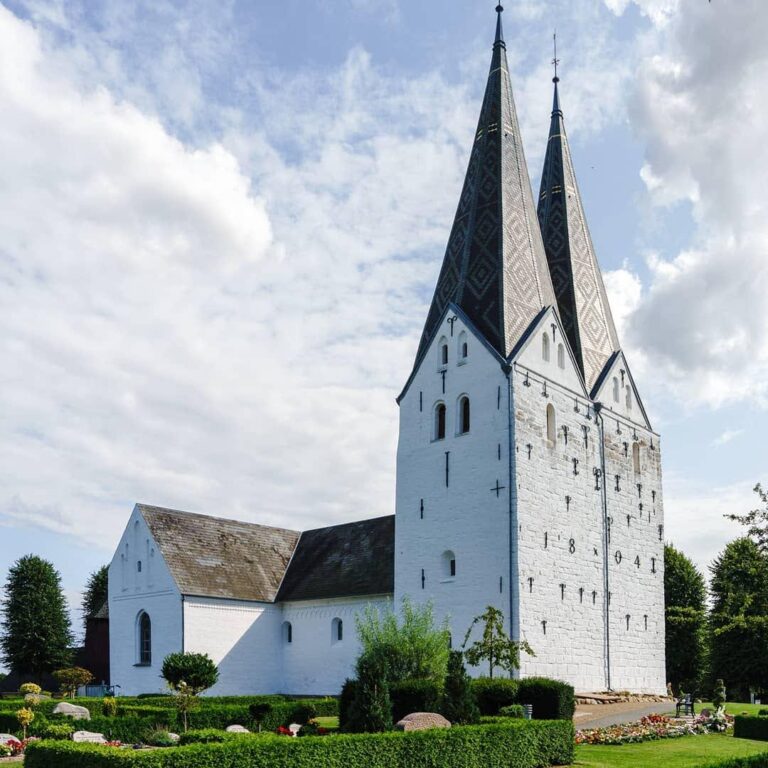
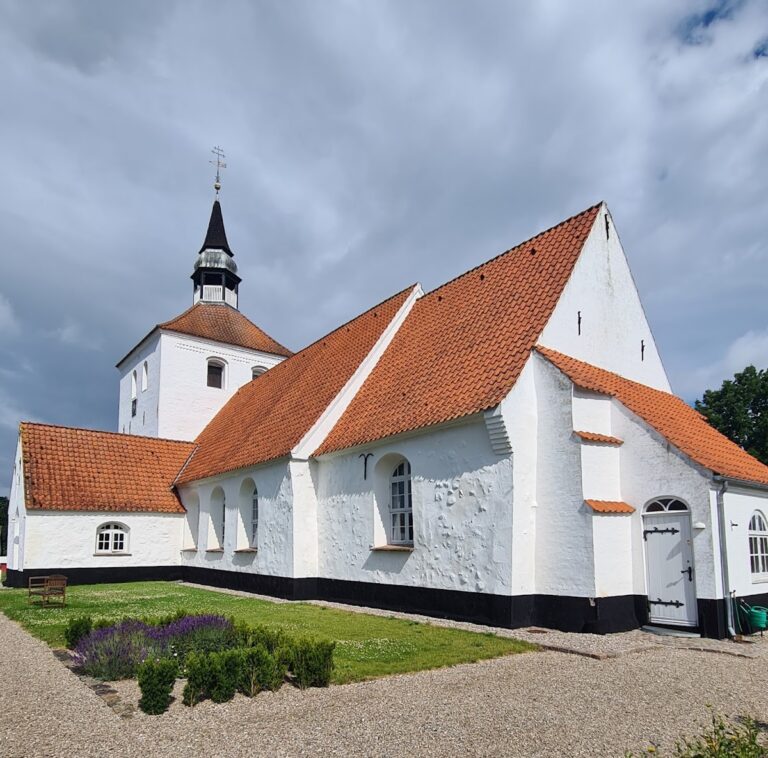
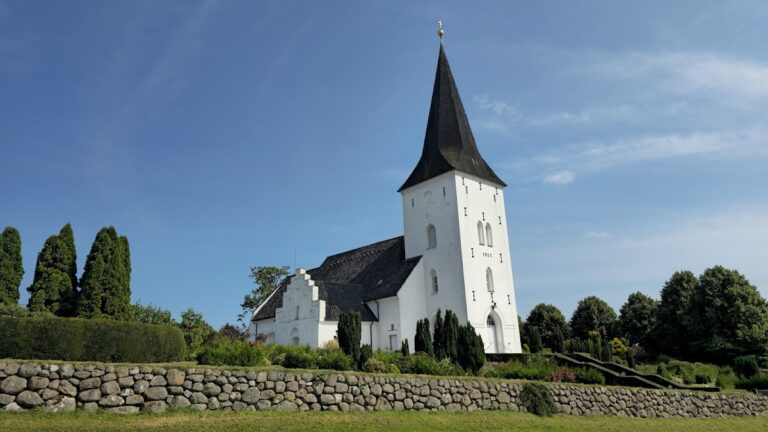
Sottrup Church is a whitewashed building set on a hill at the edge of Vester Sottrup. The original nave, the main body of the church, and chancel, the area surrounding the altar, are constructed of fieldstone on a granite socle. The late-medieval chancel extension is made of brick and replaced the original apse. Vaults were inserted into both the nave and chancel, giving the interior its principal medieval structural divisions.
Tower and spire
The fourteenth-century tower has western and southern buttresses dated 1650. Masonry anchors on its west side carry the same year, while anchors on the south side record the restoration of 1862. The present spire is the third long, pointed spire erected since 1625. Its golden ring was retained from the earlier roof construction and reinstalled during the 2006 renovation. In suitable sunlight, the ring can create the impression that the spire is floating. The tower and its tall spire form a regional landmark visible as far away as Als.
Bells
Two bells hang in the tower. The larger is a reunification bell cast in Aalborg in 1920. It replaced a bell originally cast in Lübeck in 1598 by Matthias Benningk. That earlier bell was recast in 1795 and 1841 before being surrendered for metal collection in 1917. Its former inscription stated that Sottrup’s churchwardens in Sundeved had commissioned it in Lübeck.
The smaller bell was recast in Rendsburg in 1829 by Jakob Friedrich Beseler from a bell made in 1656. The earlier bell had cracked in 1808. Its former inscription named Christoph Jäger as provost and Baltzer Melchersen of Flensburg as maker, and included two ducal coats of arms and a German devotional verse.
Interior furnishings
Baptismal fonts and chancel furnishings
The Romanesque baptismal font has a foliage motif and resembles the font at Notmark Church on Als. Its brass cover was supplied in 1847 by the Sønderborg goldsmith Linde. A second baptismal font, made of fired clay in the Classicist style, was donated in 1847. It stood little used in the nave before being transferred after 1920 to Sonderburg Castle Museum.
A crucifix hangs above the chancel arch. Its marble corpus is approximately 75 centimetres high and was donated in 1696 by Pastor Lauritz Ottosen Riese, who served from 1679 to 1714. The crossbeam carries the Latin words “Spes mea unica Christus,” meaning “Christ, my only hope,” while an inscription on the reverse identifies Riese as donor. The chandelier before the chancel arch dates from 1898.
Pulpit
Duke Philip of Glücksburg donated the pulpit and sounding board in 1642. The Flensburg woodcarver Claus Gabriel made them for 55 Reichsthaler. Richly carved reliefs on the four panels show the Annunciation, the Nativity, the Adoration of the Magi, and Christ’s baptism in the Jordan. Rounded figures, including Christ holding a globe, stand at the panel corners on consoles decorated with angels’ heads.
The pulpit’s five-sided sounding board was altered in 1844 by Mathias Petersen, a carpenter from Vester Sottrup. Its original structure had become unsafe and threatened to fall.
Altarpiece and paintings
The brick altar table and present altarpiece date from 1783. They replaced a 1703 altarpiece by Peter Petersen of Tønder, which had been damaged by fungal decay and woodworm. The replacement was made by the Sottrup carpenter Christensen and others. A dove representing the Holy Spirit sits within a Rocaille frame, a late-Baroque and Rococo design based on shell-like, asymmetrical forms. Parts of the earlier work survive in the two piers and the Corinthian columns beside the central field.
The three altarpiece paintings were made by the Aabenraa painter Jes Jessen, who was the first teacher of the Danish painter C. W. Eckersberg. The central field shows the Resurrection, the upper field the Ascension, and the central part of the predella, the lower section beneath an altarpiece, the Last Supper. Danish inscriptions on the predella translate as “Take, eat, this is my body” and “Drink of it all, this is my blood.”
Wall paintings and later textile
Paintings dating from approximately 1500–1525 were uncovered in the chancel vault and on the chancel arch in 1941. They are attributed to Peter Lykt, who also created frescoes in Broager Church and the Church of St John in Flensburg. The Sottrup decoration consists mainly of foliage with large club-shaped flowers, birds, and red cranesbill, a plant that grows beside the stream near the vicarage.
In 2011, Hanne Skyum of Kegnæs made a new altar cloth using handwoven tapestry technique. Its brown and green roots surrounded by water echo the foliage of the medieval wall paintings and refer to Job 14:7–9.
Organ and votive ship
The church probably received its first organ in the seventeenth century, possibly in 1696, when the carpenter Hans Jürgensen may have built a gallery. Organ builder Hinrich Wiese repaired the instrument in 1704, and it was rebuilt and enlarged in 1719. Johann Daniel Busch supplied another organ in 1761, which Jürgen Hinrichsen Angel repaired in 1786.
The third and present organ was built in 1844 by Marcussen and Reuter of Aabenraa. It is an early Romantic instrument that remains largely original. Its prospect pipes were confiscated during the First World War and later replaced. Two stops were probably exchanged to brighten the sound, and a Zimbelstern, an effect producing a bell-like sound from rotating small bells, was probably added later. The organ has fully mechanical tracker action, slider chests, the couplers II/I and I/P operated by stop knobs, and a Zimbelstern.
The church’s votive ship is a model of the training ship Danmark. H. C. Hansen, a fisherman, built it at Sottrupskov in 1954. A votive ship is a model vessel displayed in a church as a religious offering or memorial, often reflecting a community’s connection with seafaring.
Churchyard memorials
The western part of the churchyard contains a memorial grove with Danish and German graves and crosses connected with the Schleswig Wars and the First World War. A memorial to Prussian soldiers killed in 1864 was built from fragments of the powder magazine at the Düppel redoubts. Another First World War memorial commemorates 48 young men from Sottrup Parish.
Further memorials include one to a border guard who died at Neuengamme concentration camp during the Second World War and the overgrown grave cross of Carl Wilke, a Prussian pioneer killed in the 1864 Battle of Als. Danish- and German-language gravestones and crosses stand among the memorials, and wreaths are laid in the churchyard each year at Pentecost in memory of the dead.
Nearby sites