St. Felizitas (Vreden): A Former Women’s Collegiate Church in Germany


Site at a Glance
- Rating
- 4.9
- Popularity
- Very Low
- Country
- Germany
- Primary era
- Medieval
- External website
- Open
- Eras represented
- Medieval
- Civilizations
- Holy Roman Empire
- Site type
- Religious
- Remains
- Church
On this page16 sections
History
St. Felizitas is a historic church in Vreden, Germany, whose origins lie in the ninth-century women’s collegiate foundation of St. Felicitas. The institution was among the earliest foundations for women in Westphalia and developed from a Christian centre that may already have supported missionary activity in the Münsterland during the late eighth century. Vreden also stood on an established long-distance route leading from the Dutch region.
Foundation and early churches
The foundation existed by no later than 839. Tradition connects its establishment with Walbert, probably a member of the Billung family. In that year, he arranged for the relics of Felicissimus, Agapitus, and Felicitas to be brought to Vreden with the participation of Altfried, bishop of Münster. The arrival of the relics was regarded as completing the foundation, and Walbert was buried there.
Dedicated to Saint Felicitas, the institution admitted women of high nobility. A women’s collegiate foundation was a religious community for unmarried women, often from noble families, who followed a shared religious rule without necessarily belonging to a monastic order. The foundation’s first collegiate church was a predecessor building on the site of the present parish church of St. George. Between 1070 and 1100, St. Felicitas assumed the collegiate church’s role.
Imperial connections and changing authority
The foundation maintained close ties with the ruling house of the Holy Roman Empire. During a royal circuit in 1024, King Conrad II visited Vreden, where he was received by Adelheid, abbess of Quedlinburg, and Sophia, abbess of Gandersheim. Both women were daughters of Emperor Otto II and Theophanu. Later, Beatrix, a daughter of Emperor Henry III, became abbess of Vreden, while some of its abbesses also held the abbacy of Essen.
Until 1085, Vreden was directly subordinate to the emperor. This position, known as imperial immediacy, placed the foundation under the authority of the Holy Roman Emperor rather than a territorial lord. In 1085, Emperor Henry IV granted Vreden to Liemar, archbishop of Bremen. The foundation later recovered its direct imperial status, which it retained until the second half of the twelfth century. In 1261, however, the abbess accepted the authority of the bishop of Münster, bringing the foundation’s imperial immediacy to an end.
Legend, destruction, and dissolution
A local religious tradition associates Vreden with the conversion of Norbert of Xanten. According to the legend, lightning struck near the town in 1115 and threw Norbert from his horse shortly before he reached Vreden. The event is said to have led to his conversion.
The foundation suffered severe damage during the Bredevoort Feud in 1324. Troops serving Rainald II of Guelders plundered the complex and started a fire that destroyed its archive. In the eighteenth century, Jodocus Hermann Nünning served there as scholaster, an ecclesiastical officer responsible especially for teaching and the intellectual affairs of a chapter.
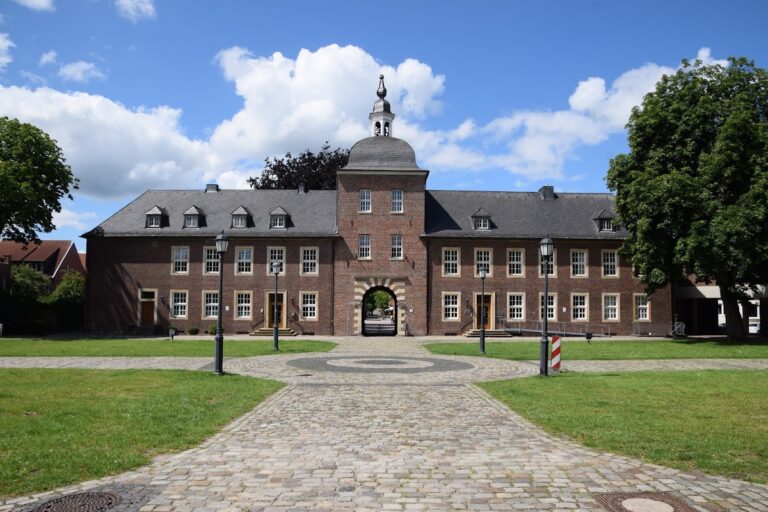
The women’s collegiate foundation was dissolved in 1810. Its former complex underwent extensive remodelling in 1911. A hospital that had formerly stood beside the collegiate church was moved away at the end of the 1960s, and the old building was entirely demolished. This changed the space between the church and the town moat, where a lawn now extends beside the church.
War damage and later renewal
Bombing at the end of the Second World War destroyed the choir and the vaults of the nave and crypt. Reconstruction was completed by 1952. A later renovation lasting several years culminated in the church’s return to service on 18 December 2016, when the Blessed Sacrament was ceremonially returned to the tabernacle.
Remains
Church structure and crypt
Eleventh-century hall crypt
St. Felizitas retains an eleventh-century crypt that originally lay below an older church and now occupies the space beneath the present choir. It is a three-aisled hall divided into four bays. Its aisles are approximately equal in height, creating a unified interior rather than a dominant central passage. The crypt uses groin vaults, formed where two barrel vaults intersect. Wartime bombing destroyed these vaults, which were rebuilt by 1952.
The present collegiate church
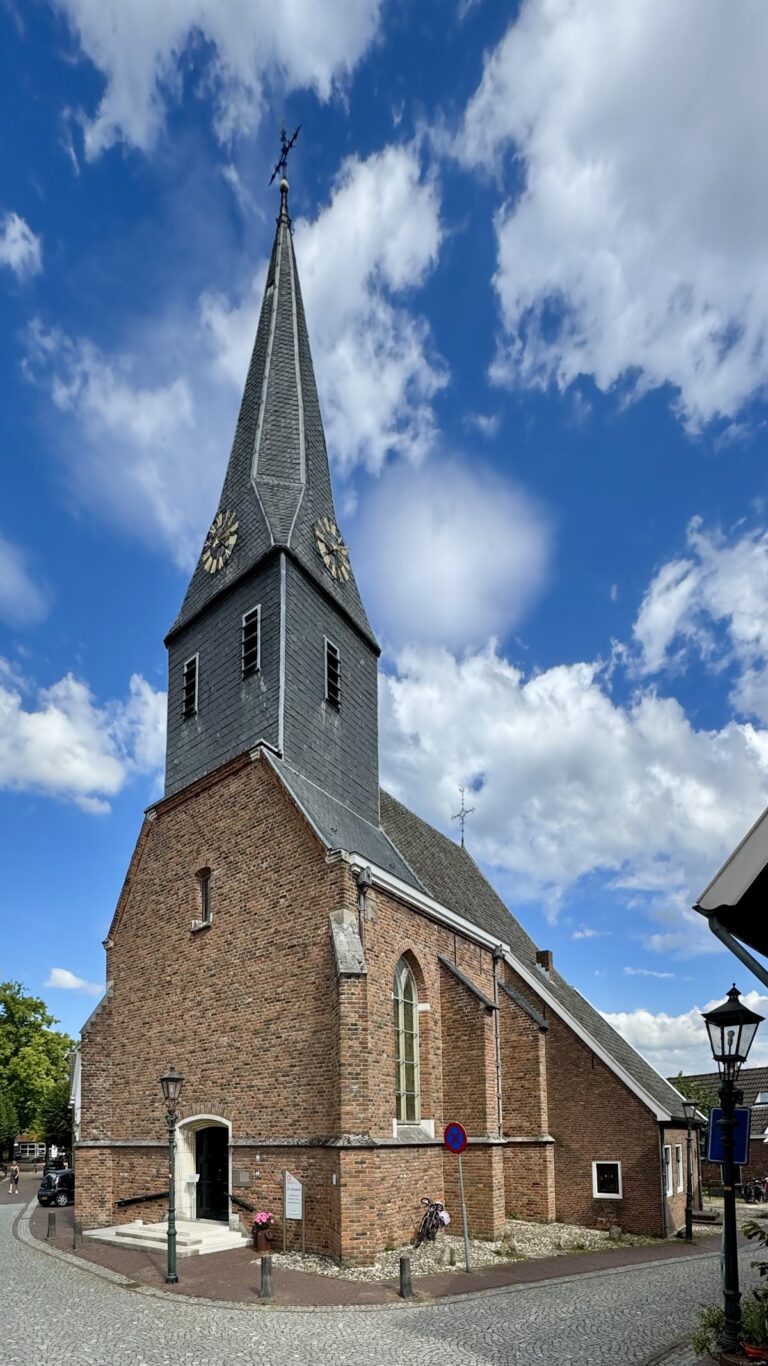
The existing church belongs to a building phase whose precise date remains uncertain. It was erected either during the first half of the twelfth century or around 1170 to 1180. The plan consists of an elongated, single-aisled hall with four bays, a crossing, and square transept arms. A crossing is the area where the nave and transept meet, while the transept arms project across the church on either side. The choir was rebuilt in 1427, and the vault over the eastern nave bay was renewed during the sixteenth century.
The north portal incorporates the portal from the destroyed parish church of St. George. This reused element connects the surviving church with the earlier parish building, whose Carolingian predecessor, like the original church of St. Felicitas, had ninth-century origins. New collegiate buildings were erected in the seventeenth century.
Furnishings and religious objects
Surviving furnishings
The church contains the Vreden Lenten veil of 1619 and a Marian chandelier from the late fifteenth century. Its former collegiate treasury included a medieval group of saints’ relics in several reliquaries, most of them works in goldsmiths’ materials. Ivory boxes, ostrich eggs, and related treasury objects were also part of the collection. Among the textile relics, the so-called Sixtus Chasuble, dated to the seventh or eighth century, is the most valuable.
Felicitas Altarpiece
The Felicitas Altarpiece stands on a side altar. It was also known as the Seven Brothers Altarpiece, reflecting the traditional account of Saint Felicitas as a Christian martyr associated with seven martyred sons. The upper scene shows Felicitas and her sons before a judge shortly before her condemnation. Below, a relief depicts the martyrdom of Felicitas and her children, with four sons, a soldier, and another man. Two angels flank the central scene, and two putti appear above it. The lower part also carries the Salm-Reifferscheidt arms on the left and the Leiningen-Dagsburg-Falkenburg arms on the right.
The altarpiece originally stood on the eastern wall of the women’s gallery. In 1747, it was moved to the western nave bay and later placed in storage. In 1910, it became the high altar of the chapel at the St. Antoniusheim workers’ colony in Vreden. After that chapel was secularized, the work was restored between 2009 and 2011 and brought back to St. Felizitas. Felix Genn, bishop of Münster, blessed it with its altar in 2012. It now serves as a memorial place for deceased children, for whom Felicitas is the patron saint.
Archaeological evidence and former grounds
Early medieval finds
Excavations carried out between 1949 and 1951 produced a bronze writing stylus from the first third of the ninth century. Such a stylus could have been used to write on wax tablets. Bronze sound discs from the same early period were also recovered, adding material evidence to the foundation’s early medieval history.
Western chapel fragments
Fragments carved in Baumberg sandstone preserve a scene of hell and parts of inscriptions dating from around 1100. They belonged to a partition that separated the western Chapel of St. Michael from the nave. The surviving pieces retain evidence of the church’s medieval internal arrangement and decoration.
Memorial features beside the church
The former hospital ground is now a lawn between St. Felizitas and the town moat. The area also contains a Way of the Cross and a five-bar steel cross made by the Vreden artist Adolf Erning. Together with the church and its surviving furnishings, these features preserve the religious memory of the former foundation grounds.
Nearby sites