Tegernsee Abbey: A Benedictine Monastery and Royal Residence in Germany


Site at a Glance
- Rating
- 4.8
- Popularity
- Very Low
- Country
- Germany
- Primary era
- Early Modern
- External website
- Open
- Eras represented
- Medieval, Early Modern, Modern
- Civilizations
- German, Holy Roman Empire
- Site type
- Domestic
- Remains
- Palace
On this page16 sections
History
Tegernsee Abbey in Germany was a Benedictine monastery founded at Tegernsee in the mid-eighth century. Its foundation is traditionally dated to 746 or around 765, while archaeological examination of remains associated with its founders places the foundation around 760 to 765. The monastery is also associated with a church consecrated and occupied in 754. Dedicated initially to Christ as the Savior of the World, it became a center of Christian and cultural activity in the eastern Alpine region and later developed into an important Bavarian monastery.
Foundation and early monastery
The traditional founders were the brothers Otkar and Adalbert, members of the Huosi, an old Bavarian noble clan. A late ninth-century account, expanded during the tenth century, tells that the brothers withdrew from secular life after the son of the Frankish king Pippin killed Otkar’s son during a chess game. The detailed story cannot be verified historically, although Adalbert is known as Tegernsee’s abbot and took part in the Synod of Dingolfing in 770. Otkar has no independent contemporary attestation.
Monks from St. Gall settled the community. From Tegernsee, Christian and cultural activities extended into Tyrol, including the area around Bolzano, and into Lower Austria. In 804, relics of Saint Quirinus, a Roman Christian martyr, were brought from Rome. The church then adopted Quirinus as its patron and became known as the Church of Saint Quirinus.
After the deposition of Tassilo III, Duke of Bavaria, Tegernsee became a Carolingian royal monastery. Hungarian raids and attempts to secularize the monastery during the rule of Duke Arnulf of Bavaria weakened the community, and monastic life died out during the tenth century. An extensive fire around 970 destroyed or damaged early evidence and marked the culmination of this decline.
Imperial abbey and medieval learning
Emperor Otto II restored and refounded Tegernsee as an Imperial Abbey in 978. An Imperial Abbey was directly subject to the Holy Roman Emperor rather than to a territorial prince. Monks from Saint Maximin’s Abbey in Trier resettled the monastery. A charter of 979 granted Tegernsee the right to elect its abbot, exemption from taxes, and imperial protection, reducing the direct authority of the Bavarian rulers.
During the eleventh and twelfth centuries, Tegernsee became a major center of literature, manuscript production, book art, scholarship, and learning. The monk Froumund and Abbot Ellinger were closely associated with this period. The monastery also helped re-establish Benedictine monasticism, the tradition of communal prayer, work, study, and obedience to the Rule of Saint Benedict, elsewhere in Bavaria. One such foundation was the Abbey of Saints Ulrich and Afra in Augsburg, settled around 1012.
The monastery’s intellectual production included Ruodlieb, written in the last third of the eleventh century, the twelfth-century Quirinals, and the religious drama Play about the Antichrist from around 1155. Its letter collection dates from 1178 to 1186. A saying associated with Walther von der Vogelweide probably dates from shortly before 1206 or from around 1212.
Tegernsee largely avoided the conflict between Pope Alexander III and Emperor Frederick I, a struggle over papal and imperial authority, while securing privileges from both powers. From 1121, the Counts of Andechs acted as the monastery’s advocates. An advocate was a lay official who protected a monastery’s legal and temporal interests. The appointment of Manegold of Berg as abbot in 1189 or 1190 reflected the influence of the Berg, Andechs, and Hohenstaufen aristocratic networks. During the thirteenth and fourteenth centuries, Tegernsee declined into an aristocratic monastery dependent on a limited number of noble families.
Reform and renewed prosperity
A major fire destroyed or severely damaged the monastery in 1410. A visitation by the vicar-general Johannes Grünwalder in 1426 began a new phase, and, with the support of Cardinal Nicholas of Cusa, Tegernsee became an important center of the Melk Reform. This fifteenth-century movement sought stricter Benedictine observance and more disciplined monastic life.
Tegernsee monks settled Andechs Abbey in 1455 and later became abbots of Benediktbeuern, Oberaltaich, Wessobrunn, and other monasteries. A large Passion altar, devoted to scenes of the suffering and death of Jesus, was dedicated in 1446. The monastery’s delegate to the Council of Basel, Johannes Keck, wrote about music, while the prior Bernhard of Waging produced mystical writings.
The monastery’s second period of prosperity continued into the early modern period. From 1573, its own printing press published theological, liturgical, and music-theoretical works under imperial printing privileges. Around 1500, the scribes compiled the Liber illuministarum, a major collection of instructions on preparing parchment, making pigments, and applying gilding. The community survived the Thirty Years’ War, including a Swedish attack or raid in 1632, and became a prominent member of the Bavarian Benedictine Congregation after its foundation in 1684.
Baroque rebuilding and dissolution
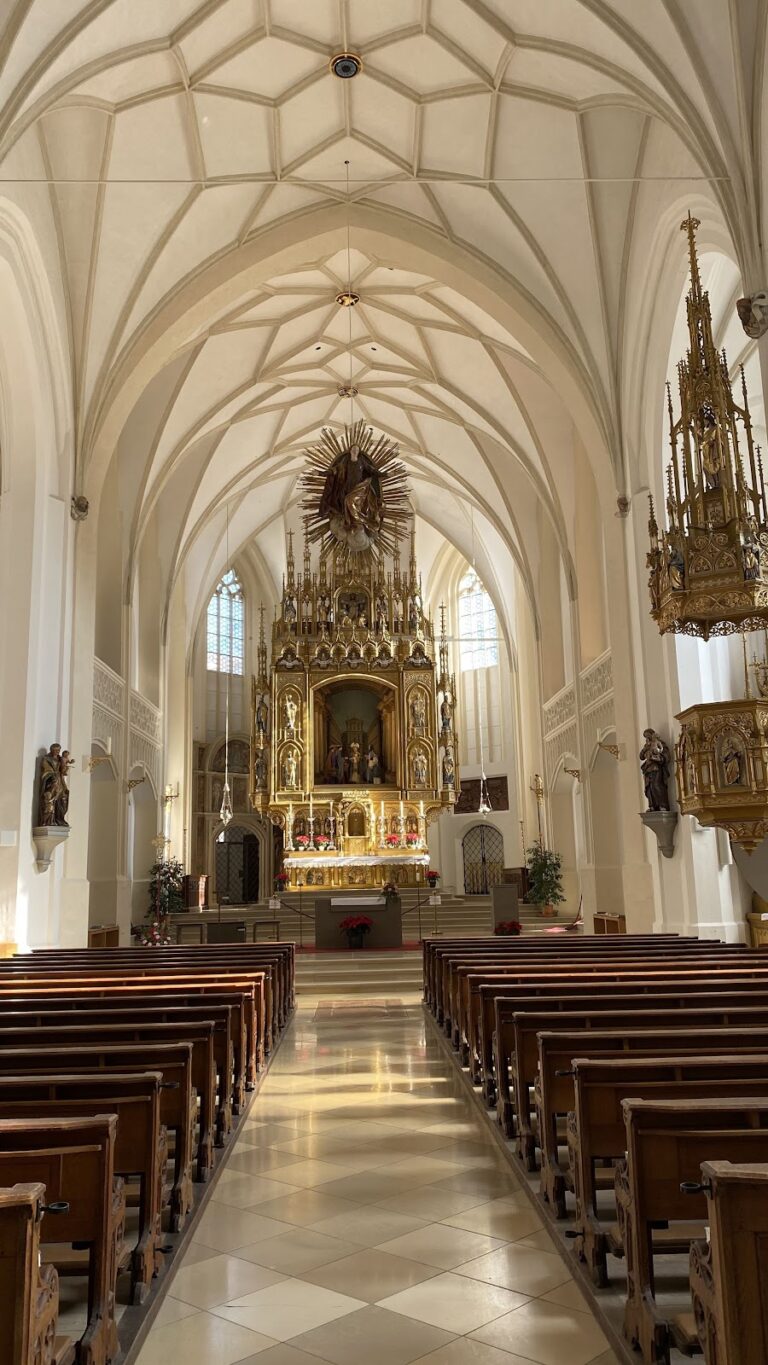
Baroque remodelling began in 1678 according to plans by Enrico Zuccalli. The church received a crossing and transept, while Hans Georg Asam created its elaborate stucco decoration and painted vault program by about 1690. The church and monastic buildings were refurbished or reshaped between 1684 and 1688, with work continuing in parts of the complex through 1689.
Signs of secularization appeared during the abbacy of Benedikt Schwarz, which ended in 1787. The abbey was dissolved on 17 March 1803, ending its monastic history. Its last abbot, Gregor Rottenkolber, died on 13 February 1810.
In 1803, Carl Josef, Count of Drechsel, acquired the monastery complex and its economic buildings for 44,000 gulden. He demolished the entire western part and removed the copper roofing. A small unofficial monastic community occupied part of the former complex until 1861. King Maximilian I Joseph of Bavaria acquired the remaining important wings on both sides of the church in 1817. On 7 and 8 October 1822, the complex hosted Maximilian I Joseph, Tsar Alexander I of Russia, and Emperor Francis I of Austria with their entourages.
Royal residence and later uses
Leo von Klenze remodelled the surviving complex in 1823 and 1824 as a royal summer residence. It later became the principal residence of the Bavarian branch of the Wittelsbach dukes. The Wittelsbachs were Bavaria’s ruling dynasty, and the Dukes in Bavaria belonged to a junior branch that retained the former monastery as a residence. The complex is now known as Tegernsee Castle and remains in the possession of that branch, whose present owner is identified as Prince Max, Duke in Bavaria.
In 1895, Duke Carl Theodor established a family crypt for the Dukes in Bavaria in the former abbey church. The building remains the Catholic parish church of Saint Quirinus. Other parts of the former monastery accommodate the Tegernsee Grammar School, the Ducal Bavarian Brewery of Tegernsee, a brew pub, restaurants, and private ducal quarters. The former monastery vicarage has housed the Museum of the Tegernsee Valley since 1999.
Remains
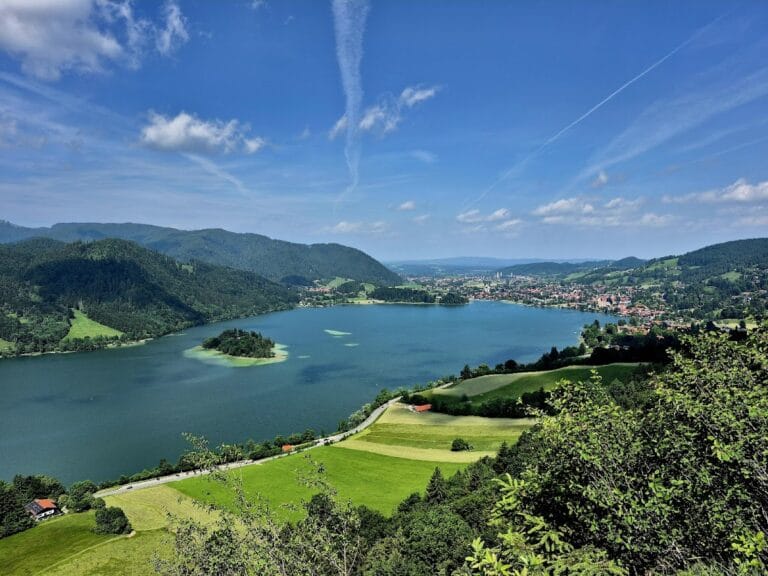
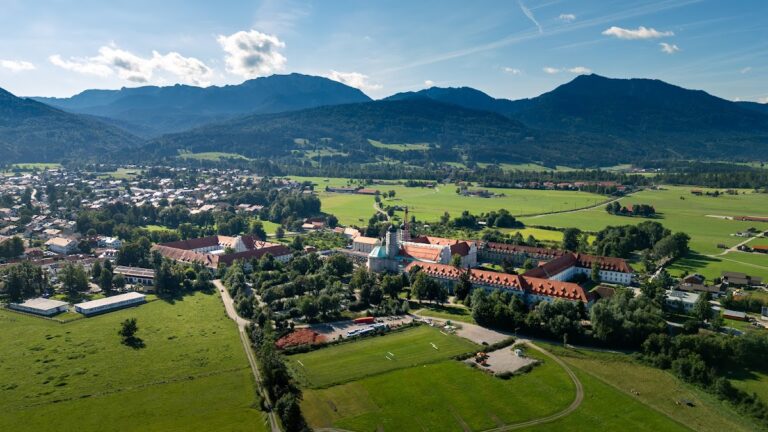
The former abbey complex stands on the shore of Lake Tegernsee, whose name derives from the Old High German expression tegarin seo, meaning “great lake.” The surviving site is organized around the former abbey church of Saint Quirinus and the remaining monastic buildings, which form a four-wing complex with plaster detailing and two inner courtyards. Planned by Enrico Zuccalli in 1678, the buildings were built or completed between 1689 and 1736 by Antonio Riva, Johann Schmuzer, and Johann Baptist Gunetzrhainer.
Former abbey church
Early fabric and medieval basilica
Parts of the crypt, a chamber below the church used for burials or relics, and the lower sections of the western twin-tower facade may derive from the rebuilding around 980. The earlier church was transformed into a Romanesque basilica in the eleventh century and rebuilt in Gothic form between 1455 and 1460. The large three-aisled basilica, a church with a long central nave flanked by lower aisles, was completed by 1476. It has no transept in its medieval structural form and remains the core of the church.
The roof structure is largely preserved. The interiors of the two western towers retain brick masonry from the fifteenth-century rebuilding, while their roofs preserve historic structural frames. The external forms of the tower roofs were altered later.
Baroque interior
The Baroque alteration inserted a crossing and transept into the church. Around 1690, Hans Georg Asam completed rich stucco decoration and a complex series of painted scenes in the vaults. Around 1820, the eastern choir used for psalm singing was separated from the church, and Leo von Klenze later altered the facade.
Founders’ remains and medieval altar
The high altar preserves remains identified with Otkar and Adalbert. Examination found that the two men were closely related but not in a direct parent-child line. They were approximately 1.87 and 1.85 meters tall. One skeleton showed traces of bone changes consistent with physical work, probably woodworking. The findings supported aspects of the foundation tradition, including the possibility that one of the men was Otkar. The other was identified as Abbot Adalbert.
The Passion altar dedicated in 1446 no longer survives at Tegernsee as a complete installation. Its surviving panels are held in Munich, Nuremberg, Berlin, and Bad Feilnbach. A large panel depicting the legendary chess-game episode involving the founders was displayed for many centuries in the nearby church of Egern.
Monastic wings and courtyards
Four-wing complex
The surviving monastic buildings enclose two inner courtyards and retain plaster architectural detailing. Secularization removed important parts of the complex, including the large staircase, the stables, and the guest lodgings around the courtyard in front of the church facade. The surviving wings preserve the principal spatial framework of the former monastery while incorporating later royal, educational, commercial, and residential uses.
Apothecary Building
The former Secretum, now known as the Apothecary Building, is a two-storey eighteenth-century structure with a hipped roof and a rusticated entrance projection. Its surviving form belongs to the period of the Baroque monastic complex.
Brewery and school wings
The northern wing contains the Ducal Bavarian Brewery of Tegernsee. The ground floor of the west wing beside the church portal houses the Ducal Brew Pub of Tegernsee. The southern wing has mixed uses. Its eastern and southern parts, acquired by the Free State of Bavaria in the 1970s, are occupied by the Tegernsee Grammar School.
The school facilities include a marble staircase and the former monastic recreation hall. That hall retains elaborate stucco decoration and a Baroque ceiling painting and now serves as the school assembly hall and as a venue for cultural events. The ground floor of the southern west wing contains a restaurant with a distillery, while its upper floors are private residential quarters of the Bavarian Wittelsbach ducal branch.
Associated buildings and grounds
South of the former monastic complex stands a monument to Queen Caroline, created by Johann von Halbig in 1870. Other surviving or associated components include later brewery buildings north of the historic complex and the former monastery vicarage, now used by the Museum of the Tegernsee Valley. Properties once owned by Tegernsee also included the Kaltenbrunn estate and the vanished Ebertshausen Castle.
Nearby sites