Uleima Monastery: A Russian Old-Rite Monastic Ensemble


Site at a Glance
- Rating
- 4.5
- Popularity
- Very Low
- Country
- Russia
- Primary era
- Early Modern
- External website
- Open
- Eras represented
- Early Modern, Modern
- Civilizations
- Russian
- Site type
- Religious
- Remains
- Fortified Monastery
On this page14 sections
History
Uleima Monastery is a women’s monastery in Russia, located in Uleima village near Uglich on the Uleima River. Founded in 1460 within the Russian Orthodox tradition, it developed as a religious centre and fortress on the route between Rostov and Uglich. Today it belongs to the Yaroslavl–Kostroma Diocese of the Russian Orthodox Old-Rite Church. Old-Rite Christians preserve Russian Orthodox practices and liturgical forms from before the reforms of the seventeenth century, and Uleima is the only sizable monastery still administered by that church.
Foundation and early churches
Tradition connects the foundation with Varlaam, a monk from Rostov who brought an icon of Saint Nicholas from Bari in Italy. In 1469, Prince Andrei Vasilyevich of Uglich supported the construction of a wooden chapel dedicated to Saint Nicholas, along with monastic cells and an enclosure.
Prince Yuri Vasilyevich of Uglich built a wooden Church of the Presentation of the Virgin in 1563. The monastery’s first stone Saint Nicholas Cathedral followed in 1589, establishing the principal church that would later be rebuilt after wartime destruction.
War and reconstruction
Uleima’s position between Rostov and Uglich gave it military importance. Polish and Lithuanian forces attacked the monastery in 1609, 1612, and 1619. During fighting associated with the Polish-Lithuanian commander Jan Sapieha, about 2,000 monks and peasants defended the complex.
The final defenders withdrew into Saint Nicholas Cathedral. After an undermining operation, the building collapsed during the fighting and buried hundreds of people. A replacement cathedral was begun over the undercroft, the lower supporting level beneath a building, in the 1620s. It was consecrated on 9 May 1677 by Jonah Sysoevich, Metropolitan of Rostov.
The monastery’s religious importance was reinforced in 1707, when a Naryshkin noblewoman presented the cathedral with a fragment of Saint Nicholas’s relics. Peter the Great, the Russian ruler from 1682 to 1725, had brought the relic to Russia. Together with the icon associated with the monastery’s foundation, it helped sustain Uleima’s importance and drew pilgrims travelling between Uglich and Rostov.
Expansion and secularization
The Church of the Holy Trinity was built above the gate between 1713 and 1717. The monastery’s churches, including Saint Nicholas Cathedral, the Presentation Church, and Trinity Church, were rebuilt several times during the eighteenth and nineteenth centuries. The Presentation Church and its refectory were rebuilt in 1695. A refectory church is incorporated into or adjoins a communal dining building.
The secularization reform of 1764 changed the monastery’s official status. Uleima became a non-staffed monastery, meaning that it stood outside the regular state-supported establishment and no longer received treasury support. It nevertheless remained a prominent religious and cultural centre in the surrounding region.
Life before closure
By the beginning of the twentieth century, Uleima was known in nearby villages and in Uglich for its venerated icon, solemn services, orderly household and economic affairs, and bells that could be heard in the city. Its central bell, called “Polyeleos,” weighed 625 poods. A pood was a traditional Russian unit of weight equal to approximately 16.38 kilograms.
In 1908, the monastery held 241 desyatinas and 761 square sazhens of land. A desyatina was a traditional Russian land measure of approximately 1.09 hectares, while a square sazhen was a traditional unit of area. The monastery operated a water-powered flour mill and possessed donated landholdings called Chistoforova, Mininskaya, Voronina, Filino, and Temnina.
The complex included a building with monastic cells, a school, and a tea house for pilgrims. Its property also included securities valued at 41,260 rubles, annual state support of 711 rubles and 42 kopecks, 18,195 rubles and 50 kopecks belonging to the brotherhood, and a 400-ruble capital fund for the school.
Festival services were held in Trinity Church, which was connected to the superior’s residence. Easter observances included a procession and Bengal lights, while the monastery school held a Christmas tree event at which gifts were given to children. In 1917, meetings took place in Uleima village, where Archimandrite Ambrose urged believers to defend the church if it was closed. Archimandrite Pavel Chistyakov, who led the monastery from 1916 to 1930, was its last head before closure.
Closure, military use, and restoration
The monastery closed in 1930 after a decision by a collective-farm meeting. Its church furnishings were transferred to museums in Uglich and Yaroslavl. From 1938, parts of the complex were used as a prisoners’ camp. Other uses included a school, a grain store, a discharge point, a children’s home from 1941 to 1957, and a psycho-neurological children’s boarding institution.
In 1941, the roofs were removed from the towers so that they could be adapted as defensive positions. Anti-tank trenches were dug to the northwest, northeast, and southeast. These wartime changes accelerated the deterioration of the complex, and the southeast tower was half destroyed. During a storm in the 1950s, the cross on the cathedral bell tower burned.
Restoration began in 1960 under the scientific direction of S. E. Novikov and was carried out by the Uglich restoration workshop. The work strengthened the eastern wall, repaired the southern towers, restored the walls and two-flight porch of the Presentation Church, repaired the Trinity Church porch, renewed the domes of Saint Nicholas Cathedral and the Presentation Church, and restored their gilded crosses together with the cross on the cathedral bell tower.
Revival as an Old-Rite monastery
Uleima was revived in 1992 as a male monastery of the Russian Orthodox Old-Rite Church within the Belokrinitsky Concord, an Old-Rite ecclesiastical jurisdiction with its own hierarchy. The first service after closure took place in the cathedral on 28 May 1993, during commemorations of the four-hundredth anniversary of the death of Tsarevich Dmitry.
Because the number of monks was small, the monastery became a women’s monastery in 1998. Abbess Barsanuphius Kilina led it from 1998 to 2015, followed by Abbess Olympiada from 2015. Metropolitan Cornelius Titov presided over the consecration of the Presentation Church on 22 August 2008 and of Saint Nicholas Cathedral on 2 July 2023. The monastery remains active and is a protected cultural-heritage property of federal significance in the Russian Federation. It is also described as the only fully preserved monastic ensemble in Uglich District.
Remains
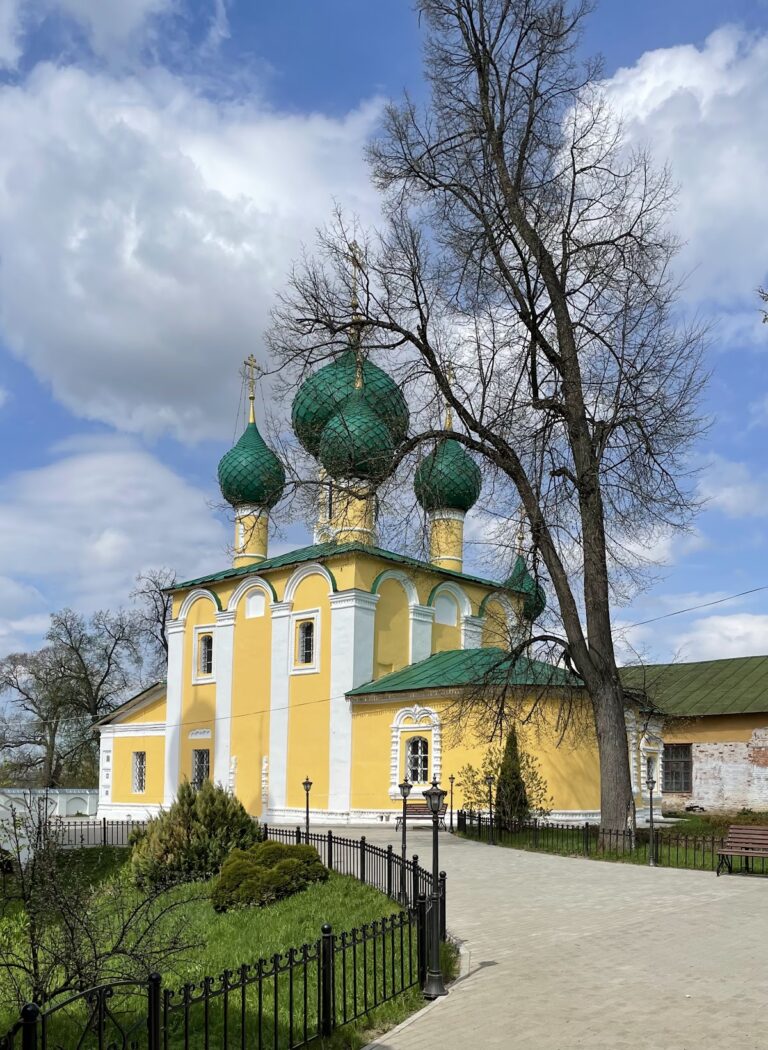
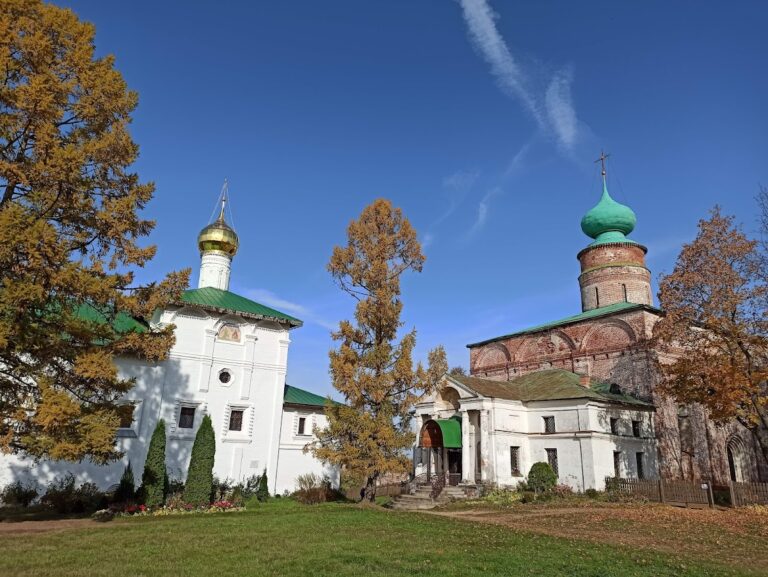
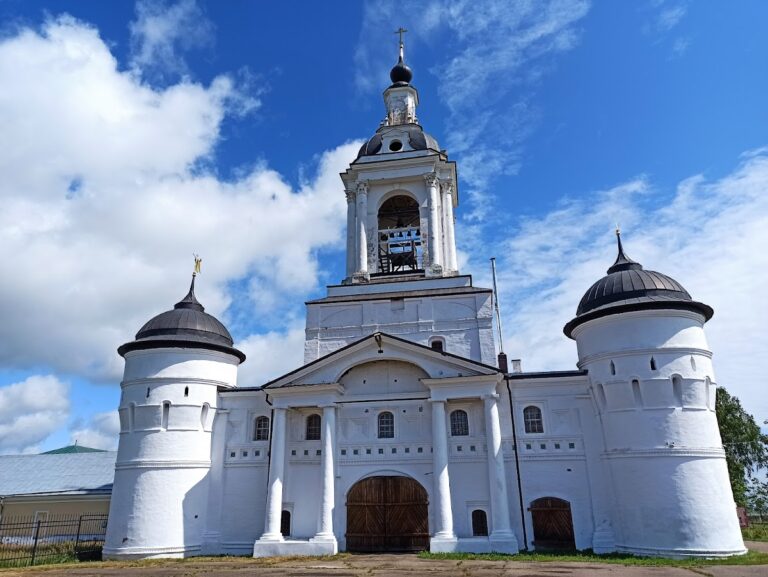
Uleima Monastery occupies a rectangular enclosure beside the Uleima River. Its layout follows the traditional arrangement of sixteenth- and seventeenth-century monastic complexes. A relatively low stone wall surrounds the enclosure, with eight towers of different forms, including round, quadrilateral, and octagonal examples. The western Holy Gate is the main entrance, while the eastern Water Gate provides the second opening. Within the walls, Saint Nicholas Cathedral, the Presentation Church with its refectory, and a multi-tiered bell tower form the central group.
Central churches and bell tower
Saint Nicholas Cathedral
Saint Nicholas Cathedral is a five-domed church whose present form developed through rebuilding from the 1620s to the 1670s, after the earlier cathedral collapsed during the attacks of the early seventeenth century. The new building was raised over the earlier undercroft and consecrated in 1677. Its religious identity is connected with the Saint Nicholas icon brought from Bari and the relic fragment presented in 1707.
The cathedral’s domes were renewed during the restoration of the 1960s, when its gilded crosses were also restored. The campaign reconstructed ancient window surrounds with an unusual star-shaped sandrik, a small horizontal cornice or pediment above a window or doorway. The southern chapel later disappeared, the window grilles were lost, and the wall paintings flaked away.
Presentation Church and refectory
The Presentation Church, dedicated to the Presentation of the Virgin, was rebuilt with its refectory in 1695. The complex also includes a two-flight porch, meaning two connected stair flights leading to an entrance. The church walls and porch were restored in the 1960s, and its domes and gilded crosses were renewed during the same campaign.
Trinity Church and bell tower
Trinity Church is a gate church, a church constructed above or within a monastery gate, built above the entrance between 1713 and 1717. It was connected to the superior’s residence, and its porch was repaired during the restoration campaign. The multi-tiered bell tower forms part of the central architectural group. Its cross burned during a storm in the 1950s and was later restored.
Walls, towers, and wartime alterations
The stone enclosure wall and its eight towers define the monastery’s defensive boundary. Their varied shapes include round, quadrilateral, and octagonal forms. In 1941, the tower roofs were removed and the towers were converted into fortifications. Anti-tank trenches extended toward the northwest, northeast, and southeast, while the southeast tower remained half destroyed after the wartime deterioration.
Domestic and working buildings
The enclosure contained a two-storey stone building for the monastic brotherhood and superior, as well as a two-storey stone guesthouse for pilgrims. Other surviving or formerly associated buildings included a house attached to the left side of the Presentation Church, a wooden house in the cattle yard, one stone workers’ outbuilding, three wooden outbuildings, and the monastery school. The water-powered flour mill and the central bell called “Polyeleos” belonged to the monastery’s wider working and religious complex.
Nearby sites