Boris and Gleb Monastery in Rostov the Great: A Russian Orthodox Monastic Complex


Site at a Glance
- Rating
- 4.8
- Popularity
- Low
- Country
- Russia
- Primary era
- Early Modern
- Eras represented
- Early Modern
- Civilizations
- Russian
- Site type
- Religious
- Remains
- Fortified Monastery
On this page14 sections
History
The Boris and Gleb Monastery in Rostov the Great is a Russian Orthodox men’s monastery in Russia, located in the urban settlement of Borisoglebsky on the road from Rostov to Uglich. Monks Theodore and Paul, who came from the Novgorod region, founded it in 1363 with the blessing of Sergius of Radonezh, a fourteenth-century Russian monastic leader closely associated with the spiritual authority of the Moscow principality. A foundation tradition holds that Sergius himself selected the site.
Foundation and royal protection
The monastery was dedicated to Boris and Gleb, the sons of Vladimir the Great who are traditionally regarded as the first saints canonized in Kievan Rus. Theodore and Paul later came to be venerated as saints, and their burial place in the northwestern corner of the cathedral became a place of devotion. The monastery also preserved a wooden cross attributed to Sergius as a sign of his blessing to its founders.
Basil II the Dark is credited with making the monastery’s first land donation, beginning its economic growth. During his struggle with Prince Yuri of Zvenigorod, Basil II took refuge at the monastery in 1433 and 1434. In 1440, Abbot Pitirim baptized Basil’s son Ivan III there. After this event, the monastery was regarded as a royal monastery and received the protection of Moscow princes and the first Russian tsars.
Alexander Peresvet, the warrior-monk later celebrated as a hero of the Battle of Kulikovo against the Golden Horde, a Mongol-Turkic state that dominated much of the Russian lands, received the monastic tonsure here. The monastery’s growing influence supported the development of the Borisoglebsky slobodas, a large commercial settlement that became the center of Borisoglebsky Volost in Rostov Uyezd, Yaroslavl Governorate. A major fair traditionally took place beside the monastery on the feast of Saints Boris and Gleb.
Monastic life and the completed ensemble
In the sixteenth and seventeenth centuries, the monastery was among the wealthiest in the Rostov region. Its architectural complex was essentially complete before the Petrine period, and the ensemble changed little after the seventeenth century. Its ecclesiastical figures included Tikhon Malyshkin, Archbishop of Rostov and Yaroslavl. In the modern period, Amphilochius Sergievsky-Kazantsev, an archaeographer and palaeographer who collected and studied monuments of Old Russian writing, served for a time as abbot before becoming Bishop of Uglich.
Irinarkh of Rostov, later known as Irinarkh the Recluse, lived at the monastery in the late sixteenth and early seventeenth centuries. He spent thirty-eight years withdrawn in his cell, including more than a decade during the Time of Troubles, a period of dynastic conflict, civil war, political crisis, and foreign intervention in Russia. According to his life, Dmitry Pozharsky and Kuzma Minin received his blessing in 1612 before campaigning against Polish forces in Russia. Statesmen including Skopin-Shuisky and Minin also visited him, and he may have been among those who spoke with Nicolas de Melo, a Portuguese Augustinian who was held there involuntarily. Irinarkh’s relics remain beneath the floor of the cathedral porch.
Confiscation, suppression, and revival
In 1764, Catherine II transferred the monastery’s slobodas from monastic ownership to her favourite, Count Grigory Orlov, after most Russian monastic property was confiscated. Soviet authorities abolished, plundered, and desecrated the monastery in 1924. Its buildings were then used by local institutions, including a post office, a state bank branch, and storage facilities for organizations procuring flax and grain. Religious services continued in the churches until October 1928.
A local-history museum opened in the former monastery on 8 November 1928 as a branch of the Rostov Museum-Reserve. It closed in 1954, and a local public museum was established on 29 September 1961; it later again became a branch of the Rostov Museum-Reserve. A monastic community returned in 1994 and shared the buildings with the museum until 2015, when the monastery regained all of its property. The ensemble is protected by the state as a cultural-heritage monument of federal significance and is affiliated with the Russian Orthodox Church. Since 1997, an annual walking religious procession has travelled about 40 kilometres from the monastery to the spring near Kondakovo associated with Irinarkh’s birthplace. Pilgrims take turns carrying his penitential chains, or verigi, heavy chains worn as an ascetic practice of bodily discipline.
Remains
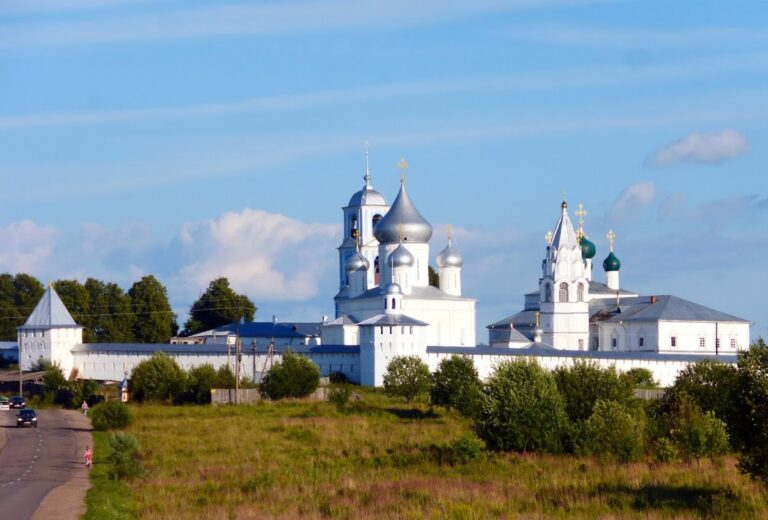
Walls and towers enclose the monastery’s largely preserved pre-Petrine ensemble. The principal surviving buildings include the Boris and Gleb Cathedral, the Annunciation Church and its refectory, the St Sergius Gate Church, the bell tower with the Church of St John the Baptist, the Presentation Gate Church, Irinarkh the Recluse’s cell, and the Church of Sergius of Radonezh. The complex combines sixteenth-century central buildings with later seventeenth-century churches, gates, and defensive elements.
Sixteenth-century churches
Boris and Gleb Cathedral
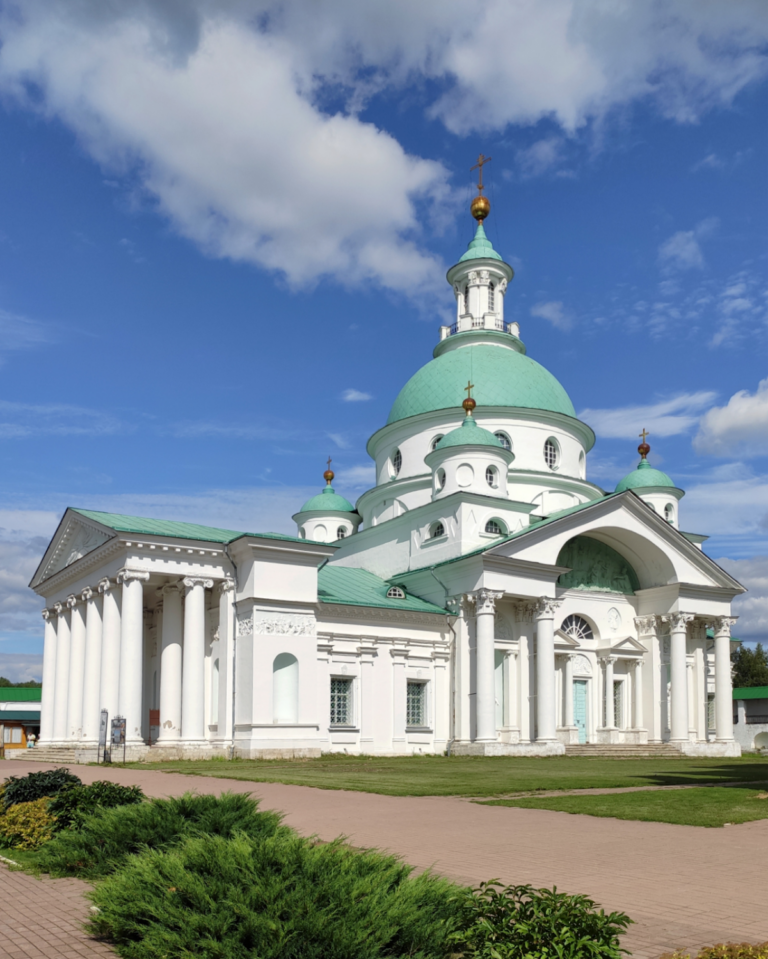
The Boris and Gleb Cathedral was built in 1522 and 1523. Its northwestern corner contains the burials of Theodore and Paul, while paintings and other wall decoration survive within the building. The cathedral also contains the relics of Irinarkh of Rostov, preserved beneath the floor of the porch, linking the church’s physical fabric with the monastery’s later devotional history.
Annunciation Church and refectory
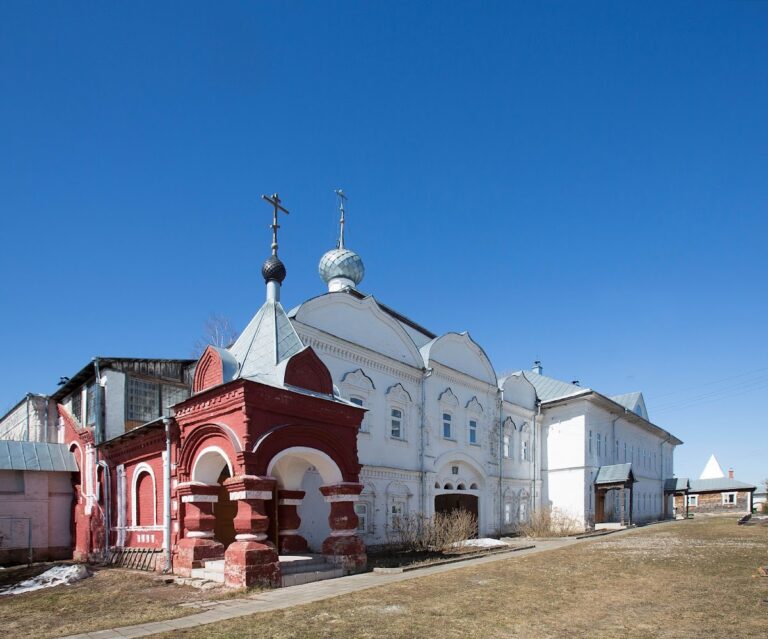
The Annunciation Church and its refectory, the monastery’s communal dining hall, were built between 1524 and 1526. The church is attributed to the architect Grigory Borisov. The refectory has a two-level structure, and its later form incorporates alterations made at the end of the seventeenth century. The wooden cross attributed to Sergius of Radonezh is housed in the Annunciation Church.
Seventeenth-century gates and churches
St Sergius Gate Church
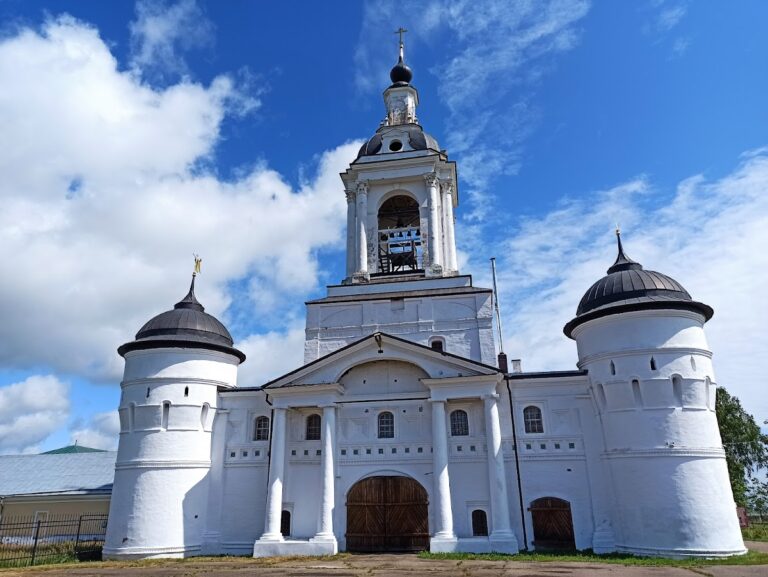
The St Sergius Gate Church dates from 1679 and forms part of a principal entrance to the monastery. The gate church type is built above or beside such an entrance. Here, two substantial towers flank the gateway, whose paired arches are separated by hanging keystones. A frieze with slender columns reflects the Vladimir-Suzdal tradition, the medieval architectural and decorative school associated with the northeastern Russian principalities, especially Vladimir and Suzdal. Restoration work was being carried out on the gate church in 2015.
Church of Sergius of Radonezh
The Church of Sergius of Radonezh is also dated to 1679. Its dedication preserves the memory of the monastic leader whose blessing is associated with the foundation of the monastery and with the founders Theodore and Paul.
Bell tower and Church of St John the Baptist
The bell tower and the Church of St John the Baptist date from 1690. They form one of the ensemble’s principal vertical and liturgical elements within the enclosed monastery complex.
Presentation Gate Church
The Presentation Gate Church dates from 1692. Its dedication refers to the Christian feast commemorating the presentation of Jesus at the Temple, and its position belongs to the monastery’s system of entrance buildings and enclosing walls.
Associated buildings and devotional remains
The cell associated with Irinarkh the Recluse survives within the monastery. The complex also preserves the relics of Theodore and Paul, the relics of Irinarkh, the wooden cross attributed to Sergius, and Irinarkh’s penitential chains. Together with the churches, walls, towers, and other architectural elements, these remains form a largely preserved ensemble whose buildings continued to receive restoration in the modern period.
Nearby sites