Basilica Shrine of the Black Madonna: A Marian Pilgrimage Complex in Italy


Site at a Glance
- Rating
- 4.7
- Popularity
- Medium
- Country
- Italy
- Primary era
- Early Modern
- External website
- Open
- Eras represented
- Medieval, Early Modern, Modern
- Civilizations
- Carolingian, Duchy of Savoy, Holy Roman Empire, Italian
- Site type
- Religious
- Remains
- Sanctuary
On this page10 sections
History
The Basilica Shrine of the Black Madonna is a Roman Catholic Marian pilgrimage complex in Italy, located at Oropa, a hamlet of Biella, in the Biellese Alps. The complex developed around devotion to the Black Madonna of Oropa and includes churches, chapels, pilgrim accommodation, cemeteries, and institutional buildings. Its origins reach back to the early medieval period, while its present form reflects successive expansions from the thirteenth century to the twentieth century.
Origins and the Medieval Sanctuary
Tradition attributes the sanctuary’s foundation in the fourth century to Saint Eusebius, the bishop of Vercelli associated with the spread of Christianity in the western Alpine and Piedmontese regions. According to the tradition, Eusebius brought a dark wooden statue of the Virgin from the Middle East and concealed it at Oropa during a period of persecution. This foundation story has no documentary confirmation, although Eusebius is associated with the growth of Christianity and Marian devotion in the Biellese valleys, where Roman and Celtic cults had previously been practiced.
A papal bull dated 2 May 1207 mentions two churches at Oropa, dedicated to Santa Maria and San Bartolomeo. Historical studies place both buildings at least as early as the eighth or ninth century. Santa Maria was gradually incorporated into the expanding sanctuary, while San Bartolomeo was later rediscovered and reopened for worship. Santa Maria was consecrated by Aimone of Challant, bishop, in the summer of 1294. Built around a small shrine associated with the Black Madonna, it later became known as the Ancient Basilica.
The statue now associated with the medieval cult dates from the first half of the fourteenth century. It is attributed to the anonymous Master of the Madonna of Oropa, a sculptor and woodcarver from the Aosta Valley active between the late thirteenth and early fourteenth centuries. Devotional tradition instead attributes both its carving to Saint Luke and its arrival at Oropa to Saint Eusebius.
Baroque Expansion and Pilgrimage
From the fifteenth century, families from the Biellese region built private houses at Oropa that could sometimes accommodate pilgrims. The sanctuary’s earliest recorded votive painting, an ex-voto, dates from 1522 and was made by Bernardino Lanino. An ex-voto is an offering given in fulfilment of a vow or in gratitude for an answered prayer. The painting began a long tradition that would eventually fill the sanctuary’s galleries with paintings, objects, and photographs.
The sanctuary expanded substantially during the Baroque period under the protection of the House of Savoy, the ruling dynasty whose royal patronage supported major building projects at Oropa. In the early seventeenth century, the church of Santa Maria was enlarged and remodelled according to a design by Francesco Conti. The work raised the walls, added a transept and dome, refaced the facade in stone, incorporated a sixteenth-century southern gallery, and added a northern nave. Four chapels built on the eastern side between the fifteenth and sixteenth centuries were connected to the church and reused as sacristies and confessionals.
During the second half of the seventeenth century, a cloister-like complex was built around the old church on the site of the Biellese families’ houses. It provided a hospice for pilgrims and helped turn the sanctuary into an organized residential and devotional centre. The wider Baroque development included work associated with Filippo Juvarra, Ignazio Galletti, Guarino Guarini, and Francesco Gallo. Juvarra designed the monumental Royal Gate. The royal princesses Maria Apollonia and Francesca Caterina also founded the Figlie di Maria, a women’s group that assisted pilgrims and served the sanctuary without taking public vows.
Devotion to the Madonna was closely connected with the history of Biella. The city invoked her during outbreaks of plague in 1522, 1599, and 1630. The 1522 vow was followed by a votive painting, while the end of the 1599 epidemic prompted a procession and offerings. When Biella believed it had been spared during the plague of 1630, the city voted to donate a silver chandelier. During the seventeenth-century plague, a further vow gave rise to an annual solemn procession from Biella to Oropa, which continues as a religious observance.
Coronations, Devotional Landscapes, and Modern Development
The first solemn coronation of the Black Madonna took place in 1620. Further coronations were held at one-hundred-year intervals. The fifth was officially carried out on 29 August 2021 after the ceremony planned for 2020 was postponed because of the coronavirus pandemic. Pope Francis granted the image a formal pontifical-coronation decree on 5 August 2021. A pontifical coronation is papal authorization for the ceremonial crowning of a revered religious image.
The Sacro Monte di Oropa, a Sacred Mount combining chapels, devotional paths, and religious sculpture groups, was established on a hill west of the sanctuary in 1617. It developed into a complex of twelve chapels and seven additional nearby chapels, presenting episodes from the life of the Virgin Mary. Oropa continued to attract pilgrims despite difficult communications. A traditional night pilgrimage from Fontainemore in the Aosta Valley takes place every five years, while Biella’s annual procession recalls the city’s seventeenth-century plague vow.
In the nineteenth century, a second court containing a cemetery was planned. Remains of an earlier cemetery were discovered only recently, and a new monumental cemetery was later built west of the sanctuary near the road to the Sacro Monte. Its family tombs served prominent noble and notable families of the Biellese region. Planning for the monumental Upper Basilica began in the late nineteenth century. Its foundation stone was laid in 1885 to Ignazio Galletti’s design, which had been prepared more than a century earlier. The church was consecrated in 1960.
Several modern institutions and transport links further shaped the sanctuary. Francesco Denza, a Barnabite priest from Naples, founded a weather and seismological observatory within the complex in 1874. The observatory became part of Piedmont’s regional meteorological network and of regional and national seismological networks, while the Oropa meteorological station remains active. The electric narrow-gauge Biella to Oropa railway opened on 4 July 1911 after two years of construction. It connected Biella with the sanctuary over approximately 14 kilometres and 800 metres of elevation gain. Its final service ran on 29 March 1958, after which buses replaced it because maintenance costs were excessive.
In 1949, during the Peregrinatio Mariae, the statue left Oropa for the first time and was carried to settlements throughout the Biellese area. Pope Pius XII elevated the church to the rank of minor basilica in March 1957. A minor basilica is a church granted a special papal ecclesiastical title because of its religious and historical importance. In 2003, the Sacri Monti of Piedmont and Lombardy, including Oropa, were inscribed as a UNESCO World Heritage site.
Three miracles attributed to the Madonna of Oropa were examined through canonical processes. In 1661, Giovanni Sa was said to have regained speech after praying at Oropa following the loss of his tongue. In 1672, Giacomo Vallet was said to have recovered from eighteen years of paralysis after making a vow to the Madonna. In 1720, Giovanni Battista Perrone was said to have regained his tongue during the second coronation ceremony; the claim was approved after a canonical investigation in 1724. Sanctuary registers and galleries preserve thousands of further ex-voto paintings and objects, including works from the fourteenth, nineteenth, and twentieth centuries. Precious offerings were repeatedly requisitioned by civil authorities during wartime, while the votive paintings remained in large numbers.
Remains
The Ancient Basilica and the Black Madonna
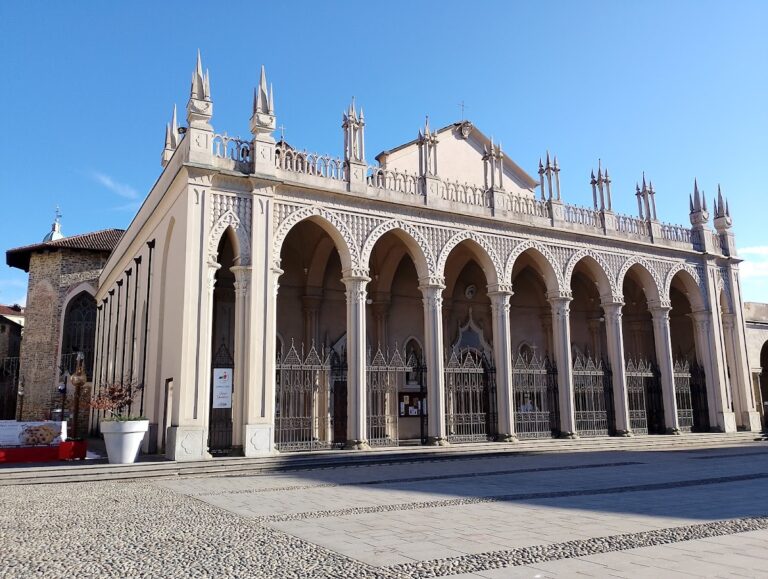
The Ancient Basilica incorporates the earlier Santa Maria church and stands beside a large erratic boulder known as the gran deyro or roc ‘dla Vita, meaning “Rock of Life.” Part of the boulder was incorporated into the church, and it remains visible on the building’s northwestern side. The place where it enters the structure can also be seen in the northern wall.
The original Santa Maria church was the same width as the present small shrine and extended to the line of the current facade. Its early seventeenth-century enlargement created the raised walls, transept, dome, stone facade, southern gallery, and northern nave that survive in the church’s fabric. The four earlier eastern chapels became sacristies and confessionals, linking the older devotional spaces with the enlarged building.
The Black Madonna is a darkened cedar-of-Lebanon statue of the Virgin and Child. The faces and hands are painted black, and the image is decorated with gold and gemstones. It is housed in the Ancient Basilica. Popular belief holds that the statue shows no trace of woodworm or age-related deterioration, that its foot has not worn down despite the former practice of touching it with devotional objects, and that dust does not settle on the faces. These claims were noted from the early seventeenth and eighteenth centuries onward. Since the mid-nineteenth century, the faces have been cleaned publicly each year to demonstrate the phenomenon.
The Sanctuary Courts and Baroque Works
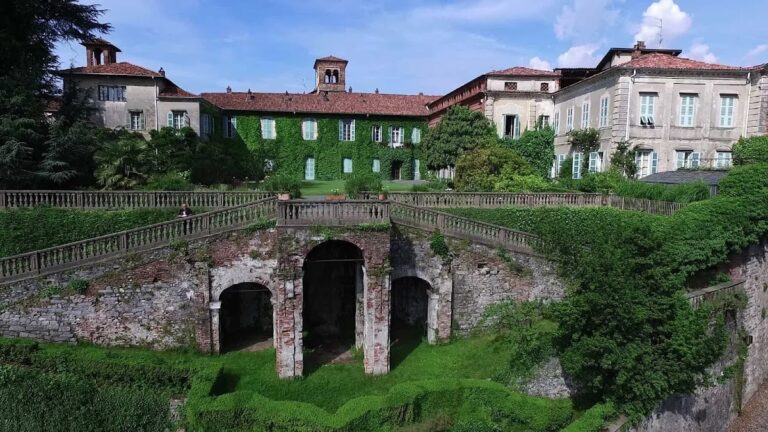
The cloister-like sanctuary surrounds the old church in a courtly arrangement created as a hospice for pilgrims. Its buildings incorporate accommodation within the larger complex of churches, chapels, cemeteries, and service institutions. The Royal Gate, designed by Filippo Juvarra in the eighteenth century, is one of the principal Baroque works. Other architectural elements are associated with Ignazio Galletti, Guarino Guarini, Francesco Conti, and Francesco Gallo.
A hill south of the sanctuary was levelled to form the Prato delle Oche. This alteration made the sanctuary visible from Biella. The later monumental cemetery lies west of the complex near the Sacro Monte road. Its family tombs belong to prominent Biellese families, and some carry esoteric or Masonic symbols. The tomb of Quintino Sella is shaped as a pyramid. The remains of the earlier cemetery discovered nearby provide evidence for an earlier phase of burial at the sanctuary.
The Upper Basilica
The Upper Basilica was constructed between 1885 and 1960 as a monumental church for the sanctuary’s large pilgrim population. Its dome rises approximately 80 metres and the building can accommodate about 3,000 people. It forms the later monumental counterpart to the Ancient Basilica within the sanctuary complex.
The Sacro Monte and Chapel of the Rock
The Sacro Monte occupies a hill west of the sanctuary. Its devotional route includes twelve chapels and seven additional chapels nearby. Sculptural groups inside the chapels depict scenes from the life of the Virgin Mary, combining the buildings and their landscape into a structured religious setting.
The chapel called del Ròc was built above the erratic boulder associated with the tradition that Saint Eusebius hid the Black Madonna beneath it. Inhabitants of Fontainemore constructed the chapel in the early eighteenth century. The boulder itself was also associated with fertility practices. Medieval women were said to rub against it to promote childbirth, a practice later expressed through striking or touching it with the buttocks. Access to the portion incorporated inside the church, which had already been reduced and levelled, was blocked by a metal gate by the nineteenth century.
Votive Collections and Former Railway
The sanctuary’s historic votive collection includes Bernardino Lanino’s 1522 painting and thousands of later paintings and objects preserved in the galleries. Professional artists, artisans, and individuals who made images of their own experiences of grace contributed to the collection, which also includes more recent photographic ex-votos. Together, these materials preserve the changing forms of personal devotion associated with the Black Madonna.
The former Biella to Oropa railway was an electric narrow-gauge line approximately 14 kilometres long, climbing about 800 metres. Its terminal station stood inside the sanctuary directly beneath the portico. The railway ceased operation in 1958, leaving its former place within the complex as part of Oropa’s modern architectural and institutional history.
The meteorological and seismological observatory founded in 1874 remains part of the sanctuary’s physical complex. Its continuing meteorological station preserves the scientific function established alongside Oropa’s religious and architectural development.
Nearby sites