Maria Locherboden: A Neo-Gothic Pilgrimage Church in Austria


Site at a Glance
- Rating
- 4.7
- Popularity
- Low
- Country
- Austria
- Primary era
- Modern
- External website
- Open
- Eras represented
- Modern
- Civilizations
- Habsburg
- Site type
- Religious
- Remains
- Church
On this page10 sections
History
Maria Locherboden is a Roman Catholic pilgrimage church in Austria, in the municipality of Mötz. The present church was built between 1896 and 1916 in the Neo-Gothic style, a nineteenth-century revival of Gothic architecture. It belongs to the Silz deanery of the Diocese of Innsbruck, and its patronal feast is celebrated on April 24. The wider pilgrimage complex grew around a Marian image associated first with a mine, later with reported answered prayers, and ultimately with the healing of Maria Kalb in 1871.
Early settlement and the Marian image
Human activity in the area reaches back to the Hallstatt period, an Iron Age cultural period in central Europe dating approximately from the eighth to the sixth centuries BC. A bronze ceremonial knife from around 800 BC was found in 1892. Burnt remains and prehistoric pottery discovered in 2009 provide further evidence of early settlement and mining activity around Locherboden.
Around 1740, the Mötz miner Thaman, also called Thomas, Kluibenschädl, placed an image of the Virgin Mary at the entrance to a mine. The reason is uncertain. He may have been giving thanks for a miraculous rescue from a blocked mine, or he may have wished to acknowledge that he had never suffered an accident while working there. The foundation legend describes Kluibenschädl being trapped while searching for silver-bearing lead ore. After a large stone blocked the tunnel, he prayed to Mary and vowed to install a Marian image if he survived.
In 1854, a footbridge was built to the image and the mine entrance was enlarged into a grotto. During the work, the image was kept at Zein, now within the municipality of Mieming, and returned to its former location on August 15. Prayers were increasingly regarded as answered, and donations supported the addition of a canopy and a kneeling bench. An almost equally large image of the Sorrowful Mother was placed beside the Marian image.
From local devotion to pilgrimage
By 1860, more than a century of exposure to the weather had damaged the original image. The painter Josef Mühlegger, known as the Ötzer Painter, made a larger replacement on canvas. Like its predecessor, it copied Lucas Cranach the Elder’s celebrated image of Mary Help of Christians. The replacement was later placed above the high altar of the church.
Pilgrimage interest subsequently declined for a time. In bad weather, the grotto was used as a shelter for livestock, while dust and cobwebs gathered around the Marian image. The site’s reputation changed markedly after the reported healing of Maria Kalb. Born in Rum near Innsbruck on February 10, 1842, Kalb developed a severe illness after injuring her back during Carnival in 1864. Doctors described her condition as “nerve wasting and nerve drying,” regarded recovery as hopeless, and gave her the last rites at an early stage.
Kalb experienced three Marian apparitions in 1871. In late April, she received a letter bearing a Marian image. In late July, Mary instructed her to seek her in the Oberland and to pray the Rosary of the Seven Sorrows, a Marian devotion centred on seven traditional episodes of Mary’s suffering. On August 4, Mary indicated the place by showing Kalb Stams, Silz, and Mötz from the sunny side of the landscape. Acquaintances recognized the location as the small pilgrimage site at Locherboden.
On September 11, 1871, Kalb travelled by horse with her brother Johann and two other relatives to Mötz, where they spent the night at an inn. The next day she was carried to the grotto and placed on two cushions, scarcely showing signs of life. Her sister-in-law held the Marian image before her while the group prayed the Rosary of the Seven Sorrows. Kalb regained consciousness, identified the apparition as Mary, knelt with the others, and prayed the Memorare with outstretched arms. During the second Rosary, she felt her strength return and walked back to Mötz without assistance. She continued visiting Locherboden and died in Rum on January 20, 1925, aged 82.
Expansion of the pilgrimage complex
After Kalb’s healing, the grotto was enlarged and a new path from Mötz was created for the increasing number of pilgrims. A larch-wood porch was erected over the grotto entrance in 1872, and three crosses visible from a distance were placed on Locherboden hill. Fourteen stations of the Way of the Cross were installed along the route in 1876.
In 1881, the Mötz curate Johann Schlatter began the construction of a masonry shrine chapel for the growing pilgrimage. The restored Marian image was returned there on June 6, 1881. Johann Speckbacher designed the chapel in the Neo-Romanesque style, a revival based on Romanesque architecture, and the Mötz master mason Josef Hörmann built it. Stams Abbey supported the work by supplying building materials, or by making them available at reduced prices. An altar was installed on November 24, 1885.
Schlatter later planned a larger church above the place associated with Kalb’s healing. Extending the existing chapel westward along the rock would have required extensive blasting, so the new church was built on the hill above the grotto. Work under the Mötz builder Heinrich Hörmann began on March 12, 1896. The nave roof frame was in place by August 22, the tower was built in 1897, and the shell was then completed. A shortage of funds delayed the final work, while Stams Abbey again provided inexpensive building materials.
On June 30, 1901, the Marian image was carried in a solemn procession from the Mötz parish church to the new church. Maria Kalb was among those present. The Brixen prince-bishop Simon Aichner consecrated the church on July 6, 1901. A sacristy was added in 1902, and the building was fully completed on May 24, 1916. Stams Abbey organized a competition for the church’s fresco decoration, which was won by the young Innsbruck painter Anton Kirchmayr. He executed the frescoes between 1914 and 1916.
Twentieth-century devotional use
A harmonium based on an American system was installed in 1906. Since May 11, 1976, night pilgrimages have taken place on the eleventh day of each month from May through October. They include a candlelit procession to the night-pilgrimage chapel.
In the late 1980s, the church could no longer accommodate everyone taking part in the night pilgrimages, leading to plans for a separate chapel. The architect Gerold Wiederin designed it in collaboration with the artist Helmut Federle. The abbot of Stams, Josef M. Köll, consecrated the chapel on September 8, 1996. A later shelter for the choir in wet weather differs from Wiederin’s original architectural concept, and Federle’s original steel mesh facing the grotto has disappeared. The church, shrine chapel, and Way of the Cross are legally protected monuments.
Remains
The pilgrimage complex occupies the Sassberg ridge at 816 metres above sea level, about 150 metres above the floor of the Inn Valley and in front of the Mieming mountain range. The grotto lies below the church, with the shrine chapel and night-pilgrimage chapel nearby. The complex therefore combines the original mine-related place of devotion with the later church, chapels, and route of fourteen stations.
Pilgrimage church
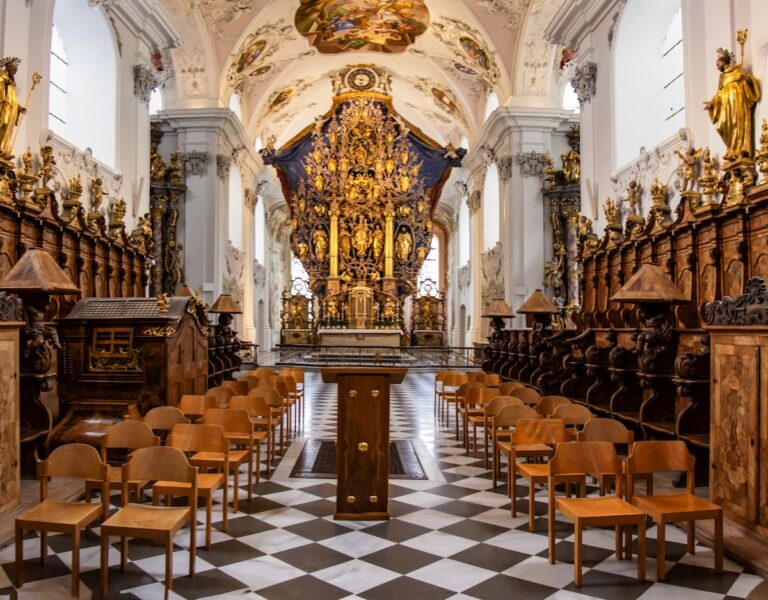
The church is a three-bay Neo-Gothic building with a south tower set before the main facade. Pointed-arch openings allow sound from the tower, whose upper form includes stepped gables and a pointed helmet roof. The chancel ends in a five-eighths polygonal apse, while rib vaults rest on corbels inside. Buttresses articulate the outer walls of both the chancel and the nave.
Josef Bachlechner of Hall in Tyrol made the high altar and its figures. The Marian image stands at its centre, with Saint Bernard on the left and Saint Cassian on the right. Cassian was chosen because Locherboden formerly belonged to the Diocese of Brixen, where he is a diocesan patron. Two small towers rise from the altar, leaving a view through the space between them towards a stained-glass window. Niches contain Saint John the Apostle and Saint Joseph with the Christ Child. Banners carry the words “This is the place where you must seek me” and “When the eye finally breaks, Mother, do not abandon me.”
The presbytery dome fresco represents Easter and the risen Christ displaying his wounds with outstretched arms. Two angels carry a crown and sceptre, while two others hold the Veil of Veronica and the Crown of Thorns. The presbytery windows, made by the Tyrolean Glass-Painting and Mosaic Institute, show the Marriage of Mary and the Visitation of Mary, both dated 1909; Saint Florian with Saint Wendelin and the Coronation of Mary, both dated 1900; and Saint Aloysius with Saint Barbara, also dated 1900.
Kirchmayr’s nave frescoes continue the sequence of the four principal Christian feasts begun with Easter in the presbytery. The Christmas scene includes the Nativity, a shepherd family presenting gifts, and the Magi paying homage, with the prophet Isaiah. The Corpus Christi scene, devoted to the Eucharist, shows a rural procession and is accompanied by the prophet Ezekiel. Angels hold a shield bearing Kirchmayr’s signature and the date 1915 to 1916. The Pentecost scene shows Mary and the disciples receiving the Holy Spirit, accompanied by the prophet Jeremiah.
The nave walls show the four Evangelists, Matthew, Mark, Luke, and John, with their traditional symbols. John and Luke appear on the right, while Mark and Matthew are on the left. Mosaic apostolic crosses supplement the wall decoration. The organ-gallery balustrade carries painted busts of the twelve Apostles, portraits of the church’s builder and Anton Kirchmayr, and an angel playing music on one side with a singing angel on the other. Their accompanying texts are “Ave Maria, gratia plena” and “Tota pulchra es, Maria.”
Kirchmayr also painted two scenes from the site’s history on the walls of the pointed-arch entrance portal. On the right, angels turn over the stone that trapped the miner; on the left, Maria Kalb’s healing is represented. Above the entrance, Josef Pfefferle made a mosaic of Mary holding a lily with the inscription “Holy Heart of Mary, be our salvation.” The present organ is a mechanical tracker-action instrument, meaning that keys are connected to the pipes by a physical mechanism. It has ten stops, was made by Orgelbau Pirchner of Steinach am Brenner, and was installed on the gallery in 1996.
Shrine chapel and grotto
The shrine chapel is a masonry, basilica-like building in Neo-Romanesque style. A three-bay porch supported by columns forms its entrance. Inside is a Pieta, a devotional image of Mary mourning over the dead Christ, made by Josef Bachlechner. The restored Marian image was installed in the chapel in 1881 before being transferred to the pilgrimage church. The grotto below preserves the place where the image was set at the former mine entrance and where the tradition of the site’s pilgrimage developed.
Night-pilgrimage chapel
The night-pilgrimage chapel stands at the foot of the rock face near the grotto. Its concrete structure measures 15.09 metres in width, 11.45 metres in depth, and 6.09 metres in height. A concrete slab carried on four supports forms a simple pavilion, while the ceiling has a cross-shaped design. The altar, ambo, or lectern for readings, and seats are also made of concrete. Milk-glass lighting rails are set into the ceiling.
An artwork by Helmut Federle occupies the centre of the rear wall. It resembles branches and consists of rough, brightly coloured glass fragments loosely piled and shaped by a steel mesh. Its colours relate to the stained-glass windows of the pilgrimage church. The chapel’s forecourt provides a view of the church on the hill. The original steel mesh facing the grotto is no longer present.
Way of the Cross
The fourteen Way of the Cross stations originally comprised wooden columns with niches containing canvas paintings by Theres Strigl of Sautens. They were consecrated on April 9, 1876. Weather damaged the paintings, and Strigl restored them in 1887. In 1915, the wooden stations were replaced by cast-concrete structures. The present paintings are by Heinrich Kluibenschedl, and the stations and paintings were consecrated on June 6, 1915.
Nearby sites