St. Peter’s Church: Hamburg’s Oldest Parish Church


Site at a Glance
- Rating
- 4.6
- Popularity
- Medium
- Country
- Germany
- Primary era
- Medieval
- External website
- Open
- Eras represented
- Medieval, Modern
- Civilizations
- Holy Roman Empire
- Site type
- Religious
- Remains
- Church
On this page19 sections
History
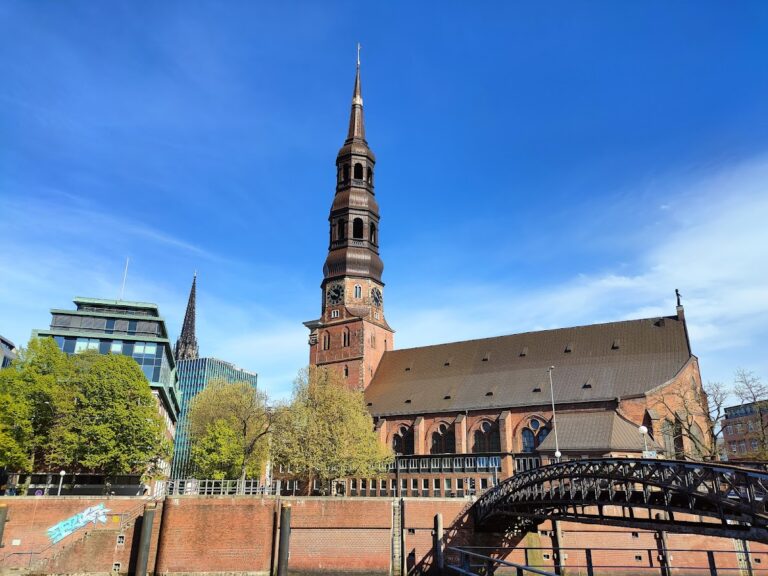
St. Peter’s Church is Hamburg’s oldest parish church in Germany and the oldest of the city’s five principal churches. Dedicated to the Apostle Peter, it belongs to the Evangelical Lutheran Church in Northern Germany. The church stands on the highest point of a Geest spur, a slightly elevated and relatively dry landform, associated with the early settlement around the Hammaburg, whose beginnings are traditionally placed around AD 800.
Early church and medieval expansion
The church’s origins are generally traced to a wooden chapel that existed no later than the beginning of the eleventh century. St. Peter’s first appears in written evidence in 1195 as an ecclesia forensis, meaning a market church serving the settlement’s commercial and civic centre. In 1220, Pope Honorius III confirmed its dedication to the Apostle Simon Peter. The date when the wooden structure was replaced by a stone building is unknown.
Hamburg’s growing prosperity from about 1310 enabled the construction of a three-aisled Gothic hall church. In a hall church, the nave and aisles are approximately equal in height, creating a unified interior space. The building was consecrated in 1327. Its medieval expansion continued with a second southern aisle in 1418 and two further chapels in the early sixteenth century.
Work on the tower foundation began in 1342. Its first spire was completed between 1377 and 1383 by the master builder Hermen van Kampen. Heinrich Berndes, also known as Barteldes, replaced it between 1513 and 1516 with a copper-covered spire. At approximately 127.5 metres, the tower was Hamburg’s tallest until the 135-metre tower of St. Nicholas surpassed it in 1518.
Reformation, occupation, and destruction
The church’s history unfolded alongside major changes in Hamburg’s religious and civic life. The Reformation, the sixteenth-century movement that challenged Roman Catholic authority and led to the establishment of Protestant churches, reshaped the city’s ecclesiastical institutions. Hamburg’s medieval cathedral, the Mariendom, was demolished between 1804 and 1807. During the French occupation, Napoleonic troops commandeered St. Peter’s in 1813, using it as a horse stable like several other Hamburg churches.
The medieval building was almost completely destroyed by the Great Fire of Hamburg on 7 May 1842. The decision was made to rebuild on the same site in a form corresponding to the medieval hall church. Alexis de Chateauneuf and Hermann Peter Fersenfeldt designed the new Neo-Gothic building, with Martin Gensler involved in the project. Johann Hermann Maack designed its copper-covered tower spire. The church was consecrated seven years after the fire, and its 132-metre tower was completed on 7 May 1878.
The rebuilding retained the medieval architectural concept while reorganizing the interior. The southern aisles were consolidated around a central pillar, the principal pillars were reconstructed with reduced cross-sections, and the interior was oriented more strongly toward the pulpit.
Changing parish and modern history
The church’s former high altar, the Grabow Altar by Master Bertram of Minden, was made between 1379 and 1383. The congregation gave it to the church at Grabow in 1731, which saved the late-medieval painted altarpiece from the 1842 fire. Alfred Lichtwark acquired it for the Hamburg Kunsthalle in 1903.
Hamburg’s old town gradually changed from a residential district into a commercial centre. The parish lost many members, particularly after residential buildings were demolished for offices, banks, department stores, and the Kontorhausviertel. St. Peter’s survived the Second World War with comparatively little damage.
Foundations discovered in 1962 during construction of the parish centre were initially interpreted as the remains of a medieval “Bishop’s Tower.” A more recent interpretation considers them more likely to belong to a city gate in the Heidenwall, an early fortification associated with Hamburg’s oldest urban defenses.
From 2 to 18 April 1979, around 400 anti-nuclear activists occupied the church. The action began with a request for church asylum for a convicted demonstrator and continued with opposition to nuclear power. Services and other events continued, although the occupation disrupted use of the building. Christoph Störmer was one of ten participating pastors who received disciplinary reprimands; he later served as the church’s senior pastor from 2002 to 2015. On 26 March 2011, activists from Robin Wood descended from a tower window and attached a Laughing Sun symbol to the tower after the Fukushima nuclear disaster.
The entrance portal was restored in 1995, while the west and south facades underwent conservation between 2005 and 2007. Since the Reformation, the church has had 31 senior pastors and one senior female pastor. Its present congregation numbers a few hundred members, and about 300 people serve it as pastors, social workers, choir directors, craftspeople, and in related roles, most voluntarily. The parish also includes a counselling and pastoral-care centre and a kindergarten.
Remains
St. Peter’s occupies the area between Mönckebergstraße to the north, Speersort to the south, Bergstraße to the west, and Bei der Petrikirche to the east. It remains a three-aisled church with side chapels. A square-plan tower dominates the western facade, while the nineteenth-century building follows the medieval arrangement of a brick Gothic hall church with four bays and a staggered three-apse termination, an eastern end formed by three semicircular recesses.
Church structure and tower
Medieval layout and chapels
The medieval church’s four-bay hall plan and three-apse eastern termination were retained in the rebuilding, although the interior received a more regular arrangement. The Martins Chapel was built north of the tower in 1376 as an extension of the northern side aisle. The Ansgar Chapel followed on the south side in the succeeding years, making the tower part of the supporting composition of the western facade.
Tower masonry and ascent
The tower rises approximately 132 metres. Its staircase has 544 steps and reaches a viewing level at about 123 metres through tower openings described as portholes. Partly glazed header bricks are arranged within the regular masonry pattern, creating a distinctive effect across the tower’s large surfaces.
Portals and sculpture
West portals
The oldest surviving artwork associated with the church is a bronze lion-head door pull on the left leaf of the central west portal. It dates from 1342 and is probably from the Lübeck workshop of Hans Apengeter, a sculptor and bronze founder. Its inscription records the beginning of the tower foundations and asks for prayers for the church council.
The right-hand west door carries a Neo-Gothic copy made by Wilhelm von Hanno in 1849. Its inscription commemorates the destruction of the church by fire on 7 May 1842 and its re-dedication on 7 May 1849.
South portal and entrance sculpture
The Baroque south portal was created in 1604 and 1605 by the sculptor Georg Baumann. The fire of 1842 damaged it, and it was reinstalled in 1922 as an architectural fragment in the courtyard of the Museum of Hamburg History.
Four marble sculptures of the Evangelists, made by August Herzig in 1888, stand in the southern entrance halls. Matthew appears with a winged human figure, Mark with a lion, Luke with a bull, and John with an eagle. Herzig and Fritz Neuber also created the west-gable sculptures of Christ with angels above Saints Peter and Paul.
Paintings, sculpture, and memorials
Medieval and Renaissance works
Two representations of Ansgar of Bremen came from the former Hamburg cathedral. Ansgar was a ninth-century Christian missionary and archbishop associated with the early Christianization of Scandinavia and northern Germany. A panel painting by Hans Bornemann, made about 1457 in oil on oak and measuring 187 by 74 centimetres, stands on a pillar between the northern and central aisles. A wooden statue from the workshop of Bernt Notke, made about 1480 to 1483 and 154 centimetres high, stands near the transition from the choir to the nave. It depicts Ansgar holding a model of Hamburg’s Marienkirche.
The Renaissance epitaph of the physician Petrus Galbius, who died in 1573, has the Raising of Lazarus by Cornelius Krommeny as its principal image. In the northern aisle, Jacob Jacobs’s 1603 painting Martin Luther with the Swan presents the relationship between Martin Luther and his predecessor Jan Hus through the traditional image of a goose becoming a swan. Jan Hus was a Bohemian religious reformer executed in 1415 and later regarded in Protestant interpretations as a predecessor of the Reformation.
Seventeenth- to nineteenth-century paintings
Gottfried Libalt’s two oval oil paintings, Jacob’s Dream and The Adoration of the Christ Child, date from 1649 and each measures 126 by 98 centimetres. Acid damaged The Adoration on 27 August 1977. Both paintings returned to St. Peter’s after extensive restoration in October 2001.
A nineteenth-century painting of the Entombment of Christ hangs in the eastern bay of the northern aisle. It is one of numerous copies after a panel painting by Hugo van der Goes. The same bay contains two oil-on-oak wings from a former altarpiece, painted about 1490 by the Master of the Lüneburg Foot Washing. They show scenes from the Passion of Christ and pairs of Christian saints. The wings once closed a retable, an ornamental altarpiece structure with painted wings, a shrine, and sculpted religious figures. Damage led to the altarpiece being divided into wings and shrine sculptures in 1824.
A 180-centimetre-high limestone Madonna stands in the northern aisle. Made about 1470 in a Westphalian or Lübeck workshop, it retains traces of its original painted surface and formerly belonged to the altar of the Theobald Brotherhood, demolished in 1789.
Works connected with Hamburg’s history
Christmas 1813 in St. Peter’s, painted by Siegfried Detlev Bendixen and donated in 1817 by the guild of millers and its Martin Brotherhood, hangs on a pillar in the southern aisle. It commemorates Hamburg residents assembled in the church and expelled from the city during the French occupation after they could not provide sufficient provisions during the siege by the Northern Army. Many of the subsequently expelled impoverished inhabitants died.
A large marble relief of the Entombment of Christ in the choir was made by Hermann Schubert in 1869. The choir has five stained-glass windows. Hermann Oetken created the southern window, depicting the Last Judgment, in 1950. Claus Wallner created the other four in 1959, with subjects from the Old Testament, Christmas, Easter, and Pentecost.
Bonhoeffer monument
Outside the northeastern end of the choir stands a bronze monument to Dietrich Bonhoeffer by Fritz Fleer. Inaugurated on 23 November 1979 and donated by Axel Springer, it depicts Bonhoeffer in prisoner’s clothing with bound hands. Its inscription commemorates his life, imprisonment, and murder at Flossenbürg concentration camp in 1945. Bonhoeffer was a German Lutheran theologian and a member of the resistance to National Socialism.
Organs and bells
Organs
St. Peter’s has three organs built by Rudolf von Beckerath Orgelbau of Hamburg: the main organ, a choir organ, and a small instrument in the Martins Chapel. The main organ followed a specification prepared by Helmut Tramnitz in 1955 and was extensively restored and reworked by Alexander Schuke Potsdam Orgelbau in 2006. It has four manuals, or separate hand keyboards, 66 stops, 4,724 pipes, mechanical action, and electrically operated stop and coupler mechanisms. About one third of its pipes derive from the predecessor organ built by Eberhard Friedrich Walcker in 1884.
Pealing and striking bells
The tower contains three pealing bells. The smallest, sounding D, is the surviving bell from a four-bell peal cast by Hermann Große in Dresden in 1878. That original peal weighed 20 tonnes, and its largest bell weighed 10.2 tonnes. The three largest bells were melted down for weapons production during the First World War. Franz Schilling Söhne of Apolda supplied replacement bells in 1922 and 1924.
The largest replacement bell is dedicated to Saints Peter and Paul, weighs 6,275 kilograms, and has an internal diameter of 2.13 metres. All three pealing bells survived the Second World War. Three additional striking bells date from 1510, 1537, and 1939.
Nearby sites