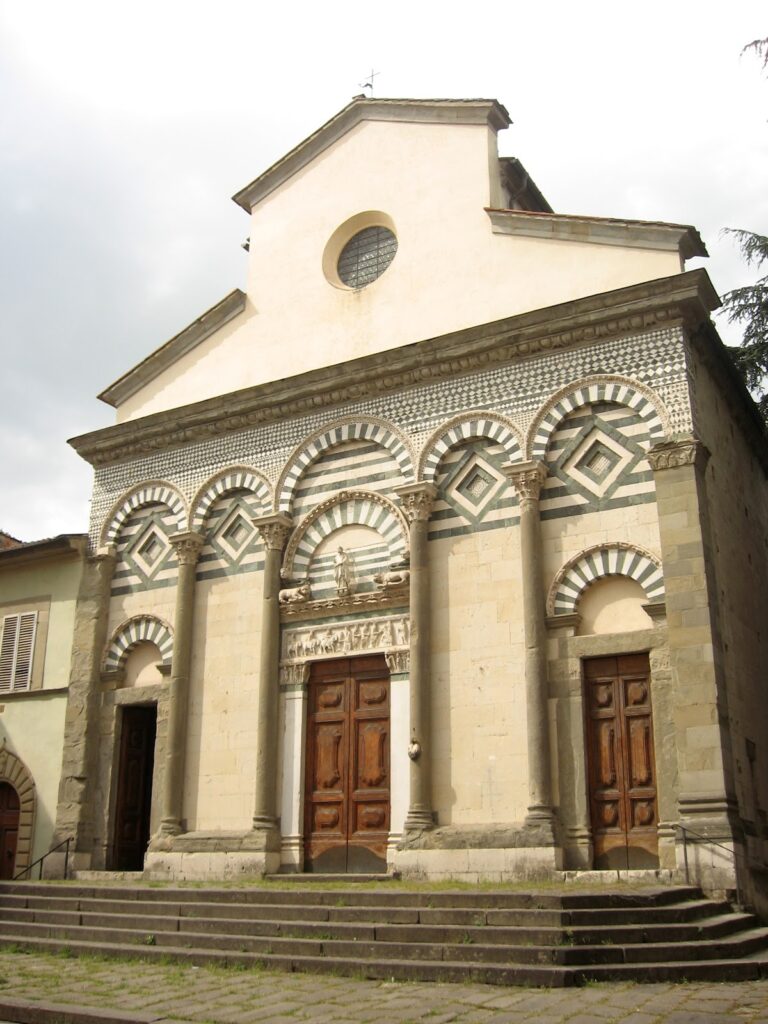
Santissima Annunziata: A Servite Church in Pistoia, Italy


Site at a Glance
- Rating
- 4.1
- Popularity
- Very Low
- Country
- Italy
- Primary era
- Medieval
- External website
- Open
- Eras represented
- Medieval, Early Modern, Modern
- Civilizations
- Grand Duchy of Tuscany, Italian, Republic of Florence
- Site type
- Religious
- Remains
- Church
On this page18 sections
History
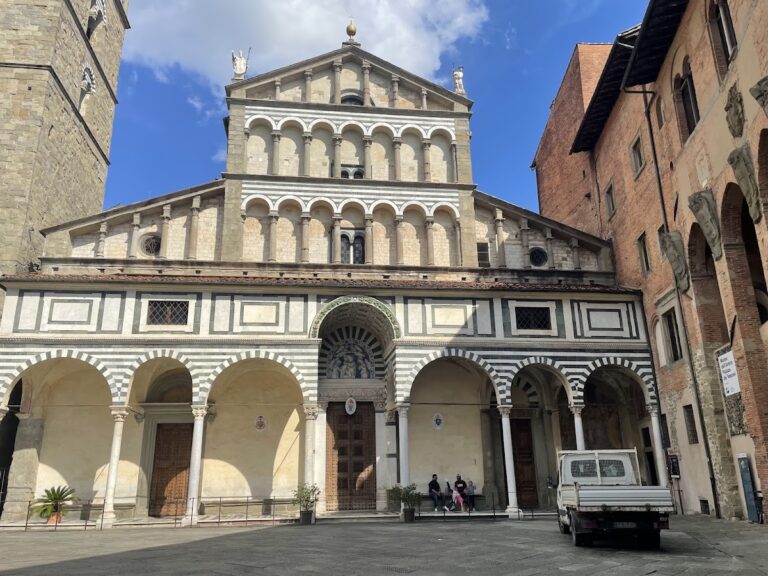
Santissima Annunziata is a Roman Catholic church of the Servite Order in Pistoia, Italy, founded around 1270 in the medieval period by the Servites, a Catholic order devoted particularly to the Virgin Mary. The church rose outside the city walls on land in the area called Poggio, purchased from the Cancellieri family. Its early names, Santa Maria del Poggio and Santa Maria de’ Servi, reflected both its location and its religious community.
The Servite foundation
The Servites reached Pistoia by 1241. They first occupied a house with a small oratory dedicated to Santa Maria Novelleta outside Porta San Piero, while remaining affiliated with San Pietro Maggiore. By 1296, a larger church was under construction at Poggio. Building continued until the church was completed in 1393, creating the principal Pistoian centre of the order.
The community’s chapter chapel was an important place of Servite government. Saint Philip Benizi, a thirteenth-century Florentine friar and leading minister of the order, held general chapters there in 1268 and 1276. Tradition associates the later chapter with the conversion of Bonaventura Bonaccorsi, a Pistoian leader of the Ghibelline faction, a medieval political group associated with imperial authority. After hearing Philip preach in 1276, Bonaventura is said to have abandoned factional leadership and entered Servite religious life.
The church’s original dedication to Santa Maria de’ Servi changed to Santissima Annunziata in 1537. Feliciano Capitoni, a Servite bishop of Avignon, consecrated the church in 1573. The building was altered during the fifteenth century and underwent extensive refurbishment in the seventeenth and eighteenth centuries, when Baroque stucco, gilding, and decoration transformed the interior.
Confraternities and charitable activity
Servite life in Pistoia also included lay and charitable institutions. In 1450, the Company of the Rossi established a hospital for poor pilgrims at the nearby monastery of San Desiderio, which Bishop Donato de’ Medici had donated. Pious Servite women known as the Ammantellate served the hospital, which remained open until 1516.
The Rossi, also called the Disciplinati di Santa Maria or Disciplinati di Santa Maria dei Servi, were a confraternity, meaning a lay religious association organized around devotion, charity, or penitential practice. Founded by Blessed Bonaventura Bonaccorsi under the protection of the Virgin, its members wore red robes associated with blood shed in civic conflicts and with their readiness to suffer for the faith. Bishop Scipione de’ Ricci later suppressed the confraternity.
Suppression, military use, and restoration
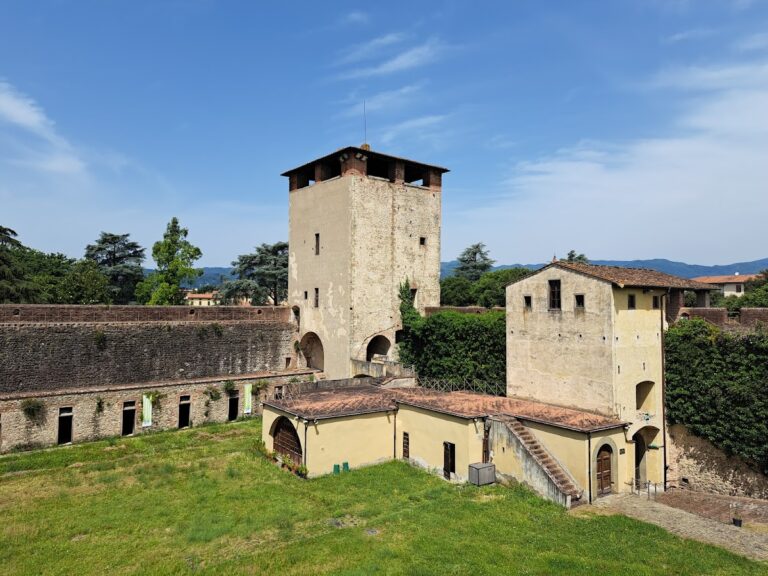
Bishop Scipione de’ Ricci suppressed the convent in 1786. It had been re-established as a monastery by 1794, but the community was suppressed again in 1810 under the Napoleonic regime. The church continued as a parish until 1856. The Servites briefly returned, yet the convent was again suppressed under the Italian kingdom. In 1859, much of the complex was requisitioned and transferred to the state for use as barracks. The former convent later became the Gavinana Barracks and now functions as a warehouse.
The convent and associated buildings were abandoned during the second half of the twentieth century. Structural failures damaged the church’s timber roof and caused collapses in both the church and former convent, making the church inaccessible in 2013. Restoration took place between 2020 and 2022. An earlier major restoration in 1915 altered portions of the interior and associated buildings while revealing painted ornament in the cloister and paintings in medallions in the chapter chapel.
The building continues to preserve a record of Servite devotion through its altars, images of saints and blesseds, and scenes concerning the origins and history of the order. The bells were recast in 1794 by the Pistoian craftsmen Giovanni Battista Cari and his brothers.
Remains
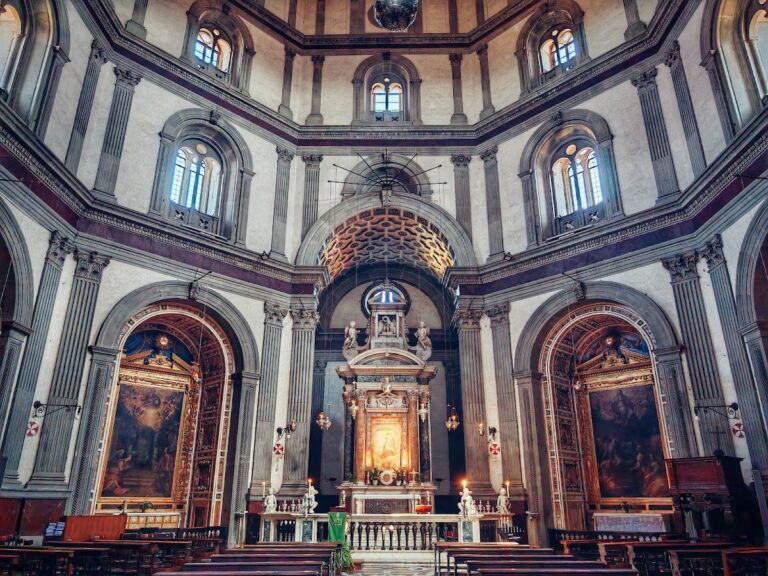
Santissima Annunziata is a large church with a single interior approximately 47 metres long, 14 metres wide, and 16 metres high. Its present character is Baroque, although Romanesque and Gothic elements survive. The primitive structure is represented by the original timber roof and a quadrangular bell tower 27 metres high, whose four Gothic windows remain part of the exterior. The original church was architecturally simple, with lateral walls carrying a trussed roof and containing small altars with paintings.
The church interior
Ceiling and wall decoration
The interior is covered by a fifteenth-century timber trussed ceiling, whose painted decoration remains well preserved. Gilded wooden altars line the walls, while the two altars at the rear use gilded stucco, a molded plaster material used for ornament. Two side chapels beside the high altar were being restored to their earlier forms.
Two painted registers extend around the church. The upper tier contains sixteen Servite saints and blesseds, including four from Pistoia, painted by Niccolò Nannetti. Giovanni Domenico Ferretti painted the angels in the lower tier and the Annunciation on the choir vault. The vault painting has suffered considerable damage. Large gilded stucco crosses, framed by ornamental stucco, separate the figures.
Peraccini Altar and Seven Sorrows Oratory
On the right side, the Peraccini Altar contains a fourteenth-century fresco, a wall painting made on wet plaster, of the Virgin of the Annunciation. Sebastiano Vini added the announcing angel, the Eternal Father, and two angels in 1590. The joins between the earlier and later plaster and paint remain visible. Between 1471 and 1480, the section showing the Virgin was moved from a larger fresco that had also included the Archangel Gabriel.
In 1579, Nofri Peraccini transformed the first altar into a small temple-like chapel with a domed roof carried by columns. Its design followed Michelozzo’s shrine at the Santissima Annunziata in Florence. Alterations to the shrine beginning in 1716 destroyed the chapel’s original structure. The associated small choir later became the Oratory of the Company of the Seven Sorrows of the Virgin. Its stalls were made in 1582 by the woodworker Piero Gerini, while Pietro Volponi painted the entrance frescoes in 1588 with stories of the Virgin and Christ among the Apostles.
Funerary monument and side altars
Beside the Peraccini Altar stands the sixteenth-century funerary monument of Antonio Galeazzo Elefanti of Bologna. He had taken refuge in Pistoia to escape conspiracies in his homeland and died there. His father, Francesco, and his grieving brothers commissioned the monument.
The Gori Altar, made around 1720, contains Giuseppe Giusti’s painting of the Visitation of the Virgin. It had previously belonged to the Company of the Conception, which commissioned a panel from Giuliano Panciatichi in 1523. In 1614 the altar passed to the gardeners’ company, which dedicated it to Saint Charles Borromeo and installed a painting by Alessio Gemignani, now in the choir.
The Puccini Altar contains a twentieth-century papier-mâché statue of the Addolorata by Collina Graziani of Faenza. A nearby modern chapel contains another statue by the same artist, depicting Saint Joseph, together with a bronze tabernacle by the Pistoian artist Ulisse Lippi. The tabernacle had been exhibited at the 1929 Sacred Art Exhibition in the Palazzo di Giano.
Presbytery and choir
The presbytery, the part of the church surrounding the high altar, rises by two steps and is separated from the nave by a marble balustrade. It contains the central choir and two lateral altars. On the right, Sebastiano Vini’s 1574 panel depicts the Circumcision of Jesus. A wooden shrine and, later, an eighteenth-century stucco frame once surrounded it, but both frames have been lost.
Choir paintings and sculptures
The choir acquired its present form through eighteenth-century alterations. Its rear wall holds a panel of the Virgin enthroned with the Christ Child and Saints John the Evangelist, Bartholomew, James, and Philip. Formerly attributed to Fra Paolino da Pistoia, Leonardo Malatesta, and Bernardino del Signoraccio, the work was almost certainly painted by Domenico di Marco Rossermini between 1518 and 1521 for Bartolomeo Baldinotti. It was made for the former choir at the centre of the nave and moved to its present position in the eighteenth century.
The choir statues of Saint Philip Benizi and Blessed Bonaventura Bonaccorsi were made by the Servite Father Giovanni Angelo M. Lottini and recorded in 1590. They were moved to the choir after the partition wall between nave and choir, built in 1568, was dismantled in the eighteenth century. Philip is shown with a three-tiered papal crown at his feet and a book, while Bonaventura holds a crucifix.
Alessio Gemignani’s painting shows Saint Charles Borromeo praying for the end of the plague. Canon Francesco Bracali commissioned it, and it was recorded in 1614. On the opposite wall is Santi di Tito’s 1572 panel of the Assumption with Saints Francis, Peter, James, and Philip Benizi. Originally made for the Peraccini Altar, it was moved to the choir in the eighteenth century and later damaged by lightning, which removed paint from several areas.
Presbytery altars
The left presbytery altar occupies the site of an altar and burial place made by Jacopo Centi, known as Papoceto, in 1568. The Baldinotti family acquired it in 1575 and later replaced Papoceto’s Christ in Limbo with Lodovico Cardi, known as Cigoli’s, Nativity of the Virgin. Installed in 1608, the painting is now in storage awaiting restoration.
The Peraccini Altar dedicated to the Assumption and Saint Philip Benizi contains Ugo Casanova’s 1915 painting of the Assumption. It also portrays Blessed Bonaventura Bonaccorsi, Saint Philip Benizi, and Saint Juliana Falconieri. Bonaccorsi’s remains lie beneath the altar in a gilded urn. They were transferred from Orvieto to Pistoia, his birthplace, in connection with the 1915 centenary of his death.
The altar of Saint Peregrine Laziosi was made in 1747. Its painting, attributed to Giovanni Battista Gigli, depicts Christ descending from the Cross to heal the saint’s gangrenous leg.
Rear altars and sacristy
Conception Altar
The Conception Altar at the rear of the church was founded in 1383 under another dedication. It first contained an altarpiece by Lippo di Dalmasio and later one by Gerino Gerini. In 1588, the Company of the Conception acquired the altar, built a small chapel modeled on the Peraccini chapel opposite, and installed Panciatichi’s panel, now in the sacristy. The present eighteenth-century painting by Tommaso Redi shows the Immaculate Conception with the kneeling Saint John the Baptist.
Sacristy
The large sacristy opens from the left side of the presbytery and is lined with valuable walnut benches. It formerly contained six canvases of miracles associated with Saint Philip Benizi and two landscapes. Servite chronicles attributed the paintings to Bernardino Poccetti, who was reportedly invited to make them in 1600, but that attribution is not secure.
The sacristy also held Giuliano di Jacopo Panciatichi’s 1523 panel of the Immaculate Conception with scriptural symbols. Although sometimes attributed to Giovanni Cristiani, it is associated with Panciatichi and was originally made for the right nave altar, now the Gori Altar. The sacristy works are in storage except for an Addolorata dated approximately 1790 to 1810.
Cloister and convent spaces
The convent cloister was built with the convent in the fourteenth century, although its present appearance is Renaissance in character. Its pietra serena columns, made from the grey sandstone widely used in Tuscan architecture, have Ionic capitals. An upper story was added in the eighteenth century. In 1905, arches were partly closed after a column at the southeast corner broke, bringing down the structure above and damaging the rest of the portico.
Cloister fresco cycle
The cloister contains twenty-six painted lunettes, portraits of eighteen Servite cardinals and bishops, and festoon decoration held by giant figures. Some festoons were uncovered in 1915 and revealed again during later work. The frescoes have darkened through dust and salt efflorescence, the crystalline residue left when salts reach and dry on plaster or masonry. Their last recorded restoration was in 1995.
The six eastern lunettes near the sacristy are attributed to Bernardino Poccetti. They show the Coronation of the Virgin; the first appearance of the Virgin and the calling of the Seven Founders; the founders’ retreat to Villa Camarzia; their presentation to the bishop of Florence and reception of the Augustinian Rule; the Virgin giving them the black Servite habit on Monte Senario; and the miraculous creation of the Virgin’s face in the Florentine Annunciation image.
The northern lunettes portray the life of Bonaventura Bonaccorsi. Scenes show his leadership of the Ghibelline faction, his conversion after hearing Philip Benizi preach in 1276, his distribution of wealth to the poor, reconciliation with his enemies, rejection of worldly rank, entry into the Servite Order, penitential practices, service under the bishop of Arezzo, and reported healings of possessed people. The artists include Francesco Montelatici, Filippo Cremoncini, and Alessio Gemignani.
Further lunettes show Bonaventura laying the foundation stone of the Dominican church of Santa Maria Novella at Montepulciano, giving the religious veil to Agnes of Montepulciano in 1306, transmitting a book, giving the Servite habit of the Addolorata to women in Pistoia, begging publicly for alms, accompanying Philip Benizi on his final journey to Todi, and giving Margaret of Montepulciano the habit of a Servite tertiary, a lay member associated with the order. These works are attributed to Alessio Gemignani, Francesco di Alessandro Leoncini, and Giovanni Martinelli.
The final lunettes show Bonaventura writing, being esteemed for holiness while serving as superior in several convents, dying on 14 December 1315, and lying in state in the Servite church at Orvieto. Most are attributed to Giovanni Martinelli, and their inscriptions identify the cycle as a visual account of Bonaventura’s life and death.
Chapter chapel and Oratory of the Rossi
The cloister gives access to the chapter chapel on the east and the Oratory of the Rossi on the west. A chapter chapel was the room where a religious community met for official assemblies, discipline, and communal decisions. The chapel walls were repeatedly whitewashed and later divided by internal partitions, obscuring earlier decoration. Giovanni Cristiani was said to have painted ten late-fourteenth-century panels of the Passion of Christ there, while Francesco Maria Piastrini was said to have frescoed the chapter room in the seventeenth century. A 1915 test revealed surviving medallion paintings in a seventeenth-century style.
The Oratory of the Rossi had its own entrance from the public street and was large enough to appear on a sixteenth-century plan of the convent and church. Giovanni di Bartolomeo Cristiani painted it in 1396 with fifteen frescoed scenes from the genealogy and life of Christ. The principal surviving fresco shows the Virgin of the Annunciation with the Angel and a kneeling confraternity member wearing a red robe. Four contemporary saints appear below.
An organ made by Filippo Tronci was recorded in 1853. The same inventory listed paintings by Bastiano Veronese, Giuseppe Giusti, Pietro Cremoncini, Pietro Dandini, Leonardo Malatesta, Cigoli, and Giovanni Battista Gigli, together with frescoes by Niccolò Nannetti and Giovanni Domenico Ferretti. The cloister decoration also includes works attributed to Francesco Montelatici, Filippo Cremoncini, Alessio Gemignani, Giovanni Martinelli, and the Piastrini family.