San Bartolomeo in Pantano: A Romanesque Church and Abbey in Pistoia
Site at a Glance
- Country
- Italy
- Primary era
- Medieval
- Eras represented
- Medieval, Modern
- Civilizations
- Grand Duchy of Tuscany, Holy Roman Empire, Lombard
- Site type
- Religious
- Remains
- Church
On this page15 sections
History
San Bartolomeo in Pantano is a church in Pistoia, Italy, founded with its adjoining abbey by Gaiduald, a Lombard physician, between 726 and 764, during the Lombards’ rule over much of Italy. Its present form chiefly reflects Pistoiese Romanesque, the local Tuscan expression of a medieval style associated with rounded arches and substantial masonry. The building is also described as Gothic, a style characterized by pointed arches and an emphasis on vertical forms. The church is dedicated to St Bartholomew the Apostle and belongs to the Diocese of Pistoia.
Early monastic history
Around the ninth century, the monks adopted the Rule of St Benedict, a set of principles for monastic life that became foundational for Western religious communities. The Marquises of Tuscany placed the abbey under their direct protection. In 1001, Margrave Hugh, a high-ranking noble, died there.
The abbey’s name refers to marshy ground associated with the site. That marsh formed after the Brana stream changed course in the fourteenth century.
Buono’s renewal
Abbot Buono renewed the abbey in the mid-twelfth century. In 1159, the church acquired the appearance it largely retains, shaped chiefly by Pistoiese Romanesque architecture.
Lateran canons and devotional practice
In 1433, the Lateran canons replaced the Benedictines, whose numbers had declined. The new community consisted of canons regular, clergy who lived together under a religious rule, and followed the Augustinian tradition. They were associated with a monastery linked to Fridianus, a saint and bishop of Lucca.
The Lateran canons established a practice for the feast of St Bartholomew on August 24: children’s foreheads were anointed to protect them from harmful spirits. Popular devotion later extended the anointing to protection from illness, especially throat ailments, and the practice continues. Special corone pastries are sold for the occasion, which remains among Pistoia’s most strongly observed festivals.
Vallombrosans and the parish church
After the Lateran canons were suppressed, the monastery was assigned to the Vallombrosans, a Benedictine monastic order, in 1779. They remained until the monastery was suppressed in 1810, when the church became a parish.
A major restoration from 1951 to 1961 removed later interior additions and recovered features of the church’s earlier appearance. The organ was restored in 1974.
Remains
The church combines Romanesque and Gothic features, with a façade and interior that retain elements of its Pistoiese Romanesque form. Its surviving decoration includes medieval sculpture, paintings, and later religious artworks.
Façade and portal
Façade design
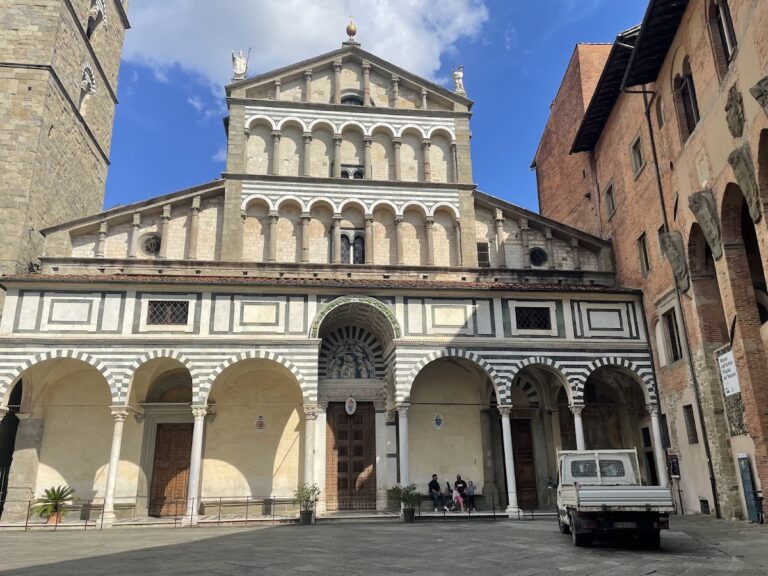
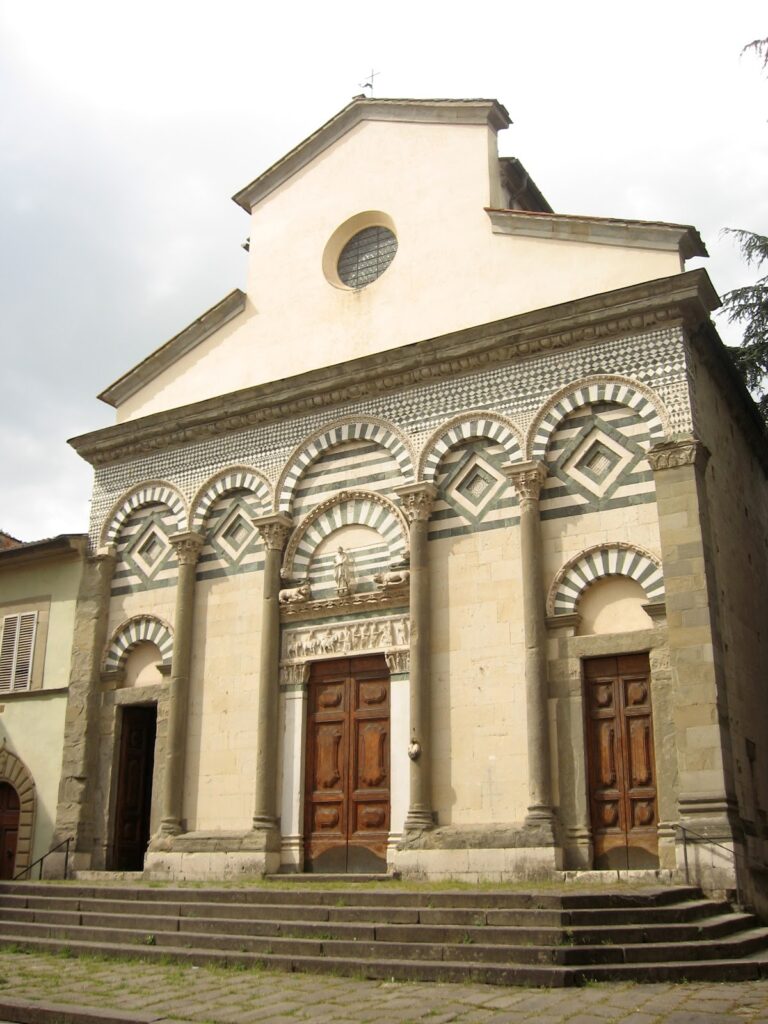
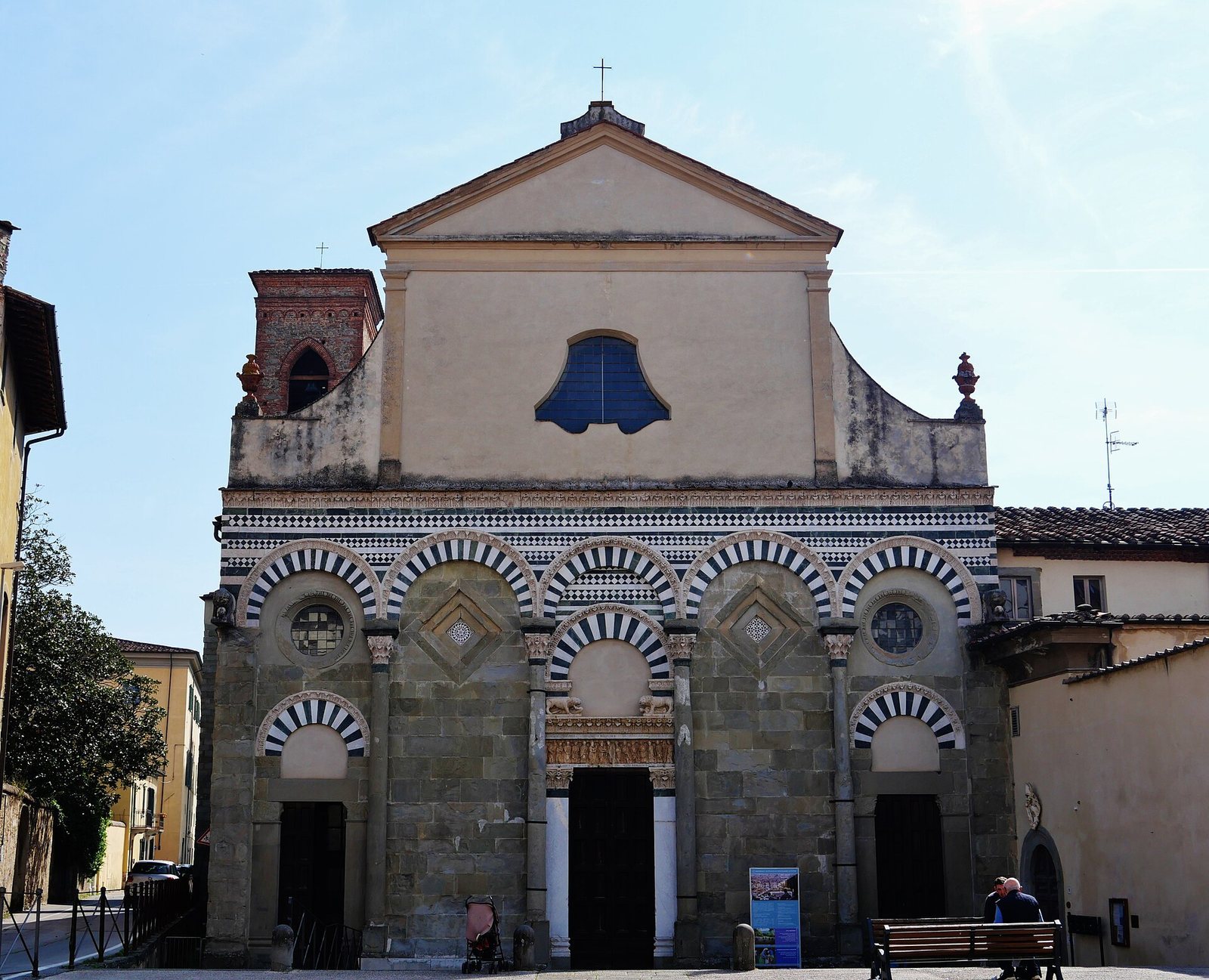
The façade is arranged in five bays, with five arches resting on slender columns. Smaller doorways occupy the outer bays, while the second and fourth arches are slightly taller and wider than the others. White marble and green serpentine stone form its two-color decoration.
Carved lions and portal
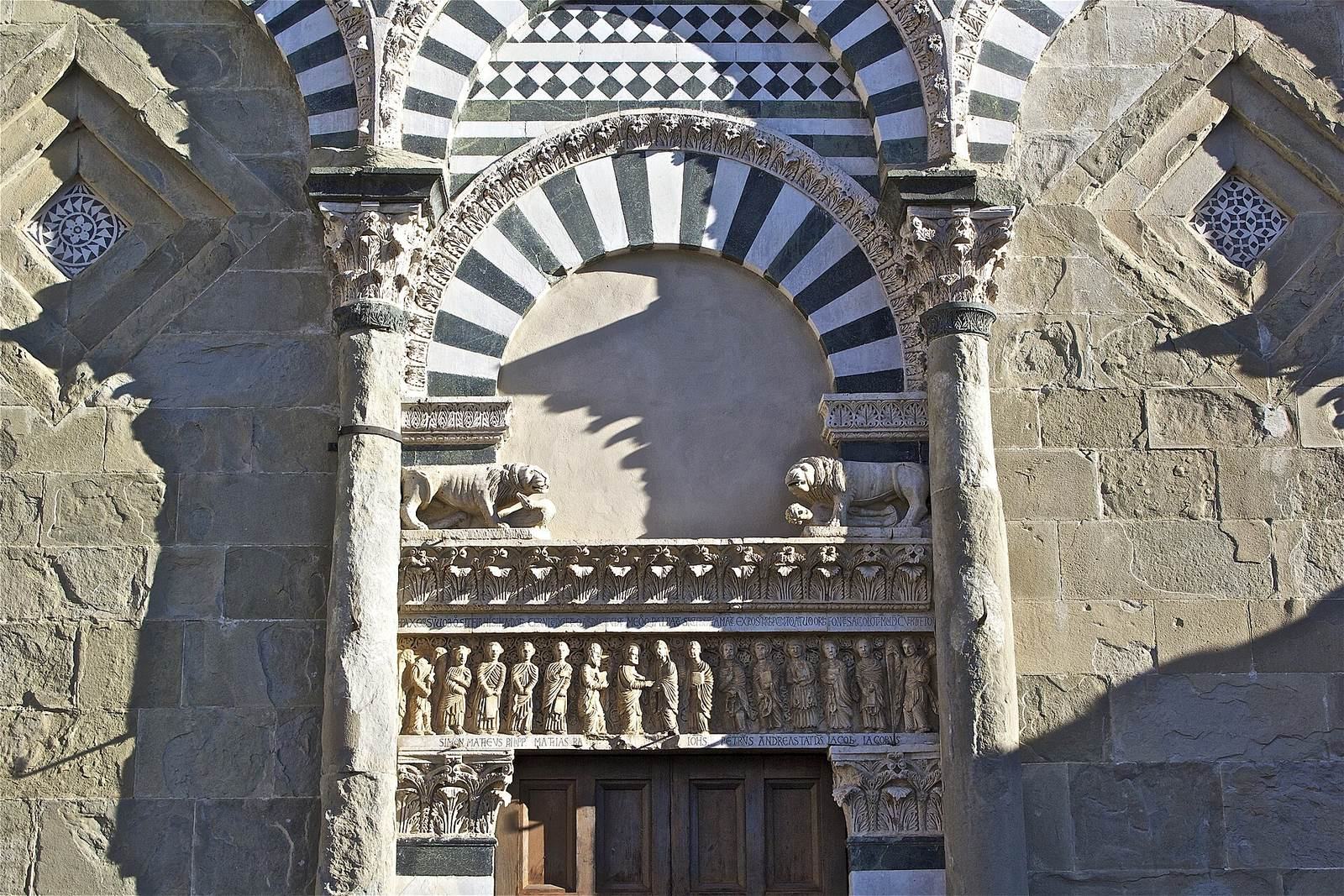
Stone lions appear at the façade’s corners and support the central arch. Above the doorway’s lintel, two more lions face one another: one rests on a reclining man, while the other stands over a large bird.
The horizontal beam above the portal, dated 1167 and attributed to the medieval sculptor Gruamonte, bears the name of its commissioner, Rodolfino. Its carved figures show Jesus among the Twelve Apostles, with an angel at either side. The scene has been understood either as Jesus giving commandments to the apostles or as the Incredulity of Thomas. In the latter interpretation, Thomas faces Jesus and Matthew takes the place of Judas.
Interior and artworks
Interior fabric
The floor is made of crushed-brick mortar, and the walls expose their stone blocks. Single-opening windows were reopened during the restoration, which also brought traces of earlier painted decoration to light.
Apse painting
A painting in the apse, the rounded sanctuary end of the church, dates to the late thirteenth century and is attributed to Manfredino d’Alberto. Against a blue ground, Christ appears in Majesty, shown in sovereign glory, among saints and angels.
Pulpit
The pulpit’s sculpted enclosing barrier was made by Guido da Como in the mid-thirteenth century and has been restored. Panels carved by another master are now mounted on a wall.
Paintings and devotional works
A wooden crucifix above the high altar is by an unidentified sculptor whose style resembles that of Giovanni Pisano. The church also holds an eighteenth-century panel by Giovanni Camillo Ciabilli depicting Vallombrosan saints, and a 1596 altarpiece by Giovanni Maria Butteri. Commissioned by Abbot Vittorio Brunaccini for the now-vanished Benedictine Abbey of San Michele in Forcole, it shows the Madonna and Child with Saints Michael, Benedict, John Gualbert, Peter Igneus, and Zeno, whose identification is uncertain. A Holy Family with the young John the Baptist is signed by Francesco Leoncini and has an uncertain date. Ignazio Hugford’s 1754 painting shows Matilda of Tuscany, a prominent medieval ruler, giving her possessions to the church.
Organ
The organ was built in 1844 by Filippo Tronci, an organ builder from Pistoia.