St. Pantaleon’s Church: An Ottonian Romanesque Basilica in Cologne


Site at a Glance
- Rating
- 4.6
- Popularity
- Low
- Country
- Germany
- Primary era
- Medieval
- External website
- Open
- Eras represented
- Classical, Medieval, Early Modern, Modern
- Civilizations
- Carolingian, German, Holy Roman Empire, Roman
- Site type
- Religious
- Remains
- Church
On this page13 sections
History
St. Pantaleon’s Church is an early Romanesque basilica in Cologne, Germany, shaped by Ottonian patronage in the tenth century and dedicated to Saint Pantaleon and Saints Cosmas and Damian. It served as the abbey church of a Benedictine monastery until the monastery was dissolved at the end of the eighteenth century. Today it remains a Roman Catholic church in the Archdiocese of Cologne and belongs to the personal prelature Opus Dei.
Roman and Merovingian predecessors
The church stands on a small hill about 17 metres above the Rhine. During the Roman period, the hill lay outside Cologne’s walls. A wooden building occupied the site in the first century, and a suburban Roman villa stood there from the second to the fourth century. Roman structural remains have been found beneath the choir and outside the church. The villa has sometimes been interpreted as an early Christian place of worship, but that interpretation is not supported by archaeological or historical evidence.
Use of the area initially ceased after the Roman villa period. Burials from the sixth or seventh centuries later appeared on the hill, including richly furnished Merovingian graves in trapezoidal limestone sarcophagi. Their presence points to the importance of the site in the early medieval period. A church at St. Pantaleon was first recorded in 866, although the chronology of the earliest medieval rebuilding remains uncertain. The church may have been destroyed during a Norman incursion in 881 and 882.
Ottonian foundation and imperial connections
Archbishop Bruno the Great of Cologne, the brother of Emperor Otto I, founded a Benedictine monastery at St. Pantaleon in 955. A further endowment by Bruno in 957 supported construction of the church, while Otto I gave the monastery numerous gifts. The surviving central nave belongs to this period and is approximately 13 metres wide. Archaeology distinguishes two Carolingian and Ottonian building phases, including annexes and a complex of crypts. Building work also revealed the remains of Saint Maurinus of Cologne.
The Ottonian period refers to the artistic and architectural culture associated with Otto I, Otto II, and Otto III in the tenth and early eleventh centuries. It continued Carolingian traditions while incorporating Byzantine influences, especially through imperial patronage, church building, sculpture, painting, and the veneration of relics. These connections were particularly strong at St. Pantaleon through its dedication and its association with the imperial court.
Saint Pantaleon was a late-antique Christian martyr traditionally associated with Nicomedia, in present-day Izmit, and with the healing profession. The church at Cologne is the oldest church dedicated to his cult west of Byzantium. Relics connected with Pantaleon may have reached the region through Aachen during the Carolingian period or earlier. Archbishop Gero was also said to have obtained the saint’s body during his mission to Byzantium in 971.
Under Empress Theophanu or shortly afterward, the western part of the church was rebuilt. The church was consecrated in 980, and its western facade received a monumental sculptural program after that date. Theophanu was a Byzantine princess who married Otto II in 972 and later served as empress and regent for her son Otto III. She visited Cologne at least once each year between 985 and 990, celebrating Christmas at St. Pantaleon in 986 and 988. She introduced the cult of Saint Nicholas from Constantinople, brought additional relics from Rome, and requested burial in the church. Bruno the Great likewise chose the church’s crypt as his burial place.
Medieval enlargement and monastic reform
Around 1070, during the episcopate of Archbishop Anno II, the abbey was forcibly reorganized according to the Siegburg Reform. This eleventh-century Benedictine movement sought stricter monastic discipline and closer control by reforming ecclesiastical authorities. At St. Pantaleon, the intervention placed the monastery under closer episcopal supervision and caused violent unrest in Cologne.
Around 1160, under Abbot Wolbero, the single-nave Carolingian and Ottonian church was enlarged into a three-nave basilica. Two side aisles were added to the earlier building, creating the basic arrangement that survives today. During the medieval expansion of Cologne and the construction of the enlarged city walls, the church was incorporated into the urban area. In the later Middle Ages, St. Pantaleon received fewer endowments than other monasteries in and around Cologne.
Baroque alterations and changing religious uses
Beginning in 1618, the church was modernized in several phases in a post-Gothic and Baroque manner. The surviving results include the organ case of 1652, the choir furnishings, and the pulpit of 1747. The choir and its decorated net vault once showed scenes from the lives of the Virgin Mary, Saint Benedict, and Saint Scholastica. These paintings were not restored after the Second World War and may survive only in fragments beneath the later white coating.
In 1757, the deterioration of the building caused one of its two side towers to collapse. The central tower and both side towers were then rebuilt on a smaller scale with Baroque terminations. The French occupation of Cologne in 1794 led to the dissolution of the monastery, and the church was converted into a stable. After Cologne became Prussian in 1815, the building served as a Protestant garrison church.
During the Prussian period, an optical telegraph was installed on the central tower. St. Pantaleon became station 51 in the 61-station line between Koblenz and Berlin, a communications route of about 550 kilometres. The first 210-word transmission from Berlin to Cologne took place on 2 February 1840. The station closed after electric telegraphy made the optical system obsolete.
From 1872, Old Catholics celebrated services in the former garrison church. Old Catholicism developed among Christians who rejected the First Vatican Council’s definitions of papal infallibility and papal jurisdictional primacy. The congregation was recognized as independent in 1874 and later moved to Christ’s Resurrection Church.
Restoration, war damage, and revival
The westwork was restored in a Romanesque style between 1890 and 1892. The Prussian War Ministry financed the work because the church was army property and still served as a garrison church. After the demilitarization of the Rhineland, the Protestant congregation exchanged St. Pantaleon for the nearby Charterhouse in 1922. The building then returned to use as a Catholic parish church.
Bombing during the Second World War destroyed the roof, parts of the outer walls, the towers, and most of the interior furnishings. Important objects, including the shrines, high altar, and rood screen, had been protected or evacuated before the destruction. Postwar reconstruction aimed to recover the building’s Romanesque character. Archaeological excavations carried out during the restoration between 1955 and 1962 clarified the sequence of Roman, early medieval, Carolingian, and Ottonian activity.
The church’s identity continues to be shaped by its long associations with the cults of Saints Pantaleon, Maurinus, and Alban, as well as by its Byzantine connections through Theophanu. Since 1987, on the initiative of Cardinal Joachim Meisner, the parish has been administered by priests of Opus Dei, a personal prelature of the Catholic Church whose members pursue Christian religious life through ordinary work and daily activities. A chapel dedicated to Josemaría Escrivá, the founder of Opus Dei, was inaugurated in 2006.
The annual memorial mass for Theophanu had been held traditionally on 15 June for eight centuries, until the abbey was dissolved under Napoleon in 1803. The parish revived the observance in 1991, marking the thousandth anniversary of her death. St. Pantaleon is also included among the Romanesque churches of Cologne supported by the city’s Romanesque Churches association.
Remains
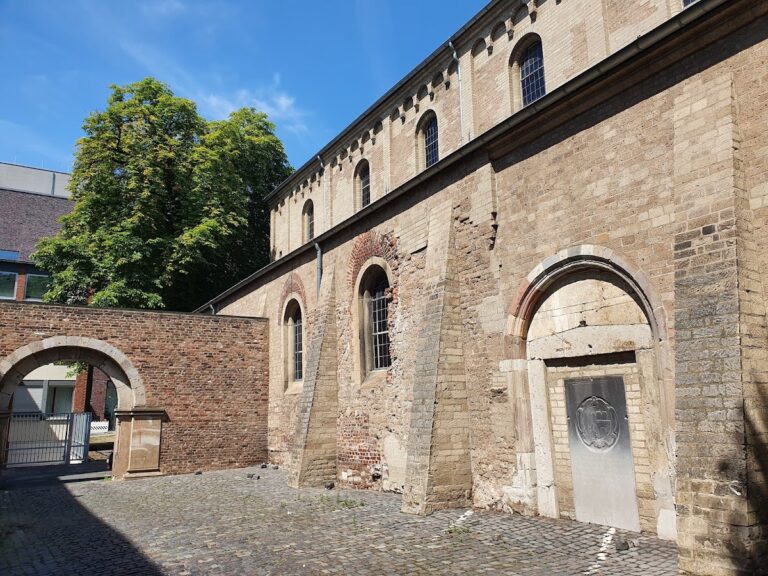
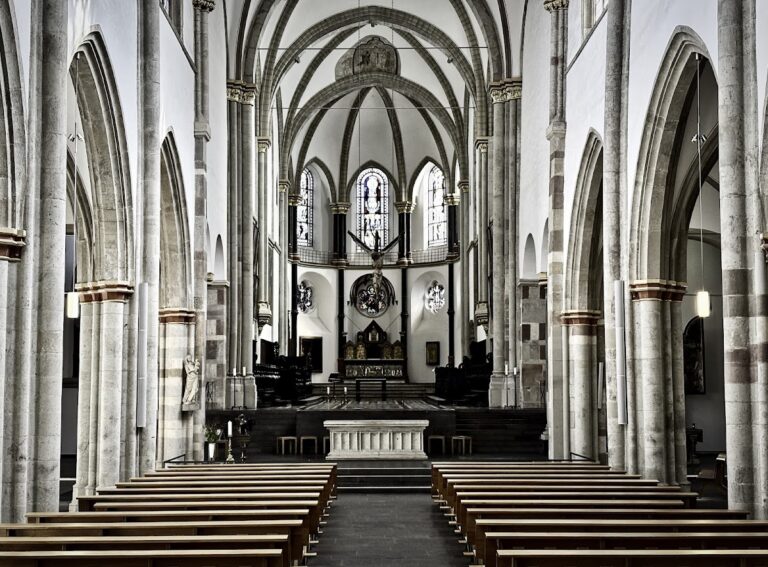
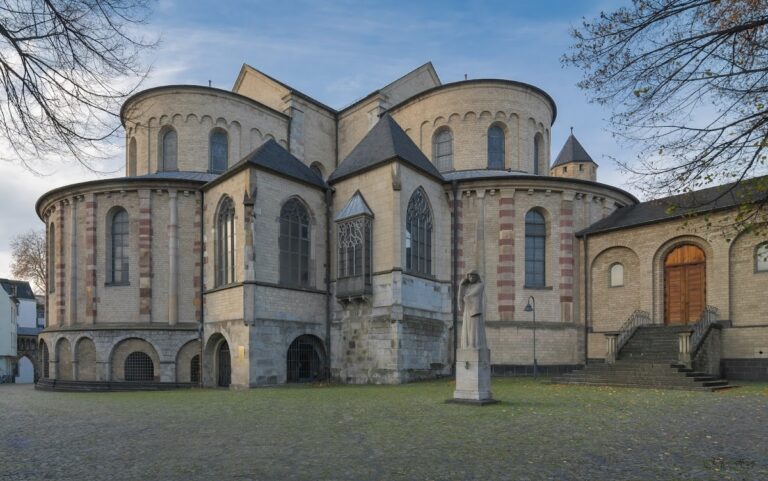
St. Pantaleon is a Romanesque three-nave basilica with two transepts, standing on a hill whose alignment lies approximately 31 degrees away from exact east. The same orientation occurs in the Roman remains beneath and outside the church. The present building combines the tenth-century central nave, the twelfth-century side aisles, a monumental western complex, later medieval and Baroque furnishings, and postwar interventions.
Archaeological remains and early structures
The Roman remains beneath the choir and outside the church relate to the wooden building of the first century and the suburban villa occupied from the second to the fourth century. The later cemetery included numerous sixth- and seventh-century trapezoidal limestone sarcophagi, several of them richly furnished. These burials form part of the physical evidence for the hill’s importance before the recorded medieval church.
The Carolingian and Ottonian complex consisted of a single-nave church with annex buildings and crypts. West of the church, excavation revealed a central structure with eight alternating sides. It may have been a memorial building or baptistery. Its finds date it to the ninth century, making its proposed identification as Bruno the Great’s mausoleum untenable.
The westwork
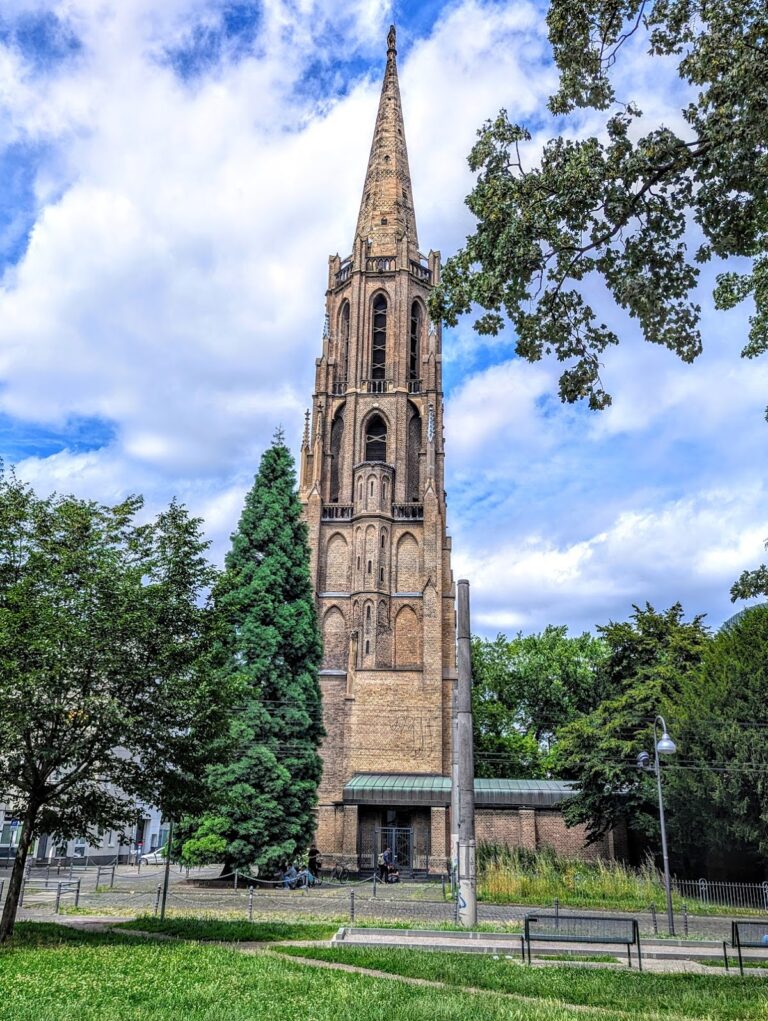
The westwork is a monumental western entrance complex with towers, an upper structure, and a porch, a form characteristic of major Carolingian and Ottonian churches. It consists of a large central tower and two smaller side towers. The central tower is about 36 metres high, while the side towers reach approximately 42 metres. The central tower is hollow and flanked by stair towers. An open-fronted porch, also called a narthex or entrance hall, forms part of the complex.
Timber more than 1,000 years old was found during repairs in 2021 and radiocarbon-dated to between 892 and 992. The result demonstrates that the present westwork belongs to the late tenth century. Its porch was reconstructed in the nineteenth century using the earlier structure as a model.
The late-tenth-century facade carried a monumental sculptural cycle. A Majestas Domini, an image of Christ in majesty, stood above figures of the titular saints Cosmas, Damian, and Pantaleon and was flanked by three angels. Additional figures were identified as Saint Alban or Saint Quirinus and Saint Maurinus, although those identifications remain uncertain.
Nave, transepts, and medieval sculpture
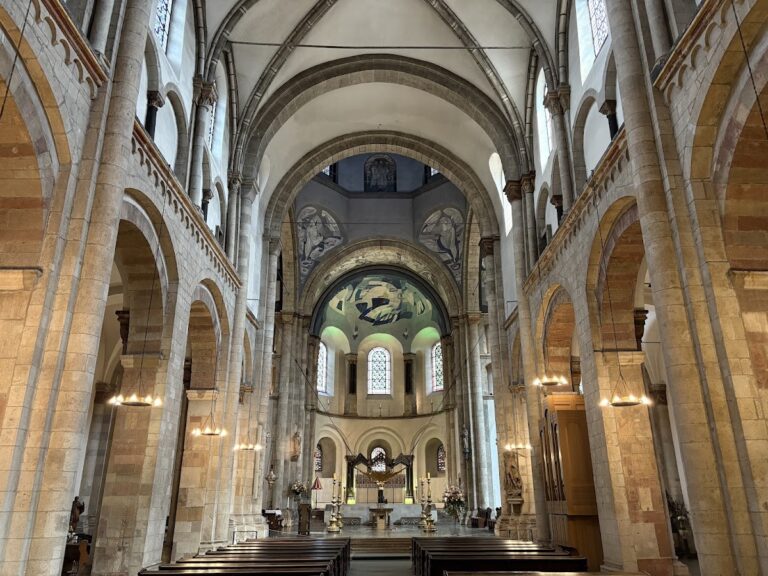
The central nave, approximately 13 metres wide, belongs to the tenth-century complex. Around 1160, the addition of two side aisles transformed the earlier single-nave church into the present basilican arrangement. A tympanum relief from approximately the twelfth century, among Germany’s oldest surviving examples, originally stood above the north transept portal. It is now preserved in Cologne’s Schnütgen Museum.
The late-medieval furnishings include fourteenth-century choir stalls and a fifteenth-century wooden crucifix. A wooden Pietà and a wooden crowned Madonna with the Christ Child and an imperial orb also date from the fifteenth century. The Pietà entered the church from the art trade in 1965, and Christ’s head appears to have been extensively recarved. The Madonna’s facial features may resemble those of Empress Theophanu.
Shrines, chapels, and paintings
The Maurinus Shrine and Albinus Shrine date from the second half of the twelfth century and show influences associated with Nicholas of Verdun. A shrine to Saint Alban has been associated with the church since the tenth century, while a twelfth-century shrine is said to contain the remains of Saint Maurinus. The church also holds fragments associated with Saint Nicholas, brought from Constantinople, and Saint Pantaleon, brought from Aachen, together with the relics of Bruno the Great.
A statue of John the Baptist with the Lamb of God was made around 1500 for the baptistery. The baptistery also contains a Crucifixion triptych from around 1550 associated with the circle of Barthel Bruyn the Elder. A Calvary painting from around 1520 is an oil work by a Franciscan painter from Korbach and was probably once part of a triptych. It shows Saint Francis of Assisi holding a chalice beneath Christ’s blood, while the painter appears at the foot of the image with a brush and palette. The work entered the church’s collection in the nineteenth century.
The late-Gothic rood screen was built at the beginning of the sixteenth century and now supports the organ. The left side apse contains a chapel designed by Elmar Hillebrand and his son Clemens Hillebrand for Josemaría Escrivá. A further shrine to Escrivá, completed and consecrated in 2006, stands in the northern aisle. A collarbone formerly associated with the Saint Alban shrine was transferred in 2002 to the shrine of Saint Alban in St Albans Cathedral, England.
Organ, ceilings, and postwar interior
The early-Baroque organ prospect dates from 1652 and is attributed to a partly unidentified master named Balthasar. It is described as Cologne’s oldest surviving organ prospect. Its seven-axis design includes a rounded central tower crowned by a crown-shaped ornament, two-storey flat fields, outer convex fields, blind wings with gilded volutes and angel heads, and gilded veilwork above the pipe fields. Johannes Klais of Bonn installed a new organ in the Baroque case in 1963.
The choir furnishings and pulpit date from 1747. The former paintings of the net vault and choir were destroyed during the Second World War, although possible fragments may remain beneath the present white finish. The damaged ceiling vault was replaced during postwar reconstruction by a flat ceiling containing 94 coffers designed by Cologne glass artist Dieter Hartmann. Gerhard Kadow created the westwork ceiling in 1966 with a depiction of the Heavenly Jerusalem. Clemens Fischer decorated the wall behind the rood screen after the war using fresco-secco, a technique in which pigments are applied to dry plaster.
Theophanu’s tomb and the bells
Theophanu’s remains lie in a white Greek-marble sarcophagus made by Sepp Hürten in 1965. It stands in the westwork, and Hürten also made its present cover. An inscription describes Theophanu as empress, wife and mother of an emperor, benefactor of the basilica, and commissioner of her own tomb.
The former peal in the westwork had a history extending to the end of the eleventh century. Its great Christina Bell, also called the Albinus Bell, traditionally retained the approximate size of its predecessors, about 4,000 kilograms, and the note B-flat through successive recastings. Its fourth recasting took place in 1313, followed by further recastings in 1523, 1764, and 1858. It was melted down for armaments in 1917.
In 1926, the Otto foundry of Hemelingen near Bremen cast three bronze bells for the church in the notes B-flat, C, and B-flat. The largest weighed 3,950 kilograms and measured 1.75 metres across. Two were melted down during the Second World War, while the largest fell from the burning bell frame. The middle bell, dedicated to the Virgin Mary, had been recast in 1303, 1559, and 1892 before being recast again in 1926 at approximately 2,850 kilograms and 1.55 metres in diameter. Its note remained C.
The small bell dedicated to Saint Quirin was last recast in 1571 by Theodorus and Henricus Gnaviter. It weighed about 1,500 kilograms, measured approximately 1.35 metres across, and sounded approximately D. It was destroyed during the Second World War, although fragments survived. The three large bells formed the same ut, re, mi tonal arrangement as the old bells of Cologne Cathedral, but one minor third higher.
A smaller choir peal once hung in a Baroque roof turret above the presbytery for the daily offices and the elevation. Two bells cast in Cologne by Johann Lehr in 1663 were later sold to St. Anna in Windberg and remain there. Another bell was recast for the third time by Martin Legros in 1768. A replacement choir bell cast in 1926 survived the war but was later melted down for the four-bell peal cast in 1956 and 1957 by Petit and Gebr. Edelbrock.
Nearby sites