Orthodox Church of SS. Peter and Paul in Siemiatycze: A Russian-Byzantine Parish Church


Site at a Glance
- Rating
- 4.6
- Popularity
- Very Low
- Country
- Poland
- Primary era
- Modern
- External website
- Open
- Eras represented
- Modern
- Civilizations
- Russian
- Site type
- Religious
- Remains
- Church
On this page15 sections
History
The Orthodox Church of SS. Peter and Paul in Siemiatycze, Poland, is a Russian-Byzantine Orthodox parish church built under Russian rule in 1865–1866. It belongs to the Siemiatycze Deanery of the Diocese of Warsaw and Bielsk within the Polish Autocephalous Orthodox Church and remains an active place of worship. The present building replaced an older wooden church whose parish history reaches back to the first half of the fifteenth century.
The medieval parish
An Orthodox church certainly stood in Siemiatycze by the first half of the fifteenth century and served as a parish church from its foundation. Its establishment may have been connected with Olechno Kmita Sudymontowicz, owner of Siemiatycze, and his wife Fedora. A supposed foundation document dated 1431 is regarded by many scholars as a later forgery, so the precise circumstances of the foundation remain uncertain.
In 1456, Olechno’s son Michał Kmita paid for the renovation of the church and gave the parish meadows and arable land at Myszkowo. In 1513, his daughter Aleksandra Tęczyńska confirmed the parish’s rights to its earlier endowments. The fifteenth-century church was dedicated to the Holy Trinity, with side altars devoted to Saints Peter and Paul and Saint Paraskeva. A chapel dedicated to Saint Anne also stood in Siemiatycze, although its possible connection with the site of the present Catholic chapel of that dedication is uncertain.
From Orthodox to Uniate jurisdiction
The church may have stood near an earlier settlement from which the town developed after Siemiatycze received its charter in 1542. In 1592, the Orthodox parish was again recorded as the center of the town’s “Russian” district, distinct from the “Polish” district around the Catholic church.
Following the Union of Brest in 1596, an agreement through which parts of the Eastern Christian hierarchy in the Polish-Lithuanian Commonwealth entered communion with Rome while retaining the Byzantine rite, the Siemiatycze parish accepted Uniate jurisdiction. The formal transfer was completed in 1614, when Father Eleferiusz Kętrzyński took charge on the recommendation of the Uniate bishop of Volodymyr and Brest. In 1627, his successor, Aleksander Oladowski, was required to remain faithful to the union.
Lew Sapieha financed a new wooden Uniate church in Siemiatycze and stipulated in his will that it should remain under Uniate jurisdiction. The church became a pilgrimage center, especially during the feast of the Holy Trinity, its original patronal celebration. After a new Catholic church opened in the town in 1638, the main celebrations moved there, and the Uniate church’s Trinity observances gradually became less solemn. Its patrons later became Saints Peter and Paul and Saint Paraskeva. The dedication changed after 1726 and before 1789, although large crowds still attended on Trinity Sunday in 1774.
Eighteenth-century change
During the eighteenth century, the church’s importance within the town’s layout declined. Its worship also underwent gradual Latinization. Latin entered the services, Roman Catholic priests sometimes officiated when Uniate clergy were unavailable, and a visitation in 1774 mentioned quiet masses at several side altars. The same visitation described the origin of this Byzantine-related practice as unknown.
After the Third Partition of Poland, the parish became part of the Uniate Diocese of Suprasl in New East Prussia. In 1809, a decree of Tsar Alexander I abolished that diocese and returned its pastoral institutions to the Diocese of Brest. The incorporation of Uniate parishes into the Russian Orthodox Church was completed by the Synod of Polotsk in 1839, the council that ended Uniate ecclesiastical structures in the Russian Empire. The Siemiatycze church then became Orthodox again.
The nineteenth-century rebuilding
From 1840, the parish belonged to the Drohiczyn Deanery of the Diocese of Lithuania. It counted an estimated 2,782 parishioners in 1851 and 2,846 in 1861. In the years before the January Uprising of 1863–1864, a Polish-Lithuanian insurrection against the Russian Empire, the rectory became a meeting place for future participants and a center for organizing military units.
The parish priest, Father Lacewicz, opposed these meetings but did not report parishioners who read prohibited Polish patriotic literature. A Polish unit captured him, but he was released after the intervention of the Catholic priest Father Roch Boguszewski. Following the rebels’ defeat at the Battle of Siemiatycze, Lacewicz persuaded Russian troops not to destroy the town’s Catholic church.
The old wooden church had become unsafe, and construction of a brick replacement began beside it in 1865. The new church was completed in 1866 and consecrated on 6 November that year, retaining the earlier dedication. It initially stood alongside the wooden building, which was later dismantled. Financing included 3,000 rubles from the Russian state treasury, a donation from Ignacy, Bishop of Brest, parish contributions, and unpaid labor by parishioners. The brickmakers Ciecierski and Fanshawe each supplied 25,000 bricks, while another 10,000 came from the demolition of part of a former Catholic Missionaries’ monastery. The state grant and some brick donations may have been secured through forced contributions.
During the following decades, the churchyard was enclosed by a stone-and-brick fence. A decorative gate with an icon of the Holy Trinity was erected in 1890, and the church underwent a general renovation during the 1890s. It was rededicated on 16 October 1897.
War, evacuation, and renewed parish life
After the Diocese of Grodno and Vawkavysk was established, the parish joined its administrative structure. In 1905 it served 5,177 people. After the Edict of Toleration that year, 70 parishioners from Siemiatycze and 340 from the wider parish converted to Catholicism. Shortly before the First World War, the parish had about 6,625 members in Siemiatycze and 22 nearby localities.
The church closed in 1915 when its clergy and most of its Orthodox parishioners left during the wartime evacuation. During the German occupation, the building was used for storage. After Poland regained independence and Orthodox residents returned, parish activity resumed and has continued. During the interwar period, the parish belonged to the Siemiatycze Deanery of the Diocese of Grodno and Vawkavysk. In 1936 it had 5,914 members, including 589 residents of Siemiatycze and people from 24 surrounding villages.
After 1945, some Orthodox residents moved, voluntarily or under compulsion, to the Belarusian Soviet Socialist Republic or to Poland’s Recovered Territories. The parish later expanded again following the creation of Siemiatycze County and the arrival of new residents. Its membership reached about 5,500 in the 1980s and was estimated at 7,000 in 1988.
Fire, conservation, and continuing use
A fire on 1 May 1973 seriously damaged the church. The interior and icons were restored over several years, after which Metropolitan Bazyli Doroszkiewicz reconsecrated the building. Further renovation and conservation followed. A comprehensive project in the 1990s renewed the exterior and interior, iconostasis, and icons. In 1995, the church, cemetery, guardhouse, and surrounding fence were entered in Poland’s register of historic monuments under number A-110.
In 1996, the original parish was reduced after new parishes were created at Boratyniec Ruski, Rogawka, and a second parish in Siemiatycze. The roof and all seven domes were renewed in 2003, when the church also received nine new crosses. The stone fence was completely replaced between 2006 and 2008.
After Archimandrite Jerzy Pańkowski became auxiliary bishop of the Diocese of Warsaw and Bielsk with the title of Bishop of Siemiatycze, the church became his titular cathedral without formally receiving cathedral rank. Warsonofiusz Doroszkiewicz was consecrated as the next Bishop of Siemiatycze in the church on 8 October 2017. Since 2004, the building has hosted an annual November Review of Religious and Paraliturgical Song, with Orthodox choirs and groups performing Belarusian, Ukrainian, and Russian folk music. In 2021, relics of Saints Peter and Paul were brought to the church.
Remains
Site and architectural form
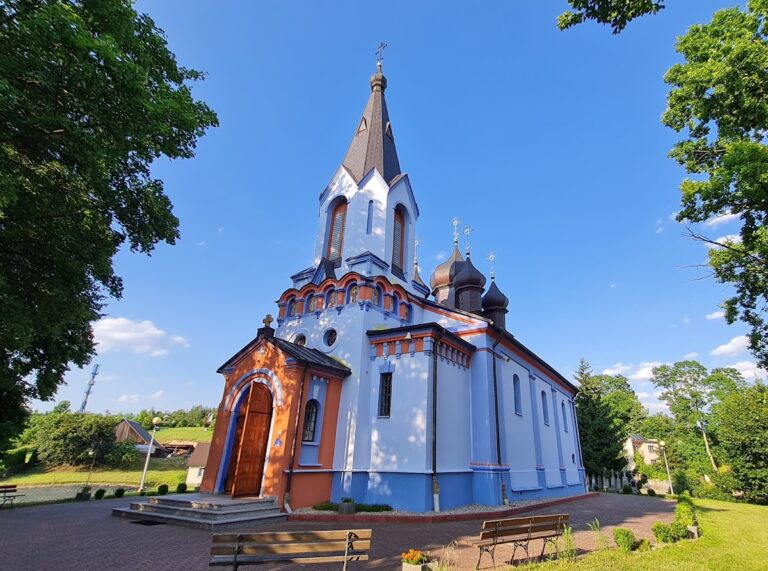
The church stands on elevated ground above the Muchawiec stream, a tributary of the Kamianka River. Its walled churchyard also functions as a cemetery, where historic tombstones survive and Orthodox clergy continue to be buried. The present church follows a design from Konstantin Thon’s pattern book. Thon was a nineteenth-century Russian architect whose model designs strongly influenced Orthodox churches in the Russian Empire. The building represents the Russian-Byzantine, or Russian Revival, style, which adapted forms associated with Russian Orthodox architecture for nineteenth-century ecclesiastical buildings.
Oriented in its liturgical alignment, the church is a three-part brick structure. A square, single-nave body joins a narrower rectangular chancel and a narrower rectangular porch. The nave has a ceiling shaped as an apparent transverse barrel vault. Lesene-and-frame articulation divides the facades, while semicircular arches crown the windows. A single-storey tower rises above the porch beneath a flattened tent roof. The nave has a gabled roof, and the building carries seven domes together with one integrated bell tower.
Interior and liturgical furnishings
Iconostasis
The church has one iconostasis, the icon-bearing screen separating the sanctuary from the nave. It dates from 1908. During the major renovation of the 1990s, its structure, icons, royal doors, frames, and ornamental elements were restored. The royal doors, the central doors of the screen, together with the icon frames and ornament, were gilded.
Icons and devotional objects
The especially venerated icons of Saints Peter and Paul and Saint Paraskeva are painted against gold backgrounds. Their dates and origins have been interpreted in several ways. They have been considered works made for the original fifteenth-century church, substantially later paintings, or Baroque icons from the first half of the seventeenth century.
Icons of Saint Anthony of the Caves and Saint Theodosius of Chernihiv, bought by the parish priest Dubiński, date from the early twentieth century. Icons of the Vilnius Martyrs and Saint Seraphim of Sarov were made in Chernihiv in 1905. Icons of Saint Nicholas and the Mother of God were placed in decorative cases at the beginning of the twentieth century. The church also holds an icon of Saint Alexander Nevsky, formerly displayed in a chapel built in the town center to commemorate the Russian victory at the Battle of Siemiatycze. That chapel was demolished in 1925.
A seven-candle chandelier was installed in 1907. Three early twentieth-century processional banners depict the Mother of God and Christ the Savior, the Częstochowa Icon of the Mother of God with Saints Cyril and Methodius, and the Kazan Icon of the Mother of God with Saint Vladimir. A nineteenth-century folk crucifix stands in the porch. A Uniate pax from 1793, a liturgical object used in the rite of peace, is preserved in the rectory.
The interior polychromy was painted by the Belarusian iconographers Aleksander Łoś and Wiktor Downar during the renovation of the 1990s. The internal doors were made in the second half of the twentieth century by Wieczysław Szum, a sculptor from Siemiatycze. During the twentieth century, the church acquired new liturgical vessels, bells, and other furnishings. Its crosses, chandelier, and candleholders were nickel-plated, while two copper candleholders were purchased by the local Orthodox brotherhood.
On 17 August 2000, a copy of the Iveron Icon of the Mother of God was displayed for veneration. Monks from Mount Athos had given it to the monastery on Grabarka Holy Mountain before it was brought to the church. In 2021, relics of the church’s patron saints, Peter and Paul, joined its devotional heritage.
Earlier church and churchyard
Wooden predecessor
The former wooden church had two domes with crosses and a separate bell tower. A visitation described its royal doors as being in good condition. The site of its altar, south of the present church, is marked by a commemorative stone. The wooden building continued to stand beside the brick church for a time after the latter’s consecration before it was dismantled.
Fence, gate, and Golgotha
The churchyard’s former enclosure included an ornate gate erected in 1890 with an icon of the Holy Trinity. The present stone fencing replaced the earlier enclosure completely between 2006 and 2008. The 1973 fire destroyed the church’s Golgotha, a devotional representation of the Crucifixion associated with the cross and the grieving Virgin Mary and Saint John. It was replaced, and a later Golgotha was made by Wiera Nieroszczuk of Kleszczele. Another had previously been funded by residents of Krupice after the First World War.
Nearby sites