Louka Monastery: A Former Premonstratensian Monastery in Czechia


Site at a Glance
- Rating
- 4.4
- Popularity
- Medium
- Country
- Czechia
- Primary era
- Early Modern
- External website
- Open
- Eras represented
- Medieval, Early Modern
- Civilizations
- Habsburg, Holy Roman Empire
- Site type
- Religious
- Remains
- Monastery
On this page11 sections
History
Louka monastery is a former Premonstratensian monastery in Czechia, located in Louka, now a district of Znojmo. Founded in 1190 by the Přemyslid prince Konrad Otto II and his mother, Maria, it was dedicated to the Virgin Mary and Saint Wenceslas. The Premonstratensians, members of a Catholic order whose communities combined religious life with pastoral and educational work, established the monastery during a period of expanding princely authority and parish organization in Moravia.
Foundation and medieval privileges
The foundation replaced an earlier chapel traditionally associated with Judith of Wittelsbach, a medieval noblewoman. That chapel has been dated either to 1048 or 1056. Louka received generous endowments, including the estates of Althart and Lodenitz, and Pope Celestine III placed it under papal protection on 27 April 1195. Its creation served religious purposes, but it probably also helped strengthen the founder’s seat, extend the parish network, and improve pastoral care in the surrounding area.
The monastery’s possessions and privileges grew during the thirteenth century. Henry Bretislav donated estates in 1194, while Vladislav Henry became one of its leading benefactors by granting land near Loděnice and providing money. In 1222, Louka bought Mramotice for 170 marks of silver, possibly using part of Vladislav Henry’s gift. The monastery also held extensive authority over parish churches in the Znojmo region. Prosiměřice and Tasovice were incorporated directly into the monastery, while other churches were placed under its patronage, giving the community the right to present or appoint parish priests.
The expansion of Znojmo under Přemysl Otakar I brought a major land exchange. An agreement concluded on 19 September 1226 compensated Louka for estates taken when Znojmo became a royal town. In return, the monastery received other properties and rights, including the patronage of the church at Prosiměřice, permission to establish mills and fishponds, high justice, and the property of condemned persons. In 1234, it gained the patronage of the church at Tasovice and an immunity privilege that exempted it from various taxes, labor duties, legal claims, lodging requirements, and demands by officials.
Rulers, conflict, and reconstruction
Louka maintained close relations with the rulers of Bohemia and Moravia. Rudolf of Habsburg stayed there after the death of Přemysl Otakar II and issued charters at the monastery on 4 January 1279 and 11 December 1280. A stay by Charles IV is considered probable. Wenceslaus II confirmed Louka’s purchase of Oblekovice in 1294. John of Luxembourg granted the monastery the right to appoint and remove Znojmo’s magistrate, and his son Charles intervened in a dispute between the monastery and the city’s citizens in 1338. John Henry confirmed its liberties in 1363. Margrave Jobst later granted Louka the right of propination, the regulated privilege of producing and selling alcoholic drinks, which contributed to disputes with Znojmo over the sale of wine.
The monastery’s exposed position beside the route from Vienna to Znojmo made it vulnerable during wars. Duke Frederick of Austria plundered it in 1242. An attack by Cumans serving King Bela IV of Hungary took place in 1252 or 1253, and the resulting economic decline contributed to the canons’ failure to make payments to Rome. They were excommunicated in 1391 and released from excommunication after the payments were made in 1392. Louka was probably plundered again by Rudolf’s forces after the Battle of Marchfeld in 1278, and Rudolf compensated the Premonstratensians for the damage in 1279.
Further devastation followed during the wars between Jobst and his brother Prokop. Monastic property was damaged and the community suffered severe financial difficulties. Wenceslaus IV and Sigismund later restored and confirmed Louka’s rights. In September 1423, Sigismund and Albert jointly settled a dispute over wine tithes in the monastery’s favor.
The Hussite Wars were fifteenth-century religious and political conflicts in the Bohemian lands associated with the reform movement of Jan Hus. During these wars, Archduke Albert occupied Louka in 1421 in an attempt to protect it. Hussite forces commanded by Sigismund Korybutovich and Bohuslav of Švamberk captured and burned the monastery on 12 November 1425 after failing to take Znojmo. The assault caused extensive loss of life and property. People who had not escaped were burned inside the monastery. The canons regained the site in 1426, and religious life resumed comparatively quickly.
Rebuilding began around 1440 and continued until 1498. The Gothic reconstruction incorporated the former palace traditionally associated with Judith of Wittelsbach. It was carried out by the master builder Niklas of Edelspitz, who also built Znojmo’s town-hall tower. Louka later recovered more successfully than many other Moravian monasteries. In 1526, its abbot was required to provide twenty horses for the war against the Turks, the largest obligation of this kind imposed on a Moravian ecclesiastical estate.
Reform, cultural life, and war
The monastery experienced serious administrative and religious crises during the sixteenth century. Mismanagement and the spread of Martin Luther’s teachings contributed to a decline from about 1528. Abbot Sebastian I began restoring Louka’s finances and religious organization in 1572. He cooperated with the Jesuits, opposed Protestantism, recovered villages that had been pledged, and reduced the monastery’s debts. His achievements led to his reputation as a second founder of Louka.
Sebastian II Fuchs of Baden, his successor, established a printing press that operated from 1595 to 1608 and produced twenty-one known prints. It finally ceased operation in 1613. Louka also maintained a tradition of manuscript production and miniature painting. The community’s religious and cultural functions extended through its schools, library, archive, and parish responsibilities.
The monastery’s religious community was expelled in 1620 and returned after the Battle of White Mountain in November of that year. The Thirty Years’ War brought further damage. A flood damaged the farm buildings in 1634. Swedish forces destroyed or plundered Louka in March 1642 and again in 1645, when the Swedish commander Torstensson stayed there after the unsuccessful siege of Brno. The monastery had to pay a war contribution and became indebted. During the Silesian Wars, Prussian forces occupied it in 1742. Louka was required to provide wine and food for Frederick II, and prominent members of the community were held hostage when it could not satisfy Prussian financial demands.
Several later figures were associated with Louka. Prokop Diviš entered the Premonstratensian order there in 1720 and worked at the monastery during the eighteenth century. The theologian and Orientalist Johann Jahn studied and taught there. Klemens Maria Hofbauer worked in the bakery, served the abbot, and attended the monastery school before leaving in 1774 to become a hermit.
Baroque rebuilding and dissolution
Abbot Antonín Nolbeck was an important eighteenth-century builder who commissioned rural residences at Kravsko, Loděnice, Lechovice, and Litohoř. A Baroque rebuilding campaign at Louka began in 1745, first under Franz Anton Pilgram and, after his death in 1761, under Franz Anton Hillebrandt. The work stopped in 1778 before the planned complex was complete. Daniel Dodl was the last abbot, and the monastery had ninety-six canons when it was dissolved.
Joseph II, the Habsburg Holy Roman Emperor whose reforms dissolved numerous contemplative monasteries and redirected their property to state purposes, abolished Louka by imperial decree on 29 July 1784. The convent became a military barracks, while a parish was established in the monastic church. After eighteen years, the barracks were abolished and the complex was converted into a tobacco factory. The estates passed into state administration and were gradually sold.
Military and later history
The Liebenberg banking family bought the Louka estate in 1827 and adapted the monastery buildings as a residence known as the New Castle. Part of the older castle became the Old Castle and was used for administration. The state purchased the complex in 1851. It later housed a military academy, barracks, and a state military stud farm for Moravia and Silesia.
A proposed transfer of the military engineering academy from Vienna to Louka at the end of the eighteenth century was initially abandoned. In 1851, however, Emperor Franz Joseph ordered the Imperial-Royal Genie Academy to move there. The monastery accommodated its boarding facilities and residences for academy administrators, while the former tobacco-factory buildings were also adapted for academy use. Only a small riding stable needed to be constructed. Inadequate drinking water and recurring epidemics along the Thaya were already known, and the transfer prompted many teachers and employees to retire early or seek reassignment. The first course could not be held as planned.
The Old Castle was eventually demolished and replaced by an officers’ building. The oldest monastery buildings became a school, while the large mill below the monastery was converted into an administrative building. Military use caused extensive physical deterioration, and the military left the site in 1993. The former monastery is now owned by the city of Znojmo. Part of the complex is leased to the wine company Znovín, and Louka was declared a national cultural monument of the Czech Republic in 2017.
Remains
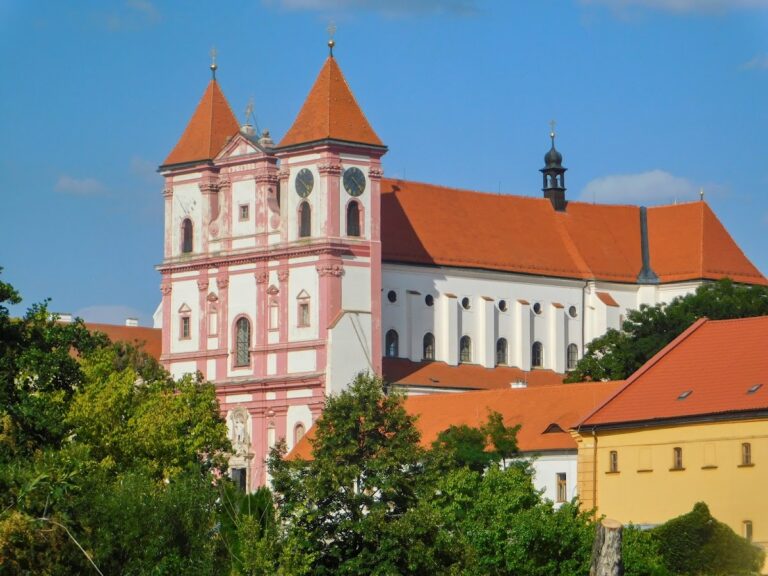
Louka monastery stands outside Znojmo’s fortified urban area, beside the important route between Vienna and Znojmo. The surviving complex was shaped by repeated wartime damage, medieval rebuilding, eighteenth-century expansion, and conversion to military and industrial purposes. The Baroque plan envisioned a massive four-sided complex with corner towers and a garden in the inner courtyard. The church was intended to project into the courtyard while remaining integrated with the new buildings. By the late eighteenth century, the entire east wing and large parts of the adjoining north and south wings had been completed, but the wider scheme was never finished.
Monastic buildings and church
The Gothic rebuilding after the Hussite attack incorporated the former palace traditionally linked with Judith of Wittelsbach. The 1425 destruction had affected the monastery’s buildings, chapel, stables, refectory, dormitory, and other rooms. Gardens, paintings, sculptures, the library, and the archive were also destroyed or damaged, although many charters, documents, and books survived. The later Baroque campaign altered the complex on a much larger scale. Johann Baptist Wenzel Bergl and Franz Anton Maulbertsch participated in its artistic decoration.
The Saint Wenceslas Church remains a central part of the former monastery. It contains the oldest surviving organ in Moravia and continued in use as a parish church after the dissolution. The church’s continued religious function preserves one of the complex’s original purposes, while other buildings reflect their later roles as barracks, academy facilities, a school, administrative offices, and a tobacco factory.
Underground passages
Secret underground passages were excavated beneath the monastery around 1480. One may have connected Louka with Saint Nicholas’s parish church in Znojmo, while another opened on the opposite bank of the Dyje. Proposed uses included movement, concealment, and escape during attacks, but the exact purpose of the system remains uncertain.
Library and manuscripts
Louka possessed a large library and supported the production of books and manuscripts. The Louka Gradual, a liturgical book containing chants for the Mass, dates from 1499 and is now held by the Scientific Library in Olomouc. Another important manuscript, Cursus Sanctae Mariae, was produced shortly after 1215. It has 182 parchment leaves containing a Latin text and one German prayer. Two scribes wrote it, and three miniature painters decorated it. Its illuminations are related to the paintings of the Znojmo Rotunda, and the manuscript is now held by the Morgan Library in New York.
Later alterations and present fabric
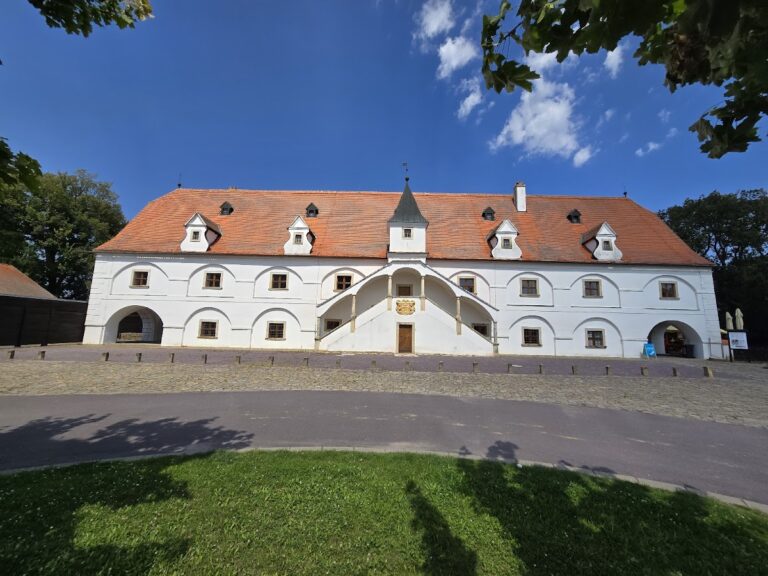
A Baroque gate was demolished in 1969. The conversion of the complex into barracks contributed to extensive deterioration. Today, part of the buildings is used for wine storage, a wine shop, social events, and a small viticulture museum. These activities occupy about one twenty-fifth of the entire complex, while most of the buildings are described as deteriorating.
The former monastery’s collections and records were dispersed after dissolution. The library fittings and part of the holdings went to Strahov Monastery. Other printed works and manuscripts were transferred to libraries in Olomouc and Vienna, while the remaining books were auctioned on 14 November 1790. Part of the surviving archive is now held in Brno.
Nearby sites