St. Maria Lyskirchen, Cologne: A Romanesque Parish Church on the Rhine


Site at a Glance
- Rating
- 4.7
- Popularity
- Low
- Country
- Germany
- Primary era
- Medieval
- External website
- Open
- Eras represented
- Medieval, Early Modern, Modern
- Civilizations
- German, Holy Roman Empire
- Site type
- Religious
- Remains
- Church
On this page22 sections
History
St. Maria Lyskirchen is a Roman Catholic parish church in Cologne, Germany, built by the medieval Christian community of the city in the Romanesque period and completed around 1225. It stands in the southern Old Town near the Rhine and is the smallest of Cologne’s twelve major Romanesque churches. Its history reaches back to a Marian chapel first mentioned in 948 and includes repeated rebuilding, Baroque alteration, wartime destruction, and careful conservation of its medieval paintings.
Early chapel and parish foundation
Later tradition attributes the church’s foundation to Maternus, an early bishop of Cologne and a saint associated with the city’s first Christian history. The earliest firm written reference dates from 948, when a private chapel dedicated to Mary was recorded. It was probably a simple hall church and may have served as the proprietary church of a man named Lisolvus or Lysolfus, who lived immediately to its north.
The names Lisolfikyrken and related medieval forms eventually developed into Lyskirchen. The present form was first written in 1528. A patrician family bearing the same name later helped finance the church’s expansion. In 1067, Archbishop Anno II incorporated the church as a parish into the collegiate foundation of St. George, which he had established. At that time it was called St. Maria in Noithusen.
The parish served the fishing settlement of Noithusen, later known as Airsbach. Cologne incorporated the settlement during its urban expansion in 1106, when the city wall was enlarged. The church’s position beside the Rhine gave it a close connection with boatmen who lived in the surrounding district from the late Middle Ages. The claim that it was formally the boatmen’s church is less certain, since a corresponding guild and a confraternity of Saint Nicholas were not established until the seventeenth century.
Medieval rebuilding
The church was described as ecclesia Lisolvi around 1135–1142. Archaeological investigation has provided only limited information about this predecessor, although a larger three-aisled church with a crypt was probably built during the first half of the twelfth century. About half a century later, that building was replaced.
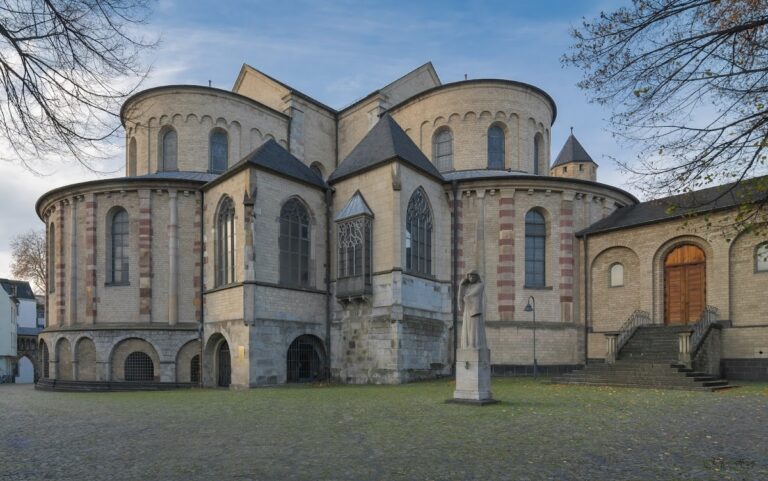
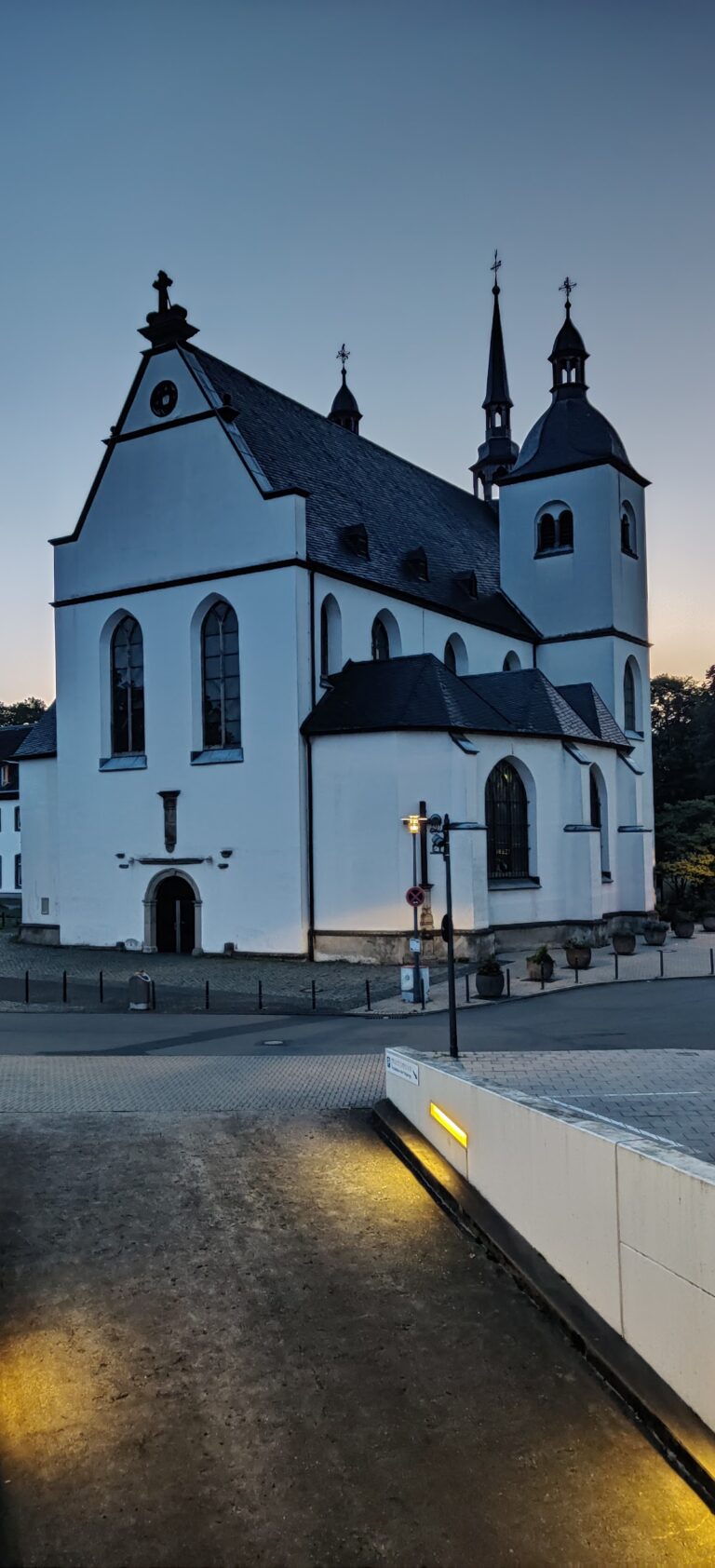
Construction of the present church began between 1198 and 1200. The building ground was raised because of the continuing danger of flooding from the Rhine. Completed around 1225, the church was a gallery basilica, meaning that its side aisles had upper galleries opening onto the central nave. Its design followed the churches of St. Kunibert and St. Severin in Cologne. The eastern end was planned with two towers to emphasize the building toward the Rhine, but financial limitations probably prevented the south tower from being completed to its intended height.
Around 1250, extensive frescoes were painted in the central nave and the chapels beside the chancel, the eastern part of the church around the main altar. These late Romanesque and early Gothic paintings remain the church’s most distinctive medieval survival. St. Maria Lyskirchen is the only one of Cologne’s twelve major Romanesque churches to retain a substantial part of its medieval vault paintings.
Gothic and Baroque changes
Major Gothic alterations took place around 1520–1530. Most windows were replaced, external buttresses were added to the side aisles, and a west gable was created to unite the three aisles into a single facade. Three important stained-glass windows in the north aisle also date from this period.
Between 1658 and 1662, the interior was extensively remodeled. The apse, the eastern terminal of the church, and the chancel vaults were removed, and their ceilings were raised to the level of the central-nave vault. The apse consequently changed from a semicircular to a polygonal form. Gothic tracery windows replaced earlier blind arcades, a frieze, and a small upper gallery. Baroque galleries with basket-shaped arches replaced most of the original triple arcades, and a Baroque high altar was installed between 1663 and 1665.
The Romanesque gallery windows were replaced by round-headed windows with forked tracery in 1697. The church was also whitewashed during the seventeenth century. Its original folded roof helmet was transformed in the nineteenth century into a Rhenish helmet with a diamond-patterned roof.
Flood, parish independence, and nineteenth-century restoration
The flood and ice movement of February 1784 destroyed part of the furnishings. A new high altar was made in 1785. In 1804, after the secularization of the collegiate foundation of St. George, St. Maria Lyskirchen became an independent parish church.
The crypt was filled in and the foundations were strengthened in 1811. It was uncovered again in 1918. From 1860 to 1865, the church received a new high altar designed by the Cologne architect Vincenz Statz, stained glass in the apse windows, and new altars in the chancel chapels.
A major restoration from 1868 to 1876 sought to give the building a more unified Romanesque appearance. The work included the west front and the gallery windows. The thirteenth-century vault frescoes, which had been covered by whitewash, were discovered in 1879, restored by 1881, and supplemented with Historicist painting by Matthias Goebbels. From 1934, Anton Bardenhewer restored the medieval paintings and removed the nineteenth-century overpainting, replacing it with a new decorative scheme. Goebbels’s work survives only in the north and south tower chapels.
War damage and modern conservation
All the church roofs except the tower roof were destroyed by Allied air raids in 1942–1943. The barrel vault over the galleries collapsed, while the central-nave vault and its paintings survived. Reconstruction and structural reinforcement continued from 1947 to 1962.
The medieval vault paintings were conserved again between 1972 and 1977, when later overpaintings were removed. From 1982 to 1989, the exterior was replastered in pink, gray, and white according to evidence for its Romanesque appearance, restoring its historic polychromy. The church, adjoining sexton’s house, and sacristy have been under monument protection since 1982 as buildings in Cologne’s Altstadt-Süd district.
The church’s association with the Schiffermadonna, a Madonna statue linked by later tradition with boatmen, encouraged its alternative description as a boatmen’s church. The statue stood outside at the eastern apse until 1868, probably helping to create the later belief that Rhine boatmen had especially venerated it. The Cologne carnival society Lyskircher Junge, founded in 1930, took its name from the district around the church.
Remains
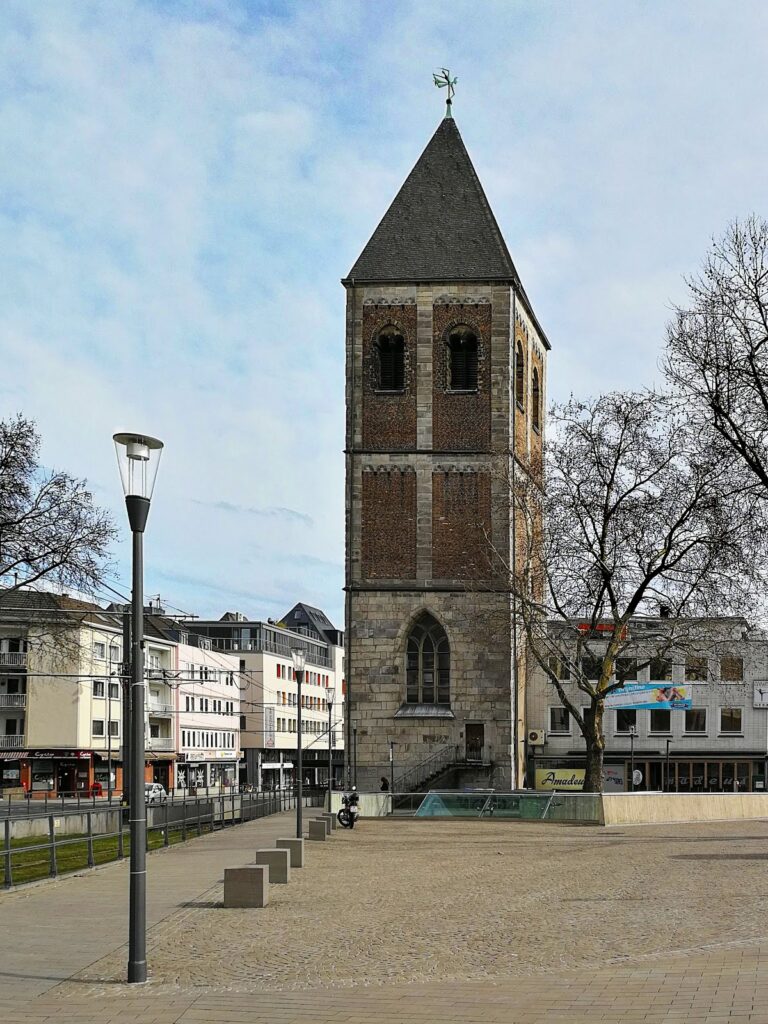
St. Maria Lyskirchen is a compact, slightly irregular three-aisled gallery basilica. Its short nave has three bays, while the three aisles together contain nine bays. The eastern portion rises above the western part and includes a chancel square, an apse, two side chapels, and a small three-aisled crypt beneath the chancel and apse. The north tower reaches its full planned height, while the south tower rises only to its second storey. Together, the eastern elements express the original intention of a two-towered composition facing the Rhine.
Structure and exterior
Vaulted interior
The interior is uniformly vaulted. Rib vaults, meaning vaults carried by intersecting structural ribs, rest on massive square piers. Some piers are partly embedded in the walls at the level of the central-nave windows and galleries. Pairs of small columns flank the piers, and several of their Romanesque capitals survive.
The walls of the central nave are arranged in three levels: the arcades opening into the aisles, the gallery arcades, and the window zone. In the upper two levels, the arcades are integrated by arches that rise toward the vaults. Original triple arcades survive in the western gallery bay, while the eastern bays contain later basket-arched openings. The two tower chapels open to the north and south of the chancel square. Behind the eastern apse, a small apsidiole, or small apse, serves as the sacristy.
West portal and adjoining buildings
The upper parts of the west facade were rebuilt in the nineteenth century, but its richly sculpted portal retains an elaborate Romanesque design. A gable-fronted doorway is flanked by columns, and its tympanum, the decorated field above the entrance, is framed by a garland. A blind zigzag arch completes the decoration. Above the door, a marker records the Rhine water level during the ice flood of 28 February 1784. The portal has been described as Cologne’s most elaborately decorated Romanesque church portal in its figural imagery.
The sexton’s house adjoins the church on the east. Its base incorporates part of the extension of Cologne’s city wall made in 1106. This surviving fabric places the church and its associated buildings within the changing medieval boundaries of the city.
Medieval paintings
Central-nave vaults
The three central-nave bays contain an extensive cycle of vault paintings. Scenes from the Old Testament occupy the northern sides and are paired with scenes from the New Testament on the southern sides. This is a typological program, in which earlier biblical events are presented as prophetic counterparts to episodes from the life of Christ and the early Christian church. The sequence moves from east to west.
The paired subjects include the promise and birth of Isaac with the Annunciation and Nativity; the offering of Samuel with the twelve-year-old Jesus in the Temple; Naaman’s bath with Christ’s Baptism; Moses receiving the Ten Commandments with the Transfiguration; Solomon’s entry into Israel with Christ’s entry into Jerusalem; and the feast of Ahasuerus with the Last Supper. Further pairs show Job in misfortune with Christ’s Flagellation, the bronze serpent with the Deposition, Samson carrying the gates of Gaza with Christ’s Descent into Hell, Elijah’s ascent and the translation of Enoch with the Ascension, and the Judgment on Mount Carmel with Pentecost.
The scenes radiate through the compartments of the rib vaults, producing the appearance of a dome. Inscription bands explain the images. Saints occupy the southern spandrels, while prophets occupy the northern ones. Figurative paintings also covered the walls, probably including the chancel.
Chancel-chapel cycles
The southern chancel chapel contains an eight-scene cycle showing the life and miracles of Nicholas of Myra, painted around 1270. Each of the chapel’s four vault compartments is divided by a painted column. The northern chancel chapel contains an eight-scene cycle devoted to Catherine of Alexandria, probably painted around 1280. This is the only fresco cycle in the church that remains in the state created by the 1879 restoration and subsequent overpainting, with dark colors and extensive use of gold bronze.
West-portal Adoration
Above the west portal is the church’s oldest surviving painting, an Adoration of the Magi made around 1220–1230. It fills a shallow-arched tympanum. Mary, crowned and seated on a throne with the Christ Child, receives the Magi, while two unidentified male figures stand to the right and may represent prophets. The broad, folded treatment of the garments belongs to the Romanesque Mulden style.
Windows and sculpture
Stained glass
Three historically important stained-glass windows in the north aisle date from around 1520–1530. The central three-light window depicts the Crucifixion. Mary Magdalene embraces the cross, while Mary and John appear in the side lights, with donor coats of arms above them. The eastern three-light window shows Saint Helena with the rediscovered Cross of Christ, together with Maternus and Gereon, who carries a banner and shield.
The three apse windows were made by Hans Lünenborg in 1987. They depict Cologne’s bishop saints, the Assumption of Mary, and Nicholas of Myra carrying a bread basket and a ship.
Schiffermadonna
The Schiffermadonna is a late Gothic wooden statue made in the Rhineland around 1410–1420. More than two meters high, it stands in a niche on the inner west wall north of the entrance. Its style belongs to the soft-style Bohemian tradition. The forward-facing Christ Child appears to offer a small apple, while Mary’s drapery falls in cascading folds. The statue may have come from the Cistercian convent of Walberberg and probably reached St. Maria Lyskirchen only in the early nineteenth century.
Peter Hecker painted the wall niche with boatmen looking upward toward the Madonna. The image connects the statue with the later boatmen tradition without establishing that the parish historically belonged to a boatmen’s guild or confraternity.
Other medieval and Baroque sculpture
A wooden statue of Bishop Maternus stands on the north nave wall between the second and third bays. It probably came from the Baroque high altar of 1665, which was destroyed in the flood of 1784, and is attributed to the circle of Jeremias Geisselbrunn. Since 1975, the statue has been painted white with gilded borders and ornaments; its original coloring is unknown.
Before the northwest pier of the chancel square stands a 1.15-meter-high Madonna and Child from the second quarter of the fourteenth century. Probably made in Cologne, it retains its old polychromy. Catharina Pütz donated it to the church in 1885. The goldfinch held by the Christ Child, an allusion to the Passion, gives the statue its name, the Goldfinch Madonna.
The elevated north chancel chapel contains a seventeenth-century altarpiece of the Crucifixion. Its figure of Christ follows a 1602 painting by Gortzius Geldorp, and a small Pietà on the altar dates from around 1480. On the east wall of the south tower chapel is a three-part choir stall made in 1520, originally for the Servite convent of St. Lucia, which was dissolved in 1802. A copy of a mid-seventeenth-century Annunciation from Santissima Annunziata in Florence, also from that convent, hangs on the north wall of the chancel.
Furnishings, treasure, and bells
Baptismal font and triptych
The octagonal baptismal font at the inner west wall south of the entrance dates from the second half of the thirteenth century. It is the only surviving Romanesque furnishing besides the frescoes. Made of Namur blue stone, it is 1.02 meters high and rests on an octagonal central support surrounded by eight light-marble columns. The basin has eight trefoil arches and carved ornamental heads at its corners.
In the northeast corner of the side aisle is a copy of a triptych, a three-panel painted altarpiece, by Joos van Cleve. Councillor Gobelinus Schmitgen donated the original in 1524, and the parish sold it in 1812. Benedikt Beckenkamp painted the replacement in 1816. Its central panel shows the Lamentation, while the wings depict Saint Veronica with the Veil of Christ and Joseph of Arimathea with the Crown of Thorns. The donor also appears in the central panel.
Parish treasures
A display case installed in a niche of the north chancel chapel in 2014 contains four objects connected in part with the parish’s history. They include a Cologne anointing-oil vessel from around 1500 showing Saint James; the Apostles’ Chalice, made in Cologne around 1695 and originating in the former Servite convent of St. Lucia; a 1795 Cologne Mass tray with wine and water cruets depicting Saint Maternus; and a 1763 Cologne sunburst monstrance. A monstrance is a liturgical vessel used to display the consecrated Eucharistic host. Its decoration includes ears of grain, grapes, the Fall of Man, the Cross, and the Lamb of God.
The Salian Cross is a twelfth-century processional cross and the church’s most valuable treasure. Its designation refers to the medieval German Salian ruling dynasty. The cross is kept in the parish’s secure depot and is used liturgically only on major feasts.
Organ, bells, and clock
The organ gallery was built around 1750 and carries an organ made in 1957 by Romanus Seifert and Son of Kevelaer. The instrument has twenty stops, two manuals, and a pedal. Matthias Goebbels decorated the gallery in 1880 with angels playing musical instruments.
Before the First World War, the church had three bells cast by Peter Boitel in 1817. The large bell was dedicated to the Virgin Mary, the middle bell to Maternus, and the small bell to Nicholas. The large bell was recast in 1870 while retaining its inscription. After the peal was surrendered during the First World War, four replacement bells were cast in 1919, but only the middle bell survived the Second World War. Two more bells were cast in 1962. Together with the surviving 1919 bell and a fourteenth-century bell lent from St. Cecilia’s, they restored a four-part peal. When the historic loan bell was transferred to St. Peter in 2005, a replacement bearing the same inscription was cast for St. Maria Lyskirchen.
A mechanical tower clock made by Johann Mannhardt of Munich in 1886 was removed during the 1955 reconstruction. Its clock faces were not restored, but the clock returned after restoration in 2015 and is displayed on the north-aisle gallery. An electric striking mechanism continues to mark the hours, and the Angelus is rung daily. A roof turret over the central nave, destroyed with its bell during the Second World War, has not been rebuilt.
Nearby sites