All Saints’ Abbey: A Former Premonstratensian Monastery in Germany
Site at a Glance
- Rating
- 4.6
- Popularity
- Medium
- Country
- Germany
- Primary era
- Medieval
- External website
- Open
- Eras represented
- Medieval, Early Modern
- Civilizations
- Holy Roman Empire
- Site type
- Religious
- Remains
- Monastery
On this page17 sections
History
All Saints’ Abbey is a former Premonstratensian monastery in Germany, located near Oppenau in the Black Forest. Founded around 1195 as a collegiate monastery of canons, it developed through Late Romanesque and Gothic building phases and remained an important religious and cultural institution in the Rench and Acher valleys until its secularization in 1803.
Foundation in the late twelfth century
A foundation legend places the choice of the site around 1192. Duchess Uta of Calw, identified as Uta of Schauenburg in later copies of the foundation charter, was associated with a donkey that dropped a bag of gold at the place selected for the monastery. A chapel dedicated to Saint Ursula was later built at the spot connected with the story. The legend may preserve a memory of the site’s early inaccessibility, because the monastery was initially reached only by a difficult path over the Sohlberg.
Uta, the widow of Welf VI, issued the foundation charter around 1195 or 1196. The foundation date has also been placed in 1192, 1191, or an earlier period. Emperor Henry VI confirmed the establishment, Philip of Swabia reconfirmed it in 1200, and Pope Innocent III confirmed it in 1204. Philip’s confirmation granted the monastery imperial immediacy, a legal status that placed it directly under the Holy Roman Emperor, as well as freedom from secular advocacy, tax exemption, immunity from prosecution within the precinct, and patronage rights over the church of Nußbach.
The endowment came from Uta’s parental inheritance. It included the monastery site, five farms in the Rench valley and its side valleys, woodland, fishing rights, and the disputed patronage and tithes of Nußbach church. The foundation may have helped settle inheritance, territorial, and lordship disputes involving Zähringer, Staufen, Welf, and Strasbourg interests. Its remote position and modest initial endowment, however, restricted the monastery’s political influence.
The first canons came from Oberzell and Marchtal. All Saints was probably first supervised by Marchtal, but in 1217 it was placed directly under Prémontré, the Premonstratensian mother abbey. The Premonstratians were members of a Catholic order founded by Norbert of Xanten whose canons combined communal religious life with pastoral work. All Saints belonged for most of its history to the order’s Swabian circary, a regional administrative subdivision, although a catalogue from 1320 assigned it to the Wadgassen circary.
Gerungus, probably from Marchtal, was recorded as the first provost in 1204. Later tradition described him as Uta’s son, but that identification is connected with altered versions of the foundation account. Early provosts mainly came from the lower nobility of the region, whereas later heads of the monastery generally came from bourgeois families.
Pastoral organization and regional connections
In 1225 Bishop Berthold of Teck of Strasbourg confirmed All Saints’ patronage over Nußbach and over its chapels at Oberkirch and Oppenau. These chapels became permanent pastoral centers, allowing the monastery to organize an independent ecclesiastical administration for the Rench valley and surrounding districts.
All Saints also developed relationships with other religious houses. In 1248 it sent canons to Lorsch to transform that foundation into a Premonstratensian house. In the fourteenth century it established a daughter-house relationship with St. Nicholas at Haguenau. In 1297, seven remaining members of the Strasbourg Saccites joined the monastery with papal approval and formed a related community in Strasbourg that lasted until 1320. The Saccites were members of the medieval Order of the Sack, which maintained a religious house in Strasbourg.
The monastery’s privileges increasingly came under pressure from Strasbourg. Although its foundation had received imperial immediacy and freedom from secular advocacy, the authority of the Strasbourg bishopric expanded during the thirteenth century. After the bishopric consolidated its territorial rule over the Rench valley in 1316, it sought to impose taxation and judicial authority on All Saints and its possessions. From 1475 it also confirmed the election of the monastery’s head.
All Saints enlarged its economic base through donations, woodland clearance, acquired farms, and rights in the Rench and Acher valleys, the Rhine plain, the Black Forest, and Alsace. Distant farms and fields were generally leased to local peasants instead of being managed directly by the canons. Pastoral work nevertheless remained central to the monastery’s activity.
Fire, displacement, and rebuilding
On 13 April 1470, a fire that began in the monastery kitchen destroyed the church and cloister buildings. Major construction work had begun shortly before the disaster. The canons temporarily moved to Lautenbach, where they later took over the unfinished Church of the Coronation of Mary in 1480. Its pilgrimage became an important source of income. They returned to All Saints in 1484 and were required to swear that they would not transfer the monastery to a more accessible site.
The church was rebuilt on its earlier remains after the fire and underwent another restoration from 1556 following a second fire. During the Peasants’ War, a widespread uprising in 1525, All Saints property suffered further damage. The monastery court and church at Oberkirch were plundered on 2 May, the church at Lautenbach was attacked the following day, and the church at All Saints was later stormed and devastated. An agreement involving nobles, the monastery, and local peasants led to the return of the church furnishings.
Reformation crisis and recovery
All Saints survived the Reformation, when many neighboring monasteries were dissolved. During the Strasbourg chapter conflict, the Protestant candidate Johann Georg of Brandenburg prohibited the admission of novices and closed the monastery school in 1592. In 1594 he rejected the election of Jakob Jehle as provost and imprisoned Jehle at Dachstein, where he disappeared. Intervention by the Premonstratensian vicar-general Jan Lohelius and Emperor Rudolf II prevented the monastery from being dissolved.
After the Catholic candidate Karl of Lorraine secured the Strasbourg bishopric, Johannes Schüßler of Strahov became provost in 1600. Schüßler negotiated the restoration of All Saints’ properties and rights in return for an annual payment. Johann Georg relinquished his claims in the Treaty of Haguenau in 1604. The monastery survived the Thirty Years’ War, a major European conflict from 1618 to 1648, although the Rench valley suffered severe devastation.
Abbey status and eighteenth-century development
The Premonstratensian general chapter raised All Saints to abbey status in 1657. During the eighteenth century, the community temporarily numbered more than twenty canons. Its school developed from 1740 into a respected boarding gymnasium with more than fifty pupils, and it also educated clergy from throughout the Strasbourg diocese.
The abbey acquired relics of Saints Clement of Metz and Boniface in 1773, increasing its importance as a pilgrimage site. On major feast days, as many as 2,000 pilgrims came to the upper Lierbach valley. By 1803 the abbey held more than 30,000 gulden in outstanding claims, in addition to income from leases, forestry, and interest.
Relations with the Strasbourg bishops became more difficult during the eighteenth century. Disputes concerned taxation, confirmation of elections, and pastoral jurisdiction. In 1756 the bishopric removed All Saints’ right to conduct services in its parish churches and replaced its clergy with Capuchins. In 1757 the abbey accepted the Bishop of Strasbourg as territorial lord under the Treaty of Saverne.
Secularization and later history
Margrave Karl Friedrich of Baden dissolved All Saints on 29 November 1802 during secularization, the transfer or confiscation of ecclesiastical institutions and their property by a secular government. The Imperial Deputation Act of 25 February 1803 confirmed the transfer. The community had twenty-nine members, eleven of whom lived in the mother house, and all had to leave by autumn 1803. Two Capuchins remained temporarily to maintain pastoral services.
Lightning caused another fire on 6 June 1804, burning out the church roof and the upper story of the cloister buildings. The church was repaired under Friedrich Weinbrenner, but a wool-spinning mill operated on the site from 1804 to 1806 and hindered further preservation. The Capuchins were withdrawn in 1812. The buildings were then auctioned for demolition and use as a quarry. The church later collapsed in 1820.
The abbey library contained more than 5,000 titles in 1788. After the dissolution, it was transferred to the court library in Karlsruhe and the University Library of Heidelberg. The archive moved between 1803 and 1805 to the General State Archives in Karlsruhe, where it remains preserved.
During the nineteenth century, the ruins became a romantic and tourist attraction. The Baden forestry administration prohibited their use as a quarry in 1840 and began securing and conserving the remains a few years later. The former west-wing forester’s house became a guesthouse in 1844 and was later expanded into a hotel complex.
The Caritas Association of Mainz acquired the hotel area in 1947 and established a children’s convalescent home. Since 1978, the complex has been used as a school residential center and religious conference facility. The Diocese of Mainz built a chapel in 1960, dedicated to God and All Saints like the former abbey church. The state of Baden-Württemberg owns the monastery-ruin grounds and established a permanent exhibition on All Saints’ history in the restored economic building in 1995. Since 1991, the surviving nave has hosted annual open-air performances, while parts of the site have been involved in efforts to establish a conference center since 2013.
Regional folklore also associates All Saints with the Moospfaff, a wandering cleric who supposedly lost a consecrated host while carrying out a last anointing during the Thirty Years’ War. According to the legend, he continues to search for it on the Moos and misleads travelers.
Remains
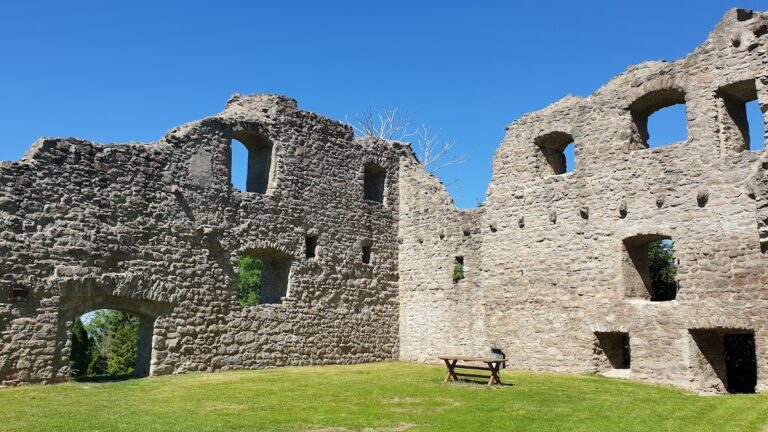
The ruins stand at approximately 620 meters above sea level in a hollow between the Schliffkopf and Eselskopf, above the All Saints Waterfalls in the upper Lierbach valley. The monastery was built on the Strasbourg side of the historical boundary between the dioceses of Strasbourg and Constance. Its principal surviving elements are the church ruins, parts of the former conventual and economic buildings, sections of the formal garden, and the west-wing building that later became a forester’s house and hotel.
Church remains
The church was a cruciform structure built mainly from locally quarried variegated sandstone. Its surviving fabric preserves phases from the Late Romanesque through the Late Gothic periods, including features attributed stylistically to the Strasbourg building workshop.
Nave and western facade
The western part of the church consisted of a three-aisled Late Gothic nave joined to a Late Romanesque entrance facade. The southern nave arcades remain standing, while the northern arcades survive at foundation level. The surviving nave forms one of the principal visible remnants of the abbey and has been used for annual open-air performances since 1991.
Choir and transepts
The square-ended choir and transepts contain Early Gothic capitals and vault ribs dated approximately to 1220-1250. These forms belong among the earliest known Gothic elements in the Upper Rhine region. A tower once rose above the rectangular crossing.
A chapel attached to the south transept remains externally preserved. Its interior retains a complete six-part vault, whose keystone resembles the abbey’s patronage emblem. The southern transept also preserves the connection with the former cloister buildings. At the northern end, the transept and its stairway survive as part of the standing remains.
Monastic precinct and garden
The cloister and conventual buildings stood directly south of the church. Archaeological work between 1976 and 1980 exposed remains of the eastern convent building. Seventeenth- and eighteenth-century views show the church and convent buildings arranged around the cloister, alongside economic buildings, the monastery school, and an enclosing wall. After All Saints became an abbey, the interiors received a Baroque refitting.
Economic building and west wing
One economic building survives and now contains the permanent exhibition on the history of All Saints established in 1995. The surviving west-wing building was later used as a forester’s house and then incorporated into a hotel complex. Together with the economic building, it represents the principal surviving building fabric outside the church.
Formal garden
The abbey possessed a formal late-Baroque garden arranged on three terraces despite the elevation and harsh climate of the site. Parts of the garden remain well preserved, including the basins and the balustrade enclosure on the upper terrace.
Furnishings and later additions
Dispersed altars and sculpture
The abbey’s altars and artistic furnishings were dispersed between 1805 and 1808. The Apostles’ altar, Magdalene altar, Cross altar with a representation of Norbert of Xanten, an image of All Saints, and four wooden statues went to the parish church at Bad Peterstal. Organ parts and the Saint Anthony altar went to Oppenau, two altars went to Kappelrodeck, and statues of Augustine and Norbert of Xanten went to Nußbach. Three statues later installed above the portal of the Princes’ Chapel at Lichtenthal Abbey represent Saint Helena, Uta of Schauenburg, and Gerungus.
Chapel and memorial
A chapel built by the Diocese of Mainz in 1960 stands on the site and is dedicated to God and All Saints. On a rise above the ruins, a war memorial for fallen and deceased members of the Black Forest Society was erected in 1925 by C. M. Meckel and A. Rickert. The chapel, memorial, surviving garden, economic building, former west wing, and church remains together preserve elements of the former abbey complex above the All Saints Waterfalls.