Ipatiev Monastery: A Dynastic Sanctuary in Kostroma, Russia


Site at a Glance
- Rating
- 4.7
- Popularity
- Medium
- Country
- Russia
- Primary era
- Early Modern
- External website
- Open
- Eras represented
- Medieval, Early Modern, Modern
- Civilizations
- Russian
- Site type
- Religious
- Remains
- Fortified Monastery
On this page25 sections
History
Ipatiev Monastery is a Russian Orthodox male monastery dedicated to the Holy Trinity in Kostroma, Russia. It stands on the bank of the Kostroma River near its confluence with the Volga and became closely associated with the Godunov and Romanov dynasties. The monastery was first mentioned in 1432, although its foundation may have taken place earlier.
Origins and Early Traditions
The monastery’s beginnings are explained by several traditions. One scholarly reconstruction places its foundation in the late thirteenth century. Another tradition dates its establishment to around 1330 and attributes it to the Tatar noble Chet, a murza, or Tatar aristocrat, who entered the service of Grand Prince Ivan Kalita and was baptized as Zacharias.
According to the foundation legend, Chet was healed after seeing the Virgin Mary accompanied by the Apostle Philip and Saint Hypatius of Gangra, a fourth-century Christian bishop and martyr associated with the monastery’s dedication. In gratitude, he supposedly established the monastery. Modern researchers regard Chet as a possibly mythical figure and interpret the story as a genealogical tradition created to give the Godunov family princely ancestry.
Other traditions credit the foundation to Prince Vasily Yaroslavich, a brother of Alexander Nevsky, or to settlers from Novgorod. The monastery declined after Vasily Yaroslavich’s death and the abolition of the Kostroma principality. Under the alternative reconstruction, Chet may have revived an existing religious foundation rather than created it.
Godunov Patronage
The monastery’s history becomes clearer after it came under the patronage of the Godunov family during that family’s rise in the mid-sixteenth century. The Godunovs and related noble families regarded Zacharias-Chet as their ancestor and supported the monastery as a family sanctuary. A burial vault contains members of the Godunov lineage, including the parents of Boris Godunov.
Between 1586 and 1591, the Godunovs gave the monastery 1,000 rubles and several villages. Its land holdings quadrupled, and by 1600 it ranked fourth among Russian monastic landowners, with more than 400 villages. In 1678, it had 3,657 peasant households, again placing it fourth among Russian monasteries by that measure.
Under Dmitry Godunov, the uncle of the future Tsar Boris Godunov, the monastery acquired substantial stone fortifications and began a new Trinity Cathedral. The Godunovs also donated church books and liturgical objects. A painting workshop and a large library of books and manuscripts were established within the monastery.
By the end of the sixteenth century, Ipatiev Monastery had become an important political and spiritual center of medieval Russia. It was sometimes called the “Pre-eminent Lavra,” using lavra, an honorific title for certain major Eastern Orthodox monasteries. In 1599, its abbot Jacob received the rank of archimandrite, a senior monastic rank normally associated with the head of an important monastery or an administrative office.
The Time of Troubles
The monastery played a major role in the Time of Troubles, a period of dynastic crisis, political conflict, foreign intervention, and civil war in Russia during the late sixteenth and early seventeenth centuries. In October 1608, its archimandrite Theodosius and the abbot of the neighboring Epiphany Monastery swore allegiance at Tushino to False Dmitry II, a claimant to the Russian throne. The monastery subsequently came under the control of supporters of False Dmitry II and Patriarch Filaret.
In late February 1609, inhabitants of Kostroma rebelled, defeated the Tushino garrison, and besieged the monastery. Its stone walls and 27 mounted cannon enabled the fortress to resist. An army supporting Tsar Vasily Shuisky began siege operations in late April under the command of David Zherebtsov, a voivode, or military and administrative commander in the Russian state.
Alexander Lisovsky attempted to relieve the monastery after bringing troops from the siege of the Trinity-Sergius Lavra, but the effort failed. Zherebtsov captured the monastery in September 1609, although the precise date of the capture is uncertain.
The Election of Mikhail Romanov
From the autumn of 1612, the young Mikhail Romanov and his mother, the nun Martha, lived in the monastery’s cells built in 1583. Their presence gave the monastery a central place in the political settlement that followed the Time of Troubles.
On March 13, 1613, a delegation of the Zemsky Sobor arrived. The assembly was a representative body of the Russian state, and its delegation was headed by Archbishop Theodoret of Ryazan, Avraamy Palitsyn of the Trinity-Sergius Monastery, and the boyar Fyodor Sheremetev.
On March 14, the delegation formally presented the Zemsky Sobor’s decision to elect the sixteen-year-old Mikhail Romanov as tsar. A solemn ceremony calling him to the throne took place in the Trinity Cathedral. The election ended the Time of Troubles and began the Romanov dynasty, which ruled Russia from 1613 until the abdication of Nicholas II in 1917.
Ipatiev Monastery thereafter became known as the cradle or ancestral sanctuary of the Romanov dynasty. Romanov rulers and members of the imperial family treated it as a dynastic shrine. Each tsar was expected to visit and make substantial donations. By decree of Tsar Mikhail Romanov, the New Town was built along the monastery’s western wall, increasing the size and administrative capacity of the complex.
Later History and Dissolution
The monastery’s wealth and influence continued to grow until the secularization and confiscation of church property in 1764 deprived it of much of its property. This began a gradual decline in its economic importance, although its dynastic and historical associations remained powerful.
The monastery’s library preserved the chronicle later known as the Hypatian Chronicle, one of the oldest copies of the Tale of Bygone Years. The name of the Hypatian Codex came from the monastery, where a group of chronicles was discovered. The discovery is associated with the historian Nikolay Karamzin.
The Romanov family continued to honor Ipatiev Monastery until the dynasty ended. In May 1913, it became a center of celebrations for the three-hundredth anniversary of the Romanov dynasty. Emperor Nicholas II visited Kostroma and stayed in a wooden house specially built for him outside the monastery walls.
After the October Revolution, the monastery was disbanded in 1919 and its property was nationalized. State valuables authorities took much of the sacristy to Moscow, while the remainder was deposited in the Kostroma regional museum. The former monastic buildings were converted into housing for textile workers, a children’s shelter, military barracks, a stadium, and a dance hall. The Nativity of the Mother of God Church was demolished during the destruction of Kostroma churches in 1934.
Museum and Religious Revival
Residents were removed from the monastery buildings in the mid-1950s. In 1958, the Kostroma State Historical, Architectural, and Museum Reserve was established at the site, and restoration removed later alterations from the historic buildings.
During the flooding of the Kostroma lowland in the mid-1950s, the Transfiguration Church from Spas-Vezhi village and four bathhouses from the village of Vederki were moved into the New Town. They formed the first exhibits of an open-air museum of wooden architecture. The museum complex expanded substantially in the late 1960s on the promontory formed by the Kostroma and Volga rivers.
The first religious service after the monastery’s closure took place on November 23, 1989. A Holy Trinity Ipatiev monastic community was registered in 1991. In 1993, the New Town was transferred for its use despite opposition from the museum reserve and members of the public.
In September 2002, the relocated Transfiguration Church from Spas-Vezhi burned down through the negligence of monastery residents. The building, constructed in 1628, had been the principal exhibit of the wooden-architecture museum in the New Town.
On December 30, 2004, the Russian Federal Agency for Federal Property Management ordered the transfer of the monastery buildings to the Kostroma Diocese, following a presidential instruction issued by Vladimir Putin in 2003. The diocese became the legal user of the entire complex in 2005, a decision that provoked opposition because of its effect on the museum reserve.
In 2008, President Dmitry Medvedev ordered the restoration of the Nativity of the Mother of God Church. Its principal construction work was completed by early 2015, and Patriarch Kirill consecrated the restored church on July 19, 2015. Ipatiev Monastery is again an active religious institution. The New Town functions as a monastic area closed to outsiders, while the Old Town, including the Trinity Cathedral, is administered as a church historical and archaeological museum. The ensemble is protected as a federal-level cultural-heritage property of the Russian Federation.
Remains
The monastery consists of two separately enclosed sections, the Old Town and the New Town. High stone walls surround both areas, reaching approximately 10 meters in places, and the entire ensemble includes ten towers. The Old Town, the historic core, has the form of an irregular pentagon and was developed chiefly in the late sixteenth century. The approximately equal-sized New Town was built in the seventeenth century, principally for monastic cells and administrative buildings.
Old Town Fortifications and Principal Churches
Walls and Towers
The Old Town retains sixteenth- and seventeenth-century walls and towers, including the Kuznechnaya, Porokhovaya, Vodianaya, Voskoboinaya, and Kvasnaya towers. The fortifications were part of the stone ensemble developed under the Godunovs and later enabled the monastery to withstand the siege of 1609. The New Town also retains its seventeenth-century walls and towers.
Trinity Cathedral
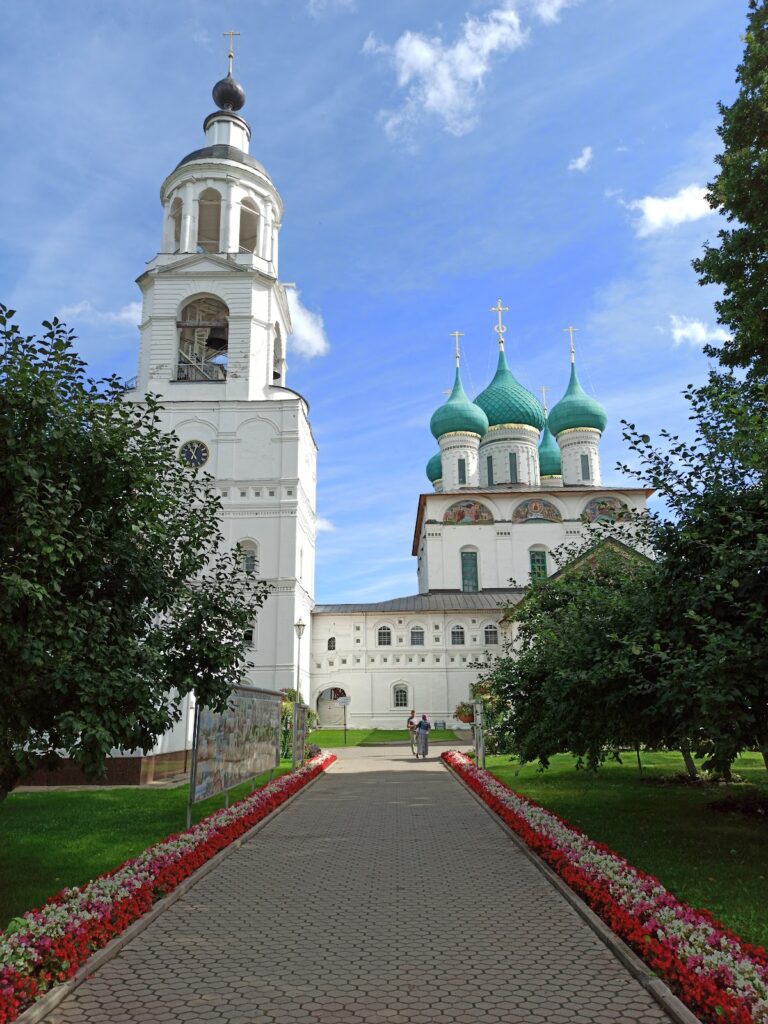
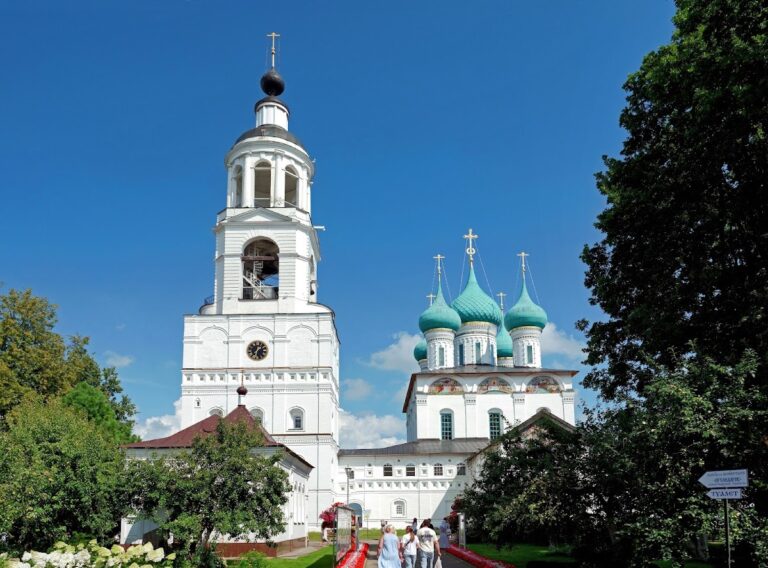
The Trinity Cathedral forms the compositional center of the monastery. Its present building was constructed in 1650-1652 after the earlier cathedral was destroyed by an explosion in a gunpowder store in 1649. The replacement was substantially larger than the church it replaced. It is a monumental five-domed structure with a broad stair gallery forming its ceremonial entrance and a tent roof above the entrance arrangement.
A team of painters led by Gury Nikitin decorated the cathedral in 1685. Its interior frescoes contain 81 biblical compositions and portraits of Russian rulers on the supporting columns. A five-tier iconostasis, the screen of icons separating the sanctuary from the main body of an Eastern Orthodox church, dates from the 1750s and remains inside.
Bell Tower
The bell tower was built in 1603-1605 and altered several times. Its pointed tent roof was added in 1645-1646, giving the structure its later profile within the monastery’s historic core.
Holy Gates and Riverside Church
The bishop’s building dates from the eighteenth century and incorporates the Holy Gates, the ceremonial entrance gates of an Orthodox monastery. On the side facing the Kostroma River, the gates carry a mid-nineteenth-century church dedicated to the martyrs Chrysanthus and Daria. The church was built above the entrance as part of the nineteenth-century reorganization of the riverside frontage.
Nativity of the Mother of God Church
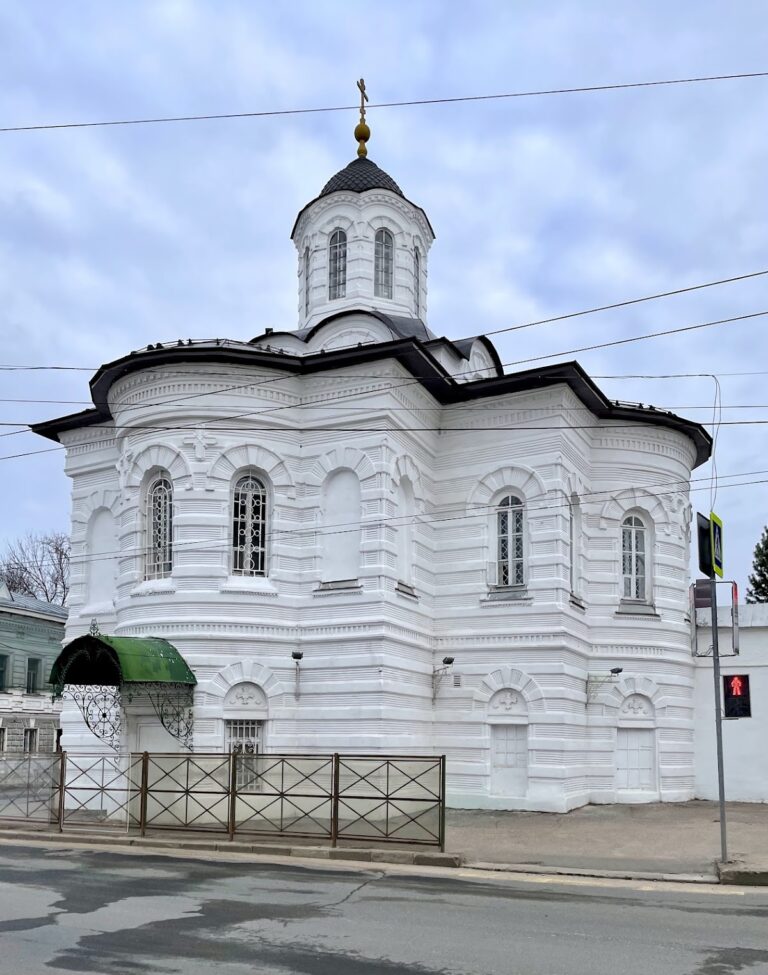
The Nativity of the Mother of God Church was built in the nineteenth century in a Byzantine-Russian style and connected to the Trinity Cathedral. Konstantin Thon directed the work as part of a major reconstruction between 1837 and 1863. The church was demolished in 1934 and reconstructed in the twenty-first century. Its restored building was consecrated in 2015.
New Town and Dynastic Buildings
Walls, Gates, and Green Tower
The walls and gates of the New Town were built under Mikhail Romanov. The enclosure included two gates and three towers, consisting of two corner towers and a central gate tower. The central tower is also called the Green Tower because of its tiled roof. It was founded at the place where a procession stopped on March 19, 1613, while escorting Mikhail Romanov toward Moscow.
Catherine Gate
The Catherine Gate was inserted into the northern curtain wall in 1767 for the visit of Empress Catherine II. It is a Baroque structure with triumphal arches. A stucco cartouche bearing Catherine’s monogram decorates the outer facade, while a pediment facing the Old Town carries a relief of the “all-seeing eye.”
Romanov Boyars’ Chambers
The Romanov Boyars’ Chambers were built as a residence in the sixteenth century and reconstructed in the mid-nineteenth century. Members of the Romanov family lived there during the Polish intervention of 1613. The traditional Russian facade resembles the Faceted Palace in the Moscow Kremlin. Inside, the building contains a relatively faithful reconstruction of an early-seventeenth-century residential interior.
The nineteenth-century reconstruction enlarged the chambers and added a broad royal staircase to the second floor. The upper floor’s exterior walls received a checkerboard pattern, and the interior was fitted with tiled stoves designed by Fyodor Richter.
Monastic Service Buildings
The Monastery Governor’s Building dates from the sixteenth century and was reconstructed in the mid-nineteenth century. Other surviving components include the eighteenth-century Fraternal Building, cells dating from the sixteenth to the eighteenth century above cellars, the Refectory Building from the sixteenth and seventeenth centuries, and the nineteenth-century Candle Building.
Candle Building
The Candle Building was constructed in the mid-nineteenth century to a design by Konstantin Thon. It originally served as a candle-production facility. Its two floors now contain displays from the former monastic sacristy, including historical icons, books, and church vessels.
Nineteenth-Century Reconstruction and Museum Features
Riverside Works
Between 1837 and 1863, Konstantin Thon directed a major reconstruction of the ensemble. Along the low riverbank, an embankment or dam known as the cutoff was built to protect the monastery’s buildings and fortifications from spring flooding. Thon also redesigned the monastery facade and built the riverside church of Saints Chrysanthus and Daria.
Memorial Column
A memorial column was erected in 1839 at the center of the Old Town on the monastery square. It commemorates people and events associated with the monastery’s history.
Relocated Wooden Buildings
The postwar open-air museum included wooden buildings moved from the Kostroma region. The Transfiguration Church from Spas-Vezhi, built in 1628, was transferred to the New Town in the mid-1950s and destroyed by fire in 2002. Four wooden bathhouses from Vederki were also moved into the monastery complex.
Religious Objects and Memorials
The monastery preserves the locally venerated Ipatiev Tikhvin Icon of the Mother of God, a reliquary containing a fragment of the Robe of the Lord, and an icon containing relics of Saint Hypatius, bishop of Gangra. It also preserves part of the head of Blessed Simon of Yuryevets.
Another memorial object is a stone from the execution room of the Ipatiev House in Yekaterinburg, where the Romanov imperial family was killed in 1918. Together with the monastery’s dynastic buildings and surviving churches, these objects connect the religious complex with the longer history of the Romanov family.